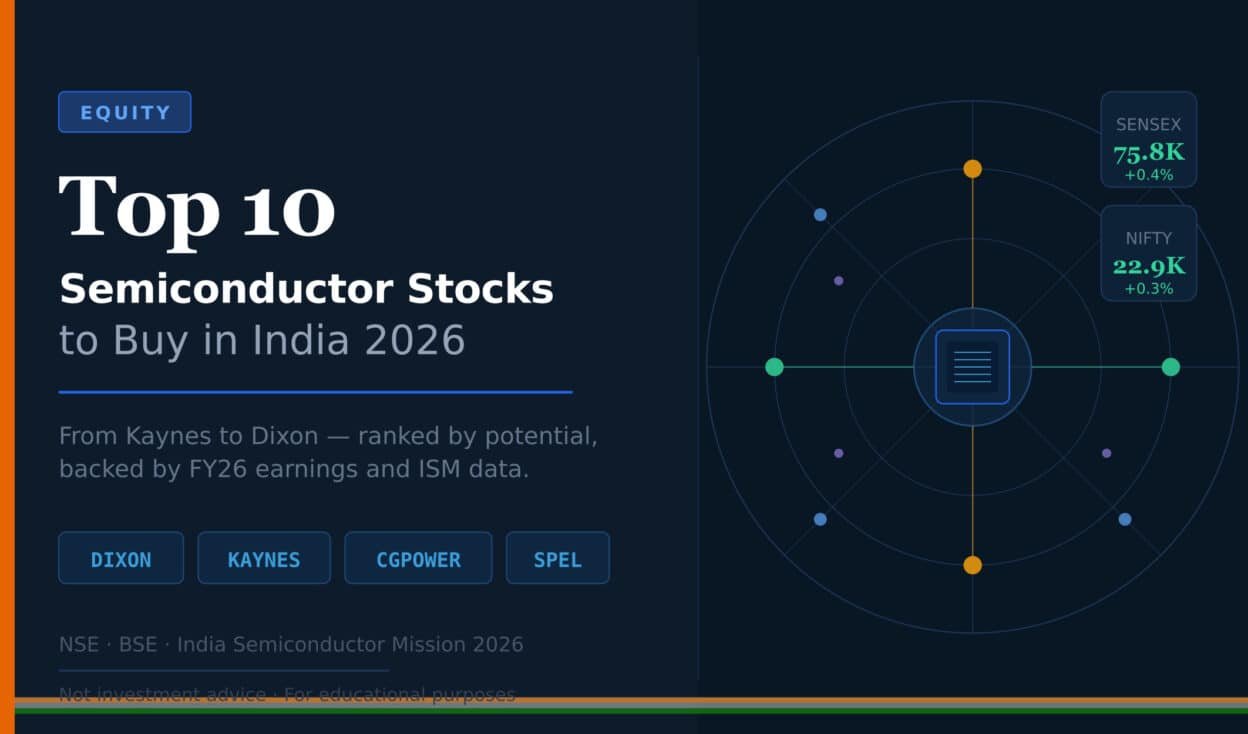
If you are searching for the top semiconductor stocks to buy in India 2026, you are asking the right question at the right time. India printed its first domestic chip in 2026 — a sentence that would have sounded like fiction five years ago.
The country that spent decades importing nearly every semiconductor it consumed is now building fabs in Gujarat, packaging units in Uttar Pradesh, and training a workforce that global chipmakers are starting to notice. For investors, this shift creates a rare window: a manufacturing sector in the early innings of a structural upgrade, backed by government money and global tailwinds from AI, EVs, and 5G.
But finding the right stock in this space is harder than it looks. Not every company calling itself a “semiconductor play” actually manufactures chips. Some design. Some test. Some just assemble consumer electronics and get grouped into the category because a fund manager needed a theme.
In this guide, you’ll find the 10 semiconductor stocks that matter most right now, sorted by category, with their financial performance in FY26, what they actually do, and where the risks sit. You’ll also get answers to the questions most retail investors search for, including which penny stocks are worth considering and how mutual funds fit in, without needing to wade through a dozen brokerage PDFs.
I’ve tracked India’s electronics and semiconductor sector for over seven years, analyzing ESDM policy shifts and company-level financials across BSE and NSE. The analysis below draws on FY26 earnings data, Union Budget allocations, and Semicon India Mission disclosures.
What Counts as a Semiconductor Stock in India?
A semiconductor stock is a share in a company that designs, manufactures, assembles, tests, or provides specialized services for semiconductor devices. These devices, commonly called chips, power everything from smartphones and medical equipment to electric vehicles and AI servers. The value chain runs from chip design (fabless companies) through wafer fabrication (fabs) to assembly, testing, marking, and packaging (ATMP or OSAT). Most Indian-listed companies sit in the ATMP/OSAT and electronics manufacturing services (EMS) segments for now, with full-scale fabs still under construction.
India’s semiconductor market stood at an estimated $45-53 billion in FY25 and is projected to cross $100 billion by 2030, growing at a CAGR of 12-13%.
The Three Categories You Need to Understand
Before you buy a single share, know which part of the value chain you’re buying into:
EMS companies (Dixon, Kaynes, Syrma SGS) manufacture electronics and are building semiconductor sub-assembly capacity. They have revenue today but limited direct chip exposure.
Pure-play semiconductor firms (SPEL Semiconductor, RIR Power, MosChip) work directly on chip packaging, testing, or design. Smaller companies, higher risk, higher upside if India’s fab ecosystem matures.
Diversified conglomerates (Tata Elxsi, CG Power, Bharat Electronics) have semiconductor divisions inside broader businesses. Lower volatility, more stable cash flows, but diluted upside.
India’s Semiconductor Policy: Why 2026 Is Different
The Union Budget 2025-26 allocated Rs. 70 billion to the semiconductor sector, with the chip fabrication scheme outlay rising 56% to Rs. 39 billion. Financial support for establishing new semiconductor facilities nearly doubled from Rs. 12 billion to Rs. 24.99 billion.
More significantly, the government launched India Semiconductor Mission 2.0 (ISM 2.0) in February 2026, focused on producing semiconductor equipment and materials, designing full-stack Indian intellectual property, and fortifying domestic supply chains. This follows ISM 1.0, which approved 10 semiconductor projects worth approximately Rs. 1.60 lakh crore across six states.
The first Made-in-India chips rolled out in 2026. Micron’s ATMP facility in Sanand, Gujarat, crossed initial production milestones. Kaynes Semicon’s six-million-chips-per-day unit received Cabinet approval and entered construction. The HCL-Foxconn joint venture in Jewar, Uttar Pradesh, cleared environmental hurdles.
For stock market purposes, this matters because OSAT and ATMP facilities generate revenue faster than full-scale fabs. Companies in this segment will see earnings traction over the next 12-24 months, which is the window most equity analysts are currently pricing in.
The India-US tariff deal announced in early 2026, bringing tariffs on Indian goods down to 18% from 50%, gave semiconductor and EMS stocks a visible catalyst. Dixon Technologies jumped over 6%, Kaynes Technology gained 5%, and CG Power surged 10% on that single day’s trade.
Top 10 Semiconductor Stocks to Buy in India 2026
1. Dixon Technologies (India) Ltd — NSE: DIXON
What it does: Dixon is India’s largest electronics manufacturing services company by revenue. It produces mobile phones, LED televisions, washers, lighting, and telecom equipment for brands including Samsung, Motorola, and Lenovo.
The semiconductor angle: Dixon acquired a 51% stake in Kunshan Q Tech Microelectronics (India) in September 2025, a move that strengthens its backward integration into semiconductor components. The company is building capacity to move up the value chain from pure assembly to sub-component manufacturing.
FY26 financials: Dixon reported strong revenue growth in FY26, with the mobile segment remaining the primary driver. Raw material inflation and high memory prices created some cost pressure in Q4 FY26, but order book diversification with clients like Lenovo provided a buffer.
Why it makes the list: Dixon holds a dominant position in a sector that the government is actively incentivizing. Its scale gives it pricing power with suppliers and clients that smaller EMS players can’t match.
Risk: The mobile segment faces softness in handset demand. HDFC Securities flagged that EMS sector growth may moderate in the near term because of this. The stock trades at a premium valuation, so any earnings miss hits the price hard.
Live price: Check Dixon Technologies live share price on NSE (ticker: DIXON) or BSE.
2. Kaynes Technology India Ltd — NSE: KAYNES
What it does: Founded in 1988 and based in Mysore, Kaynes is an end-to-end electronics manufacturer serving automotive, aerospace, defence, medical, and IoT sectors. It offers design, process engineering, manufacturing, and lifecycle support.
The semiconductor angle: Kaynes Semicon, a wholly owned subsidiary, received Cabinet approval to build a semiconductor ATMP unit in Sanand, Gujarat, with an investment of Rs. 3,300 crore and a production capacity of six million chips per day. The chips target automotive, industrial, EV, consumer electronics, and telecom applications.
FY26 financials: Revenue from operations climbed from Rs. 2,722 crore in FY25 to Rs. 3,626 crore in FY26, a 33% jump. Operating profit rose 38% to Rs. 574 crore. Net profit increased 24% to Rs. 364 crore.
Working capital is the near-term concern. Kaynes carries an elevated receivable cycle, with some analysts citing a 500-day receivable period that triggered a 27% stock fall after Q4 FY26 results. Management committed to receivables improvement by year-end.
Why it makes the list: Among all Indian EMS firms, Kaynes has the clearest direct semiconductor manufacturing commitment through its Sanand project. When that unit hits commercial production, the revenue profile changes fundamentally.
Risk: Working capital pressure and execution timing risk on the Sanand facility. The stock trades at a P/E of 58.4x versus an industry P/E of 30.5x, making it expensive if earnings disappoint.
Analyst view: Motilal Oswal and Prabhudas Lilladher rated Kaynes positively for Q4 FY26, citing a robust order pipeline and diversification across business segments as key positives.
3. CG Power and Industrial Solutions Ltd — NSE: CGPOWER
What it does: CG Power is a diversified electrical equipment company with major revenue from power systems and industrial motors. Its semiconductor division, backed by a joint venture approved under ISM, is building an OSAT facility.
The semiconductor angle: The government approved CG Power’s semiconductor facility in Sanand, Gujarat, alongside Tata and Micron projects. The company entered the semiconductor space through a partnership with Renesas Electronics and Stars Microelectronics from Thailand.
FY26 performance: CG Power shares gained as much as 10% on the day the India-US trade deal was announced in early 2026, reflecting strong market confidence in the company’s semiconductor positioning.
Why it makes the list: CG Power gives you exposure to India’s first wave of government-backed OSAT facilities inside a profitable, cash-generative business. The electrical equipment segment funds the semiconductor buildout, reducing balance sheet risk.
Risk: The semiconductor division is still pre-revenue. Gestation timelines for OSAT facilities can stretch. If CG Power’s core business hits a rough patch, capital allocation toward semiconductors may slow.
4. Tata Elxsi Ltd — NSE: TATAELXSI
What it does: Founded in 1989, Tata Elxsi is a design and technology services company serving automotive, broadcast, healthcare, and semiconductor clients globally. It provides embedded software, chip design services, and product engineering.
The semiconductor angle: Tata Elxsi works directly with semiconductor companies on chip design and verification, placing it in the fabless services ecosystem. Its automotive practice benefits from the EV and software-defined vehicle trend, where semiconductor content per vehicle is rising sharply.
Why it makes the list: Tata Elxsi earns revenue from semiconductor design today. There is no “project under construction” risk. The company’s automotive design business has a direct line to the global chip demand boom driven by ADAS, connectivity, and electrification.
Risk: Tata Elxsi’s revenue depends on global technology spending. A slowdown in automotive capex or client-side delays in product programs hits utilization rates. The stock has historically commanded a steep premium.
5. MosChip Technologies Ltd — NSE: MOSCHIP
What it does: Founded in 1999 and headquartered in Hyderabad, MosChip is a semiconductor and system design company. It offers chip design, ASIC development, VLSI design, embedded engineering, and IoT solutions. Clients span automotive, consumer electronics, aerospace, defence, healthcare, and communications.
FY26 financials: Revenue from operations grew from Rs. 467 crore in FY25 to Rs. 585 crore in FY26, up 25%. Operating profit grew from Rs. 56 crore to Rs. 60 crore, a more modest 7% increase, indicating margin pressure even as top-line grew. Net profit also improved. The stock was trading at around Rs. 224 per share, about 22% below its 52-week high of Rs. 288.
Why it makes the list: MosChip is one of very few listed Indian companies that actually designs chips. Every other company on this list manufactures or assembles. As India builds out its chip ecosystem, design-capability companies become acquisition targets and strategic partnerships candidates.
Risk: The P/E of 107x against an industry P/E of 21.2x is the loudest warning sign on this list. The margin improvement hasn’t kept pace with revenue growth. At this valuation, execution must be near-perfect.
6. SPEL Semiconductor Ltd — NSE: SPEL
What it does: SPEL is India’s only dedicated semiconductor IC assembly and testing company. It provides packaging, wafer sort, and reliability testing to international fabless companies. Clients operate in communications, automotive, and consumer electronics.
The semiconductor angle: SPEL holds a structural position most Indian companies don’t: it sits squarely in the post-fabrication value chain. As India’s fab ecosystem matures and domestic chip production rises, SPEL becomes a critical domestic OSAT partner.
Recent performance: SPEL shares gained 3.51% on Union Budget day in February 2026, when Finance Minister Sitharaman announced ISM 2.0. The stock sits in the Rs. 139-177 range, qualifying it as a penny stock by Indian market definitions (below Rs. 200).
Why it makes the list: Strategic relevance. SPEL does what almost no other listed Indian company does: it runs a clean-room IC assembly facility. The government’s push to develop domestic OSAT capability directly benefits SPEL.
Risk: The facility is small relative to global competitors. Ongoing capex to modernize equipment is a constant drain on cash. A meaningful capacity expansion requires either government support or fresh equity capital.
7. Bharat Electronics Limited (BEL) — NSE: BEL
What it does: BEL is a defence and aerospace public sector undertaking with deep expertise in radar systems, communication systems, electronic warfare, and semiconductor applications for defence use cases.
The semiconductor angle: BEL designs and manufactures specialized semiconductor components for defence electronics. As India’s defence budget expands and the government pushes for indigenous defence electronics, BEL benefits directly.
Why it makes the list: BEL combines semiconductor exposure with defence spending growth. The government’s “Atmanirbhar Bharat” policy in defence directly translates into procurement orders for BEL. Balance sheet is clean, dividends are consistent.
Risk: BEL is a PSU. Order flow depends on government procurement cycles, which can be lumpy. Valuation is not cheap by PSU standards given the sector re-rating over the past two years.
8. RIR Power Electronics Ltd — NSE: RIRPOW
What it does: Founded in 1969 and formerly known as Ruttonsha International, RIR Power manufactures power semiconductor devices and modules, specifically high-efficiency power diodes, thyristors, and rectifiers. These components are critical for solar inverters, high-speed railway power systems, and industrial automation.
Recent performance: RIR Power shares gained 4.99% on Budget day 2026 and 3.07% on the India-US tariff deal day, showing sharp sensitivity to sector-positive news.
Why it makes the list: Renewable energy and industrial automation demand for power semiconductors will grow regardless of fab construction timelines. RIR Power serves end markets with structural demand, making it less dependent on the fab ecosystem maturing than pure OSAT players.
Risk: Small company. Limited liquidity in the stock means large moves on low volumes. Financial disclosures are less detailed than larger-cap peers.
9. Syrma SGS Technology Ltd — NSE: SYRMA
What it does: Syrma SGS is an EMS company specializing in high-mix, low-to-medium volume electronics manufacturing for sectors including healthcare, IT, telecom, consumer, and industrial.
Why it makes the list: Syrma is building capacity in specialized electronics that requires precise semiconductor assembly. Its diversification across multiple end markets reduces the single-client concentration risk that affects some peers. The company showed up in analyst watchlists for Q4 FY26 alongside Dixon and Kaynes as a key EMS sector name.
Risk: Smaller than Dixon and Kaynes, which limits its ability to negotiate large-volume contracts or invest in upstream semiconductor capability.
10. ASM Technologies Ltd — NSE: ASMTECH
What it does: ASM Technologies provides engineering and technology services, including embedded systems design, VLSI design, and product development for global clients.
The semiconductor angle: ASM’s VLSI and embedded design services put it in the chip design services category, similar to MosChip but focused primarily on engineering services rather than chip products.
Recent activity: ASM Technologies was among the top decliners in the semiconductor sector on some trading days in mid-2026, showing the volatility typical of smaller semiconductor services companies.
Why it makes the list: Engineering services companies with VLSI capability become increasingly valuable as global semiconductor firms look for cost-effective design resources outside Taiwan and South Korea.
Risk: Revenue visibility is lower than manufacturing companies because services contracts don’t always convert to multi-year commitments.
Semiconductor Penny Stocks in India: Should You Buy Them?
Semiconductor penny stocks in India are shares priced below Rs. 200, typically from small-cap companies in the chip design, packaging, or component manufacturing space. The most commonly cited names in 2026 include SPEL Semiconductor, MIC Electronics, and Surana Solar.
SPEL is the most credible of the bunch. It runs an actual semiconductor assembly facility, carries OSAT capability, and benefits from ISM policy. The others require more scrutiny.
Two names worth watching:
SPEL Semiconductor (Rs. 139-177 range, 2026): India’s only IC assembly and testing specialist. Strategic, but capital-hungry.
MIC Electronics: Display technology and LED semiconductor components. Smaller revenue base, higher execution risk.
Penny stocks in any sector carry specific risks: thin trading volumes make entry and exit difficult, financial disclosures are often sparse, and one bad quarter can erase months of gains. Size your position accordingly and do not allocate more than 5% of your portfolio to any single penny stock.
Semiconductor Mutual Funds: A Safer Route for Most Investors
No single fund in India is labelled “semiconductor only” yet, but several thematic and sectoral mutual funds provide meaningful semiconductor exposure:
Technology-focused funds from Nippon India, SBI, and Mirae Asset allocate to EMS and semiconductor-adjacent stocks. Check individual scheme portfolios for Dixon, Kaynes, and Tata Elxsi holdings before investing.
Electronics manufacturing themes within smallcase portfolios curated on platforms like Zerodha Coin and Groww allow you to invest in a basket of semiconductor and EMS stocks.
ETFs tracking Nifty India Manufacturing or Nifty EMS indices offer broader exposure with lower stock-specific risk.
For investors who want semiconductor exposure without picking individual stocks, a technology or manufacturing thematic fund is the cleaner route. You get the sector upside while letting a fund manager handle position sizing and rebalancing.
Which Is the Best Potential Semiconductor Stock in India Right Now?
The answer depends on your risk appetite and time horizon.
For long-term growth (5+ years): Kaynes Technology, despite its near-term working capital issues, carries the clearest direct semiconductor manufacturing story of any listed Indian company. When the Sanand ATMP unit hits commercial production, the earnings profile changes. Tata Elxsi is the low-volatility choice in the same bucket.
For mid-term (2-3 years): Dixon Technologies benefits from policy tailwinds, scale, and backward integration moves. CG Power gives you a profitable base business funding a semiconductor bet.
For high-risk, high-reward: MosChip for chip design exposure at a steep valuation. SPEL Semiconductor for structural OSAT relevance at penny-stock prices.
For stability: BEL combines semiconductor exposure with government procurement certainty and a clean balance sheet.
Where to Check Live Share Prices for Indian Semiconductor Stocks
You can track real-time prices for all NSE and BSE-listed semiconductor stocks on these platforms:
NSE India (nseindia.com): Official exchange data with a 15-minute delay for free users. Real-time through trading platforms.
BSE India (bseindia.com): Same structure as NSE. Useful for BSE-only listed stocks like some smaller semiconductor names.
Tickertape: Provides a dedicated semiconductor stocks screener with filters for market cap, P/E, revenue growth, and analyst ratings.
Equitymaster: Maintains a live semiconductor sector page with top gainers and losers updated through each trading session.
Groww and Zerodha Kite: Both offer real-time quotes through your demat account with charting tools for technical analysis.
For tracking the full semiconductor stocks list in India at once, Tickertape’s collection page and Equitymaster’s sector list are the fastest options without needing to look up each ticker individually.
Key Risks Every Semiconductor Investor in India Must Know
The sector story is compelling. The risks are real.
Valuation: Many semiconductor stocks in India trade at P/E multiples that price in two to three years of future growth. A single earnings miss can cause 20-30% drops, as Kaynes’s 27% fall post-Q4 FY26 results demonstrated.
Execution risk: Fab and ATMP projects face timeline slippage. What the company’s investor presentation shows and what actually gets built often differ by 12-18 months.
Global demand cycles: Semiconductor demand is cyclical. A downturn in consumer electronics spending or a slowdown in AI capex hits Indian EMS companies whose clients cut orders.
Raw material and logistics costs: EMS firms faced margin pressure in Q4 FY26 from raw material inflation driven by AI-driven global demand, rupee depreciation, and supply chain disruptions from geopolitical events.
Concentration: Several Indian semiconductor stocks have one or two large clients contributing over 30% of revenue. Losing that client is an existential event for smaller companies.
Expert View: What Analysts Are Saying in 2026
Motilal Oswal included Dixon Technologies and Kaynes Technology in its top small and midcap picks for 2026, citing order pipeline strength and manufacturing capacity additions.
HDFC Securities noted that EMS sector growth may moderate near-term due to a handset demand slowdown, while flagging that companies with diversified segments would outperform.
Prabhudas Lilladher maintained a positive outlook on Kaynes for Q4 FY26, citing recovery in execution and improving order diversification despite working capital concerns.
The government’s own projection, shared through ISM documentation, expects OSAT and ATMP facilities to generate the bulk of near-term revenue traction, making companies like Kaynes Semicon, Micron’s Indian unit, and CG Power’s semiconductor division the clearest near-term earnings catalysts in the space.
Semiconductor Stocks List India: Quick Reference
| Company | NSE Ticker | Category | FY26 Revenue Growth | Key Catalyst |
|---|---|---|---|---|
| Dixon Technologies | DIXON | EMS + backward integration | Strong | Lenovo contract, Q-Tech acquisition |
| Kaynes Technology | KAYNES | EMS + ATMP | +33% | Sanand fab unit |
| CG Power | CGPOWER | OSAT + diversified | N/A | Renesas JV, ISM approval |
| Tata Elxsi | TATAELXSI | Design services | Steady | EV/automotive chip demand |
| MosChip Technologies | MOSCHIP | Chip design | +25% | ASIC and VLSI services |
| SPEL Semiconductor | SPEL | IC packaging/testing | Small base | ISM 2.0, domestic OSAT push |
| Bharat Electronics | BEL | Defence semiconductors | Stable | Defence procurement orders |
| RIR Power Electronics | RIRPOW | Power semiconductors | Reactive | Renewable energy demand |
| Syrma SGS | SYRMA | EMS (high-mix) | Growing | Sector diversification |
| ASM Technologies | ASMTECH | VLSI/embedded design | Variable | Global chip design outsourcing |
Prices and financial data as of FY26 close. Always verify current figures on NSE/BSE before investing.
Should You Buy Semiconductor Stocks in 2026?
If you can hold for three to five years and tolerate 30-40% drawdowns without panic-selling, yes. India’s semiconductor buildout is real, it has government money behind it, and global supply chain diversification gives it a structural tailwind that domestic demand alone wouldn’t provide.
If you need stable returns in 12-18 months, tread carefully. Many stocks in this space are priced for a future that hasn’t arrived yet. Working capital issues, execution delays, and global demand cycles can all interrupt the journey.
A sensible approach: allocate 10-15% of your equity portfolio to semiconductor-related stocks, spread across two large caps (Dixon, CG Power, or BEL) and one higher-conviction mid-cap like Kaynes or Tata Elxsi. Add a small speculative position in SPEL or MosChip only if you understand the specific risks. Check the live prices on NSE before any buy decision, since valuations in this sector move faster than most.
Conclusion : Top Semiconductor Stocks to Buy in India
India’s semiconductor sector is past the announcement phase. Fabs are under construction, chips are rolling off ATMP lines, and the first made-in-India semiconductors reached commercial viability in 2026. The companies that built manufacturing capability before the mainstream arrived, Kaynes, Dixon, CG Power, SPEL, and MosChip, are now sitting at the front of a structural shift in global chip supply chains.
The three things to take away: government policy support (Rs. 70 billion in Budget 2026 alone) gives this sector a funding floor most industries lack. OSAT and ATMP facilities generate near-term revenue while full fabs build out, so companies like Kaynes and SPEL should see earnings traction before 2028. Valuation discipline matters: stocks like MosChip at 107x P/E demand execution perfection that few companies deliver consistently.
Now it’s your turn. Drop a comment below with the semiconductor stock you’re tracking in 2026 and why, or ask a specific question about any company on this list. If you found this guide useful, share it with a fellow investor who’s been trying to make sense of India’s chip sector.
Disclaimer: This article is for educational and informational purposes only. Nothing here constitutes investment advice. Semiconductor stocks are high-risk assets subject to market volatility, global demand cycles, and execution uncertainty. Consult a SEBI-registered financial advisor before investing. All financial figures cited are from publicly available FY26 earnings disclosures, exchange filings, and government announcements. Verify current prices and financials on NSE/BSE before making any investment decision.
Frequently Asked Questions
Which is the best potential semiconductor stock in India?
Kaynes Technology carries the strongest long-term case because of its Sanand ATMP project, which will put it directly in semiconductor manufacturing. Tata Elxsi is the lower-volatility option for investors who want chip design exposure without fab construction risk.
What stocks are involved in a semiconductor business in India?
The main listed names include Dixon Technologies, Kaynes Technology, CG Power, Tata Elxsi, MosChip Technologies, SPEL Semiconductor, Bharat Electronics, RIR Power Electronics, Syrma SGS, and ASM Technologies.
Should I buy semiconductor stocks?
Only if you have a three-to-five year horizon and can accept significant drawdowns. Many semiconductor stocks in India trade at high valuations priced for future growth. A 20-30% drop on a single bad quarter is not unusual in this sector.
Which is the best semiconductor company in India right now?
Dixon Technologies leads by revenue and scale in the EMS space. SPEL Semiconductor is the only company purely in IC packaging and testing. MosChip has the strongest chip design capability among small-cap listed players.
What are semiconductor penny stocks in India?
SPEL Semiconductor and MIC Electronics are the two most cited names in 2026. SPEL is the more credible pick because it runs an actual IC assembly facility. Penny stock positions should be small given thin liquidity and execution risk.
What semiconductor mutual funds are available for Indian investors?
No dedicated semiconductor-only mutual fund exists in India yet. Technology thematic funds from Nippon India, SBI, and Mirae Asset hold meaningful semiconductor and EMS exposure. Smallcase portfolios on Groww and Zerodha offer curated semiconductor baskets.
Where can I find live share prices for Indian semiconductor stocks?
NSE India (nseindia.com), BSE India (bseindia.com), Tickertape, Equitymaster, Groww, and Zerodha Kite all provide real-time or near-real-time price data for semiconductor stocks.

He founded Finance and Tax Guide to simplify complex tax and accounting topics for Indian small businesses, entrepreneurs, and individual taxpayers.
His expertise includes:
• GST Registration and Return Filing
• Income Tax Return (ITR) Filing
• TDS and TCS Compliance
• Business Bookkeeping
• Financial Accounting
• Tax Planning for Small Businesses
Every article published on Finance and Tax Guideis based on practical accounting experience and current Indian tax laws to provide accurate,
easy-to-understand financial guidance.