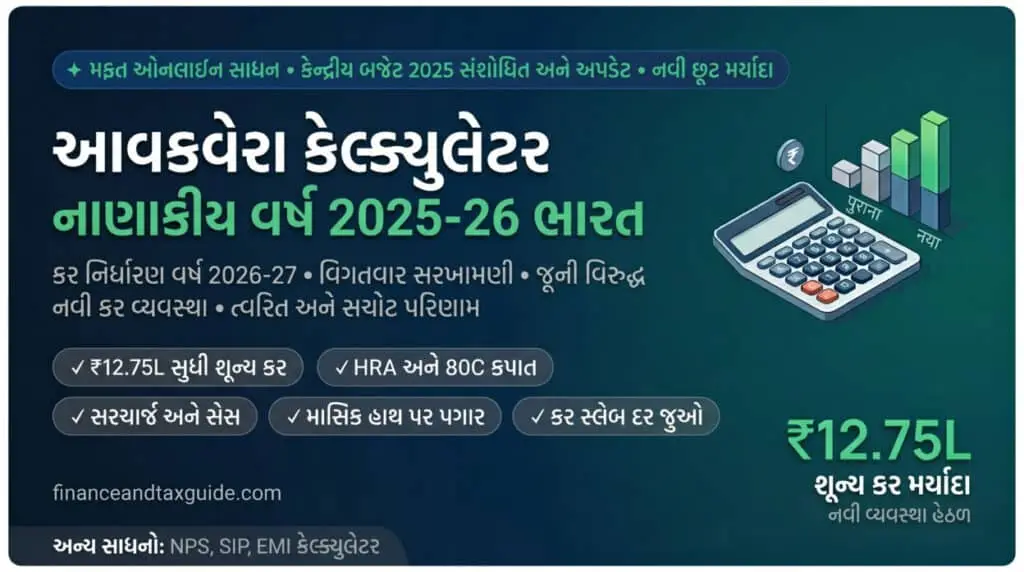
Income Tax Calculator FY 2025-26 (AY 2026-27)
Calculate your income tax free. Instantly compare Old vs New Tax Regime, see take-home salary & slab-wise tax. Updated for Union Budget 2025.
Salary & Employment
Enter your CTC or gross salary before any deductions.
Other Income Sources
Section 80 Deductions (Old Regime)
Max ₹25,000 (self) + ₹25,000 parents. Senior citizen parents: up to ₹50,000.
Income Tax Calculator India FY 2025-26 – Complete Guide
Our free Income Tax Calculator for India is updated for FY 2025-26 (AY 2026-27) with all Union Budget 2025 changes. Compare the Old Tax Regime vs New Tax Regime instantly and see which saves you more money.
New Tax Regime Slab Rates FY 2025-26
| Income Tax Slab | Tax Rate | Tax on Slab |
|---|---|---|
| Up to ₹4,00,000 | Nil | ₹0 |
| ₹4,00,001 – ₹8,00,000 | 5% | ₹20,000 |
| ₹8,00,001 – ₹12,00,000 | 10% | ₹40,000 |
| ₹12,00,001 – ₹16,00,000 | 15% | ₹60,000 |
| ₹16,00,001 – ₹20,00,000 | 20% | ₹80,000 |
| ₹20,00,001 – ₹24,00,000 | 25% | ₹1,00,000 |
| Above ₹24,00,000 | 30% | On balance |
Old Tax Regime Slabs FY 2025-26
| Income Slab | Below 60 | Senior (60–80) | Super Senior (80+) |
|---|---|---|---|
| Up to ₹2.5L | Nil | Nil | Nil |
| ₹2.5L – ₹3L | 5% | Nil | Nil |
| ₹3L – ₹5L | 5% | 5% | Nil |
| ₹5L – ₹10L | 20% | 20% | 20% |
| Above ₹10L | 30% | 30% | 30% |
Income-wise Tax Comparison: Old vs New Regime
| Gross Salary | New Regime Tax | Old Regime Tax | You Save (New) |
|---|---|---|---|
| ₹5 Lakh | ₹0 | ₹0 | — |
| ₹7.5 Lakh | ₹0 | ₹46,800 | ₹46,800 |
| ₹10 Lakh | ₹0 | ₹1,17,000 | ₹1,17,000 |
| ₹12.75 Lakh | ₹0 | ₹1,79,400 | ₹1,79,400 |
| ₹15 Lakh | ₹1,09,200 | ₹2,52,000 | ₹1,42,800 |
| ₹20 Lakh | ₹2,08,000 | ₹4,05,600 | ₹1,97,600 |
| ₹30 Lakh | ₹5,20,000 | ₹7,41,000 | ₹2,21,000 |
*Includes 4% cess. Old Regime assumes no deductions. Actual tax depends on deductions claimed.
New vs Old Tax Regime — Which is Better for You?
Choose New Tax Regime if:
- Your gross salary is below ₹12.75 lakh — zero tax either way
- You have minimal deductions (investments under ₹1.5L, no HRA or home loan)
- You prefer simpler tax filing without investment proofs
Choose Old Tax Regime if:
- You pay house rent and claim HRA (₹1 lakh+ per year)
- You have a home loan and claim Section 24 interest (up to ₹2L)
- You invest ₹1.5 lakh under 80C (LIC, PPF, ELSS, PF)
- Total deductions exceed ₹3.75 lakh (break-even threshold)
How to Use This Income Tax Calculator
- Step 1 – Basic Info: Select your Financial Year and age group.
- Step 2 – Income: Enter your gross salary and other income sources.
- Step 3 – Deductions: Enter 80C, 80D, HRA, home loan interest (Old Regime only).
- Calculate: Click “Calculate Tax” to see both regimes side by side with monthly take-home salary.
What is Section 87A Rebate?
| Regime | Income Limit | Max Rebate | Result |
|---|---|---|---|
| New Tax Regime | Up to ₹12,00,000 | ₹60,000 | Zero Tax |
| Old Tax Regime | Up to ₹5,00,000 | ₹12,500 | Zero Tax |
📝 Example: Salary ₹12.75 Lakh — New Regime
| Gross Salary | ₹12,75,000 |
| Less: Standard Deduction | − ₹75,000 |
| Taxable Income | ₹12,00,000 |
| Tax on ₹4L–₹8L @ 5% | ₹20,000 |
| Tax on ₹8L–₹12L @ 10% | ₹40,000 |
| Less: 87A Rebate | − ₹60,000 |
| Net Tax Payable | ₹0 (Zero!) |
Frequently Asked Questions (FAQ)
⚠️ Disclaimer: This Income Tax Calculator is for informational and planning purposes only. Results are estimates based on Income Tax Act provisions for FY 2025-26 (Budget 2025). Consult a qualified CA for professional advice. Not affiliated with the Government of India or the Income Tax Department.

He founded Finance and Tax Guide to simplify complex tax and accounting topics for Indian small businesses, entrepreneurs, and individual taxpayers.
His expertise includes:
• GST Registration and Return Filing
• Income Tax Return (ITR) Filing
• TDS and TCS Compliance
• Business Bookkeeping
• Financial Accounting
• Tax Planning for Small Businesses
Every article published on Finance and Tax Guideis based on practical accounting experience and current Indian tax laws to provide accurate,
easy-to-understand financial guidance.