Finance and Tax Guide

Tax

fabrication work hsn code
Tax

Fabrication Work HSN Code: The Complete 2026 Guide for MS, Steel & Metal Fabrication

If you’ve ever raised a GST invoice for fabrication work and stared at the HSN/SAC field wondering what number goes there, you’re not alone. Contractors, fabricators, and procurement teams get this wrong constantly, and a wrong code on your invoice can mean a mismatch notice from the GST department, a blocked ITC claim, or worse, a demand with penalty. Here’s the core problem: fabrication sits on an awkward line. Sometimes it’s a supply of goods (you’re delivering a fabricated MS structure). Sometimes it’s a supply of services (you’re working on the client’s material at their site). GST treats these two scenarios completely differently, with different HSN codes, different SAC codes, and different tax rates. In this guide, you’ll find the exact HSN and SAC codes for MS fabrication work, steel fabrication, aluminium fabrication, and job work on metal structures. You’ll also understand when to use a goods code vs a service code, what 998873 means, and how to pick the right GST rate for your invoice — without calling a CA every time. I’ve spent years working with fabrication contractors, structural steel suppliers, and industrial clients navigating GST compliance. The confusion in this space is real, and most of what’s written online is either too generic or just plain outdated. What Is an HSN Code? HSN stands for Harmonised System of Nomenclature. It’s a 6-to-8-digit international product classification system that India adopted under GST. Every physical good sold in India needs one. The CBIC (Central Board of Indirect Taxes and Customs) maps GST rates to these codes. An HSN code is a standardised 6–8 digit number that classifies physical goods for GST purposes. It works by grouping products into chapters (2 digits), headings (4 digits), and sub-headings (6–8 digits) based on material composition and product type. Most commonly used on B2B invoices where the buyer claims input tax credit. SAC stands for Services Accounting Code — the equivalent classification for services under GST. Where HSN covers goods, SAC covers what you do. Fabrication work is complicated because the same job can be either. A structural MS fabricator who purchases raw MS angle, fabricates trusses in his workshop, and delivers the finished structure to the client is supplying goods. A job worker who goes to the client’s site, uses the client’s MS material, and does cutting, welding, and assembly is supplying a service. The GST rule is clear: if you supply a fabricated product, use an HSN code. If you supply fabrication as a service (including job work), use a SAC code. HSN Codes for MS and Steel Fabrication Products (Goods) When you manufacture and supply fabricated goods made of mild steel or structural steel, Chapter 73 of the HSN schedule applies. Chapter 73 covers “Articles of Iron or Steel.” The primary HSN codes for MS and steel fabrication products fall under Chapter 73 (Iron and Steel Articles). The most relevant heading is 7308, which covers structures and parts of structures made of iron or steel — including bridges, towers, columns, beams, frames, doors, and similar fabricated items. GST rate on most Chapter 73 fabricated structural items is 18%. Here are the most-used Chapter 73 HSN codes for fabricated MS and steel goods: HSN Code Description GST Rate 7308 Structures and parts of structures of iron or steel (towers, trusses, columns, frames, bridges, shuttering) 18% 7308 10 Bridges and bridge sections 18% 7308 20 Towers and lattice masts 18% 7308 30 Doors, windows, and frames 18% 7308 40 Equipment for scaffolding, shuttering, and prop systems 18% 7308 90 Other structures (sheds, columns, beams, platforms) 18% 7326 Other articles of iron or steel 18% 7214 Bars and rods of iron or non-alloy steel 18% For MS fabrication work where you supply a finished product — a fabricated shed, staircase, railing, structural column, or mezzanine floor — HSN 7308 90 is the most commonly applicable code. For MS pipes and pipe fittings fabricated and supplied, look at HSN 7304 (seamless tubes/pipes) or 7306 (welded tubes/pipes). What “MS Structure” Means for GST Classification MS (Mild Steel) structures include everything from factory sheds and storage platforms to industrial frames and staircase structures. All of these, when fabricated and supplied as finished goods, fall under HSN 7308. The GST rate of 18% applies across the board. There is no concessional rate for MS structural work when supplied as goods. SAC Code for Fabrication Work as a Service (998873 Explained) Here’s where most people get confused. If you’re not supplying fabricated goods but instead doing fabrication on someone else’s material, you’re providing a service. GST classifies this as “Manufacturing Services on Physical Inputs Owned by Others” — what used to be called job work. SAC code 998873 covers “treatment and coating of metals and machining services,” which under the broader GST framework for manufacturing services covers metal fabrication work done as a service on materials supplied by the client. The applicable GST rate is 18%. This code applies when a fabricator works on material owned by the principal manufacturer or client. The full SAC hierarchy looks like this: SAC Code Description GST Rate 9988 Manufacturing services on physical inputs owned by others 18% 998871 Structural metal product manufacturing services 18% 998872 Fabricated metal product manufacturing services 18% 998873 Treatment and coating of metals and machining services 18% 998874 Cutlery, hand tool, and general hardware manufacturing services 18% SAC 998871 is the most directly applicable code for structural MS fabrication services — making it the correct choice for most contractors doing job work on iron/steel structures. SAC 998873 specifically applies when the work involves surface treatment, galvanizing, powder coating, or machining as part of the fabrication process. When to Use 998871 vs 998873 Use 998871 when your scope of work is: cutting, drilling, welding, assembling, and erecting steel structures from material supplied by the client. Use 998873 when your work is primarily: blasting, priming, painting, galvanizing, powder coating, heat treatment, or precision machining of metal components. Many fabrication contracts involve both. In that case, the principal supply

How Is Section 87A Rebate Calculated
Tax

How Is Section 87A Rebate Calculated: Complete Guide for FY 2025-26

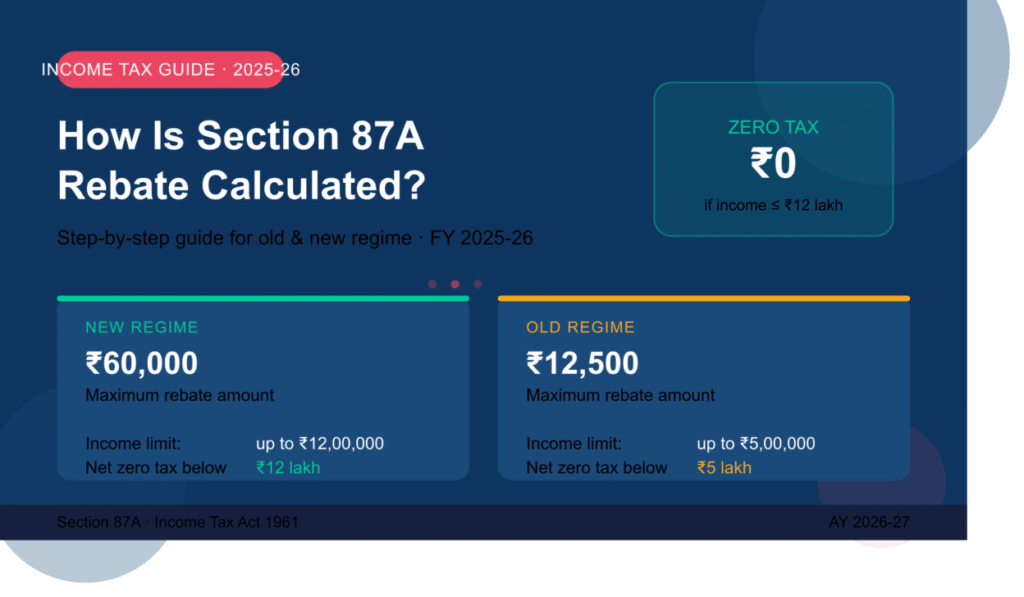
Over 4 crore Indian taxpayers will pay zero income tax in FY 2025-26 — and most of them don’t fully understand why. Section 87A of the Income Tax Act 1961 is the reason. Many salaried individuals either miss this rebate entirely or misapply it, ending up paying tax they don’t owe. The calculation is not complicated, but the rules differ by tax regime, income level, and the type of income you earn — and getting those details wrong costs money. In this guide, you’ll learn exactly How Is Section 87A Rebate Calculated step by step, which tax regime gives you more benefit, and how marginal relief protects you if your income just crosses the threshold — without wading through dense legal language. As a tax practitioner with experience filing returns for salaried and self-employed individuals across India, the most common filing mistake I see is taxpayers missing the 87A rebate claim on their ITR. What Is Section 87A of the Income Tax Act 1961? Section 87A sits inside Chapter VIII of the Income Tax Act 1961, which deals with rebates and reliefs. The government introduced it in FY 2013-14 to reduce tax burden on low-to-middle income resident individuals. What is Section 87A Rebate? Section 87A is a direct rebate on your final income tax liability – not a deduction from income. It works by subtracting the rebate amount from the tax calculated on your taxable income, before the 4% health and education cess is applied. It applies to resident individuals whose net taxable income falls within the prescribed limit for their chosen tax regime. The key distinction: a deduction reduces your taxable income; the 87A rebate reduces the tax you owe after income is already computed. This makes it one of the most powerful provisions in the Act for eligible taxpayers. Who Is Eligible for Tax Rebate Under Section 87A? Eligibility under Section 87A has two firm conditions. Both must be satisfied simultaneously. Condition 1 — Residential Status: You must be a resident individual under Section 6 of the Income Tax Act. HUFs, firms, companies, and non-resident Indians cannot claim this rebate. Condition 2 — Taxable Income Threshold: Tax Regime Income Limit (FY 2025-26) Maximum Rebate New Tax Regime Up to ₹12,00,000 ₹60,000 Old Tax Regime Up to ₹5,00,000 ₹12,500 The income limit applies to net taxable income — the figure you arrive at after all eligible deductions, not your gross salary or CTC. What Counts as Taxable Income? Your taxable income includes salary, rental income, business/profession income, and most capital gains. However, special rate capital gains — particularly long-term capital gains on listed equity under Section 112A — are excluded from the rebate calculation in the old regime. Under the new regime, Budget 2025 has aligned the treatment, but taxpayers with significant LTCG should verify their specific position with a CA before filing. How Is Section 87A Rebate Calculated — Step-by-Step The calculation follows a fixed sequence. Skipping or reordering steps leads to errors. Step 1: Compute Gross Total Income Add all income from all heads — salary (after standard deduction), house property, business/profession, capital gains, and other sources. Step 2: Apply Deductions Under the old regime: subtract deductions under Chapter VI-A (80C, 80D, 80G, etc.). Under the new regime: limited deductions apply (standard deduction of ₹75,000 for salaried individuals, employer NPS contribution under 80CCD(2)). Step 3: Arrive at Net Taxable Income This is the figure after Step 2. Compare it against the applicable threshold. If it exceeds the limit, Section 87A is not available — stop here. Step 4: Calculate Tax as Per Slab Rates Apply the income tax slab rates for your regime to your net taxable income. Step 5: Apply the 87A Rebate Subtract the rebate from the tax calculated in Step 4. The rebate is the lower of: This ensures your tax liability does not go below zero. Step 6: Add Cess Apply 4% health and education cess on the tax after the rebate. If tax after rebate is zero, cess is also zero. Calculation Example — New Regime (FY 2025-26) Scenario: Salaried individual, Gross Salary ₹12,75,000 Step Amount Gross Salary ₹12,75,000 Less: Standard Deduction ₹75,000 Net Taxable Income ₹12,00,000 Tax on ₹12,00,000 (as per new regime slabs) ₹60,000 Less: Rebate u/s 87A ₹60,000 Tax after rebate ₹0 Add: 4% Cess ₹0 Total Tax Payable ₹0 Calculation Example — Old Regime (FY 2025-26) Scenario: Individual with taxable income ₹4,80,000 after 80C deductions Step Amount Net Taxable Income ₹4,80,000 Tax on ₹4,80,000 (as per old regime slabs) ₹11,500 Less: Rebate u/s 87A ₹11,500 Tax after rebate ₹0 Add: 4% Cess ₹0 Total Tax Payable ₹0 Note: The rebate is capped at actual tax payable. Since ₹11,500 is less than the ₹12,500 maximum, the full tax is offset. Section 87A Under New Regime vs Old Regime — Key Differences The 2025 Union Budget expanded the Section 87A benefit substantially under the new regime. Here is a direct comparison for FY 2025-26: Parameter Old Tax Regime New Tax Regime Income threshold for rebate ₹5,00,000 ₹12,00,000 Maximum rebate amount ₹12,500 ₹60,000 Effective zero-tax income Up to ₹5 lakh Up to ₹12 lakh Applicable to salaried Yes Yes (+ ₹75,000 std deduction) Applicable to self-employed Yes Yes For most salaried individuals with income up to ₹12 lakh, the new regime now offers a substantially better outcome. A salaried person earning ₹12.75 lakh gross pays zero tax under the new regime after the standard deduction and the 87A rebate. Under the old regime, the same person would need to claim over ₹2.75 lakh in 80C and other deductions to achieve a comparable result. Marginal Relief Under Section 87A — When Income Slightly Exceeds ₹12 Lakh Budget 2025 also provides marginal relief to taxpayers whose income crosses the rebate threshold by a small amount. Without this relief, an individual earning ₹12,00,001 would owe tax on the entire ₹12,00,001 — a jump from zero to roughly ₹60,000 in tax, triggered by a single rupee of additional income. Marginal relief ensures the additional

GST Guide for India
Tax

The Complete GST Guide for Indian Businesses (2026)

GST (Goods and Services Tax) is India’s unified indirect tax on supply of goods and services, replacing VAT, service tax, and 17 other levies. In 2026, GST compliance involves registration (if turnover > ₹40L / ₹20L for services), monthly/quarterly return filing (GSTR-1, GSTR-3B), input tax credit (ITC) reconciliation via GSTR-2B, mandatory e-invoicing for businesses with turnover > ₹5 crore, and annual returns (GSTR-9/9C). Non-compliance attracts penalties up to 100% of tax dues plus interest at 18% per annum. 1. Why GST Still Confuses Indian Businesses in 2026 On 1 July 2017, India replaced a patchwork of 17 indirect taxes — Central Excise, VAT, Service Tax, CST, Octroi, and more — with a single, destination-based Goods and Services Tax. Nine years later, GST has stabilised, but it has never become simple. In 2026, Indian businesses face a more demanding GST environment than ever: mandatory e-invoicing for crores of businesses, AI-powered GST department scrutiny of return mismatches, blocked ITC for non-reconciled purchases, and new sections under the Income Tax Act 2025 that interact directly with GST turnover. Staying compliant is not just about filing returns on time — it is about building an integrated finance function where GST, income tax, TDS, and ESG reporting all speak to each other. This pillar guide is the most comprehensive GST resource for Indian businesses in 2026. It covers every aspect of GST — from registration and rate classification to e-invoicing, ITC reconciliation, department audits, and niche scenarios like crypto taxation, ESOP perquisites, and succession through private trusts. The GST Framework at a Glance Component Detail Full Form Goods and Services Tax Implemented 1 July 2017 Type Dual GST — CGST (Central) + SGST (State) for intra-state; IGST for inter-state Governing Law CGST Act 2017, IGST Act 2017, UTGST Act 2017, GST Compensation Cess Act 2017 Rate Slabs 0%, 5%, 12%, 18%, 28% (+ Cess on sin goods) Administering Body GST Council (Finance Ministers of Centre + all States) Returns Portal www.gst.gov.in E-Invoice Portal einvoice1.gst.gov.in 2. GST Registration — Who Must Register, Thresholds & Process 2.1 Registration Thresholds (FY 2025-26) Category Threshold States Goods supplier — General states ₹40 lakh annual turnover All states except Special Category Goods supplier — Special Category states ₹20 lakh annual turnover NE states, Uttarakhand, HP, J&K, Sikkim Service provider — General states ₹20 lakh annual turnover All general states Service provider — Special Category states ₹10 lakh annual turnover NE states etc. E-commerce operators / sellers on e-commerce No threshold — mandatory registration All India Inter-state supplier (any turnover) No threshold — mandatory All India Casual taxable person / NRI taxable person No threshold Temporary registration Reverse Charge Mechanism (RCM) recipient No threshold (for RCM supplies) All India 2.2 Voluntary Registration Businesses below the threshold can register voluntarily — and often should. Voluntary registration enables ITC claims on purchases, participation in government tenders (many require GSTIN), and credibility with corporate buyers who prefer GST-registered vendors. 2.3 Registration Process — Step by Step Important: From 2023, Aadhaar authentication is mandatory for new registrations. Failure to authenticate results in physical verification before GSTIN is granted. Ensure registered mobile is linked to Aadhaar before applying. 2.4 Composition Scheme — For Small Businesses Type of Business Turnover Limit GST Rate Payable Restriction Goods trader / manufacturer Up to ₹1.5 crore 1% of turnover Cannot supply inter-state or to SEZ Restaurants (not serving alcohol) Up to ₹1.5 crore 5% of turnover No ITC available Service providers Up to ₹50 lakh 6% of turnover (3% CGST+3% SGST) Cannot issue tax invoice Mixed supplier (goods + services) Up to ₹1.5 crore 1% Service ≤ 10% of turnover or ₹5L 3. GST Rate Structure — Slabs, HSN/SAC Codes & Exemptions 3.1 GST Rate Slabs Slab What It Covers Examples 0% (Exempt) Essential goods and services Fresh fruits, vegetables, milk, eggs, health services, education 5% Basic necessities, mass consumption Packaged food, medicines, economy hotel rooms (<₹1000/night), transport 12% Processed goods, some services Butter, cheese, computers, business class air travel, works contracts 18% Most goods and services (standard rate) IT services, financial services, restaurants (AC), most manufactured goods 28% Luxury, sin goods Automobiles, aerated drinks, tobacco, cement, large ACs, casinos 28% + Cess Special goods Luxury cars (+ 1-22% cess), pan masala, cigarettes, betting 3.2 HSN and SAC Codes — Mandatory Classification Every GST invoice must carry an HSN (Harmonised System of Nomenclature) code for goods or an SAC (Services Accounting Code) for services. The number of digits required depends on turnover: Annual Turnover HSN Digits Required Mandatory on Invoice? Up to ₹5 crore 4-digit HSN Yes — for B2B invoices; optional for B2C Above ₹5 crore 6-digit HSN Yes — for all invoices (B2B and B2C) Notified goods (any turnover) 8-digit HSN Yes (e.g. pharmaceutical products) Tip: Use the HSN search tool at gst.gov.in/masters/hsn to verify correct codes. Wrong HSN classification is one of the most common triggers for GST department notices. An incorrect HSN can result in wrong rate application, mismatch with e-invoice data, and denial of ITC to buyers. 3.3 Key GST Exemptions to Know 4. GST Returns — Complete Filing Calendar & Procedures 4.1 Return Types and Due Dates Return Who Files Frequency Due Date GSTR-1 All regular taxpayers (outward supplies) Monthly 11th of following month GSTR-1A Amendment to GSTR-1 Before GSTR-3B Before 3B filing date IFF (Invoice Furnishing Facility) QRMP taxpayers Monthly (Months 1 & 2 of quarter) 13th of following month GSTR-3B All regular taxpayers (summary + tax payment) Monthly 20th (Turnover >5Cr) / 22nd or 24th (others) GSTR-2B Auto-generated ITC statement Monthly 14th of following month (generated) GSTR-4 Composition scheme taxpayers Annual 30th April GSTR-5 Non-resident taxable persons Monthly 20th of following month GSTR-6 Input Service Distributors (ISD) Monthly 13th of following month GSTR-7 TDS deductors (u/s 51) Monthly 10th of following month GSTR-8 E-commerce operators (TCS u/s 52) Monthly 10th of following month GSTR-9 All regular taxpayers Annual 31st December of following FY GSTR-9C Taxpayers with turnover > ₹5 crore Annual (self-certified) 31st December of following FY GSTR-10 Cancelled/surrendered registrations Once

How to Calculate Income Tax on Salary
Tax

How to Calculate Income Tax on Salary – FY 2025-26 (With Real Example)

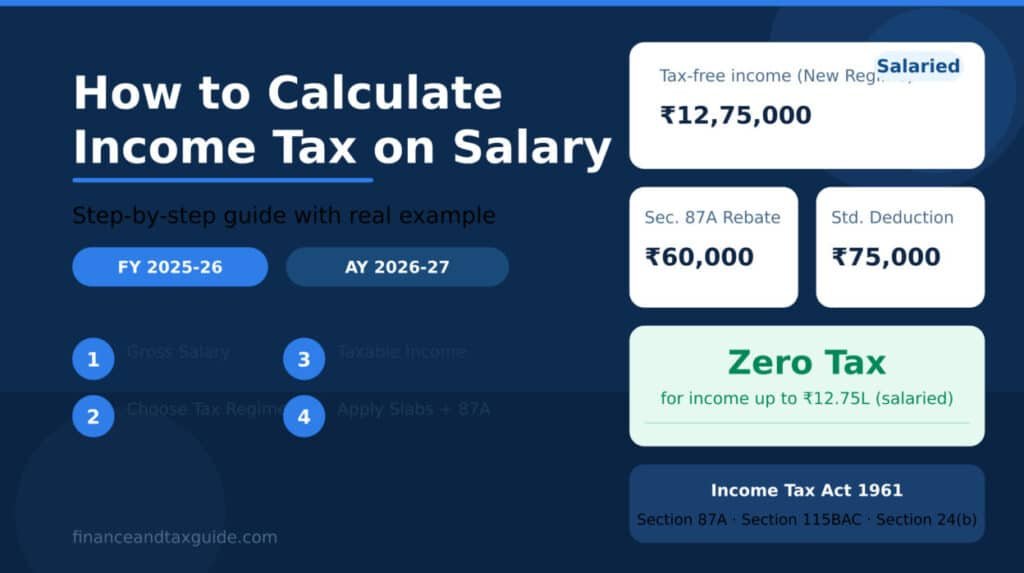
If you want to know how to compute income tax on salary for the fiscal year 2025-26, this guide will walk you through the entire process step by step.. Most salaried employees in India know how much tax their employer deducts each month. What they often do not have is a clear picture of why that number is what it is — or whether it has been computed correctly. Income tax on salary follows a defined process under the Income Tax Act 1961. Once the steps are clear, the calculation is straightforward. This guide walks through each one using a single real-world example so the numbers stay grounded throughout. If you prefer to skip the manual steps, you can use the free Income Tax Calculator on Finance and Tax Guide to compare both regimes instantly. How to Calculate Income Tax on Salary: What You Need to Know First Before working through the numbers, it helps to understand what counts as salary income for income tax purposes. Gross salary is broader than just the monthly figure credited to your bank account. Under the provisions of income tax law, it includes every monetary benefit received from an employer during the financial year. A typical salary structure for a salaried employee in India includes: Some components reduce your tax burden directly; others do not. Understanding which is which is the first step in accurate tax calculation. Real Example Used in This Guide: Arjun, Software Engineer, Pune To keep the calculation concrete, this guide follows one person through every step. Arjun is 34 years old, works as a software engineer at a mid-sized IT company in Pune, and earns the following annual income for FY 2025-26: Salary Component Annual Amount (Rs.) Basic Salary 7,80,000 House Rent Allowance (HRA) 3,12,000 Leave Travel Allowance (LTA) 24,000 Special Allowance 1,44,000 Annual Bonus 72,000 Gross Salary 13,32,000 Arjun lives in a rented flat in Pune and pays Rs. 22,000 per month in rent (Rs. 2,64,000 annually). He has an active home loan on a property in his hometown and makes regular investments in PPF and ELSS. Step 1: Choose the Tax Regime The first decision in how to calculate income tax on salary is choosing the right tax regime. For FY 2025-26, two options are available under the Income Tax Act 1961. For a full side-by-side breakdown, see the New vs Old Tax Regime comparison guide on this site. New Tax Regime — Income Tax Slabs FY 2025-26 The new tax regime is now the default under Section 115BAC. It offers lower income tax slabs but does not allow most common deductions — no HRA exemption, no LTA, no Section 80C, and no home loan interest deduction under Section 24(b). New Tax Regime — Income Tax Slabs for FY 2025-26: Annual Taxable Income Tax Rate Up to Rs. 4,00,000 Nil Rs. 4,00,001 – Rs. 8,00,000 5% Rs. 8,00,001 – Rs. 12,00,000 10% Rs. 12,00,001 – Rs. 16,00,000 15% Rs. 16,00,001 – Rs. 20,00,000 20% Rs. 20,00,001 – Rs. 24,00,000 25% Above Rs. 24,00,000 30% What the new regime does allow for salaried employees: Old Tax Regime — Income Tax Slabs FY 2025-26 The old tax regime carries higher slab rates but permits a range of deductions and exemptions. Taxpayers who claim HRA, have a home loan, invest in 80C instruments, or pay health insurance premiums often find the old regime more efficient despite the higher base rates. Old Tax Regime — Income Tax Slabs for FY 2025-26 (Age below 60): Annual Taxable Income Tax Rate Up to Rs. 2,50,000 Nil Rs. 2,50,001 – Rs. 5,00,000 5% Rs. 5,00,001 – Rs. 10,00,000 20% Above Rs. 10,00,000 30% What the old regime allows: The right choice depends entirely on the numbers. Neither regime is universally better — the one that results in lower tax for a specific income and deduction profile is the right one for that year. Step 2: Compute Your Taxable Income Taxable income is gross salary minus all eligible deductions and exemptions. The figure differs under each regime because the old regime permits more reductions. Taxable Income Under the New Tax Regime Under the new regime, only the standard deduction applies for most salaried employees. Taxable Income Under the Old Tax Regime The old regime involves more steps. Calculating the HRA Exemption: House rent allowance exemption is the lowest of these three figures: The exempt HRA amount is Rs. 1,86,000. Deductions Summary (Old Regime): Deduction Applicable Section Amount (Rs.) Standard Deduction — 50,000 HRA Exemption — 1,86,000 LTA Exemption — 24,000 PPF + ELSS Investment Section 80C 1,50,000 Health Insurance Premium Section 80D 25,000 Home Loan Interest Section 24(b) 2,00,000 Total Deductions 6,35,000 Step 3: Apply the Income Tax Slabs and Calculate Tax With taxable income established for both regimes, the next step is applying the slab rates to calculate the base tax amount. New Tax Regime Tax Calculation (Taxable Income: ₹12,57,000) Income Slab Rate Tax (Rs.) Up to Rs. 4,00,000 Nil 0 Rs. 4,00,001 – Rs. 8,00,000 5% 20,000 Rs. 8,00,001 – Rs. 12,00,000 10% 40,000 Rs. 12,00,001 – Rs. 12,57,000 15% 8,550 Total Tax Before Cess 68,550 Arjun’s taxable income of Rs. 12,57,000 exceeds Rs. 12,00,000, so the Section 87A rebate is not available here under the new regime. The rebate applies only when taxable income is up to Rs. 12,00,000. Old Tax Regime Tax Calculation (Taxable Income: ₹6,97,000) Income Slab Rate Tax (Rs.) Up to Rs. 2,50,000 Nil 0 Rs. 2,50,001 – Rs. 5,00,000 5% 12,500 Rs. 5,00,001 – Rs. 6,97,000 20% 39,400 Total Tax Before Cess 51,900 Arjun’s taxable income of Rs. 6,97,000 is above Rs. 5,00,000, so the Section 87A rebate under the old regime — which applies only up to Rs. 5,00,000 — is not available either. Final Comparison New Regime Old Regime Gross Salary Rs. 13,32,000 Rs. 13,32,000 Total Deductions Rs. 75,000 Rs. 6,35,000 Taxable Income Rs. 12,57,000 Rs. 6,97,000 Base Tax Rs. 68,550 Rs. 51,900 Section 87A Rebate Nil Nil 4% Cess Rs. 2,742 Rs. 2,076 Final Tax

financial things to do before May 31
Tax

3 Financial Things You to Do Before May 31 (Or Pay the Price Later)

Why May 31 Is a Critical Financial Date for Every Indian Taxpayer Every year, millions of Indian taxpayers scramble in the last days of July when the ITR filing deadline looms. But what most people don’t realize is that the real groundwork for a smooth, penalty-free tax filing begins in May itself — specifically before May 31. we’re going deep on the 3 financial things to do before May 31, along with a bonus reminder checklist and everything you need to know to stay compliant, save money, and avoid penalties. Whether you’re a salaried employee, a freelancer, an investor, or a business owner — this guide is for you. Let’s break it all down. Why May 31 Matters: The Financial Calendar You Need to Understand India’s financial year runs from April 1 to March 31. The new financial year (FY 2025-26) has already begun, but many tasks from the previous financial year (FY 2024-25) are still pending. May is the critical transition month. This is when: Your employer files TDS returns and generates Form 16 The Income Tax Department updates the Annual Information Statement (AIS) and Taxpayer Information Summary (TIS) Miss this window and you’re looking at wrong ITRs, unverified returns, interest penalties on advance tax, and last-minute investment decisions made in panic. To stay ahead of all compliance deadlines year-round, bookmark our Complete Guide to Accounting in India 2026. Here’s what you must do — right now, before May 31. Task 1: File and Verify Your ITR (If Applicable) What Is ITR and Why Does It Matter? The Income Tax Return (ITR) is a form submitted to the Income Tax Department of India, declaring your income, deductions, and taxes paid for the previous financial year. Filing your ITR on time is not just a legal obligation — it’s a gateway to financial credibility. Your ITR is needed for: When Should You File? The general deadline for non-audit taxpayers is July 31 of the assessment year. But the earlier you file, the better — especially if you’re expecting a refund. May is the perfect time to start preparing, so your July filing is smooth and error-free. Step-by-Step: How to Check AIS and TIS Before Filing This is the most important pre-filing step that most taxpayers skip — and it costs them dearly. What is AIS? The Annual Information Statement (AIS) is a comprehensive document available on the Income Tax e-filing portal that shows all financial transactions reported against your PAN — salary, interest income, dividends, mutual fund transactions, property purchases, foreign remittances, and more. What is TIS? The Taxpayer Information Summary (TIS) is a simplified version of AIS that provides category- wise processed values for ease of filing. How to Check Your AIS/TIS: 1. Log in to incometax.gov.in 2. Go to “Annual Information Statement (AIS)” under the Services tab 3. Download both AIS and TIS in PDF or JSON format 4. Cross-check every entry against your actual income sources What to look for: Common AIS Errors and What to Do: If you find incorrect or missing information in your AIS, you can submit feedback directly on the portal by clicking the “Optional” feedback button next to each transaction. The department will review it, and the corrected data will reflect in your TIS. Don’t rush your filing based on incorrect AIS data — this is one of the biggest mistakes taxpayers make. Match Salary, Interest, and Capital Gains After checking your AIS, match the figures with: ITR Verification: The Step Most People Forget This is critical: Filing your ITR is NOT enough. You MUST verify it. An unverified ITR is treated as if it was never filed. This means: How to verify your ITR: Deadline for verification: 30 days from the date of filing. ⚠ Wrong or unverified ITR = NOT valid filing. Period. Task 2: Complete Your Investment Proof Planning Why Plan Investments in May for the New Financial Year? FY 2025-26 has just begun. You have the entire year ahead of you. So why plan investments now? Because last-minute investments = poor decisions. Every year, lakhs of taxpayers invest blindly in January-March just to save taxes, without understanding what they’re investing in. They end up locking money in wrong products, missing better options, or making sub-optimal choices under time pressure. May is the ideal time to: Tax-Saving Sections to Plan Section 80C – Up to ₹1.5 Lakh Deduction Section 80C is the most popular tax-saving provision that qualify : Pro Tip: Start your ELSS SIP from May itself. If you invest ₹12,500/month, you complete your ₹1.5 lakh 80C target by March — without any last-minute rush. Section 80D — Health Insurance Premium (Up to ₹1 Lakh) Health insurance is not just a tax-saving tool — it’s essential financial protection. Section 80D allows: Action point for May: Review your existing health insurance policy. Is the coverage adequate? Did you pay the premium for FY 2025-26? Ensure you have your premium receipt. NPS — National Pension System (Additional ₹50,000 Under 80CCD(1B)) Over and above the 80C limit, you can claim an additional ₹50,000 deduction under Section 80CCD(1B) by investing in NPS (National Pension System). This is one of the most under-utilized deductions in India. Start your NPS contribution in May to spread it across the year. ELSS and SIP Alignment Review your existing SIP portfolio: May is the time to course-correct. Switch to better funds if needed, set up new SIPs, and align your investment calendar with your tax-saving goals. Investment Proof Planning Checklist for May Here’s a practical checklist to complete this month: Task 3: Check Your Advance Tax Liability What Is Advance Tax? Advance tax is the payment of income tax in installments during the financial year itself, instead of paying it all at the end of the year. It is applicable if your estimated tax liability for the year exceeds ₹10,000 after TDS. In simple terms: the government wants its share of your tax throughout the year — not just at the end. Who Needs to Pay

Crypto Tax
Tax

US Crypto Tax vs. India’s 30% VDA Tax: The 2026 Regulatory

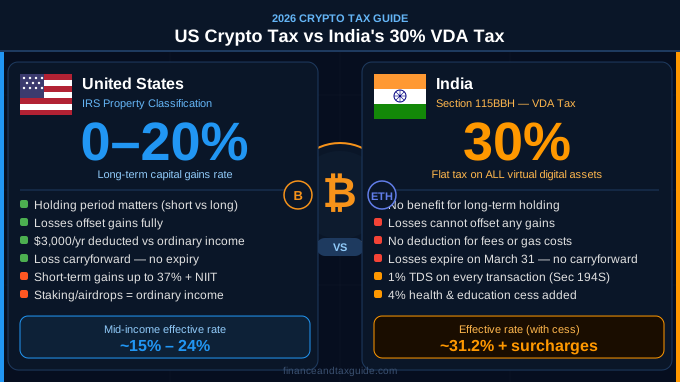
The cryptocurrency market has matured significantly over the past few years, and so have the regulatory frameworks governing it. If you’re a crypto investor operating across borders or considering your options in 2026, understanding how the United States and India approach digital asset taxation is no longer optional—it’s essential. Two major markets. Two completely different philosophies. One dramatic difference in tax outcomes. While the US has evolved a more nuanced system over the past decade, India took a harder line in 2022 and has maintained a strict, flat-rate approach ever since. For someone holding digital assets or trading cryptocurrency on both sides of the world, this comparison matters—sometimes to the tune of hundreds of thousands of rupees or dollars. This guide breaks down exactly how each system works, explores the gaps between them, and helps you understand what 2026 really means for your crypto portfolio if you’re navigating both jurisdictions. India’s Crypto Tax Framework – The 30% VDA Tax Regime The Indian Approach: Simplicity Through Rigidity India’s crypto taxation system, solidified through the Finance Act 2022, operates on a principle that sounds straightforward but proves remarkably inflexible in practice: a blanket 30% tax on all virtual digital asset gains. What is a Virtual Digital Asset (VDA)? Under Section 2(47A) of the Income Tax Act, a VDA is any digitally generated token or code that represents value, can be transferred or traded, and exists electronically. This remarkably broad definition includes: Conspicuously absent: the Indian Rupee and foreign currencies. Also exempt: the RBI’s own Digital Rupee, because it’s legal tender and falls outside the speculative asset framework. The Three Tax Anchors in India: India’s 30% Flat Tax: How It Actually Works The math looks deceptively simple: Gain = Sale Price – Purchase Price, then multiply by 30%. But the devil hides in several details: What You Can Deduct: Only the cost of acquisition. Nothing else. What You Cannot Deduct: A trader who pays ₹5,000 in exchange fees to execute a ₹2,00,000 trade can’t reduce their taxable gain by even a rupee. The system doesn’t recognize transaction friction. The Add-Ons: For most Indian crypto investors, the effective rate lands around 31.2%. For higher earners, it climbs notably higher. The Loss Problem: India’s Most Controversial Rule This is where India’s system generates the most friction. You cannot offset crypto losses against crypto gains. Not even partially. If you make ₹3,00,000 on Bitcoin and lose ₹1,50,000 on Ethereum, you owe tax on the full ₹3,00,000. The loss simply vanishes. Moreover: For active traders who experience inevitable losing trades, this creates a tax burden that feels disproportionate to actual profitability. Tax on Crypto Swaps: A Hidden Tax Event Many investors don’t realize that swapping one cryptocurrency for another—say, ETH for SOL—is treated as a taxable event in India. Why? Because the law defines a “transfer” as any exchange that results in a change of beneficial ownership, regardless of whether cash is involved. So if you swap 2 ETH (worth ₹5,40,000) for SOL: You now owe ₹72,000 in tax… without receiving any cash. For liquidity, you’d need to sell some SOL or other holdings to cover this liability. The 1% TDS Mechanism: Tracking, Not Necessarily Taxation Section 194S mandates a 1% Tax Deducted at Source on crypto transfers. Think of it as a tracking mechanism disguised as a tax. How it works: Important: This 1% is not “extra” tax. It’s an advance payment credited against your final tax liability. Thresholds: Once you cross the threshold, every transaction gets hit with 1% deduction for the rest of that financial year. Filing VDA Income: Schedule VDA When you file your ITR, crypto income gets reported separately in Schedule VDA. The system requires: For active traders with dozens or hundreds of transactions, this becomes tedious but manageable through aggregation. Foreign Assets & Offshore Exchanges: Schedule FA If you use foreign exchanges or hold crypto in offshore wallets, you must declare it in Schedule FA. The stakes here are higher. Non-disclosure triggers penalties under the Black Money Act: This isn’t a slap on the wrist—it’s a serious enforcement mechanism. US Crypto Tax Framework – Complexity Over Simplicity The American Approach: Multiple Rate Brackets, Multiple Asset Types The United States taxes crypto gains far more complexly than India, but arguably more equitably in certain respects. The IRS classifies most cryptocurrencies as “property” for tax purposes, meaning: Short-Term Capital Gains (held ≤ 1 year): Taxed at ordinary income rates: Add 3.8% Net Investment Income Tax (NIIT) if modified adjusted gross income exceeds $200,000 (single) or $250,000 (married filing jointly), and you’re looking at potential rates exceeding 40%. Long-Term Capital Gains (held > 1 year): Much more favorable: For most middle-income Americans, long-term gains are taxed at either 0% or 15%—dramatically lower than short-term rates. The US Advantage: Loss Harvesting Here’s where the US system differs most sharply from India’s: losses are meaningful. In the US: This enables a practice called “tax-loss harvesting”—selling losing positions to offset gains, then sometimes re-entering similar positions (with timing restrictions). A trader experiencing a ₹3,00,000 gain and ₹1,50,000 loss can reduce taxable gain to ₹1,50,000. In India, they’d owe tax on the full ₹3,00,000. Staking Rewards, Airdrops, Mining: Income (Not Capital Gains) The IRS takes a different view on how you acquire crypto: Staking rewards: Taxable as ordinary income at fair market value on the date received. Airdrops: Same—ordinary income at fair market value at the moment of receipt. Mining: Also ordinary income. So if you receive 0.1 BTC worth $4,000 in staking rewards, you recognize $4,000 of income in that tax year, regardless of whether you sell it later. Later, when you sell, that $4,000 becomes your cost basis. Gains above that are capital gains (short or long-term depending on holding period). This creates the possibility of “phantom income”—tax liability on assets you haven’t sold—which complicates cash flow for some investors. DeFi Activities: Complex and Evolving The IRS position on DeFi taxation remains somewhat uncertain, but the prevailing view is: The tax treatment of complex DeFi

How to file income tax return in gujarati
Tax

How to file income tax return in gujarati

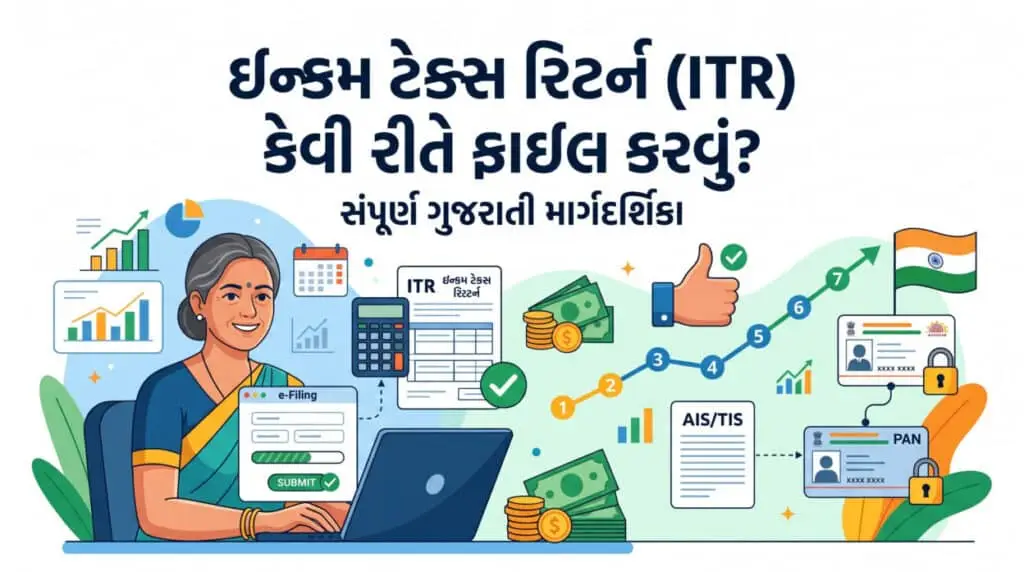
આજના ડિજિટલ યુગમાં ઇન્કમ ટેક્સ રિટર્ન (ITR) ફાઇલ કરવું એ માત્ર એક કાનૂની જવાબદારી નથી, પરંતુ દેશના વિકાસમાં અને તમારી નાણાકીય સ્થિરતામાં એક મહત્વપૂર્ણ પગલું છે. ઘણા લોકોને ટેક્સ રિટર્ન ફાઇલ કરવાની પ્રક્રિયા જટિલ અને અઘરી લાગે છે, પરંતુ જો સાચી માહિતી અને યોગ્ય માર્ગદર્શન હોય, તો આ પ્રક્રિયા ખૂબ જ સરળ બની જાય છે. આજના આ વિસ્તૃત લેખમાં આપણે ઇન્કમ ટેક્સ રિટર્ન એટલે શું, તે શા માટે જરૂરી છે, તેનાથી શું ફાયદા થાય છે અને તેને ઓનલાઇન તથા ઓફલાઇન કેવી રીતે ફાઇલ કરી શકાય તે અંગે સંપૂર્ણ સ્ટેપ-બાય-સ્ટેપ માહિતી ગુજરાતીમાં મેળવીશું. ૧. ઇન્કમ ટેક્સ રિટર્ન (આઇટીઆર) એટલે શું? ઇન્કમ ટેક્સ રિટર્ન (ITR) એ એક નિર્ધારિત ફોર્મ છે જેમાં કરદાતા (Taxpayer) પોતાની વાર્ષિક આવક, કરેલા ખર્ચાઓ, ટેક્સ બચાવવા માટે કરેલા રોકાણો (ડિડક્શન) અને પોતાની ટેક્સ જવાબદારી (Tax Liability) ની સંપૂર્ણ વિગતો આવકવેરા વિભાગ (Income Tax Department) ને દર્શાવે છે. જ્યારે કોઈ વ્યક્તિ, પેઢી કે કંપની આ ફોર્મમાં પોતાની નાણાકીય વિગતો ભરીને આઇટી (IT) વિભાગમાં સબમિટ કરે છે, ત્યારે તેમણે પોતાનું આવકવેરા રિટર્ન ફાઇલ કર્યું છે તેમ કહેવાય છે. કરદાતાની આવકના સ્ત્રોત અને વ્યવસાયના પ્રકારના આધારે આઇટીઆર-૧ (ITR-1) થી લઈને આઇટીઆર-૭ (ITR-7) સુધીના વિવિધ ફોર્મ્સ ઉપલબ્ધ હોય છે. નાણાકીય વર્ષ (Financial Year) અને આકારણી વર્ષ (Assessment Year) ITR ફાઇલ કરતી વખતે આ બે શબ્દો સમજવા અત્યંત જરૂરી છે: પ્રોફેશનલ નોંધ: ડાયરેક્ટ ટેક્સ કોડ (DTC) ૨૦૨૫ ના આગામી ડ્રાફ્ટ અને અપેક્ષિત સુધારાઓ મુજબ, આવનારા સમયમાં આ અલગ-અલગ પારિભાષિક શબ્દો (FY અને AY) ને બદલે વિશ્વ કક્ષાની સિસ્ટમ મુજબ એક સમાન ‘ટેક્સ યર’ (Tax Year) નો ખ્યાલ અમલમાં આવી શકે છે. તેથી, કરદાતાઓએ અને ટેક્સ પ્રોફેશનલ્સે આ નવી પરિભાષા અને ફોર્મ્સના માળખાકીય ફેરફારો માટે માનસિક રીતે સજ્જ રહેવું હિતાવહ છે. ૨. આઇટીઆર (ITR) ફાઇલ કરવાના મુખ્ય ફાયદાઓ ઘણા લોકો માને છે કે જો તેમની આવક ટેક્સ મુક્તિ મર્યાદા (Basic Exemption Limit) કરતા ઓછી હોય, તો રિટર્ન ભરવાની કોઈ જરૂર નથી. પરંતુ ‘નિલ રિટર્ન’ (Nil Return) ભરવાના પણ અનેક લાંબા ગાળાના ફાયદા છે: ૩. ઇન્કમ ટેક્સ રિટર્ન ફાઇલ કરવા માટે જરૂરી ડોક્યુમેન્ટ્સ રિટર્ન ફાઇલ કરવાની શરૂઆત કરતા પહેલા નીચે મુજબના દસ્તાવેજો તમારી પાસે હોવા જરૂરી છે: એકાઉન્ટન્ટ્સ અને ટેક્સ પ્રોફેશનલ્સ માટે મહત્વની સલાહ: ગ્રાહકોનું ડેટા મેનેજમેન્ટ કરતી વખતે ડીપીડીપી એક્ટ (DPDP Act – ડિજિટલ પર્સનલ ડેટા પ્રોટેક્શન એક્ટ) ની જોગવાઈઓનું કડક પાલન કરવું અનિવાર્ય છે. ઉપરાંત, નાણાકીય વર્ષ ૨૦૨૫-૨૬ ના નિયમો મુજબ, એકાઉન્ટિંગ સોફ્ટવેરમાં ફરજિયાત ‘ઓડિટ ટ્રેઇલ’ (Audit Trail) જાળવી રાખવાની જવાબદારી એકાઉન્ટન્ટ્સ પર રહેલી છે, જેથી ડેટામાં છેડછાડ અટકાવી શકાય. ૪. How to file income tax return in gujarati (offline) ઇન્કમ ટેક્સ રિટર્ન ઓનલાઇન (e-Filing) ફાઇલ કરવાની પ્રક્રિયા હવે ઘણી ઝડપી અને યુઝર-ફ્રેન્ડલી બની ગઈ છે. નીચે આપેલા સ્ટેપ્સ અનુસરીને તમે જાતે જ તમારું રિટર્ન ફાઇલ કરી શકો છો: ૫. How to file income tax return in gujarati (online) જો તમને ડાયરેક્ટ ઓનલાઇન પોર્ટલ પર ડેટા ભરવામાં મુશ્કેલી પડતી હોય, તો તમે ઇન્કમ ટેક્સ વિભાગની ઑફલાઇન યુટિલિટી (Excel અથવા Java Utility) નો ઉપયોગ કરી શકો છો: ૬. બિઝનેસ ઇન્કમ, GST સ્લેબ્સ અને ITR નો સીધો સંબંધ જો તમે કોઈ વ્યવસાય કે ઉદ્યોગ ચલાવતા હોવ અને ITR-3 કે ITR-4 ફાઇલ કરી રહ્યા હોવ, તો તમારે તમારા જીએસટી (GST) રિટર્નના આંકડા ઇન્કમ ટેક્સ રિટર્ન સાથે મેચ કરવા ખૂબ જ જરૂરી છે. જો આ બંને ડેટામાં તફાવત હશે, તો ઇન્કમ ટેક્સ વિભાગ તરફથી નોટિસ આવવાની પૂરી સંભાવના રહે છે. ખાસ ધ્યાન રાખો: તાજેતરમાં જીએસટી કાઉન્સિલ દ્વારા જે રીતે જીએસટી સ્લેબમાં સંભવિત ફેરફારો વિચારાયા છે (જેમ કે અગાઉના ૧૨% અને ૨૮% ના સ્લેબને કાઢીને તેને ૫%, ૧૮% અને ૪૦% ના નવા માળખામાં શિફ્ટ કરવાની ચર્ચા), ત્યારે દરેક બિઝનેસમેને પોતાની ઇન્વેન્ટરીનું નવેસરથી પુનઃવર્ગીકરણ કરવું પડશે. આ ઇન્વેન્ટરીનું મૂલ્યાંકન સીધી રીતે તમારા આઇટીઆર ના પ્રોફિટ એન્ડ લોસ એકાઉન્ટ (P&L) ને અસર કરશે, તેથી ક્લોઝિંગ સ્ટોક અને ઇનપુટ સર્વિસ ડિસ્ટ્રીબ્યુટર (ISD) ના નિયમોને ધ્યાનમાં રાખીને જ બેલેન્સ શીટ ફાઇનલ કરવી. ૭. સામાન્ય ભૂલો જે ITR ફાઇલ કરતી વખતે ક્યારેય ન કરવી નિષ્કર્ષ ઇન્કમ ટેક્સ રિટર્ન ફાઇલ કરવું એ હવે પહેલાં જેટલું કઠિન અને સમય માંગી લે તેવું કાર્ય નથી રહ્યું. ઓનલાઇન પોર્ટલની સુવિધાના કારણે કોઈપણ વ્યક્તિ ઘરે બેઠા સરળતાથી પોતાનું રિટર્ન ભરી શકે છે. સમયસર રિટર્ન ભરવાથી તમે દંડથી બચી શકો છો અને તમારા ભવિષ્યના નાણાકીય આયોજનો (જેમ કે લોન કે વિઝા પ્રક્રિયા) સુગમ બનાવી શકો છો. જો તમારો કોઈ મોટો વ્યવસાય હોય કે જટિલ નાણાકીય વ્યવહારો હોય, તો યોગ્ય ચાર્ટર્ડ એકાઉન્ટન્ટ (CA) કે ટેક્સ પ્રોફેશનલની સલાહ લેવી હંમેશા હિતાવહ છે. FAQs (Pro Tip): જો તમે કન્ફ્યુઝ છો કે નવી ટેક્સ રિજીમ પસંદ કરવી કે જૂની, તો રિટર્ન ફાઇલ કરતા પહેલા તમારો ટેક્સ ક્યાં ઓછો આવે છે તે જાતે જ ચેક કરો. અત્યારે જ આ Income Tax Calculator Gujarati ની મદદથી તમારી આવક પર લાગતા ટેક્સની ગણતરી કરો.

income tax calculator hindi
Tax, Calculators

Income Tax Calculator hindi

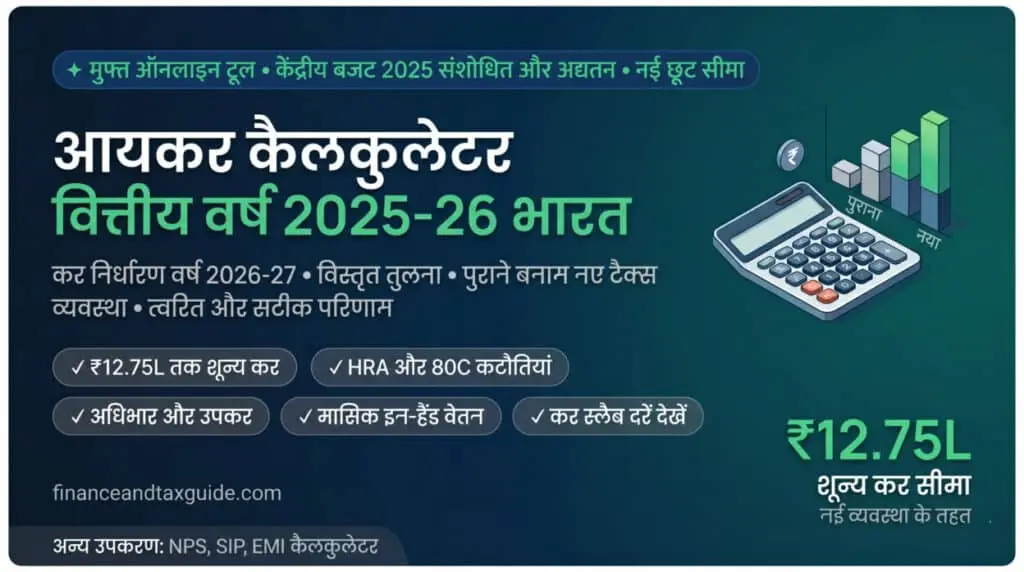
इनकम टैक्स कैलकुलेटर FY 2025-26 (AY 2026-27) | मुफ्त ऑनलाइन टैक्स कैलकुलेटर भारत इनकम टैक्स कैलकुलेटर FY 2025-26 (AY 2026-27) अपना इनकम टैक्स ऑनलाइन मुफ्त में कैलकुलेट करें। पुरानी vs नई टैक्स व्यवस्था की तुरंत तुलना करें, टेक-होम सैलरी जांचें, और स्लैब-वार टैक्स ब्रेकडाउन देखें। बजट 2025 के अनुसार अपडेटेड। ✅ मुफ्त उपयोग ⚡ रियल-टाइम परिणाम 🔄 पुरानी vs नई व्यवस्था 📱 मोबाइल फ्रेंडली 🗓️ बजट 2025 अपडेटेड 1 बुनियादी विवरण 2 आय विवरण 3 कटौतियाँ वित्तीय वर्ष FY 2025-26 (AY 2026-27) FY 2026-27 (AY 2027-28) आयु वर्ग (पुरानी व्यवस्था में टैक्स स्लैब भिन्न होते हैं) 👤 60 से कम सामान्य करदाता 🧓 60 – 80 वर्ष वरिष्ठ नागरिक 👴 80+ वर्ष अति वरिष्ठ नागरिक आगे जारी रखें → वेतन और रोजगार आय वार्षिक सकल वेतन किसी भी कटौती से पहले ₹ किसी भी कटौती से पहले अपना CTC (कंपनी की लागत) या सकल वार्षिक वेतन दर्ज करें। छूट प्राप्त भत्ते (LTA आदि) केवल पुरानी व्यवस्था ₹ अन्य आय ब्याज आय (बचत / FD) वार्षिक ₹ किराया आय (30% मानक कटौती के बाद) ₹ फ्रीलांसिंग / व्यवसाय आय ₹ गृह ऋण ब्याज (किराए पर दी गई संपत्ति) ₹ ← वापस आगे जारी रखें → 💡 नई टैक्स व्यवस्था: नीचे दी गई कटौतियाँ (80C, 80D, HRA आदि) लागू नहीं होतीं। केवल ₹75,000 की मानक कटौती लागू होती है। ये कटौतियाँ केवल पुरानी टैक्स व्यवस्था में लागू होती हैं। धारा 80 कटौतियाँ (पुरानी व्यवस्था) 80C – LIC, PPF, ELSS, PF आदि अधिकतम ₹1,50,000 ₹ 80D – स्वास्थ्य बीमा प्रीमियम स्वयं + माता-पिता ₹ अधिकतम ₹25,000 (स्वयं) + ₹25,000 (माता-पिता) = ₹50,000। वरिष्ठ नागरिक माता-पिता: ₹50,000। HRA छूट (यदि लागू हो) ₹ गृह ऋण ब्याज – स्व-अधिकृत धारा 24, अधिकतम ₹2,00,000 ₹ + अधिक कटौतियाँ (80E, 80G, 80TTA, NPS) ▼ 80E – शिक्षा ऋण ब्याज ₹ 80G – दान (चैरिटी) ₹ 80TTA – बचत बैंक ब्याज अधिकतम ₹10,000 ₹ NPS – 80CCD(1B) स्वयं का योगदान अधिकतम ₹50,000 ₹ अन्य कटौतियाँ (80DD, 80U आदि) ₹ ← वापस ⚡ टैक्स कैलकुलेट करें आपकी वार्षिक आय ₹0 नई व्यवस्था ₹0 कुल टैक्स बनाम पुरानी व्यवस्था ₹0 कुल टैक्स नई व्यवस्था से आप बचाते हैं ₹0 WhatsApp पर शेयर करें 🖨️ प्रिंट करें 🔄 पुनः कैलकुलेट करें नई व्यवस्था ₹0 कुल टैक्स देय सकल आय₹0 मानक कटौती₹0 कर योग्य आय₹0 स्लैब टैक्स₹0 87A छूट₹0 सरचार्ज₹0 सेस (4%)₹0 कुल टैक्स देय₹0 प्रभावी दर0% पुरानी व्यवस्था ₹0 कुल टैक्स देय सकल आय₹0 मानक कटौती₹0 धारा 80 कटौतियाँ₹0 कर योग्य आय₹0 स्लैब टैक्स₹0 87A छूट₹0 सरचार्ज₹0 सेस (4%)₹0 कुल टैक्स देय₹0 प्रभावी दर0% 📅 मासिक ब्रेकडाउन (सर्वोत्तम व्यवस्था के आधार पर) मासिक सकल ₹0 मासिक TDS ₹0 टेक-होम ₹0 प्रभावी दर 0% 📊 स्लैब-वार टैक्स विज़ुअलाइज़र नई व्यवस्था दिखाई जा रही है (आपके लिए अनुशंसित) 🟢 नई व्यवस्था 🟡 पुरानी व्यवस्था आय सीमा दर ₹4 लाख तक शून्य ₹4L – ₹8L 5% ₹8L – ₹12L 10% ₹12L – ₹16L 15% ₹16L – ₹20L 20% ₹20L – ₹24L 25% ₹24L से ऊपर 30% ✅ धारा 87A: ₹12 लाख तक शून्य टैक्स📋 मानक कटौती: ₹75,000 आय सीमा (60 वर्ष से कम) दर ₹2.5 लाख तक शून्य ₹2.5L – ₹5L 5% ₹5L – ₹10L 20% ₹10L से ऊपर 30% * वरिष्ठ नागरिक (60-80): ₹3L तक शून्य | अति वरिष्ठ (80+): ₹5L तक शून्य FY 2025-26 के लिए मुख्य तथ्य 🎉 टैक्स-मुक्त सीमा (नई व्यवस्था) ₹12.75 लाख तक 💰 धारा 87A छूट ₹60,000 (नई) | ₹12,500 (पुरानी) 📋 मानक कटौती ₹75,000 (नई) | ₹50,000 (पुरानी) 📊 स्वास्थ्य एवं शिक्षा सेस कुल टैक्स पर 4% ⬆️ सरचार्ज (₹50L से ऊपर) 10% से 37% 📅 ITR दाखिल करने की अंतिम तारीख 31 जुलाई 2026 पुरानी vs नई व्यवस्था – त्वरित तुलना सुविधा नई पुरानी मानक कटौती ₹75K ₹50K 87A छूट ₹60K ₹12.5K 80C (LIC, PPF…) नहीं हाँ HRA छूट नहीं हाँ गृह ऋण ब्याज नहीं हाँ 80D (स्वास्थ्य बीमा) नहीं हाँ NPS कटौती नियोक्ता पूर्ण डिफ़ॉल्ट व्यवस्था हाँ ✓ नहीं FY 2025-26 (AY 2026-27) के लिए इनकम टैक्स कैलकुलेटर – सम्पूर्ण गाइड हमारा भारत के लिए मुफ्त इनकम टैक्स कैलकुलेटर वित्तीय वर्ष 2025-26 (मूल्यांकन वर्ष 2026-27) के लिए केंद्रीय बजट 2025 में घोषित सभी बदलावों के साथ अपडेट किया गया है। चाहे आप वेतनभोगी कर्मचारी हों, फ्रीलांसर हों, या व्यवसाय स्वामी हों, यह कैलकुलेटर आपको पुरानी टैक्स व्यवस्था बनाम नई टैक्स व्यवस्था की तुरंत तुलना करने और यह जानने में मदद करता है कि कौन सी व्यवस्था आपके लिए अधिक बचत करती है। इस कैलकुलेटर की मुख्य विशेषताएं: टाइप करते समय रियल-टाइम गणना, स्लैब-वार टैक्स ब्रेकडाउन चार्ट, मासिक टेक-होम सैलरी, प्रभावी कर दर, और उच्च आय वालों के लिए सरचार्ज गणना — सब एक जगह। FY 2025-26 और FY 2026-27 के लिए नई टैक्स व्यवस्था स्लैब दरें नई टैक्स व्यवस्था FY 2023-24 से डिफ़ॉल्ट व्यवस्था है। FY 2025-26 और FY 2026-27 के लिए स्लैब दरें समान हैं: इनकम टैक्स स्लैब टैक्स दर स्लैब पर टैक्स ₹4,00,000 तक शून्य ₹0 ₹4,00,001 – ₹8,00,000 5% ₹20,000 ₹8,00,001 – ₹12,00,000 10% ₹40,000 ₹12,00,001 – ₹16,00,000 15% ₹60,000 ₹16,00,001 – ₹20,00,000 20% ₹80,000 ₹20,00,001 – ₹24,00,000 25% ₹1,00,000 ₹24,00,000 से ऊपर 30% शेष राशि पर ℹ️ ₹12 लाख तक शून्य टैक्स: नई टैक्स व्यवस्था के तहत, यदि आपकी कर योग्य आय (मानक कटौती के बाद) ₹12 लाख तक है, तो धारा 87A की ₹60,000 की छूट के कारण आपका प्रभावी टैक्स ₹0 है। ₹12.75 लाख तक सकल वेतन वाले वेतनभोगी कर्मचारी शून्य टैक्स देते हैं (₹12.75L − ₹75K मानक कटौती = ₹12L कर योग्य आय)। FY 2025-26 के लिए पुरानी टैक्स व्यवस्था स्लैब दरें पुरानी टैक्स व्यवस्था हाल के वर्षों में नहीं बदली है। इसमें उच्च कर दरें हैं लेकिन कई कटौतियों और छूटों की अनुमति देती है जो आपकी कर योग्य आय को काफी कम कर सकती हैं। आय स्लैब 60 वर्ष से कम वरिष्ठ (60–80) अति वरिष्ठ (80+) ₹2.5 लाख तक शून्य शून्य शून्य ₹2.5L – ₹3L 5% शून्य शून्य ₹3L – ₹5L 5% 5% शून्य ₹5L – ₹10L 20% 20% 20% ₹10L से ऊपर 30% 30% 30% आप कितना टैक्स देंगे? आय-वार तुलना नीचे दी गई तालिका दिखाती है कि एक वेतनभोगी व्यक्ति (पुरानी व्यवस्था में कोई कटौती नहीं मानते हुए) विभिन्न आय स्तरों पर दोनों

income tax calculator gujarati
Tax, Calculators

Income Tax Calculator Gujarati

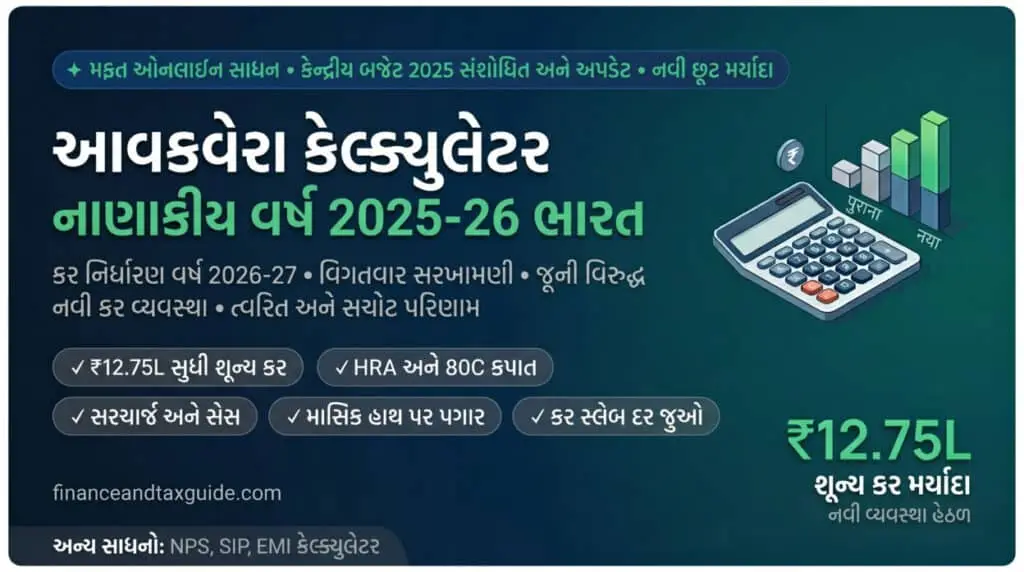
આવકવેરા કેલ્ક્યુલેટર FY 2025-26 (AY 2026-27) | મફત ઓનલાઈન ટેક્સ કેલ્ક્યુલેટર ભારત આવકવેરા કેલ્ક્યુલેટર FY 2025-26 (AY 2026-27) તમારો આવકવેરો ઓનલાઈન મફતમાં ગણો. જૂની વિરુદ્ધ નવી ટેક્સ વ્યવસ્થાની ત્વરિત સરખામણી કરો, ટેક-હોમ પગાર તપાસો અને સ્લેબ મુજબ ટેક્સ જુઓ. કેન્દ્રીય બજેટ 2025 અપડેટ. ✅ મફત ⚡ રીઅલ-ટાઇમ 🔄 જૂની vs નવી 📱 મોબાઇલ ફ્રેન્ડલી 🗓️ Budget 2025 1 મૂળભૂત 2 આવક 3 કપાતો નાણાકીય વર્ષ (Financial Year) FY 2025-26 (AY 2026-27) FY 2026-27 (AY 2027-28) ઉંમર જૂથ 👤 60 નીચે સામાન્ય 🧓 60–80 વરિષ્ઠ 👴 80+ અતિ વ. આગળ વધો → પગાર અને આવક વાર્ષિક કુલ પગાર કોઈ કપાત પહેલાં ₹ CTC અથવા Annual Gross Salary દાખલ કરો (કોઈ કપાત પહેલાં). કરમુક્ત ભથ્થાં (LTA વગેરે) માત્ર જૂની વ્યવ. ₹ અન્ય આવક વ્યાજની આવક (બચત / FD) વાર્ષિક ₹ ભાડાની આવક 30% SD બાદ ₹ ફ્રીલાન્સ / વ્યવસાયની આવક ₹ હોમ લોન વ્યાજ (ભાડે આપેલ) ઘટાડ ₹ ← પાછળ આગળ → 💡 નવી ટેક્સ વ્યવ.: 80C, 80D, HRA લાગુ નથી. ફક્ત ₹75,000 સ્ટાન્ડર્ડ કપાત. નીચેની કપાતો જૂની વ્યવ. માટે જ છે. સેક્શન 80 કપાતો (જૂની વ્યવ.) 80C – LIC, PPF, ELSS, PF મહ. ₹1,50,000 ₹ 80D – હેલ્થ ઈન્સ્યો. સ્વ + માતાપિતા ₹ ↑ ₹25K (સ્વ) + ₹25K (માતા-પિ.) = ₹50K. વ.ના. માતા-પિ.: ₹50K. HRA મુક્તિ ₹ હોમ લોન વ્યાજ – Sec 24 મહ. ₹2,00,000 ₹ + વધુ કપાતો (80E, 80G, 80TTA, NPS) ▼ 80E – એજ્યુ. લોન વ્યાજ ₹ 80G – ચેરિટી દાન ₹ 80TTA – સેવિંગ્સ વ્યાજ મહ. ₹10,000 ₹ NPS 80CCD(1B) મહ. ₹50,000 ₹ અન્ય (80DD, 80U વગ.) ₹ ← પાછળ ⚡ ટેક્સ ગણો તમારી વાર્ષિક આવક ₹0 નવી વ્યવ. ₹0 કુલ ટેક્સ VS જૂની વ્યવ. ₹0 કુલ ટેક્સ નવી વ્યવ. સાથે બચત ₹0 WhatsApp 🖨️ પ્રિન્ટ 🔄 ફરીથી નવી વ્યવ. ₹0 કુલ ટેક્સ કુલ આવક— સ્ટાન્ડર્ડ કપાત— કરપાત્ર આવક— સ્લેબ ટેક્સ— 87A રિબેટ— સરચાર્જ— સેસ (4%)— કુલ ટેક્સ — અ. ટેક્સ દર— જૂની વ્યવ. ₹0 કુલ ટેક્સ કુલ આવક— સ્ટાન્ડર્ડ કપાત— અ. કપાતો— કરપાત્ર આવક— સ્લેબ ટેક્સ— 87A રિબેટ— સરચાર્જ— સેસ (4%)— કુલ ટેક્સ — અ. ટેક્સ દર— 📅 માસિક ઇન-હેન્ડ (શ્રેષ્ઠ વ્યવ. આધારે) માસિક કુલ — માસિક ટેક્સ — ટેક-હોમ — ટેક્સ દર — 📊 સ્લેબ ટેક્સ વિભાજન — ટેક્સ સ્લેબ દરો FY 2025-26 (AY 2026-27) નવી વ્યવ. જૂની વ્યવ. આવક ટેક્સ ₹4 લાખ સુધી નીલ ₹4L – ₹8L 5% ₹8L – ₹12L 10% ₹12L – ₹16L 15% ₹16L – ₹20L 20% ₹20L – ₹24L 25% ₹24L+ 30% ✅ ₹12.75L સુધી શૂન્ય ટેક્સ (87A ₹60K + ₹75K SD) આવક (60 નીચે) ટેક્સ ₹2.5 લાખ સુધી નીલ ₹2.5L – ₹5L 5% ₹5L – ₹10L 20% ₹10L+ 30% * ૬૦-80: ₹3L નીલ | 80+: ₹5L નીલ FY 2025-26 મુખ્ય હકીકતો 🎉 ટેક્સ-ફ્રી (નવી) ₹12.75 લાખ સુધી 💰 87A રિબેટ ₹60,000 (નવી) | ₹12,500 (જૂની) 📋 સ્ટાન્ડર્ડ કપાત ₹75,000 (નવી) | ₹50,000 (જૂની) 📊 હ. અ. એ. સેસ 4% (કુલ ટેક્સ પર) ⬆️ સરચાર્જ (₹50L+) 10% – 37% 📅 ITR ફાઇલ ડેડલાઇન 31 જુલાઈ 2026 જૂની vs નવી – ઝડપી સરખામણી વિશ. નવી જૂની Std. Ded. ₹75K ₹50K 87A ₹60K ₹12.5K 80C ના હા HRA ના હા HL વ્યાજ ના હા 80D ના હા ડિફોલ્ટ ✓ ના FY 2025-26 (AY 2026-27) આવકવેરા કેલ્ક્યુલેટર – સંપૂર્ણ માર્ગદર્શિકા ભારત માટે અમારું મફત આવકવેરા કેલ્ક્યુલેટર કેન્દ્રીય બજેટ 2025 ના ફેરફારો સાથે FY 2025-26 (AY 2026-27) માટે અપડેટ છે. ભલે તમે પગારદાર, ફ્રીલાન્સર અથવા વ્યવસાયી હો, આ ટૂલ જૂની vs નવી ટેક્સ વ્યવ. ની ત્વરિત સરખામણી કરે છે. નવી ટેક્સ વ્યવ. – FY 2025-26 સ્લેબ આવકવેરા સ્લેબ ટેક્સ દર સ્લેબ ટેક્સ ₹4,00,000 સુધી નીલ ₹0 ₹4L – ₹8L 5% ₹20,000 ₹8L – ₹12L 10% ₹40,000 ₹12L – ₹16L 15% ₹60,000 ₹16L – ₹20L 20% ₹80,000 ₹20L – ₹24L 25% ₹1,00,000 ₹24L+ 30% બાકી પર ℹ️ ₹12.75L સુધી શૂન્ય ટેક્સ: 87A રિબેટ (₹60,000) + ₹75K SD = ₹12.75L સુધી ₹0 ટેક્સ. જૂની ટેક્સ વ્યવ. – FY 2025-26 સ્લેબ સ્લેબ 60 નીચે 60–80 80+ ₹2.5L સુધી નીલ નીલ નીલ ₹2.5L–₹3L 5% નીલ નીલ ₹3L–₹5L 5% 5% નીલ ₹5L–₹10L 20% 20% 20% ₹10L+ 30% 30% 30% આવક મુજબ ટેક્સ સરખામણી પગાર નવી ટેક્સ જૂની ટેક્સ બચત ₹5 લાખ ₹0 ₹0 ₹0 ₹7.5 લાખ ₹0 ₹46,800 ₹46,800 ₹10 લાખ ₹0 ₹1,17,000 ₹1,17,000 ₹12.75 લાખ ₹0 ₹1,79,400 ₹1,79,400 ₹15 લાખ ₹1,09,200 ₹2,52,000 ₹1,42,800 ₹20 લાખ ₹2,08,000 ₹4,05,600 ₹1,97,600 ₹30 લાખ ₹5,20,000 ₹7,41,000 ₹2,21,000 *4% સેસ સહિત. જૂની: કોઈ કપાત ધારેલ નથી. કઈ ટેક્સ વ્યવ. પસંદ કરવી? નવી ટેક્સ વ્યવ. પસંદ કરો: ₹12.75 લાખ સુધીનો પગાર — ₹0 ટેક્સ ઓછી કપાત (HRA, HL, 80C ઓછા) સરળ ITR ફાઇલિંગ પસંદ જૂની ટેક્સ વ્યવ. પસંદ કરો: HRA ₹1L+ ક્લેમ 80C ₹1.5L રોકાણ HL વ્યાજ Sec 24 ₹2L કુલ કપાત ₹3.75L+ ✅ પ્રો ટીપ: ઉપર Calculator માં ચોક્કસ કપાત ભરો — ₹15L સુધી મોટાભાગને નવી વ્યવ. ફાયદો. 87A રિબેટ ઉદાહરણ 📝 રાહુલ — પગાર ₹12.75 લાખ (નવી) કુલ પગાર ₹12,75,000 − SD −₹75,000 કરપાત્ર ₹12,00,000 ₹4L–₹8L (5%) ₹20,000 ₹8L–₹12L (10%) ₹40,000 સ્લેબ ટેક્સ ₹60,000 − 87A −₹60,000 ચોખ્ખો ટેક્સ ₹0 🎉 વારંવાર પૂછાતા પ્રશ્નો (FAQ) ₹12L સુધી સંપૂર્ણ ટેક્સ-ફ્રી? + હા, નવી ટેક્સ વ્યવ. હેઠળ ₹12L (SD પછી) સુધી 87A (₹60K) ના કારણે ₹0 ટેક્સ. STCG/LTCG આ રિબેટ બહાર છે. કઈ ટેક્સ વ્યવ. ચૂઝ કરવી? + Calculator વાપરો — ₹3.75L+ કપાત = જૂની; ₹12.75L- = નવી. નવી ડિફોલ્ટ છે; જૂની Form 10-IE થી. FY 2025-26 SD કેટલી? + નવી: ₹75,000 | જૂની: ₹50,000 — કોઈ document નથી જોઈતા. 4% સેસ ક્યારે? + ટેક્સ + સરચાર્જ પર 4% = Health & Education Cess. બધા કરદાતા માટે. ITR ડેડલાઇન FY 2025-26? + 31 જુલાઈ 2026 (વ્ય., non-audit). Audit: 31 ઓક. 2026. મોડું: Sec 234F ₹5,000 ફી. ફ્રી અને સચોટ? + હા, Budget 2025 અપડેટ. આ planning estimate છે — ચોક્કસ ITR ફાઇલ માટે CA ની સલાહ લો. ⚠️ ડિસ્ક્લેમર: આ calculator FY 2025-26 ટેક્સ planning માટે estimate આપે છે. Budget 2025 અપડેટ. Professional ટેક્સ advice અને ITR filing માટે CA ની સલાહ લો. Govt/IT Dept સાથે affiliated નથી.

Form No 121
Tax

Form No 121 Income Tax Act 2025: What It Is, How to Fill & Download PDF

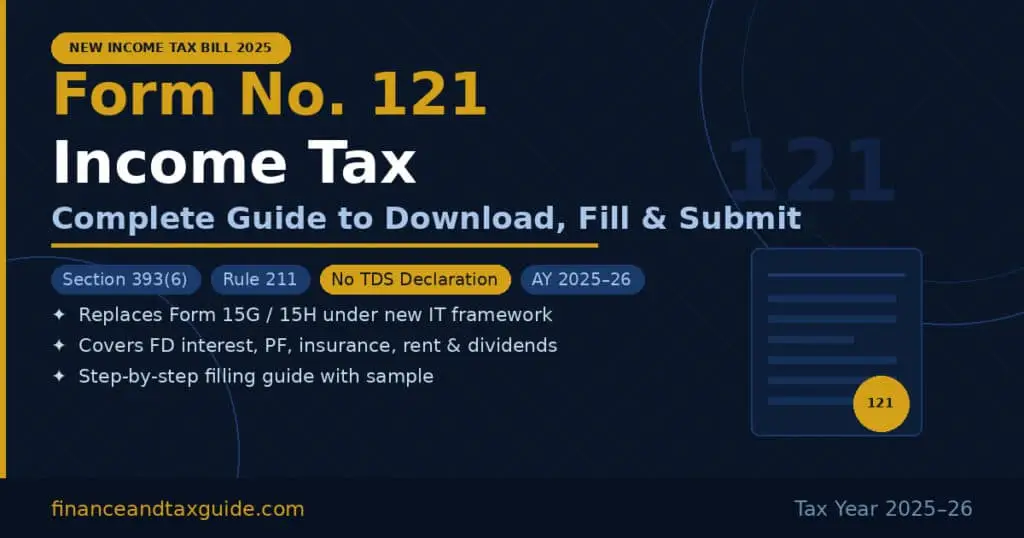
Form No 121 is a declaration form prescribed under Rule 211 of the Income Tax Rules. It is filed under Section 393(6) to receive certain specified incomes – such as provident fund payouts, insurance commission, rent, mutual fund units, FD interest, life insurance proceeds, and dividends – without deduction of tax (TDS). It is the new-era equivalent of the older Form 15G/15H, now applicable under the Income Tax Bill 2025 framework. What Is Form No 121 in Income Tax? Form No 121 is a statutory declaration form prescribed under Rule 211 of the Income Tax Rules, operative under Section 393(6) of the new Income Tax Code (Income Tax Bill 2025). It is officially titled: “Declaration under section 393(6) for receipt of certain incomes without deduction of tax” In plain terms, Form No. 121 is the document you submit to the person or institution paying you a specified income – your bank, insurance company, mutual fund, employer, or any other payer – to declare that your estimated total income for the tax year is nil or below the taxable threshold, and therefore, no TDS (Tax Deducted at Source) should be deducted from that income. This form is the successor to the old Form 15G and Form 15H under the restructured Income Tax Bill 2025. While Form 15G was for individuals below 60 years and Form 15H was for senior citizens aged 60 and above, Form No. 121 consolidates both into a single unified declaration form with a specific built-in Yes/No condition for those aged 60 or more. Why Does Form No. 121 Matter? When you earn income from fixed deposits, provident fund withdrawals, insurance maturity proceeds, dividends, or mutual fund income, the payer is legally required to deduct TDS before paying you. If your total income for the year is below the taxable limit, this TDS deduction reduces your in-hand money unnecessarily and you have to wait months to claim it back as a refund after filing your ITR. Form No. 121 solves this problem. By submitting it, you declare in advance that your total income is below the taxable threshold (resulting in nil tax), and the payer is legally permitted to release your full amount without cutting any TDS. Who Should File Form No 121? As per the form’s Notes and Section 393(6), Form No. 121 can be filed by: Category 1 – Resident Individual (Section 393(6), Table Sl. No. 1): A resident individual whose estimated total income for the tax year including the income for which the declaration is made will result in nil tax liability. Category 2 – Any Other Person (Section 393(6), Table Sl. No. 2): Any person who is NOT a company, NOT a firm, and NOT a resident individual covered under Sl. No. 1 such as a Hindu Undivided Family (HUF), Association of Persons (AOP), or Body of Individuals (BOI) can also file Form No. 121. You CANNOT file Form No. 121 if: Incomes Covered Under Form No. 121 Form No. 121 applies specifically to the following types of income listed in Note 5 of the form (under Section 393(6)): Sl. Nature of Income Common Real-Life Situation (a) Payment of accumulated balance due to an employee from a Recognised Provident Fund PF withdrawal before completing 5 years of service (b) Insurance commission for soliciting or procuring insurance business including continuance, renewal, or revival of policies Insurance agents earning commission income (c) Rent from a specified person Rental income paid by certain specified category payers (d) Income from (i) units of a mutual fund, (ii) units from the Administrator of a specified undertaking, or (iii) units from a specified company Mutual fund redemptions or income distributions (e) Interest on securities, or interest other than interest on securities by a banking company / co-operative society / post office deposits under notified schemes, or by a specified person FD interest, savings interest from banks, cooperative banks, post offices (f) Payment in respect of life insurance policy including bonus allocated on such policy Life insurance maturity proceeds (g) Dividend (including dividend on preference shares) declared by a domestic company Dividend income from equity or preference shares Most Common Use Case: The vast majority of Form No. 121 filings are for FD interest income from banks (category (e) above) by individuals and senior citizens with income below the taxable threshold who want their bank to pay full interest without TDS deduction. Form No 121 vs Form 15G vs Form 15H – Key Differences Feature Form No. 121 (New) Form 15G (Old) Form 15H (Old) Applicable Law New Income Tax Code, Section 393(6), Rule 211 Income Tax Act 1961, Section 197A Income Tax Act 1961, Section 197A(1C) Who Can File Resident individuals + certain non-individual entities Resident individuals below 60 Resident individuals aged 60+ Age Distinction Single form with a Yes/No field for age 60+ Below 60 only 60 and above only Tax Liability Condition Total estimated tax must be nil Total estimated tax must be nil Tax on estimated income must be nil Income Limit for Below-60 Income from specified sources must not exceed basic exemption limit Same condition Not applicable Senior Citizen Exception Yes, income limit condition does not apply for age 60+ Not applicable No income limit condition Unique Identification Number Yes, mandatory; payer must allot UIN and report in quarterly TDS statement No No Quarterly TDS Reporting Mandatory for payer Payer files separate statement Payer files separate statement Current Status Applicable under new Income Tax Code Being phased out Being phased out How to Download Form No 121 PDF Method 1: Official Income Tax India Website Method 2: From Your Bank’s Branch or Website Banks that are required to accept this form provide it for customers: Major banks providing it: SBI, HDFC Bank, ICICI Bank, PNB, Bank of Baroda, Canara Bank, Axis Bank, Kotak Mahindra Bank Method 3: From Your Employer (for PF Withdrawals) If you are filing Form No. 121 in connection with a provident fund payout, your HR department or the PF trust administrator

Scroll to Top