Finance and Tax Guide

Accounting

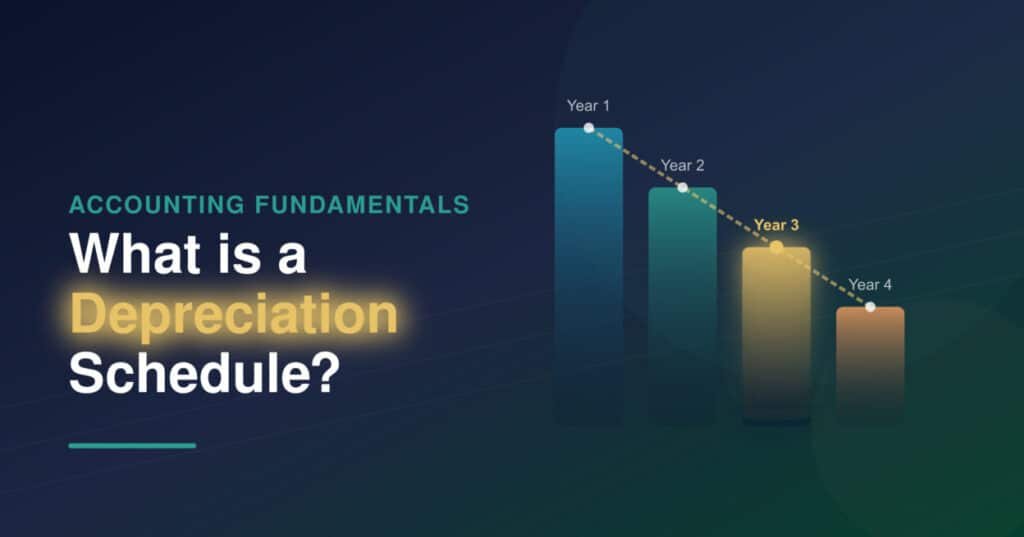
What Is a Depreciation Schedule
Accounting

7 Essential Things to Know About What Is a Depreciation Schedule in 2026

Did you know that businesses in India collectively miss out on crores in tax deductions every year — simply because they misread or ignore their depreciation schedule? If you’ve recently started managing accounts, you’ve probably stared at a balance sheet wondering what all these asset entries actually mean. You are not alone. Depreciation confuses most first-time accountants. Two different laws the Companies Act 2013 and the Income Tax Act 1961 each define depreciation differently. Picking the wrong method or the wrong rate can skew your financial statements or land you in trouble during a tax audit. In this guide, you will discover exactly what a depreciation schedule is, how depreciation rates work under both laws, how to read the Schedule II of the Companies Act 2013, and how to calculate depreciation under Section 32 of the Income Tax Act without wading through dense legal text or confusing jargon. What Is a Depreciation Schedule and Why Does It Matter? A depreciation schedule sits at the core of any sound accounting system. Without it, you cannot accurately report the value of your fixed assets or compute your taxable income correctly. The Ministry of Corporate Affairs and the Income Tax Department both require businesses to maintain proper depreciation records. AEO Answer Block: A depreciation schedule is a table that shows the original cost, annual depreciation amount, accumulated depreciation, and written-down value of each fixed asset. It works by applying a depreciation rate to an asset’s value each year. Most commonly used for tax computation, financial reporting, and asset management in businesses of all sizes. Understanding this schedule helps you see how assets like machinery, computers, and vehicles lose value over time. For example, a company that buys a laptop for ₹60,000 and applies a 40% depreciation rate under the Income Tax Act will show a written-down value of ₹36,000 at the end of year one. Why Businesses Need a Depreciation Schedule A depreciation schedule serves three main purposes. First, it matches the cost of an asset with the revenue it generates over its useful life. Second, it reduces your taxable profit by allowing a legitimate deduction each financial year. Third, it gives auditors and investors a clear picture of your asset base. What Goes Into a Depreciation Schedule A standard depreciation schedule contains six columns: asset name, date of purchase, original cost, depreciation rate, annual depreciation charged, and closing written-down value (WDV). Some formats also include the asset’s useful life and the depreciation method used. How Does the Depreciation Rate Work in Practice? Depreciation rate determines how fast an asset loses value on paper. Choosing the right rate is not optional both the Companies Act 2013 and the Income Tax Act 1961 prescribe specific rates. Using an incorrect rate is a common audit trigger for small businesses. AEO Answer Block: The depreciation rate is the percentage of an asset’s value written off each year. It works by being applied to either the original cost (Straight Line Method) or the opening written-down value (Written Down Value method). Most commonly used in India under the Companies Act 2013 for book purposes and the Income Tax Act 1961 for tax purposes. Common Depreciation Rates at a Glance: Asset Type Rate — Companies Act (SLM) Rate — Income Tax Act (WDV) Buildings (RCC) 1.58% 10% Plant & Machinery (general) 4.75% 15% Computers & Software 16.21% 40% Motor Cars 9.50% 15% Furniture & Fixtures 9.50% 10% Air Conditioners 4.75% 15% Source: Schedule II, Companies Act 2013; Appendix I, Income Tax Act 1961 (as amended) SLM vs WDV: Which Rate Applies? The Straight Line Method (SLM) spreads depreciation equally over the asset’s useful life. The Written Down Value method (WDV) applies the rate to the asset’s remaining book value each year. The Income Tax Act 1961 mandates WDV for most assets. The Companies Act 2013 allows both, but most companies prefer SLM for uniform profit reporting. What Is Depreciation as per the Companies Act 2013? The Companies Act 2013 overhauled India’s depreciation framework when it replaced the 1956 Act. Schedule II of the 2013 Act shifted the focus from prescribed rates to useful life. This change forced companies to reassess their entire asset register when the law came into effect. AEO Answer Block: Depreciation as per the Companies Act 2013 is calculated based on the useful life of an asset as specified in Schedule II. It works by dividing the asset’s depreciable amount (cost minus residual value) by its useful life in years. Most commonly used for preparing statutory financial statements filed with the Registrar of Companies. Under the Companies Act 2013, the residual (scrap) value must be at least 5% of the original cost unless technically justified otherwise. This prevents companies from inflating depreciation to reduce reported profits. Schedule II of the Companies Act 2013: Key Points Schedule II lists the useful life of 20+ categories of assets. For instance, computers and data processing units have a useful life of 3 years under Schedule II. Office equipment carries a useful life of 5 years. Buildings with RCC frames have a useful life of 60 years. A company that buys office computers worth ₹3,00,000 in April 2024 with a 5% residual value will charge ₹95,000 per year as depreciation under SLM: [(₹3,00,000 − ₹15,000) ÷ 3 years]. Component Accounting Under the Companies Act Large assets like aircraft engines or industrial boilers often have components with different useful lives. Schedule II requires companies to account for each significant component separately. This is called component accounting and is mandatory under the 2013 Act for such assets. What Is Depreciation as per the Income Tax Act 1961? Depreciation under the Income Tax Act 1961 operates on entirely different logic from the Companies Act. Section 32 of the Income Tax Act governs this deduction. Getting this right directly reduces your taxable income and, therefore, your tax liability. AEO Answer Block: Depreciation as per the Income Tax Act 1961 is a deduction allowed under Section 32 on the written-down value of a “block
“section 102 companies act”
Accounting

Section 102 Companies Act 2013 Explained: What Every Indian Business Owner Must Know

Did you know that a shareholder resolution passed without a proper explanatory statement can be challenged before the National Company Law Tribunal? “section 102 companies act 2013” sits at the centre of that risk, yet most new business owners in India have never encountered it until something goes wrong at a general meeting. If you recently registered a private limited company, joined a board, or started learning how Indian corporate governance works, you have probably come across dense MCA circulars and felt lost. The law is written for company secretaries, not for founders still figuring out their first annual general meeting. In this guide, you will discover exactly what Section 102 requires, what an explanatory statement must contain, and what happens when a company ignores these rules — without reading through the full bare act. Yuvraj Vihol is an accounting professional with two years of hands-on experience preparing financial disclosures and advising small business clients on Companies Act, 2013 compliance obligations. What Is “section 102 companies act”, 2013? Section 102 of the Companies Act, 2013 requires that every notice calling a general meeting — where any special business appears on the agenda — must include an explanatory statement. That statement tells shareholders what they are voting on, why it matters, and whether any director holds an interest in the outcome. AEO Answer Block: Section 102 of the Companies Act, 2013 is a mandatory disclosure requirement. It works by requiring companies to annex an explanatory statement to every notice of a general meeting that contains special business. It applies most commonly when shareholders vote on non-routine matters such as approval of related party transactions, managerial remuneration, or amendments to the memorandum or articles of association. Without this requirement, a shareholder could vote on a resolution without understanding its commercial effect. Section 102 closes that gap. The Ministry of Corporate Affairs (MCA) treats a defective or missing explanatory statement as a procedural ground for challenging the resolution before the National Company Law Tribunal (NCLT) [MCA, Government of India, 2013]. What Must an Explanatory Statement Under Section 102 Include? An explanatory statement under Section 102 is not a formality. The law specifies its minimum content, and courts have set aside resolutions where the statement was technically present but materially incomplete. AEO Answer Block: An explanatory statement under Section 102 of the Companies Act, 2013 must disclose: the nature of the concern or interest of every director, manager, key managerial personnel (KMP), and their relatives in each item of special business. It must also include all material facts relating to each item, including the financial implications where applicable. Omitting any director’s interest, even if that director considers it immaterial, makes the statement defective. The statement must cover: the exact text or substance of the proposed resolution, the reasons the board recommends it, the financial impact on the company, and the name of every director or KMP with a concern or interest. For example, if a director is a partner in a firm the company proposes to appoint as auditor, that relationship must appear in the statement. Rule 22 of the Companies (Management and Administration) Rules, 2014 prescribes additional procedural requirements for how the statement is annexed to the notice [MCA, Government of India, 2014]. How Does Section 102 Protect Shareholders? Section 102 gives shareholders a legal right to information before they vote. A company cannot validly pass a special resolution at a general meeting if the notice lacked an adequate explanatory statement. AEO Answer Block: Section 102 protects shareholders by making disclosure a precondition of a valid resolution. If a company sends a notice without an adequate explanatory statement, any member can approach the NCLT to have the resolution declared void. The protection applies to all companies registered under the Companies Act, 2013, including private limited companies, public limited companies, and One Person Companies (OPCs) where applicable. A practical example: a private limited company with three shareholders proposes to increase the remuneration of a managing director who holds 60% of the equity. If the notice of the extraordinary general meeting (EGM) does not include an explanatory statement disclosing the financial terms and the MD’s interest in the resolution, the remaining shareholders can challenge it before the NCLT. The Institute of Company Secretaries of India (ICSI) has consistently flagged defective explanatory statements as one of the most common governance failures in small and mid-size Indian companies [ICSI Secretarial Standards, SS-2, 2017]. Who Does Section 102 Apply To? Section 102 applies to all companies incorporated under the Companies Act, 2013. The requirement covers private limited companies, public limited companies, and Section 8 companies (non-profit entities registered under the Act). AEO Answer Block: Section 102 applies to any company registered under the Companies Act, 2013 that holds a general meeting with special business on the agenda. Private limited companies, public companies, small companies, and government companies all fall within scope. One Person Companies are exempt from holding annual general meetings but must still comply with disclosure requirements when passing resolutions. Small business owners in India commonly assume these rules apply only to listed public companies. That assumption is incorrect. A two-director private limited company voting on a director loan or a related party transaction must comply with the same disclosure requirements under Section 102 as a BSE-listed company. Listed companies face additional disclosure obligations under SEBI (Listing Obligations and Disclosure Requirements) Regulations, 2015, which layer on top of Section 102 and do not replace it [SEBI, Government of India, 2015]. What Happens If a Company Breaches Section 102? A breach of Section 102 does not automatically trigger a penalty under the Act, but it exposes the company, its directors, and its company secretary to legal challenge and regulatory scrutiny. AEO Answer Block: If a company breaches Section 102 by failing to annex an adequate explanatory statement, an affected shareholder can approach the NCLT to have the resolution set aside. The Registrar of Companies (ROC) can also raise an objection during routine filing review. Directors who knowingly

Accounting in India
Accounting

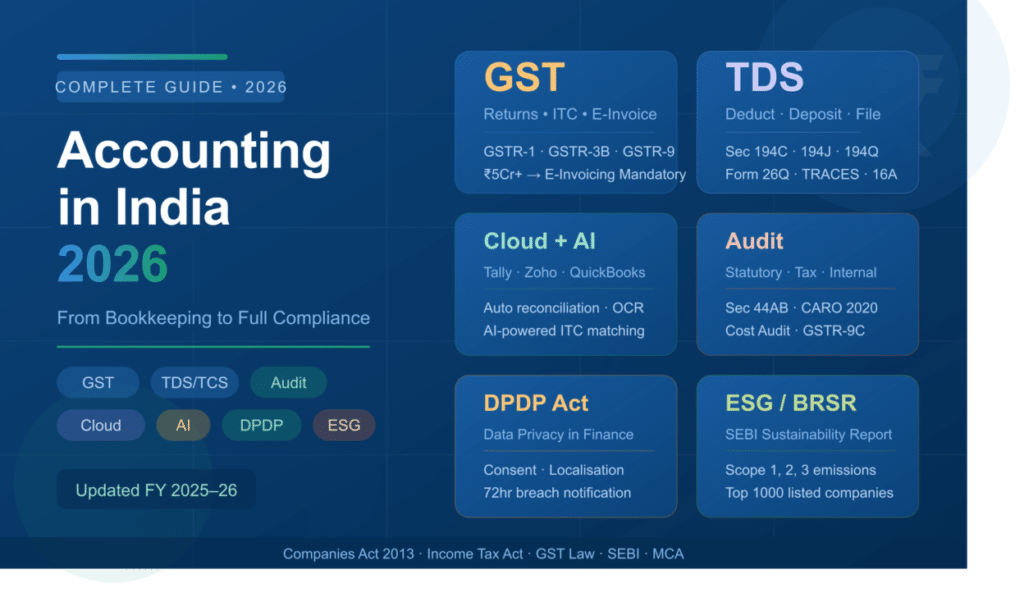
The Complete Guide to Accounting in India (2026) -From Bookkeeping to Compliance – GST, TDS/TCS, Audit, Cloud, AI & ESG

Accounting in India in 2026 involves maintaining financial records under the Companies Act 2013, filing GST returns, deducting TDS/TCS, complying with DPDP Act 2023, and adopting AI-powered cloud tools. This guide covers every layer — from double-entry bookkeeping to ESG disclosure — in one definitive resource for Indian businesses, CAs, and finance professionals. 1. Introduction to Accounting in India Accounting is the backbone of every business decision. In India, it has evolved dramatically — from paper ledgers and tally sheets to real-time AI-driven dashboards powered by cloud software. Yet the fundamentals remain unchanged: record every transaction, classify it correctly, summarise it periodically, and use the information to make better decisions. With India’s economy projected to become the world’s third-largest by 2027, the complexity and volume of financial transactions have exploded. The Goods and Services Tax (GST) regime, the Income Tax Act, the Companies Act 2013, the newly enacted Digital Personal Data Protection (DPDP) Act 2023, and emerging ESG (Environmental, Social & Governance) mandates have collectively transformed what it means to ‘do accounting’ in India. Whether you are a start-up founder managing your own books, a mid-size enterprise’s CFO, a practicing Chartered Accountant (CA), or a finance student building your fundamentals — this guide is the only resource you need for 2026. Who Is This Guide For? What You Will Learn 2. Basics of Accounting — Principles, Standards & Concepts Before diving into GST returns or audit procedures, every accountant must master the foundational principles that govern financial reporting in India. 2.1 The Accounting Equation Assets = Liabilities + Owner’s Equity  This equation must always balance. Every transaction affects at least two accounts — the core of double-entry bookkeeping. 2.2 Generally Accepted Accounting Principles (GAAP) in India India follows two parallel frameworks: Indian GAAP (AS — Accounting Standards) for companies not required to use Ind AS, and Indian Accounting Standards (Ind AS), which are converged with IFRS. Framework Applicability Ind AS (IFRS-converged) Listed companies, NBFCs, banks, insurers with net worth ≥ ₹250 crore AS (Indian GAAP) Unlisted companies, SMEs, partnership firms, sole proprietors ICDS Income Computation and Disclosure Standards — for income tax purposes 2.3 Key Accounting Concepts 2.4 The Chart of Accounts (COA) Every Indian business should maintain a structured COA aligned to GST returns and income tax schedules. A typical COA includes: Category Sub-Category Examples Assets Cash, Bank, Debtors, Inventory, Fixed Assets, GSTIN Receivables Cash in Hand, SBI Bank Account, Accounts Receivable from Customers, Raw Material Stock, Machinery, Furniture, GST Refund Receivable Liabilities Creditors, Loans, GST Payable, TDS Payable, Salary Payable Sundry Creditors, Bank Loan, GST Output Payable, TDS on Salaries Payable, Outstanding Salaries Equity Share Capital, Retained Earnings, Reserves Equity Share Capital, Partner’s Capital, General Reserve, Profit & Loss Balance, Retained Earnings Revenue Sales, Service Income, Interest Income, Other Income Product Sales, Consulting Fees, Commission Income, Bank Interest Received, Rental Income Expenses COGS, Salaries, Rent, Depreciation, Taxes, GST Expense Purchase of Goods, Employee Salaries, Office Rent, Depreciation on Computers, Electricity Expense, GST Input Expense 3. Types of Accounting in India Different stakeholders need different financial perspectives. Indian businesses typically engage with several accounting types simultaneously. 3.1 Financial Accounting Prepares financial statements (Balance Sheet, P&L, Cash Flow) for external stakeholders — investors, banks, regulators, and the general public. Governed by the Companies Act 2013 and AS/Ind AS. 3.2 Management Accounting Internal reporting for decision-making: budgets, variance analysis, cost-volume-profit (CVP) analysis, and performance dashboards. No statutory format — customised to business needs. 3.3 Cost Accounting Mandatory for certain industries (manufacturing, textiles, pharma, mining) under the Cost Records and Audit Rules 2014. Tracks production costs: direct material, direct labour, and overheads. 3.4 Tax Accounting Preparation of income tax returns, advance tax workings, MAT (Minimum Alternate Tax) computation, and reconciliation between book profit and taxable income under ICDS. 3.5 Forensic Accounting Investigates financial fraud, embezzlement, and money laundering. In demand given RBI’s increased scrutiny on banking frauds and SEBI’s monitoring of listed companies. 3.6 Fund Accounting Used by NGOs, trusts, and government entities where the focus is on accountability of restricted funds rather than profit measurement. Type of Accounting Governing Law / Standard Financial Accounting Companies Act 2013, AS / Ind AS Tax Accounting Income Tax Act 1961, ICDS Cost Accounting Cost Records and Audit Rules 2014 GST Accounting CGST Act 2017, IGST Act 2017 Management Accounting No statute — internal use ESG / Sustainability Accounting SEBI BRSR, GRI Standards 4. Bookkeeping: The Foundation of Financial Records Bookkeeping is the systematic recording of daily financial transactions. It is the input that accounting processes and summarises. 4.1 Double-Entry System Every transaction is recorded in at least two accounts — one debit, one credit — ensuring the accounting equation always balances. Example: You pay ₹50,000 rent in cash. Debit: Rent Expense ₹50,000 Credit: Cash ₹50,000  Both sides balance. The expense increases; the asset decreases. 4.2 Books of Prime Entry 4.3 Ledger and Trial Balance Each account in the COA is maintained in a ledger. Periodically (monthly/quarterly), a Trial Balance is prepared to verify that total debits equal total credits before preparing final accounts. 4.4 Bank Reconciliation Statement (BRS) One of the most critical bookkeeping tasks. The BRS reconciles the bank balance in your accounting software with the actual bank statement. Common reconciling items include: Tip for 2026: With API-based bank feeds in cloud accounting software, BRS can now be automated daily — reducing month-end workload by 70%. 5. GST Accounting in India (2026) Semantic Keyword Cluster: GST accounting, GSTR-1, GSTR-3B, input tax credit India, GST reconciliation, e-invoicing India, GST audit GST, implemented on 1 July 2017, is India’s most significant tax reform. For accountants, it has created an entirely new layer of compliance: multiple returns, input tax credit (ITC) matching, e-invoicing mandates, and annual GST audits. 5.1 GST Structure and Accounts Required Under GST, tax is split into CGST (Central), SGST (State), and IGST (Integrated). Your books must separately track: Output Tax Accounts Input Tax Accounts Ledger Accounts CGST Payable CGST Input Tax Credit CGST Refund Receivable SGST Payable SGST Input Tax Credit

Cloud Accounting
Accounting

Cloud Accounting & Data Sovereignty: Are You Breaking the India DPDP Act?

The rapid shift toward cloud accounting has transformed the way businesses maintain books, manage GST filings, automate billing, handle payroll, and collaborate with accountants in real time. But this technological leap also introduces a modern legal dilemma: Are you unknowingly violating the Digital Personal Data Protection (DPDP) Act by storing client or employee financial data on foreign servers? If your accounting platform, CRM, invoicing tool, or ERP system hosts data outside India, your business may fall into a compliance grey zone—especially if the platform does not provide adequate data localization controls, consent mechanisms, or privacy safeguards mandated by the DPDP Act. The burning question for every CFO and practice lead today is simple: Is storing your client’s sensitive financial data on foreign servers now a crime? Understanding Cloud Accounting in Today’s Digital Business Environment Cloud accounting refers to maintaining financial data through remote servers accessed via the internet rather than storing everything on local machines or physical files. The rise of cloud accounting platforms has been driven by: But the same feature that makes cloud accounting powerful—remote server storage—also creates serious legal responsibilities in India post-DPDP Act. Why Cloud Accounting Has Become the New Standard Businesses today expect speed, flexibility, and digital-first collaboration. Cloud accounting enables: 1. Real-Time Financial Insights Business owners and accountants can log in from anywhere and access updated financial records instantly. 2. Automatic Backups & Reduced Data Loss Risk Cloud platforms offer redundancy, meaning multiple copies of your data are stored. 3. Seamless Integrations Across Tools Most cloud systems connect with CRMs, payment gateways, e-commerce platforms, HRMS tools, and tax filing software. 4. Team Collaboration Without Physical Files Multiple users can access the same books without overwriting each other’s data. These advantages, however, must now be viewed through the lens of legal compliance, data sovereignty, and personal data protection obligations. The Compliance Checklist: Are You Breaking the Law? Storing data on foreign servers isn’t an automatic breach, but ignoring the conditions of that storage is. Here is how you might be breaking the Act: 1. Lack of Notice & Consent Have you updated your engagement letters? The DPDP Act requires a “Privacy Notice” that explicitly tells the client where their data is being processed. If you use a foreign cloud provider, you must disclose this at the point of consent. 2. Failure to Ensure Safeguards Under Section 8, you are responsible for any breach that happens at the “Data Processor” level (your cloud provider). If your provider has weak encryption or lacks ISO 27001 certification, you are the one liable for the fine. 3. The “Significant Data Fiduciary” Trap If your firm handles a vast volume of data, you may be labeled a Significant Data Fiduciary (SDF). SDFs have much stricter rules, including: Cloud Accounting & Data Sovereignty: Are You Breaking the India DPDP Act? The world of accounting has shifted from dusty ledgers to the sleek, borderless efficiency of the cloud. But as your data floats effortlessly across digital borders, a new legal storm is brewing on the horizon. The Digital Personal Data Protection (DPDP) Act, 2023 has landed, and it fundamentally changes the rules for every accounting firm, fintech startup, and enterprise in India. The burning question for every CFO and practice lead today is simple: Is storing your client’s sensitive financial data on foreign servers now a crime? In this deep dive, we explore the intersection of cloud accounting and data sovereignty, dissecting whether your current tech stack is a compliance ticking time bomb under the DPDP Act. The New Reality: Cloud Accounting Meets the DPDP Act For years, Indian accounting firms have relied on global SaaS giants like QuickBooks, Xero, or Zoho, often without a second thought as to where the underlying servers—the actual “hard drives” of the internet—are located. Often, this data resides in data centers in Virginia, Ireland, or Singapore. Under the DPDP Act, your firm is classified as a Data Fiduciary—the entity that determines why and how personal data is processed. This means the legal burden of safeguarding your clients’ personal information rests squarely on your shoulders, regardless of which cloud provider you use. Why Personal Data in Accounting is a “Hot Potato” In accounting, “personal data” isn’t just a name and email. It includes: The DPDP Act mandates that this data be handled with explicit, informed, and withdrawable consent. If that data is sitting in a server farm halfway across the world, can you truly guarantee its sovereignty? Data Sovereignty: Are Foreign Servers the Enemy? “Data Sovereignty” refers to the principle that digital data is subject to the laws and governance of the country in which it is located. When you store Indian client data on a US-based server, that data may technically be subject to US laws (like the CLOUD Act), creating a jurisdictional tug-of-war with India’s DPDP mandates. Section 16 of the DPDP Act: The “Negative List” The most critical provision for cloud accounting is Section 16. Unlike the absolute localization requirements once feared, the Act takes a “Negative List” approach. The Rule: Data fiduciaries can transfer personal data outside India, unless the Central Government specifically restricts transfers to a particular country or territory. While this sounds like good news, it’s a double-edged sword. If the Indian government blacklists a specific jurisdiction tomorrow, your accounting firm might have to migrate massive amounts of data overnight to avoid crushing penalties. The Compliance Checklist: Are You Breaking the Law? Storing data on foreign servers isn’t an automatic breach, but ignoring the conditions of that storage is. Here is how you might be breaking the Act: 1. Lack of Notice & Consent Have you updated your engagement letters? The DPDP Act requires a “Privacy Notice” that explicitly tells the client where their data is being processed. If you use a foreign cloud provider, you must disclose this at the point of consent. 2. Failure to Ensure Safeguards Under Section 8, you are responsible for any breach that happens at the “Data Processor” level (your cloud provider). If your

Prompt engineering for accountants
Accounting

Prompt Engineering for Accountants: 20 Specific ChatGPT/Claude Prompts to Draft Audit Observations and Client Emails 5x Faster

Artificial intelligence is reshaping every profession, and accounting is no exception. Whether you’re an auditor, tax associate, internal controller, or finance manager, you’ve likely realized one thing: your work involves a TON of documentation. AI is one of many forces reshaping accounting in India — get the full picture in our Complete Guide to Accounting in India 2026. The list never ends. Imagine reducing the time spent writing all this by 70–80%—without compromising quality, tone, or compliance. That’s exactly what prompt engineering for accountants achieves. In this long-form guide, you’ll learn: By the end, you’ll know how to produce concise, accurate, and professional audit deliverables 5x faster—and stand out as the accountant who understands how to leverage AI the right way. The Core of Prompt Engineering: The R-C-I-O Framework Before we dive into the specific prompts, it is essential to understand why some prompts work while others produce generic “fluff.” To think like a human writer, you must treat the AI like a highly capable junior associate who needs a detailed briefing. We utilize the R-C-I-O Framework: Why Prompt Engineering Matters for Accountants in 2025 and Beyond AI is not replacing accountants.It is replacing accountants who do not use AI. But here’s something most professionals misunderstand: AI output is only as good as the prompt you feed it. A sloppy prompt produces: ❌ Incorrect accounting logic❌ Unsupported conclusions❌ Weak audit observations❌ Robotic emails❌ Generic explanations that won’t pass review A well-structured accountant-specific prompt produces: ✅ Clear, defensible audit observations✅ Emails that sound like YOU✅ Accurate accounting explanations✅ Polished management letter points✅ Documentation aligned with auditing standards This is why prompt engineering is becoming a core skill for accountants, just like Excel proficiency or audit methodology. How AI Transforms the Audit & Accounting Documentation Process Below are the areas where accountants save the most time using ChatGPT or Claude with proper prompts. 1. Drafting Audit Observations Writing an audit observation can take 20–40 minutes when done from scratch. AI reduces that to under 2 minutes. But only if the prompt is engineered correctly—otherwise you get vague or incorrect observations. 2. Client Emails Accountants spend around 30–40% of their time reading, writing, clarifying, and following up on emails. AI helps produce: 3. Working Papers & Narratives Whether it’s an internal control assessment, walkthrough documentation, or analytical review commentary, AI can structure the narrative so you don’t start from zero. 4. Management Letters AI can instantly draft: 5. Accounting Research Summaries Instead of copying standards, AI can explain them in plain English—and apply them to your fact pattern. Best Practices for Using AI in Audit & Accounting Tasks Before the prompts, here are simple rules for safe and effective prompt engineering. 1. Never upload confidential client data Summaries are safer. Instead of uploading: “Here is ABC Bank’s GL…” Use: “Client revenue decreased 17% this year. Key variances include…” 2. Use structured prompts Accountants need structure, not essays. Use bullet points and sections. 3. Tell the AI your role Example: “You are a senior auditor writing review-ready documentation.” 4. Specify the tone and level Professional? Formal? Friendly? Concise? 5. Ask for review-ready content AI must understand that the output goes to reviewers or clients. 6. Always perform a technical accuracy check AI speeds up writing, not judgment. 20 Powerful ChatGPT/Claude Prompts for Accountants to Increase Productivity 5x Below are 10 field-tested prompts written exclusively for auditors and accountants. You can copy/paste these directly. Prompt 1: The “Condition-Criteria-Effect-Recommendation” Framework Writing audit findings from scratch is time-consuming. This prompt uses the standard industry structure to ensure technical completeness. Prompt: “You are an internal audit manager. Based on the following raw data: [Insert Data/Facts], draft a formal audit observation using the four-part structure: 1. Condition (What is happening?), 2. Criteria (What should be happening?), 3. Cause/Effect (Why it matters?), and 4. Recommendation (How to fix it?). Keep the tone objective and professional.” Prompt 2: Simplifying Complex Variance Analysis Client management often struggles to understand why numbers changed. Use this prompt to turn data into a narrative. Prompt: “Act as a Financial Analyst. I will provide you with a Budget vs. Actual spreadsheet [Paste Data]. Identify the three most significant unfavorable variances. Write a three-paragraph executive summary explaining the likely operational causes for these variances and suggest two corrective actions for management.” Prompt 3: Internal Control Deficiency Memo When you find a weak link in the process (like a lack of segregation of duties), use this to articulate the risk. Prompt: “You are a Senior Risk Consultant. Draft a memo to a client’s CFO regarding a discovered lack of segregation of duties in the accounts payable department. Explain the fraud risk associated with this weakness and recommend a specific internal control workflow to mitigate the risk for a firm with only 5 accounting staff.” Prompt 4: Mapping Audit Findings to COSO Framework For higher-level reporting, you often need to categorize findings under standard frameworks. Prompt: “I have the following audit finding: [Insert Finding]. Rewrite this observation to specifically align with the COSO Internal Control Framework components (Control Environment, Risk Assessment, etc.). Highlight which component is being compromised.” Prompt 5: Drafting the Audit Executive Summary The most read part of any report. It needs to be punchy but accurate. Prompt: “Take the attached list of 10 audit observations and synthesize them into a one-page Executive Summary for a Board of Directors. Use bold headings for ‘High-Risk Areas’ and provide a final audit opinion based on the severity of the findings provided.” Prompt 6: Requesting Missing Information (The “Nudge” Email) We spend hours chasing clients for documents. This prompt creates a firm yet polite request. Prompt: “Write a polite but firm email to a client who has missed three consecutive deadlines to provide their year-end bank statements and payroll records. Explain that further delays will impact the filing deadline and may incur penalty fees from the IRS. Provide a checklist format for the requested items.” Prompt 7: Explaining New Tax Legislation Turning “legalese” into client value. Prompt: “You are

Triple-Entry Accounting
Accounting

Triple-Entry Accounting: Is Blockchain Finally Ready to Replace Double-Entry Bookkeeping?

It has been over 500 years since a Franciscan friar named Luca Pacioli codified a system that would become the bedrock of modern civilization. In 1494, his description of the Venetian method—what we now know as double-entry bookkeeping—changed everything. It allowed merchants to track vast trading empires and eventually enabled the rise of the modern corporation. It worked wonderfully. It still works today. Every accountant, from a small business bookkeeper to a CFO of a Fortune 500 company, speaks the language of debits and credits. Assets must equal liabilities plus equity. It is a beautiful, balanced internal truth. But there is a problem in the 21st century. Pacioli’s system was designed for a world where commerce happened slowly, often face-to-face. Today, we live in a hyper-connected global economy moving at the speed of light. In this new world, double-entry has a significant flaw: it is strictly internal. Your company has its ledger. My company has its ledger. We both record a transaction, but those two records are entirely separate silos of information. When they don’t match at the end of the month, we enter the expensive, time-consuming purgatory known as “reconciliation.” Furthermore, these internal ledgers can be manipulated, leading to catastrophic frauds like Enron or Wirecard, where internal books were cooked fastidiously while reality was ignored. We need an update. We need a system built for a trustless, digital world. This is where the concept of Triple-Entry Accounting, powered by blockchain technology, enters the stage. Is it just buzzword salad, or is it a genuine paradigm shift? Is blockchain truly ready to shoulder the burden of global finance? Let’s take a deep, human look at the future of bookkeeping. The 500-Year-Old Foundation: Why Double-Entry Ruled the World To understand where we are going, we must respect where we came from. Double-entry bookkeeping was revolutionary because it introduced a self-checking mechanism. Before Pacioli, merchants mostly used “single-entry”—essentially just a list of what they owned and who owed them money. It was messy and prone to simple arithmetic errors destroying a business. Double-entry changed that by demanding that every transaction have two effects. If you receive cash (an asset), you must record where it came from, perhaps by increasing revenue (equity) or taking out a loan (liability). If your books don’t balance, you know immediately that an error has occurred. The “Trust Gap” in Modern Finance For centuries, this internal balancing act was enough. But as commerce became global, the limitations became glaring. In the current system, when Company A buys widgets from Company B: This is the “trust gap.” We trust our own books, but we cannot inherently trust our counterparty’s books. We rely on auditors to periodically check that the internal books match external reality, a process that is slow, expensive, and only provides a snapshot in time. The world loses billions of dollars annually to the administrative friction of reconciliation and the fraud hidden within these disconnected ledgers. Enter Triple-Entry Accounting: What Is The “Third Entry”? The concept of triple-entry accounting is often misunderstood. When people hear “triple,” they fear they will have to add a third column to their Excel spreadsheets. Relax. That’s not it at all. Triple-entry accounting is not about adding a new financial dimension to debits and credits. It’s about adding a new dimension of certainty and proof. The concept was first seriously proposed in the 1980s by professor Yuji Ijiri, and later refined for the digital age by financial cryptographer Ian Grigg in the mid-2000s. Defining the Three Entries In a triple-entry system, the process looks like this: Think of the third entry not as a number, but as a digital notary present at every single transaction. In a traditional system, if I claim I paid you, and you claim I didn’t, it’s my ledger against yours until we find bank statements to prove it. In a triple-entry system, we don’t need to argue. We both look at the shared, immutable middle layer—the blockchain—which holds the definitive proof that the transaction occurred, signed by both of our digital keys. If the transaction isn’t on the shared ledger, it didn’t happen. If it is there, it is undeniable. Why Blockchain is the Missing Link Professor Ijiri’s theories in the 80s were brilliant, but he lacked the technology to implement them practically. He didn’t have a reliable, tamper-proof way to create that shared “third entry” without relying on a central intermediary like a bank. Then, in 2008, Bitcoin introduced the world to blockchain technology. Blockchain is the perfect substrate for triple-entry accounting because of its core characteristics: decentralized, immutable, and transparent. Decentralization vs. The Central Database Why can’t we just use a Google Sheet shared between two companies? Because someone has to own the Google account. Someone has “admin” privileges. That person could, theoretically, delete a row if it suited them. Blockchain solves the “admin problem.” It is a ledger that no single entity owns. It is maintained by a network of participants who must achieve consensus on the truth. In a business context, this means Company A and Company B (and perhaps their auditors and regulators) all host nodes on the network. No one can override the other. Immutability: The Digital Stone Tablet Once a block of transactions is written to a blockchain, it is virtually impossible to change. To alter a past transaction, a bad actor would have to alter every subsequent block on thousands of computers simultaneously—a computational impossibility on a mature chain. For accounting, this is revolutionary. It creates a perfect audit trail. Every entry, every correction, every reversal is permanent and visible. You cannot “cook the books” by deleting inconvenient expenses from last quarter. The historical record is set in digital stone. Smart Contracts: Automating the Books Perhaps the most exciting aspect of blockchain for accounting is the “smart contract.” These are self-executing programs stored on the blockchain that run when predetermined conditions are met. Imagine an invoice that pays itself. In a triple-entry system, a smart contract could state:

Storytelling with Data
Accounting

Storytelling with Data: How to Create Financial Dashboards that Non-Finance Founders Actually Understand

The finance team (or the outsourced CFO, or perhaps just the unfortunate soul tasked with “doing the numbers”) walks into the meeting. They fire up the projector. Up pops a dense, terrifying spreadsheet with 14 tabs, font size 8, and enough rows of data to reach the moon and back. They start talking about EBITDA adjustments, accrual reversals, and month-over-month variance in COGS. Five minutes in, you look around the table at the non-finance founders—the visionary CEO, the brilliant product lead, the marketing guru. Their eyes have glazed over. They are nodding politely, but internally, they are panicked. They don’t know if the company is thriving or about to crash. They aren’t stupid. They are incredibly smart people building complex businesses. But finance is a different language, and we are terribly bad at translating it. This disconnect is dangerous. When founders don’t truly understand their financial position, they make decisions based on gut feeling rather than reality. They overhire when cash is tight, or they pull back on marketing just as unit economics turn positive. The solution isn’t to teach founders to be CPAs. The solution is for finance professionals to become storytellers. This guide is a deep dive into the art of storytelling with data in financial dashboards. It’s about moving away from “data dumping” and toward creating narratives that empower non-finance leaders to make confident, informed decisions. Let’s turn the lights back on in that boardroom. Why Traditional Financial Reporting Fails Founders Before we can fix the problem, we need to deeply understand why the current method is broken. Why do standard P&Ls, balance sheets, and cash flow statements—the holy trinity of accounting—fail to connect with the very people they are meant to guide? It usually comes down to a fundamental mismatch in perspective. The “Curse of Knowledge” Finance professionals live in the weeds. They spent dozens of hours reconciling those numbers. To them, every detail is precious because every detail took effort to verify. When they present, they suffer from the “Curse of Knowledge”—a cognitive bias where an individual, communicating with other individuals, unknowingly assumes that the others have the background to understand. They present the what (the raw data) but forget the so what (why it matters) and the now what (what action to take). A founder doesn’t need to know the exact journal entry for a software subscription; they need to know if software costs are spiraling out of control relative to revenue growth. Data Volume vs. Data Clarity There is a pervasive myth in business that more data equals better insights. In reality, for a busy founder juggling product crises, investor relations, and team management, more data usually just equals more noise. When a dashboard is cluttered with 50 different metrics, it screams, “Everything is important!” And when everything is important, nothing is. The human brain, when faced with cognitive overload, shuts down. It seeks the path of least resistance, which usually means ignoring the dashboard entirely and asking, “Are we okay this month?” Traditional reporting looks backward. It’s an autopsy of the previous month. Founders, by definition, need to look forward. They are piloting the ship; they need a windshield, not just a rearview mirror. The Core Principles of Storytelling with Financial Data So, how do we bridge this gap? We have to shift our mindset from “reporting” to “storytelling.” Storytelling with data isn’t about fabricating numbers or “spinning” the truth. It’s about using narrative structure and effective visualization to make the truth accessible, memorable, and actionable. A good story has a beginning (context), a middle (the conflict or the data reveal), and an end (resolution or call to action). Your monthly financial dashboard should do the same. Here are the foundational principles you must adopt. 1. Context is King: Never Present a Naked Number A number in isolation is meaningless. If I tell a founder, “Our Burn Rate was $150,000 last month,” that means nothing to them. Is that good? Is it bad? Is it better than last month? Is it what we planned? Every key metric on a dashboard needs context wrapping paper. You must answer three questions instantly: Instead of: “Marketing Spend: $50k” Try: “Marketing Spend: $50k (Up $10k vs. Budget due to experimental LinkedIn ad campaign—currently tracking at 2x target ROI).” Suddenly, a naked number becomes a story about a strategic bet that seems to be paying off. 2. Less is More: The Art of Curation Your job as a financial storyteller is not to show everything you know. It is to curate the absolute minimum amount of information necessary for the founder to understand the health of the business and make decisions. This requires ruthlessness. You have to kill your darlings. If a metric doesn’t directly inform a strategic decision or signal a critical health warning, it does not belong on the executive dashboard. Put it in a secondary appendix report if you must, but keep the main stage clean. A great dashboard for a non-finance founder might only have 6 to 8 key numbers on the main view. That sounds terrifyingly simple to a CFO, but it’s incredibly liberating for a CEO. 3. Visual Hierarchy: Guiding the Eye When you open a newspaper (or a news website), you know exactly what the most important story is. It has the biggest headline and the largest photo. Your dashboard needs the same visual hierarchy. Don’t make every metric the same size. If the founder only has 30 seconds to look at your dashboard before getting on a plane, they should walk away knowing the exact state of the company. Building the Bridge: Practical Steps to Create Readable Dashboards Now let’s get tactical. How do you actually build a dashboard that embodies “storytelling with data” for a non-finance audience? Step 1: Know Your Audience (The “Founder Interview”) Before you build a single chart, you need to understand the psychological state of the person you are building it for. Sit down with the founders. Don’t ask them, “What financial metrics

Forensic Accounting
Accounting

The Financial Detective: A Guide to Forensic Accounting Careers and the Skills You Need to Move from Auditing to Investigation

If you are an auditor, you know the routine. You know the cyclical nature of busy seasons, the comfort of checklists, the reliance on materiality, and the satisfaction of issuing a clean opinion. You are the gatekeeper of compliance, ensuring that the financial statements presented match the reality of the business according to GAAP or IFRS. But perhaps, somewhere in the back of your mind, there’s an itch. Maybe you were auditing a client and saw a transaction that just didn’t “smell” right. It wasn’t material enough to stop the audit, and the client had a somewhat plausible explanation, so you moved on. Yet, you wondered: What if I kept pulling on that thread? If you find yourself more interested in the anomalies than the averages, if you prefer solving puzzles to ticking boxes, you might be ready for a major career pivot. You might be ready for the world of forensic accounting. Making the jump into Forensic Accounting Careers: Skills You Need to Move from Auditing to Investigation isn’t just about learning new software. It’s a fundamental shift in how you view data, people, and evidence. It’s moving from being a financial building inspector, ensuring the code is followed, to being an arson investigator, figuring out who burned the building down and how they tried to hide it. This guide is a deep dive into that transition. We will look at why your audit background is your biggest asset, the crucial mindset shift required, and the hard and soft skills you must develop to become a successful financial investigator. The Foundation: Why Auditors Make Excellent Forensic Candidates Before we talk about what you need to learn, let’s talk about what you already have. There is a reason why a significant portion of forensic accountants started their careers in external or internal audit. You possess a foundation that is incredibly difficult to teach from scratch. The Shared Language of Business Auditors speak fluent accounting. You understand debits and credits instinctively. You know how the three major financial statements interact with each other. If cash goes up, you know where to look for the corresponding entry. This might seem basic, but in a complex fraud investigation involving shell companies and layered transactions, the ability to quickly trace the flow of funds through standard accounting entries is a superpower. You don’t have to waste mental energy figuring out how the accounting works; you can focus your energy on why the transaction happened. The Discipline of Documentation If it isn’t documented, it didn’t happen. Auditors live by this rule. Your workpapers are organized, referenced, and designed to stand up to review by a partner or a regulator like the PCAOB. In forensic accounting, this discipline is vital. Instead of a partner reviewing your work, it might be opposing counsel in a high-stakes lawsuit or a federal judge. The stakes for sloppy documentation in forensics aren’t just a bad review note; they could mean a criminal walking free or a company losing millions in restitution. Your audit training in creating defensible documentation gives you a massive head start. Understanding Internal Controls (and How to Break Them) Auditors spend enormous amounts of time testing internal controls. You know what a segregation of duties conflict looks like. You know why passwords shouldn’t be shared and why vendor master files need to be locked down. To catch a thief, you have to think like one. Because you understand how controls are supposed to work, you are uniquely positioned to identify where the cracks are. You can look at a system and immediately hypothesize: “If I wanted to steal cash from this company, here are the three ways I would bypass their current controls to do it.” That hypothesis is the starting point of an investigation. The Mindset Shift: From Reasonable Assurance to Evidentiary Proof This is the hardest part of the transition. It’s not about IQ; it’s about rewiring your professional instincts. Auditing and investigation are two different games played on the same field. Abandoning “Materiality” In auditing, materiality is your safety net. If an error is below a certain threshold, it won’t change the user’s decision based on the financial statements, so you pass on it. You are looking for the forest, not every single diseased leaf. In forensic accounting, you must abandon the concept of materiality. Fraud always starts small. The embezzler doesn’t steal $1 million on day one. They steal $500 to see if anyone notices. Then $1,000. Then $5,000. A forensic accountant sees a $500 variance not as “immaterial,” but as a potential “smoking gun.” You have to retrain your brain to stop filtering out the small stuff. In investigation, the devil isn’t just in the details; the entire case is often hidden in the details that an auditor would rightly ignore. Moving Beyond Professional Skepticism Auditors are trained to employ “professional skepticism”—a questioning mind that doesn’t assume management is dishonest but doesn’t blindly trust them either. You verify, then trust. Forensic accountants need to dial this up significantly. When you are brought onto a forensic engagement, there is usually already a suspicion of wrongdoing (a whistleblower tip, a regulator inquiry, etc.). You must operate under the assumption that you are being actively deceived. You assume documents could be forged. You assume the helpful controller is trying to steer you away from the damaging evidence. You assume emails have been deleted. Your skepticism must evolve into a hardened investigative instinct that demands irrefutable proof, not just reasonable explanations. The Goal: Evidence vs. Opinion The output of an audit is an opinion on financial statements. The output of a forensic investigation is evidence that can stand up in a court of law. Auditors look for “sufficient appropriate audit evidence” to support their opinion. Investigators look for evidence that proves intent, method, and quantification of loss beyond a reasonable doubt (in criminal cases) or a preponderance of evidence (in civil cases). You are no longer just vouching for numbers; you are building a narrative

Carbon Credits Accounting
Accounting

Guide to Carbon Credits Accounting: Recording, Valuing, and Reporting Offsets

The race to “Net Zero” is no longer just a PR slogan; it’s a strategic business imperative. As companies scramble to meet ambitious sustainability goals, the Voluntary Carbon Market (VCM) has exploded in value. Businesses are buying millions of dollars worth of carbon offsets—investments in projects that reduce or remove greenhouse gases elsewhere—to compensate for their own emissions. But here is where the rubber meets the road for finance teams: When your company spends $5 million on reforestation credits in Brazil, what happens to that money on the books? Is it an immediate expense? Is it an investment? Is it inventory? If you are scratching your head, you are not alone. Carbon credits accounting is currently one of the grayest areas in financial reporting. The standard-setters (IASB and FASB) have lagged behind the market’s rapid evolution, leaving CFOs and controllers to navigate a maze of interpretations. This guide is designed to cut through the confusion. We will move beyond the theoretical and look at practical ways to record, value, and report carbon offsets on the balance sheet, ensuring your financial statements are as robust as your sustainability promises. The Core Problem: What Exactly IS a Carbon Credit Financially? Before we can account for something, we have to define what it is. In the real world, a carbon credit represents one metric ton of CO2 equivalent that has been reduced or removed from the atmosphere. It’s a certificate proving environmental benefit. In the accounting world, however, its identity crisis is the root of all confusion. To determine how to treat a credit, you must first determine why your company bought it. The intent dictates the accounting treatment. Generally, companies acquire carbon credits for one of three reasons: The accounting treatment for scenario #3 is relatively straightforward (it’s usually inventory). The real challenge—and the focus of this article—lies in scenarios #1 and #2: buying credits for your own use. The Great Debate: Inventory vs. Intangible Asset Since there isn’t one specific standard labeled “Carbon Offset Accounting,” accountants have to look at existing standards and apply the one that fits best by analogy. Currently, the consensus among the “Big Four” accounting firms and major standard-setters leans toward two main classifications for credits held for own-use: 1. The Intangible Asset Argument (Most Common) An intangible asset is an identifiable, non-monetary asset without physical substance. Does a carbon credit fit this? Yes. Under both International Financial Reporting Standards (IFRS) – specifically IAS 38 – and US GAAP (ASC 350), classifying carbon credits held for long-term use as intangible assets is often viewed as the most appropriate approach. 2. The Inventory Argument (Less Common for Own-Use) Inventory is generally defined as an asset held for sale in the ordinary course of business, or materials to be consumed in the production process. While some argue that carbon credits are “consumed” in the process of generating revenue (by offsetting the emissions caused by production), this is a stretch for most non-heavy-industry companies. If you aren’t in the business of selling credits, classifying them as inventory usually doesn’t fit the economic reality. The Verdict: For most corporates buying offsets to meet sustainability goals, the Intangible Asset model is currently the safest and most widely accepted bet. Step-by-Step Guide: How to Record Carbon Offsets Let’s get practical. How do these transactions look in your general ledger? We will use the intangible asset model for these examples. Scenario: Your company, Acme Corp, purchases 10,000 carbon credits for $20 each ($200,000 total) on January 1st. Scenario A: Purchasing for Future Use (Capitalization) If Acme Corp intends to hold these credits to offset emissions likely to occur in two years, the purchase should be capitalized on the balance sheet. Journal Entry at Purchase Date: Account Debit Credit Dr. Intangible Assets – Carbon Credits $200,000 Cr. Cash / Accounts Payable $200,000 To record the purchase of carbon credits held for future use. Scenario B: Purchasing for Immediate Retirement (Expensing) Sometimes, a company buys credits at the end of the year specifically to cover that year’s emissions footprint and immediately “retires” them (cancels them in the registry so they cannot be used again). If the time between purchase and retirement is negligible, many companies choose a policy of immediate expensing for simplicity. Journal Entry at Purchase/Retirement Date: Account Debit Credit Dr. Carbon Offset Expense (P&L) $200,000 Cr. Cash / Accounts Payable $200,000 To record the purchase and immediate retirement of carbon credits. Note: Even if you capitalize the asset initially (Scenario A), when you eventually “use” the credit to offset emissions, you must move it from the Balance Sheet to the P&L. This is done via amortization or derecognition upon retirement. Journal Entry at Retirement (Following Scenario A): Account Debit Credit Dr. Carbon Offset Expense (P&L) $200,000 Cr. Intangible Assets – Carbon Credits $200,000 To recognize expense upon retirement of credits. How to Value Carbon Credits on the Balance Sheet You have recorded the credits on the balance sheet. Now, the tricky part: what are they worth a year later? The Voluntary Carbon Market is notoriously volatile. The price of a specific type of nature-based credit could swing wildly based on market demand, verification standards, or even geopolitical events in the host country. How you handle this volatility depends on the accounting standard you follow. Valuation Under IFRS (IAS 38) If you treat the credits as intangible assets under IFRS, you generally have two models for subsequent measurement: 1. The Cost Model (Most Common) The asset is carried at its initial cost less any accumulated amortization and any accumulated impairment losses. 2. The Revaluation Model (Rarely Used) This model allows you to carry the asset at its fair value at the revaluation date. If the market price goes up, you increase the asset value on the balance sheet. Why is this rare? IAS 38 requires that fair value be determined by reference to an “active market.” Given the fragmentation and lack of transparency in many segments of the VCM, proving an “active market” exists

Corporate Fraud
Accounting

Corporate Fraud: How to Spot “Deepfake” Invoices and AI-Generated Receipts 2026

Welcome to the new frontier of corporate fraud. We have moved past the Nigerian Prince email scams and clumsy phishing attempts. We have entered an era where artificial intelligence is weaponized against corporate finance departments, creating a threat landscape so sophisticated that human eyes alone are no longer enough to defend against it. In this deep dive, we are going to pull back the curtain on how fraudsters are using AI to generate fake invoices and receipts. We will explore why this is becoming the preferred method for cybercriminals and, most importantly, equip you with the knowledge and strategies to spot these digital forgeries before they drain your company’s bank account. The Evolution of the Con: From Cut-and-Paste to Neural Networks To understand the severity of the current threat, we need to appreciate how rapidly things have changed. Financial fraud isn’t new; as long as there have been ledgers, there have been people trying to cook them. The Old School Methods Historically, vendor fraud or invoice fraud relied on human effort and a fair bit of luck. A fraudster might intercept a legitimate paper invoice in the mail, white out the bank details, type in their own, and send it on. Later, in the digital age, we saw the rise of Business Email Compromise (BEC). Criminals would gain access to an executive’s email account and send instructions to AP to make a wire transfer. While effective, these attacks often relied on social engineering—tricking a person—rather than sophisticated documentary evidence. If they did attach a fake invoice, it was often a crude forgery created in Microsoft Word or an outdated graphic design program. They were detectable by anyone paying close attention. The AI Revolution in Fraud Artificial Intelligence, specifically Generative Adversarial Networks (GANs) and Large Language Models (LLMs), has fundamentally changed the economics of fraud. What used to take a skilled forger hours to create—a single, convincing document—can now be generated by AI in seconds. Furthermore, AI can do this at scale. It can churn out thousands of unique, contextually appropriate invoices for different companies, varying the amounts, dates, and item descriptions so they don’t look like carbon copies. AI has democratized high-level forgery. A criminal no longer needs artistic skill or deep knowledge of accounting software. They just need access to readily available AI tools and a target. This has lowered the barrier to entry, leading to an explosion in the volume and sophistication of attacks. We are facing an industrialized fraud machine. Demystifying “Deepfake” Invoices When we hear “deepfake,” we usually think of videos of celebrities saying things they never said. But the underlying technology applies to static images and documents just as effectively. A deepfake invoice isn’t just a fake picture of a document. It’s a synthetic creation built from the ground up by algorithms that understand what a “real” invoice should look like. How the Tech Works (In Plain English) Imagine feeding an AI system millions of real invoices from thousands of different companies. The AI analyzes them down to the pixel. It learns the typical fonts used, the standard layouts, the mathematical relationship between subtotal, tax, and total, and even the microscopic artifacts left by different types of digital scanners or PDF generators. Once trained, you can ask this AI to “create an invoice from Vendor X to Company Y for $15,000 for IT services.” The AI doesn’t just copy and paste an old invoice. It dreams up a completely new one that perfectly matches the requested parameters while maintaining the statistical reality of a genuine document. It can insert correct logos, generate plausible PO numbers, and ensure the tax calculations are precisely correct for the alleged jurisdiction. The Dangerous Scenarios These aren’t just hypothetical threats. They are happening right now in various forms: The Menace of AI-Generated Receipts and Expense Fraud While deepfake invoices threaten massive, one-time losses through AP departments, AI-generated receipts are wreaking havoc on a different front: employee expense reports. This type of fraud is insidious because it is often perpetrated internally by employees, and it consists of smaller amounts that add up significantly over time. The “Perfect” Expense Report In the past, employees padding their expenses might try to alter a physical receipt with a pen or create a clumsy fake one. These were often caught during audits because they looked off—the font was wrong, the paper didn’t match, or the numbers didn’t align. Today, there are websites and Telegram bots specifically designed to generate fake receipts. An employee can input the desired vendor (e.g., a high-end restaurant, an airline, an electronics store), the date, and the amount. The AI generates a digital receipt that is indistinguishable from the real thing. It can include: Why It’s Hard to Catch For a busy manager approving expense reports, or even an automated expense management system, these AI receipts pass the initial smell test. The dates align with the business trip, the amounts seem reasonable, and the document itself looks authentic. If an employee submits a $150 fake Uber receipt for a client meeting that actually happened, it’s incredibly difficult to disprove without cross-referencing credit card statements for every single line item—a process most companies don’t have the manpower for. This “death by a thousand cuts” drains corporate resources and creates a culture of dishonesty. The Red Flags: How to Spot the Imitations This is the critical section. If AI can create perfect-looking documents, how can a human possibly spot them? The key is to understand that while AI is brilliant at mimicking appearance, it often struggles with context and consistency across different data layers. We need to move beyond just looking at the document and start analyzing the data surrounding it. Here is a multi-layered approach to spotting deepfake financial documents. Layer 1: The Visual “Tells” (Human Inspection) While AI is getting better, it’s not infallible. There are sometimes subtle visual clues that something has been synthetically generated. The “Uncanny Valley” of Perfection Paradoxically, sometimes the biggest clue is that the document

Scroll to Top