Finance and Tax Guide

Financing

Top Semiconductor Stocks to Buy in India
Financing

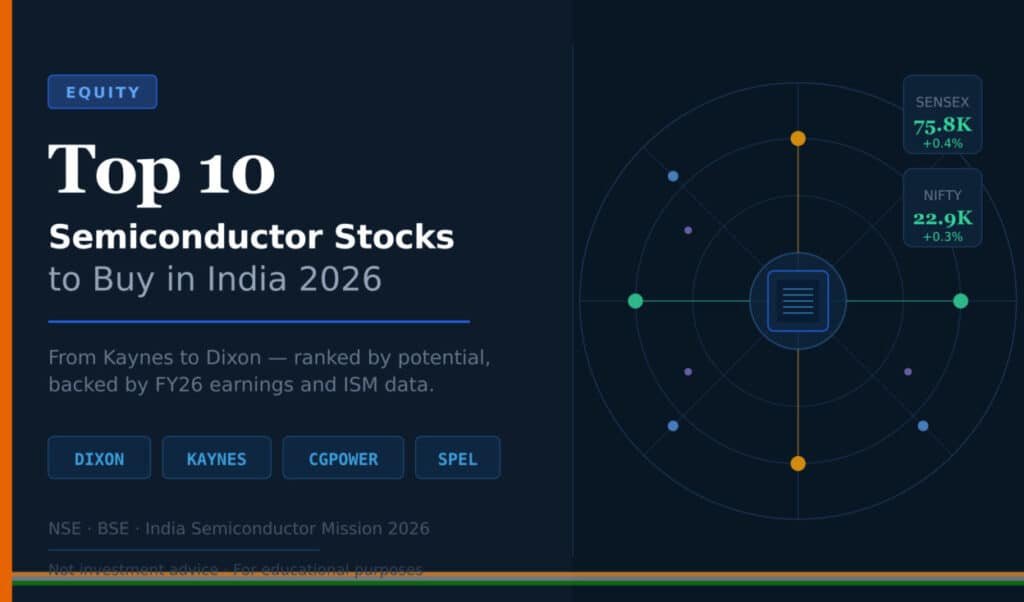
10 Top Semiconductor Stocks to Buy in India 2026

If you are searching for the top semiconductor stocks to buy in India 2026, you are asking the right question at the right time. India printed its first domestic chip in 2026 — a sentence that would have sounded like fiction five years ago. The country that spent decades importing nearly every semiconductor it consumed is now building fabs in Gujarat, packaging units in Uttar Pradesh, and training a workforce that global chipmakers are starting to notice. For investors, this shift creates a rare window: a manufacturing sector in the early innings of a structural upgrade, backed by government money and global tailwinds from AI, EVs, and 5G. But finding the right stock in this space is harder than it looks. Not every company calling itself a “semiconductor play” actually manufactures chips. Some design. Some test. Some just assemble consumer electronics and get grouped into the category because a fund manager needed a theme. In this guide, you’ll find the 10 semiconductor stocks that matter most right now, sorted by category, with their financial performance in FY26, what they actually do, and where the risks sit. You’ll also get answers to the questions most retail investors search for, including which penny stocks are worth considering and how mutual funds fit in, without needing to wade through a dozen brokerage PDFs. I’ve tracked India’s electronics and semiconductor sector for over seven years, analyzing ESDM policy shifts and company-level financials across BSE and NSE. The analysis below draws on FY26 earnings data, Union Budget allocations, and Semicon India Mission disclosures. What Counts as a Semiconductor Stock in India? A semiconductor stock is a share in a company that designs, manufactures, assembles, tests, or provides specialized services for semiconductor devices. These devices, commonly called chips, power everything from smartphones and medical equipment to electric vehicles and AI servers. The value chain runs from chip design (fabless companies) through wafer fabrication (fabs) to assembly, testing, marking, and packaging (ATMP or OSAT). Most Indian-listed companies sit in the ATMP/OSAT and electronics manufacturing services (EMS) segments for now, with full-scale fabs still under construction. India’s semiconductor market stood at an estimated $45-53 billion in FY25 and is projected to cross $100 billion by 2030, growing at a CAGR of 12-13%. The Three Categories You Need to Understand Before you buy a single share, know which part of the value chain you’re buying into: EMS companies (Dixon, Kaynes, Syrma SGS) manufacture electronics and are building semiconductor sub-assembly capacity. They have revenue today but limited direct chip exposure. Pure-play semiconductor firms (SPEL Semiconductor, RIR Power, MosChip) work directly on chip packaging, testing, or design. Smaller companies, higher risk, higher upside if India’s fab ecosystem matures. Diversified conglomerates (Tata Elxsi, CG Power, Bharat Electronics) have semiconductor divisions inside broader businesses. Lower volatility, more stable cash flows, but diluted upside. India’s Semiconductor Policy: Why 2026 Is Different The Union Budget 2025-26 allocated Rs. 70 billion to the semiconductor sector, with the chip fabrication scheme outlay rising 56% to Rs. 39 billion. Financial support for establishing new semiconductor facilities nearly doubled from Rs. 12 billion to Rs. 24.99 billion. More significantly, the government launched India Semiconductor Mission 2.0 (ISM 2.0) in February 2026, focused on producing semiconductor equipment and materials, designing full-stack Indian intellectual property, and fortifying domestic supply chains. This follows ISM 1.0, which approved 10 semiconductor projects worth approximately Rs. 1.60 lakh crore across six states. The first Made-in-India chips rolled out in 2026. Micron’s ATMP facility in Sanand, Gujarat, crossed initial production milestones. Kaynes Semicon’s six-million-chips-per-day unit received Cabinet approval and entered construction. The HCL-Foxconn joint venture in Jewar, Uttar Pradesh, cleared environmental hurdles. For stock market purposes, this matters because OSAT and ATMP facilities generate revenue faster than full-scale fabs. Companies in this segment will see earnings traction over the next 12-24 months, which is the window most equity analysts are currently pricing in. The India-US tariff deal announced in early 2026, bringing tariffs on Indian goods down to 18% from 50%, gave semiconductor and EMS stocks a visible catalyst. Dixon Technologies jumped over 6%, Kaynes Technology gained 5%, and CG Power surged 10% on that single day’s trade. Top 10 Semiconductor Stocks to Buy in India 2026 1. Dixon Technologies (India) Ltd — NSE: DIXON What it does: Dixon is India’s largest electronics manufacturing services company by revenue. It produces mobile phones, LED televisions, washers, lighting, and telecom equipment for brands including Samsung, Motorola, and Lenovo. The semiconductor angle: Dixon acquired a 51% stake in Kunshan Q Tech Microelectronics (India) in September 2025, a move that strengthens its backward integration into semiconductor components. The company is building capacity to move up the value chain from pure assembly to sub-component manufacturing. FY26 financials: Dixon reported strong revenue growth in FY26, with the mobile segment remaining the primary driver. Raw material inflation and high memory prices created some cost pressure in Q4 FY26, but order book diversification with clients like Lenovo provided a buffer. Why it makes the list: Dixon holds a dominant position in a sector that the government is actively incentivizing. Its scale gives it pricing power with suppliers and clients that smaller EMS players can’t match. Risk: The mobile segment faces softness in handset demand. HDFC Securities flagged that EMS sector growth may moderate in the near term because of this. The stock trades at a premium valuation, so any earnings miss hits the price hard. Live price: Check Dixon Technologies live share price on NSE (ticker: DIXON) or BSE. 2. Kaynes Technology India Ltd — NSE: KAYNES What it does: Founded in 1988 and based in Mysore, Kaynes is an end-to-end electronics manufacturer serving automotive, aerospace, defence, medical, and IoT sectors. It offers design, process engineering, manufacturing, and lifecycle support. The semiconductor angle: Kaynes Semicon, a wholly owned subsidiary, received Cabinet approval to build a semiconductor ATMP unit in Sanand, Gujarat, with an investment of Rs. 3,300 crore and a production capacity of six million chips per day. The chips target automotive, industrial,

Behavioral finance
Financing

Behavioral Finance: The Psychology of “Loss Aversion”—Why Business Owners Hoard Cash During Inflation and How to Advise Them Differently

Inflation is more than a macroeconomic trend—it’s a psychological trigger. When prices rise and economic uncertainty dominates headlines, many business owners instinctively hoard cash, delay investment, and resist strategic moves that could create future growth. While traditional financial advice focuses on numbers, ratios, and forecasts, behavioral finance helps us understand the deeper truth: people don’t make financial decisions logically—they make them emotionally. At the center of these emotions lies Loss Aversion, one of the most powerful behavioral biases ever documented. It shapes perception, distorts risk assessment, and often leads business owners to make choices that feel safe today but cost them significantly tomorrow. This article takes a deep dive into why business owners hoard cash during inflation, the psychology behind it, and most importantly, how advisors can guide clients toward healthier, more profitable financial decision-making. What Is Behavioral Finance and Why Does It Matter in Inflationary Periods? Behavioral finance examines how emotions, cognitive biases, and social dynamics shape financial choices. Unlike classical economics—which assumes people behave rationally—behavioral finance acknowledges that uncertainty triggers instinctive responses rooted in human psychology. Inflation amplifies these responses. When the cost of living rises and markets become volatile, the brain defaults to threat detection mode. Business owners start thinking less about growth and more about protection. Three behavioral factors matter most here: 1. Threat Sensitivity Increases During Inflation The brain interprets inflation as a loss of control. Cash reserves appear to be the only “safe” asset—even though they lose purchasing power. 2. Risk Perception Becomes Distorted Inflation magnifies uncertain outcomes, making business owners fear investment even if the long-term benefits outweigh the short-term risks. 3. Decision Paralysis Sets In With too many conflicting variables—prices rising, demand fluctuating, supply chain unpredictability—many decision-makers default to doing nothing, believing inaction avoids loss. This is where Loss Aversion comes into play. Understanding Loss Aversion: The Psychological Core of Cash Hoarding Loss aversion is a cornerstone principle in behavioral finance:People feel the pain of losses twice as intensely as the pleasure of equivalent gains. This means: Let’s break down the cognitive mechanisms behind this behavior. Why Loss Aversion Intensifies During Inflation 1. Inflation Makes Money Feel Scarcer Even if revenue remains stable, business owners feel poorer because their dollars buy less. This illusion of scarcity activates survival instincts. 2. Cash Feels Like Control In uncertain environments, liquid money appears to offer freedom and flexibility. Owners think: “If things get worse, at least I have cash.” Ironically, keeping too much cash during inflation guarantees real loss, since inflation erodes purchasing power. 3. Loss Aversion Causes Overestimation of Worst-Case Scenarios Business owners often imagine dramatic negative outcomes that are statistically unlikely, such as complete market collapse or sudden bankruptcy. 4. Familiarity Bias Reinforces Cash Hoarding People prefer assets they understand. Cash is familiar. Investments, expansion, automation, or hiring during inflation feel unfamiliar—and therefore risky. Psychological Patterns Seen in Business Owners During Inflation Advisors often observe these predictable patterns: These decisions stem not from poor business sense, but from cognitive biases triggered by real or perceived threats. Why Hoarding Cash Feels Safe—But Isn’t Always Rational From a behavioral standpoint, hoarding cash provides psychological comfort. But from a financial standpoint, it carries hidden risks. 1. Inflation Erodes Value If inflation is 6%, cash loses 6% of its purchasing power annually.Hoarding may feel safe, but financially, it ensures a slow and silent loss. 2. Missed Opportunities Cost More Than Small Losses During inflation, many competitors retreat. This creates rare chances to: Not acting can be more harmful than making the wrong move. 3. Cash Hoarding Creates Strategic Rigidity Businesses that cling to liquidity often: 4. Hoarding Can Signal Fear to Employees and Stakeholders When leaders make fear-driven decisions, teams sense instability—reducing morale and productivity. How Advisors Can Guide Business Owners Differently (Based on Behavioral Finance Principles) Traditional advice like “diversify your investments” or “focus on growth” falls flat during inflation because it ignores the emotional reality of the business owner. To influence decisions effectively, advisors must address the psychology first, then the strategy. Step 1 – Acknowledge the Fear Before Offering Analysis Do not begin with spreadsheets. Begin with empathy. Say things like: “It makes sense that inflation feels risky right now.”“Your caution shows responsible leadership.” When business owners feel understood, they become open to guidance. Step 2 – Reframe Loss Aversion into “Opportunity Cost Awareness” Instead of focusing on potential losses, shift the conversation toward losses that happen from inaction. For example: This subtle reframing reduces psychological resistance. Step 3 – Present Options in Simple, Limited Choices Behavioral research shows that too many options paralyze decision-making. Offer two or three well-structured alternatives, such as: Business owners feel more in control, not overwhelmed. Step 4 – Use Scenario Planning to Reduce Fear of the Unknown Show owners what happens under: Highlight that the balanced or growth strategy performs better in most realistic scenarios. Step 5 – Introduce “Safe-to-Fail Experiments” Instead of asking business owners to commit to 100% of a strategy, suggest small steps: These micro-investments build confidence and reduce loss aversion. Step 6 – Create a Cash Allocation Framework That Feels Safe Most owners hoard cash because they lack a structured liquidity plan. Help them calculate: Once they see cash in buckets, they stop overprotecting all of it. Strategic Financial Recommendations That Work During Inflation Business owners need clarity, not vague encouragement. Here are evidence-based strategies aligned with behavioral finance: 1. Maintain 3–6 Months of Operating Liquidity This satisfies the safety instinct without over-hoarding. 2. Channel Excess Cash Into Inflation-Resistant Assets Depending on the business type: These reduce long-term cost pressure. 3. Prioritize Pricing Power and Value Elevation The best inflation defense is strong pricing power—achieved through: Advisors should help clients justify price increases confidently. 4. Invest in Efficiency Instead of Expansion Alone Efficiency investments often bring: Business owners find these decisions emotionally easier because they reduce, rather than increase, perceived risk. The Advisor’s Mindset: Become a Behavioral Guide, Not a Financial Lecturer Your ultimate role is to bridge the gap between emotion and

AI startup valuation
Financing

Pre-Revenue AI Startup Valuation: Why “Discounted Cash Flow” (DCF) Fails and Better Models to Use

Artificial Intelligence (AI) startups are among the fastest-growing and most heavily funded businesses globally. Yet, they are also the hardest companies to value especially pre-revenue AI startup valuation that have not yet monetized their models, products, or platforms. Investors who try to apply the traditional Discounted Cash Flow (DCF) method often end up with unrealistic numbers, distorted assumptions, or valuations that fail to reflect the true potential (or risk) of the business. Traditional finance practitioners often reach for the Discounted Cash Flow (DCF) method. While it is the “gold standard” for mature corporations, applying DCF to a pre-revenue AI startup is like trying to measure the speed of a rocket with a sundial. It’s the wrong tool for the job. In this definitive guide, we explore why DCF breaks down for early-stage tech, how AI compounds these weaknesses, and which valuation frameworks investors actually rely on today. Why the Discounted Cash Flow (DCF) Fails for Pre-Revenue AI The DCF method determines a company’s current value by projecting future cash flows and “discounting” them back to the present day using a discount rate (usually the Weighted Average Cost of Capital, or WACC). While mathematically elegant, DCF crumbles under the uncertainty of pre-revenue AI for three key reasons: 1. The “Garbage In, Garbage Out” Paradox A DCF is only as good as its revenue projections. For a mature firm, you can project growth based on historical trends. For a pre-revenue startup, you are essentially guessing. If you change a single growth assumption from 20% to 25%, the “valuation” might swing by millions. In high-stakes AI, where product-market fit hasn’t been established, these projections are purely fictional. 2. The Extreme Sensitivity of Terminal Value In a typical DCF, about 60% to 80% of the calculated value comes from the “Terminal Value”—the value of the business beyond the initial 5-year forecast. This figure relies on a stable growth rate. However, the AI landscape changes every six months. Predicting the “stable” growth of an AI firm ten years from now is an exercise in futility. 3. Prohibitive Discount Rates (WACC) For public companies, a discount rate might be 8-10%. For a pre-revenue AI startup, the risk of failure is so high that investors effectively apply a discount rate of 30% to 70%. When you discount future money by 50% year-over-year, the “present value” of those future cash flows shrinks to almost nothing, failing to capture the massive upside potential that makes AI attractive. Better Valuation Models for Pre-Revenue Tech Firms If DCF is off the table, how do savvy angel investors and VCs decide what an AI startup is worth? They use a combination of qualitative and comparative models. 1. The Berkus Method: Focus on Risk Mitigation Developed by angel investor Dave Berkus, this method is ideal for pre-revenue firms. It ignores financial forecasts and instead assigns a monetary value (traditionally up to $500,000 per factor) to five key indicators of success. 2. The Scorecard Valuation Method: Benchmarking against the Best The Scorecard method compares your startup to average valuations of similar startups in the same region and sector. You start with a “baseline” (e.g., $4 million for a seed-stage AI firm in San Francisco) and adjust it based on comparative factors: If your team is significantly better than the average, you might multiply that 30% by a factor of 1.5, increasing your valuation. 3. The Venture Capital (VC) Method: Working Backward from Exit The VC method doesn’t look at what you have today; it looks at what you could be in 5–7 years. The Formula: This method aligns with the reality of high-growth tech: you aren’t valuing the business for today; you are valuing the possibility of a billion-dollar acquisition. AI-Specific Valuation Drivers AI companies are unique because they have specific “moats” that traditional tech firms do not. When using qualitative models, ensure you weight these heavily: Why Valuing AI Startups Is Uniquely Complex AI startups operate very differently from traditional businesses. Their core value often lies in: Unlike conventional firms—where revenue, margins, and cash flows follow somewhat predictable trajectories—AI companies evolve rapidly and unpredictably. Even the startup itself may not have a clear monetization strategy at the early stage. The Revenue Problem: Why Most AI Startups Don’t Earn Early Many AI startups spend their first 2–5 years focusing on: Revenue frequently comes later, often suddenly, and may scale exponentially if product-market fit is achieved. This non-linear growth makes early valuation difficult. Why Discounted Cash Flow (DCF) Fails for Pre-Revenue AI Startups DCF was designed for stable, predictable businesses—manufacturers, retailers, mature tech firms, etc. DCF Requires Cash Flow Visibility – AI Startups Don’t Have It DCF relies on projecting future free cash flows, often 5–10 years forward. For pre-revenue AI startups, these numbers are: Even tiny assumption changes—CAC, churn, cloud costs, LLM usage, pricing—can swing valuation by millions. The Terminal Value Problem DCF valuations often derive 60–90% of value from terminal assumptions. For AI startups, terminal value depends on: These cannot be predicted with the certainty DCF requires. AI Unit Economics Are Not Stable Early On AI costs shift drastically due to: DCF assumes stable long-term margins. AI does not behave that way. DCF Penalizes Innovation DCF discounts future earnings heavily. But AI value often materializes after years of research. DCF systematically undervalues: Exponential Growth and S-Curves Break DCF Math AI adoption follows: DCF assumes linear or modest growth, so it cannot capture asymmetric upside. What Valuation Models Actually Work for Pre-Revenue AI Startups Investors and VCs rarely use DCF for pre-revenue tech. Instead, they rely on alternative frameworks designed for uncertainty. Below are the methods most commonly used for AI startups today. 1. The Venture Capital (VC) Method This is the most widely used method for early-stage AI. How It Works Unlike DCF, it does not require detailed cash flow projections. Why the VC Method Suits AI 2. Comparable Company Analysis (Comps) AI startups are often valued by comparing them to: What Metrics Are Used? Even pre-revenue companies have relevant inputs: 3.

Invoice Discounting
Financing

Invoice Discounting (TReDS): The “Hidden” Way for MSMEs to Unlock Working Capital Without Taking a Bank Loan

Micro, Small, and Medium Enterprises (MSMEs) are the backbone of India’s economic engine. They contribute more than 30% to India’s GDP and employ millions. Yet, they face one persistent and painful problem: delayed payments from buyers. Even MSMEs supplying to large, reputable corporate buyers often wait 45–120 days or more to receive payments. This gap creates working capital stress, disrupts cash flow, and forces entrepreneurs to rely on costly loans, credit cards, or informal borrowing. But what if there was a smarter way?A way to convert unpaid invoices into cash within days, without taking a loan, without pledging collateral, and often at lower interest rates than traditional credit? That solution already exists – It’s called Invoice Discounting on TReDS (Trade Receivables Discounting System). And surprisingly, many MSMEs still don’t know about it.This blog is your ultimate guide to understanding how TReDS can unlock hidden working capital for your business—quickly, safely, and digitally. What Is Invoice Discounting? (Simple Explanation) Invoice Discounting is a financing method where a business uses its unpaid invoices to get early payment from a financier (banks or NBFCs) before the actual due date. Instead of waiting 60–90 days for a buyer to pay, the MSME receives funds immediately (minus a small discount fee). How Invoice Discounting Works in One Line: You sell your invoice → Financier pays you early → Buyer pays financier later. Why It’s Not a Loan This is why it is one of the most powerful financial tools for MSMEs today. What Is TReDS? Understanding the Government-Approved Platform TReDS stands for Trade Receivables Discounting System, an RBI-regulated digital marketplace that enables MSMEs to discount their invoices with participating financiers. Purpose of TReDS Who Operates TReDS Platforms? RBI has authorized specific institutions to run TReDS platforms in India.(We will not mention individual platforms to avoid unnecessary brand reference.) Each platform acts as a neutral marketplace connecting: Why TReDS Is Called the Hidden Way to Raise Working Capital Although TReDS has been active for years, many MSMEs still rely on costly loans, overdrafts, or informal credit because they simply don’t know about invoice discounting—or they misunderstand it. Here’s why TReDS is considered a hidden gem: 1. Collateral-Free Working Capital You don’t need property, machinery, or personal guarantees.Invoices themselves become the asset. 2. Financing Depends on Buyer’s Credit Rating Even if the MSME has a low credit score or thin credit history, financing is still possible because lenders evaluate the buyer’s credibility. 3. Lower Cost Than Typical Loans Interest rates can be significantly lower than: 4. Full Digital, Transparent, and Fast No branch visits.No paperwork chaos.Everything happens on a secure online platform. 5. Zero Risk of Buyer Default Once the buyer accepts the invoice on TReDS, it becomes a guaranteed payment obligation, reducing risk for financiers and sellers alike. How Invoice Discounting Works on TReDS—Step-by-Step Process Let’s break it down into the simplest form possible. Step 1 – MSME Supplies Goods or Services You deliver the product/service to the buyer as usual. Step 2 – MSME Uploads Invoice on TReDS You upload the invoice to the TReDS platform. Step 3 – Buyer Confirms the Invoice This is a crucial step.Once the buyer validates the invoice, financiers know that payment is guaranteed on the due date. Step 4 – Financiers Bid to Discount the Invoice Banks and NBFCs compete by offering the lowest discount rate. This benefits MSMEs because the cost of funding goes down due to competition. Step 5 – MSME Accepts the Best Rate You choose the most attractive offer. Step 6 – Financier Pays MSME Immediately You receive funds (usually within 24–72 hours). Step 7 – Buyer Pays Financier on Due Date The buyer pays the full invoice amount to the financier. You don’t have to do anything after receiving the discounted amount. Key Features of Invoice Discounting Through TReDS 1. 100% Digital Workflow Right from invoice upload to fund disbursal. 2. Multiple Financiers More competition → Better discount rates → Lower financing costs 3. No Follow-Ups for Payment Financiers collect payment from the buyer—You only focus on business. 4. Faster Cash Flow Cycles Turn receivables into instant cash. 5. Strengthens MSME–Corporate Relationship Buyers see MSMEs as stronger, more reliable partners. Who Can Use TReDS? (Eligibility Criteria) MSME Sellers All registered MSMEs (manufacturing or service-based). Corporate Buyers Large companies from any industry with substantial procurement activity. Government Departments / PSUs Many government organizations are already on TReDS. Banks & NBFCs Registered financiers approved by RBI. Why MSMEs Should Choose Invoice Discounting Over Bank Loans 1. No Loan Application Hassles No documentation of: 2. No Additional Debt Your balance sheet stays clean. 3. Uses Existing Business Transactions Funding comes from your day-to-day invoices. 4. Instant Liquidity = Faster Growth With quick working capital, you can: 5. Removes Cash Flow Uncertainty If your buyers regularly delay payments, invoice discounting becomes a life-saver. Comparison Table: Invoice Discounting vs. Bank Loan Feature Invoice Discounting Bank Loan Requires Collateral ❌ No ✔️ Yes (often) Credit Check Based On Buyer MSME Time to Get Funds 1–3 Days Weeks to Months Impact on Balance Sheet No debt Increased liabilities Process Fully digital Paper-heavy Follow-up for Payment Not needed Required Interest Cost Competitive Higher Invoice Discounting wins clearly for MSMEs needing predictable working capital. Benefits of TReDS for MSMEs (In Detail) 1. Improves Cash Flow Stability No more worrying about 60–90 day payment cycles.This enables better monthly planning. 2. Reduces Working Capital Gap Quick access to funds means smoother operations. 3. Strengthens Financial Health 4. Encourages Timely Payments by Buyers Buyers gain visibility and must adhere to timelines. 5. Boosts Growth and Expansion Your business can take larger orders confidently. Common Misconceptions About Invoice Discounting & TReDS “It’s a Loan.” No, it’s not. There is no EMI, no collateral, and no debt added. “Only big companies can use it.” Registered MSMEs are the primary beneficiaries. “It is complicated.” It is simpler than applying for an overdraft. “My buyer might not approve my invoices.” Most reputable buyers already support TReDS because it improves

Fractional Ownership vs REITs
Financing

Fractional Ownership vs REITs: The Battle for Commercial Real Estate

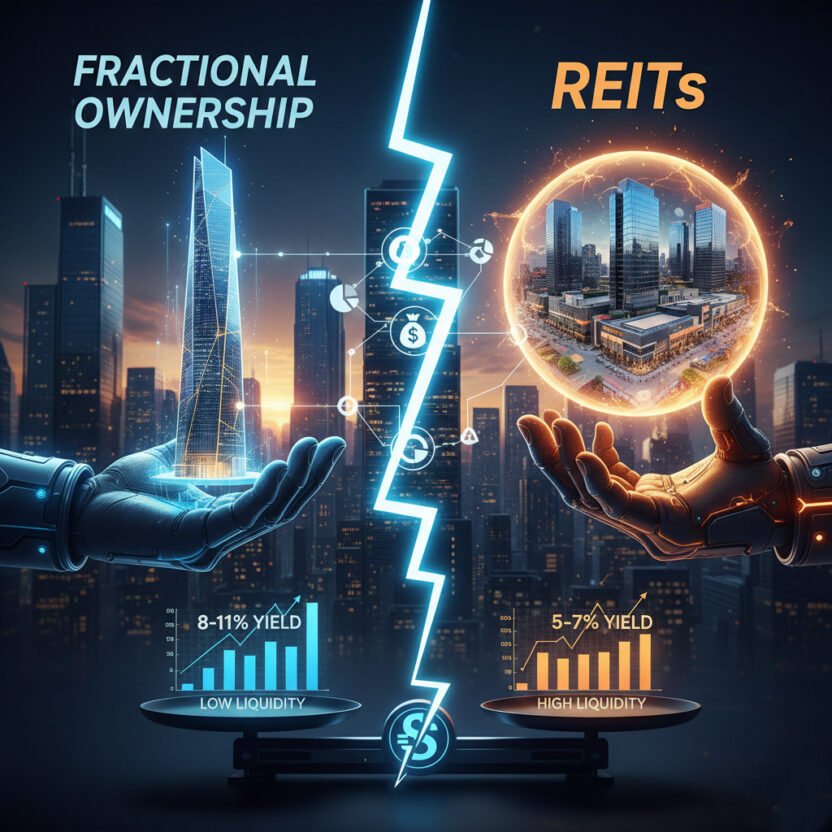
For decades, the soaring glass towers of commercial real estate (CRE) were the playground of the ultra-wealthy and institutional giants. The average investor was locked out by a “velvet rope” of multi-million dollar price tags. Today, that rope has been cut. The rise of Fractional Ownership vs REITs (Real Estate Investment Trusts) has democratized the sector, turning “trophy assets” like Grade-A office spaces and luxury warehouses into accessible retail investments. But as these two giants clash for space in your portfolio, which one actually delivers? Both promise passive income, diversification, and asset-backed security—but they differ fundamentally in returns, liquidity, control, taxation, risks, and how the underlying properties are managed. In this comprehensive guide, we strip away the jargon to compare yields, lock-in periods, and tax treatments in the ultimate showdown of fractional ownership vs. REITs. The Rise of Alternative Commercial Real Estate Investments Investors today want real estate exposure without the hassles of full property ownership—no tenants, no maintenance, no negotiations. At the same time, they want stable yields, inflation-hedged returns, and tangible assets backing their investments. Fractional Ownership and REITs have emerged as two powerful solutions: Both methods democratize commercial real estate, but their mechanics—and results—are worlds apart. What Is Fractional Ownership? Fractional ownership allows multiple investors to co-own a commercial property—like an office floor, warehouse, retail outlet, or pre-leased Grade A building. How it works: Key characteristics: Fractional platforms often handle leasing, tenant management, and maintenance, making it genuinely passive. What Are REITs? A Real Estate Investment Trust (REIT) is a company that owns and operates income-producing properties. Investors buy shares of the trust, not the properties themselves. How REITs work: Key characteristics: Fractional Ownership vs. REITs: Key Differences (Quick Overview) Feature Fractional Ownership REITs Type of Ownership Direct share of a property Shares of a company owning properties Avg Yield 8–10% rental + appreciation 5–7% dividend Lock-in 3–6 years No lock-in (listed REITs) Liquidity Medium (secondary resale) High (stock market) Taxation Pass-through in SPVs Dividend + capital gains tax Control & Transparency High (property-level) Low (portfolio-level) Volatility Low (property-based) High (market-based) Risk Profile Asset-specific Market & interest-rate driven Comparing Yields: Which Gives Better Returns? Fractional Ownership Yields Fractional investments typically focus on pre-leased Grade A commercial assets, which offer: Because investors own the property directly, they participate in: REIT Yields Listed REITs in most markets offer: REITs must distribute 90% of earnings, making them attractive—but yields fluctuate with share price volatility. Winner: Fractional Ownership higher yields in most cases. Lock-In Periods: Which Is More Flexible? Fractional Ownership Lock-Ins Fractional ownership usually comes with: This is because properties aren’t sold frequently and require a defined investment cycle. REIT Lock-Ins Publicly listed REITs: Private REITs may have limited liquidity, but listed ones are very flexible. ⭐ Winner: REITs—best liquidity and no mandatory lock-in. Tax Treatment: Which Saves You More Money? Taxation in Fractional Ownership Most fractional CRE investments are structured using SPVs (Special Purpose Vehicles), where income passes directly to investors. Taxation applies as: Investors avoid double taxation because SPVs act as pass-through entities. Taxation in REITs REITs have complex tax structures: Investors benefit from equity tax rules but lose transparency over expenses and income types. ⭐ Winner: Fractional Ownership—more tax-efficient for rental income and capital gains. Liquidity Comparison Fractional Ownership Liquidity Some platforms provide resale marketplaces but liquidity varies by asset. REIT Liquidity ⭐ Winner: REITs. Transparency & Control Fractional Ownership Investors get: Because you own part of a real asset, the transparency is property-specific. REITs Investors see: But they cannot track or inspect individual properties. ⭐ Winner: Fractional Ownership—superior transparency and control. Asset Quality & Diversification Fractional Ownership You own a stake in one property, making returns dependent on: REITs You automatically get diversification across: ⭐ Winner: REITs built-in diversification reduces risk. Fees & Costs Fractional Ownership Fees May include: However, these fees often justify better asset curation and management. REIT Fees ⭐ Winner: REITs for lower visible fees. Risk Comparison Fractional Ownership Risks But property value tends to remain stable even in downturns. REIT Risks REIT prices can drop even when properties perform well. ⭐ Winner: Fractional Ownership—lower volatility and asset-based stability. Which Investor Profile Suits Which Option? Fractional Ownership Is Ideal For: REITs Are Ideal For: Round 1: The Yield War Rental Income vs. Dividends When investing in commercial real estate, the primary goal is often passive income. Here is how the yields stack up. Fractional Ownership: High-Octane Yields Fractional ownership typically focuses on single assets with high-quality tenants (e.g., global banks or tech firms). REITs: Lower, but Diversified Payouts REITs are legally mandated to distribute at least 90% of their taxable income to shareholders. The Verdict: If you are chasing maximum cash flow, Fractional Ownership wins on pure yield performance. Round 2: The Lock-in Period & Liquidity Trap Commercial real estate is famously illiquid, but these two models handle the “exit” very differently. The REIT Advantage: Instant Liquidity REITs are listed on stock exchanges. If you need cash tomorrow, you can sell your units with the click of a button. There is no official “lock-in” period. This makes REITs an excellent tool for investors who might need their capital back at short notice. The Fractional Reality: A Test of Patience Fractional ownership is a private investment. While most platforms offer a resale marketplace, selling your “fraction” can take weeks or even months. Round 3: Tax Treatment—The Silent Profit Eater What you earn is secondary to what you keep. Tax treatments vary wildly between these two structures. Taxation on Fractional Ownership Because you hold a stake in an SPV, the income is treated as Rental Income. Taxation on REITs REIT payouts are a mix of dividends, interest, and capital repayment. Comparative Summary: At a Glance Feature Fractional Ownership REITs Asset Exposure Specific single property Diversified portfolio Minimum Investment Moderate (often $10k – $25k) Very Low (price of 1 unit) Annual Yield 8% – 11% 5% – 7% Liquidity Low (Secondary market) High (Stock Exchange) Control High (Choose the building) Low (Trust manager decides) Real-World

GIFT City
Financing

Family Offices in GIFT City: Why India’s Ultra-Wealthy Are Moving Assets to Gujarat Instead of Singapore or Dubai

Over the past decade, India has witnessed an explosive rise in the number of ultra-high-net-worth individuals (UHNWIs). With increasing global investments, cross-border structures, and multi-generational wealth planning needs, family offices have become central to managing private capital. For years, the default destinations for Indian wealth were Singapore and Dubai—two global hubs known for tax clarity, sophisticated financial markets, and robust regulatory environments. But a new trend is emerging: India’s wealthiest families are re-domesticating capital and setting up family offices in GIFT City, a tax-advantaged, globally integrated financial enclave designed to rival the world’s top financial centers. This shift is not temporary—it represents a structural change in how Indian wealth is created, managed, and transferred across generations. The Rise of GIFT City as India’s Global Financial Hub GIFT City (Gujarat International Finance Tec-City), located between Ahmedabad and Gandhinagar, is India’s first International Financial Services Centre (IFSC). It is designed as a foreign jurisdiction within India, offering benefits comparable to international hubs while keeping capital closer to home. Why the Indian Government Built an IFSC GIFT City was built to: In essence, GIFT City is India’s answer to global competition—an economic zone designed specifically to keep India’s money in India while giving investors the advantages traditionally found only abroad. Why Family Offices Matter And Why They Are Choosing GIFT City A family office goes far beyond investment management. It handles taxation, estate planning, philanthropy, governance, private equity, succession, luxury assets, and even family constitutions. Historically, wealthy Indian families set up structures abroad due to advantages in: But today, GIFT City offers all of these—plus the advantage of location, cost, and strategic control. Top Reasons India’s Ultra-Wealthy Are Moving Family Offices to GIFT City Below is the most comprehensive breakdown of why GIFT City is becoming the preferred headquarters for India’s wealth. 1. Unmatched Tax Benefits for Family Offices GIFT City offers some of the most attractive tax incentives in Asia. Key Tax Advantages Include: Compared to Singapore, which has recently tightened tax residency rules, and Dubai, which introduced corporate tax in 2023, GIFT City now looks even more competitive. 2. Liberalized Regulations Tailored for Global Wealth India created a separate regulator—the International Financial Services Centres Authority (IFSCA)—specifically for GIFT City. Why this matters: This is very different from India’s domestic regulatory maze and is a major reason for the shift. 3. Seamless Global Investment Access A GIFT City family office can invest across: Using freely convertible foreign currency accounts, they can deploy capital globally with minimal friction—similar to an offshore entity. This offers the best of both worlds: global access with Indian governance and transparency. 4. Lower Operating Costs Compared to Singapore or Dubai Running a family office in GIFT City can cost 30–60% less than operating in major hubs abroad, because: Cost matters, especially for family offices handling a few hundred million dollars rather than multi-billion dollar empires. 5. India’s Wealth Is Growing Faster Than Any Other Major Economy India is creating millionaires at an unprecedented speed. Factors driving domestic wealth creation: This economic momentum is prompting families to keep capital at home, where opportunities are strongest. 6. Stronger Control and Compliance Comfort Many wealthy Indians have become cautious about: GIFT City offers: Families feel safer keeping assets in India while still enjoying global access. 7. Facilitation of Succession & Estate Planning Within India India lacks a formal estate tax—but many foreign jurisdictions do not. For instance: GIFT City simplifies the process of: Families also appreciate that planning is aligned with Indian cultural preferences and legal frameworks. 8. India’s Push to Become a Global Financial Hub GIFT City is not an experiment—it is a flagship national project with political backing and long-term vision. The government continues to: As a result, GIFT City is acquiring real economic gravity, attracting: This booming ecosystem makes GIFT City a natural home for family offices. Comparing GIFT City with Singapore and Dubai Below is a realistic, ground-level comparison from a family office perspective. Taxation Comparison Feature GIFT City Singapore Dubai Corporate Tax 0% for 10 yrs 17% (with incentives) 9% corporate tax (from 2023) Capital Gains Mostly exempt Exempt (conditions apply) Exempt Dividend Tax Exempt Exempt Exempt GST/VAT Zero for offshore 8% GST 5% VAT Personal Income Tax Regular Indian tax 0% 0% GIFT City now offers the strongest tax incentives among the three. Regulatory & Ecosystem Comparison Feature GIFT City Singapore Dubai Regulatory speed Fast Moderate Fast Global banking infrastructure Growing Very strong Very strong Family office ecosystem Rapidly expanding Mature Mature Minimum substance requirements Reasonable Increasing Increasing Singapore recently tightened residency rules for family offices, while Dubai introduced corporate tax. GIFT City’s rules are currently most favorable for Indian-origin wealth. Why GIFT City Beats Singapore and Dubai for Indian Wealth While Singapore and Dubai provide excellent global access, GIFT City offers something they cannot: The “Onshore-Offshore” Advantage. 1. Superior Tax Efficiency and Holiday Benefits Singapore has a corporate tax rate of roughly 17%, and while Dubai was historically tax-free, it recently introduced a 9% corporate tax. In contrast, GIFT City offers a 100% income tax exemption for any 10 consecutive years out of a 15-year block. 2. Lower Operational Costs The “Cost of Doing Business” in GIFT City is approximately one-fifth of that in Singapore or Dubai. Rent for Category-A office space, administrative overheads, and the cost of skilled local financial talent are significantly lower in Gandhinagar, allowing family offices to allocate more capital toward investments rather than high upkeep. 3. Exemption from Stringent “ODI” Rules Domestic family offices in India are often hamstrung by the Overseas Direct Investment (ODI) regime, which requires cumbersome disclosures and restricts investments in unlisted entities. GIFT City acts as a legal “detour.” By channeling funds through an FIF, families can invest up to 50% of their net worth into global unlisted assets without the compliance friction of the mainland RBI rules. The Strategic Shift: From Capital Outflow to Capital Control Bypassing Currency Volatility The Indian Rupee has seen long-term headwinds against the US Dollar. By maintaining assets

Section 8 Companies
Financing

Section 8 Companies (Non-Profit): The New FCRA Compliance Hurdles That Every Indian NGO Must Navigate Now

India’s non-profit ecosystem is undergoing a dramatic transformation. Whether you run a Section 8 company, a registered society, or a charitable trust, you’ve likely felt the pressure of rapidly tightening compliance regulations—especially those related to foreign funding. The Foreign Contribution (Regulation) Act, 2010 — Foreign Contribution (Regulation) Act, 2010 — has always been a gatekeeper for NGOs seeking foreign donations. But the recent amendments, stricter enforcement mechanisms, increased scrutiny, digital surveillance tools, and evolving audit requirements have reshaped how Indian NGOs operate. For Section 8 (Non-Profit) companies, which must already maintain high levels of statutory compliance under the Companies Act, these changes introduce even more layers of operational and governance complexity. This in-depth guide breaks down every major FCRA compliance hurdle that Indian NGOs must navigate now, why these hurdles exist, and how your organization can strategically adapt to stay compliant and scalable. Understanding the Non-Profit Landscape: What Exactly Is a Section 8 Company? Before diving into the FCRA complications, it’s essential to understand why Section 8 companies are under the scanner more than ever. Why NGOs Prefer Section 8 Registration A Section 8 company is formed under the Companies Act, 2013, solely for: Unlike societies or trusts, Section 8 companies enjoy a higher degree of credibility due to: This transparency—although beneficial—also invites higher scrutiny from regulatory authorities. Why Section 8 Companies Face Stricter FCRA Scrutiny Section 8 companies are often preferred by international donors, including foundations, impact investors, and global CSR partners. Consequently, they handle larger volumes of foreign contributions compared to smaller trusts or societies. Because of this: Regulators view Section 8 companies as high-value entities This means more audits, more reporting, and more visibility on compliance lapses. Even minor compliance errors now result in severe consequences Suspensions, questions, account freezes, or show-cause notices under FCRA have become common. What Is the FCRA and Why Does It Matter More Today Than Ever? The Foreign Contribution (Regulation) Act, 2010 governs how NGOs receive and utilize foreign funding. It aims to ensure that foreign money does not influence India’s political, economic, or social environment in ways that compromise national security or public interest. The Act is monitored and enforced by the Ministry of Home Affairs (MHA) — Ministry of Home Affairs. The Big Shift: FCRA Has Become a National Security Instrument Earlier, FCRA was perceived mainly as a financial regulation act. Today, it is treated as a strategic regulatory tool tied to: This has fundamentally changed how NGOs must operate. The New FCRA Compliance Hurdles Every Indian NGO Must Navigate Below are the most significant challenges introduced through recent amendments, notifications, enforcement changes, and compliance expectations. Hurdle 1 Mandatory FCRA Bank Account at SBI New Delhi Branch This is perhaps the biggest operational shift for NGOs. All NGOs receiving foreign funds—Section 8 companies included—must open the designated FCRA account at State Bank of India, New Delhi Main Branch (NDMB). Key Challenges for Section 8 Companies a) Slow processing timelines Documentation, verification, and approval often take longer than expected. b) Technical issues with bank-FCRA portal sync If the NGO’s details don’t correctly match between the bank and MHA portal, delays or rejections can occur. c) Operational dependency on a single branch Even though sub-accounts are allowed, all foreign funds must pass through the SBI NDMB account. Hurdle 2 End-to-End Digital Monitoring of Foreign Contribution Flow One of the biggest FCRA changes is the digitization of regulatory oversight. What This Means for NGOs FCRA uses integrated data-matching tools that connect: This means: Every rupee of foreign contribution is traceable from source to utilization. New Risk Areas Introduced All of these can trigger automated scrutiny. Hurdle 3 Zero Tolerance for Fund Transfer to Other NGOs One of the most controversial amendments was the complete prohibition on sub-granting foreign funds to other NGOs. Impact on Section 8 Companies Most Section 8 companies work with: Now, they cannot legally transfer foreign contributions to these smaller entities. What You Can Do Instead But every step must be documented precisely. Hurdle 4 Stricter Eligibility & Registration Requirements NGOs must prove that their work aligns with national interests. The MHA now evaluates: This has resulted in: Increased rejections of new FCRA applications Even Section 8 companies with strong structures report rejections due to technicalities. Reasons Commonly Cited for Rejection Hurdle 5 Annual Returns, Quarterly Disclosures, and Detailed Reporting FCRA compliance is no longer annual—it is quarterly, annual, and continuous. Mandatory Reporting Requirements Include Why NGOs Struggle a) Increased administrative cost Section 8 companies already maintain compliance under the Companies Act. Adding multiple FCRA layers significantly increases the cost of compliance. b) Requirement of real-time accounting discipline Back-dated entries or mismatched ledger accounts can lead to: Hurdle 6 FCRA Licence Suspension & Cancellation Becoming More Common The MHA has dramatically increased enforcement actions. Reasons for Suspension Often Include Impact of Suspension on NGOs For Section 8 companies working with global partners, this is devastating. Hurdle 7 Stricter Governance and Board Compliance FCRA now mandates that: Section 8 Companies Face Additional Challenges Hurdle 8 Limitations on Administrative Expenses FCRA caps administrative expenses at 20% of total foreign contributions. This includes: Why Section 8 Companies Are Hit Hardest Section 8 companies typically maintain: These costs alone may exceed the FCRA-allowed cap. Proactive planning is now essential. Hurdle 9 Increased Collaboration Restrictions with Foreign Entities NGOs must now disclose: Why This Matters Even non-financial collaborations may require compliance checks if they indirectly influence project design funded by foreign sources. Hurdle 10 Heightened Audit & Verification Standards External auditors must now certify: Even minor audit qualification remarks can lead to MHA scrutiny. Best Practices for Section 8 Companies to Stay Fully FCRA Compliant Here’s a practical roadmap you can implement immediately. 1. Strengthen Your Finance & Compliance Team Include: 2. Maintain Real-Time Accounting Avoid back-dated expense entries. Use accounting software with: 3. Create Comprehensive FCRA SOPs (Standard Operating Procedures) Include: 4. Conduct Quarterly Internal Audits Identify: 5. Train Your Board & Senior Management They must understand: 6. Avoid Red Flags at All

Virtual CFO services
Financing

Virtual CFO Services: How to Structure a “Subscription-Based” Finance Package for Your Clients (Pricing & Deliverables)

The rise of Virtual CFO (vCFO) services has transformed how small and mid-sized businesses access financial leadership. Instead of hiring a full-time CFO—which can easily cost six figures—companies are choosing subscription-based Virtual CFO packages that bundle strategic finance support, reporting, forecasting, and advisory into predictable monthly fees. But for accountants, bookkeepers, and finance consultants, one big challenge remains: How do you structure a subscription-based Virtual CFO package that clients value—and happily pay for every month? In this comprehensive guide, you’ll learn exactly how to design, price, package, and deliver Virtual CFO services that are scalable, profitable, and irresistible to growing businesses. Why Subscription-Based Virtual CFO Services Are in High Demand Before we break down pricing and deliverables, let’s understand why subscription models outperform hourly billing in the CFO advisory world. 1. Businesses Want Predictable, Transparent Pricing Entrepreneurs hate unpredictable financial costs. A fixed subscription aligns with how they already purchase key services (like SaaS, payroll, legal, and HR support). 2. Recurring Revenue Creates Stability for You A properly structured Virtual CFO subscription gives you: This stability matters whether you’re a solo CFO consultant or building a full advisory firm. 3. Subscription Packages Allow You to Productize Your Expertise Instead of selling hours, you’re selling an outcome: financial clarity, improved cash flow, increased profits, and better decision-making. This approach: 4. Virtual CFO Services Solve Real Problems Today’s business owners struggle with: A subscription-based Virtual CFO package addresses all of these pain points. How to Design a Subscription-Based Virtual CFO Package Your goal is to create tiered, scalable packages that clearly show increasing value at each level. Below is a proven framework. Step-1 Define Your Core Virtual CFO Deliverables The best Virtual CFO packages include three categories of deliverables: (A) Recurring Financial Management Deliverables These include the routine, monthly essentials clients rely on: Monthly Financial Reporting Monthly Strategy & Advisory Meetings These meetings focus on: Cash Flow Planning & Management Forecasting & Budgeting Finance System Optimization (B) Strategic Advisory Deliverables Higher-tier subscription packages should include: ● Financial modeling ● Profit margin analysis ● Revenue forecasting ● Pricing strategy reviews ● Break-even analysis ● Operational efficiency audits ● Cost containment strategies ● Capital planning (loans, investments, fundraising) ● Board or investor-level reporting packages These are high-value and justify premium pricing. (C) CEO Partnership Deliverables These deliverables position you as a strategic partner, not a spreadsheet operator: This is what separates a Virtual CFO from a bookkeeper or accountant. Step-2 Build Tiered Subscription Packages A high-performing Virtual CFO business usually offers three tiers: 1. Basic Subscription Package (Starter Advisory) Best for: Small businesses under $500k–$1M revenue. Includes: Price Range: $750 – $2,500 per month 2. Growth Subscription Package (Full vCFO Service) Best for: Businesses $1M–$5M revenue. Includes everything in Basic PLUS: Price Range: $2,500 – $7,500 per month 3. Premium Subscription Package (Fractional CFO + Strategic Leadership) Best for: Businesses $5M+ or those preparing for investment, acquisition, or rapid scaling. Includes everything in Growth PLUS: Price Range: $7,500 – $15,000+ per month This tier often includes custom pricing because each client’s needs differ. Step-3 Decide What NOT To Include To prevent scope creep, clearly exclude: If you offer these, price them separately or bundle into optional add-ons. Step-4 Create Clear “Deliverables Lists” for Each Package Clients should never be confused about what they’re paying for. Use simple categories: Crystal-clear deliverables increase trust and reduce complaints. Step-5 Create a Strong Virtual CFO Client Onboarding System A smooth onboarding experience shows professionalism and builds confidence. Your onboarding workflow should include: 1. Kickoff Strategy Call Understand goals, challenges, KPIs, and priorities. 2. Document Collection Financial statementsBank statementsLoan documentsPayroll recordsSubscription listsCurrent budgets 3. Systems Audit Analyze accounting software, chart of accounts, reporting workflows, and automation opportunities. 4. Clean-Up & Setup This may include: 5. First 90-Day Roadmap This gives the CEO clarity and confidence in the process. How to Price Virtual CFO Services (In Detail) Your pricing should be based on: 1. Complexity of Work Industries like manufacturing, construction, and SaaS require more advanced modeling. 2. Revenue Size Larger companies = more transactions and deeper analysis. 3. Meeting Frequency Weekly meetings demand a higher fee. 4. Urgency Level Fast deadlines = premium pricing. 5. Depth of Strategy Investor fundraising and M&A support significantly increase value. Three Pricing Models for Virtual CFO Services 1. Fixed Monthly Subscription This is the most common and easiest for clients to adopt. Pros: Cons: 2. Tiered Subscription Packages Bronze / Silver / Gold structure. Pros: Cons: 3. Custom Pricing (Quote-Based) Used for high-growth, investor-backed, or complex companies Pros: Cons: What Makes a Virtual CFO Subscription Package Worth the Price? 1. Strategic insight—not just reporting A great vCFO translates numbers into actions. 2. Predictive tools, not reactive spreadsheets Forecasting and cash flow modeling provide real value. 3. Direct access to a financial expert Clients pay for access, confidence, and guidance. 4. Consistency + communication Regular meetings, clear dashboards, and timely reporting matter. How to Sell Subscription-Based Virtual CFO Packages Successfully 1. Lead with Pain Points Speak about: 2. Use Value-Based Sales Language Show the cost of NOT having a CFO. Example:A business losing $30k per month due to poor cash flow management will gladly pay $5k monthly for a vCFO who can fix it. 3. Offer Three Options Studies show people choose the middle package most often. 4. Focus on Outcomes, Not Deliverables Deliverables are the vehicle.Outcomes are the transformation. 5. Show Before/After Examples Demonstrate improved: Should You Offer Month-to-Month or Annual Contracts? You can offer both. Month-to-Month More flexible, easier to close. Annual Subscription Better for cash flow, higher commitment.Offer a discount for upfront payment. Add-On Services to Increase Revenue These can significantly boost profit: A strong v CFO business earns 20–40% of revenue from add-ons. Red Flags When Structuring a CFO Subscription Package Avoid these pitfalls: Example of a Subscription-Based Virtual CFO Package (Template) Basic Package – $1,500/month Growth Package – $4,500/month Elite Package – $9,500/month Final Thoughts: The Future of Subscription-Based Virtual CFO Services As businesses seek deeper insights and

SME IPO Boom in 2025
Financing

SME IPO Boom in 2025: Is Listing on the SME Exchange a Better Exit Strategy Than VC Funding

The year 2025 is shaping up to be a turning point in the Indian fundraising ecosystem. For nearly a decade, venture capital (VC) funding has dominated the startup narrative. But a silent revolution has been happening: SME IPO Boom in 2025 More founders and early investors are questioning whether listing on the SME Exchange—such as NSE Emerge and BSE SME—is actually a better exit strategy than chasing VC funding rounds. If you asked a startup founder in 2021 about their dream exit, the answer was almost scripted: Raise a Seed round, hit Series A, scale to Series C, and eventually maybe IPO on the mainboard. But in 2025, the script has been rewritten. We are witnessing a fundamental shift in the Indian capital markets. While Venture Capital (VC) funding is slowly thawing from the “winter” of 2023-24, a new avenue has exploded into the mainstream: The SME IPO. No longer just a playground for traditional manufacturing businesses, the SME platforms of BSE and NSE are now attracting high-growth tech startups, D2C brands, and service-based companies. With over ₹9,000 Crore raised in recent listings and subscription numbers hitting record highs, the “SME IPO Boom” is not just a trend; it is a structural change in how Indian businesses finance their growth. But is it right for you? Is taking your company public at an early stage truly a better strategy than the prestige and deep pockets of a VC? This guide dives deep into the data, the psychology, and the financials of 2025 to give you the answer. The Funding Landscape Is Changing Fast For years, startups believed that raising venture capital was the ultimate validation of their business. But by 2023–2025, global VC funding experienced slowing momentum, inflated valuations shrank, due diligence tightened, and funds became more selective. Meanwhile, SME IPOs surged, with many companies: This brings us to the central question: Is listing on the SME Exchange a better exit strategy than VC funding in 2025? Let’s break it down. What Is an SME IPO? An SME IPO (Small and Medium Enterprise Initial Public Offering) is a public listing route designed for smaller companies to raise capital and offer shares to the public through platforms like: Key Features of SME IPOs Why Are SME IPOs Booming in 2025? Several macro and micro factors have aligned to create the SME IPO boom: 1. Drying VC Funds for Early-Stage Startups By 2024–2025, VC funds became: As a result, founders began exploring alternative funding. 2. High Investor Appetite for Profitable SMEs Investors are shifting from loss-making unicorns to: 3. Faster Exit Opportunities VC capital often locks founders for 7–10 years, while SME IPOs help them: 4. Better Valuations for Strong Businesses Unlike VC valuation based on future projections, IPO valuation considers: In 2025, good SMEs are getting higher valuations via IPO compared to VC rounds. 5. Government Push & Regulatory Support Authorities have streamlined: Making SME listing simpler than ever. The State of Funding in 2025: VC Thaw vs. Public Market Heat To understand why the SME exchange is becoming attractive, we first have to look at the alternative. 1. The VC Landscape: Cautious Optimism In 2025, VCs are back, but they are different. The “growth at all costs” mantra is dead. VCs today are demanding: 2. The SME Exchange: The “Maturation” Phase Conversely, the SME platforms (BSE SME and NSE Emerge) have matured. 2024 was a year of frenzy, but 2025 is the year of quality. SME IPO vs. VC Funding: The Great Comparison This is the core dilemma for any founder in 2025. Let’s break it down by the metrics that actually matter to your business. 1. Valuation and Dilution This is often the dealbreaker. Key Takeaway: A VC buys a chunk of your company and a seat at the table. The public market buys a share of your profits but leaves you at the head of the table. 2. Control and Autonomy 3. Liquidity and Exit 4. Credibility and Visibility Being a “Listed Company” carries immense weight in India. Why 2025 is the “Goldilocks” Year for SME Listings Why is everyone talking about this now? 1. The SEBI Confidence Boost In late 2024 and early 2025, SEBI introduced stricter checks for SME IPOs. 2. The Tech-First Investor The retail investor in 2025 is using apps like Zerodha, Groww, and Upstox. They are younger, risk-tolerant, and understand business models that traditional older investors didn’t. They get SaaS. They get D2C. This demographic shift has provided the demand side of the boom. 3. The Migration Path The SME exchange is a stepping stone. Companies like Eki Energy and many others started on the SME board and migrated to the Mainboard. 2025 has streamlined this migration process, making the SME board a legitimate “training ground” for the big leagues. Strategic Checklist: Are You Ready for an SME IPO in 2025? Before you call a Merchant Banker, check this list. If you check 4 out of 5, you are a candidate. Risks: It’s Not All Green Arrows We must be honest. The SME IPO route is not for everyone. SME IPO vs VC Funding: A Detailed Comparison Below is a complete analytical comparison for founders evaluating the right exit strategy in 2025. Equity Dilution SME IPO VC Funding Winner: SME IPO for founders wanting to retain control Speed of Raising Capital SME IPO VC Funding Winner: SME IPO for speed and certainty Branding and Credibility SME IPO VC Funding Winner: SME IPO Exit Opportunities SME IPO VC Funding Winner: SME IPO Compliance Burden SME IPO VC Funding Winner: VC Funding for lower compliance Cost of Raising Funds SME IPO VC Funding Winner: Depends on business—you choose between higher upfront cost or higher lifetime dilution Case Studies & Real-World Trends (Generalized) Case Study 1: A Manufacturing SME A mid-sized engineering company needed ₹25 crore. VC firms offered funds but demanded 40% dilution. Instead, the company listed on the SME Exchange, raised capital in 5 months, diluted only 18%, and gained credibility that unlocked

Startup Funding in India
Financing

The Ultimate Roadmap to Startup Funding in India (2026): Stages, Valuation & Strategies

India is currently the third-largest startup ecosystem in the world, home to over 100+ unicorns and thousands of soonicorns. However, the narrative has shifted. The “funding frenzy” of 2021 is over. We are now in the era of Sustainable Growth. If you are reading this, you likely have an idea, an MVP, or early traction, and you are wondering how to fuel the engine. You’ve seen competitors raise millions, and you’ve read the headlines. But the gap between reading about funding and signing a term sheet is massive. Your competitors might tell you what the stages are. This guide will tell you how to survive them. We will move beyond generic advice and look at the hard data: ticket sizes in INR, equity dilution percentages, and the exact metrics Indian VCs (Venture Capitalists) demand in 2025. The Golden Rule of Funding: Money is not the goal; it is the fuel. Raising capital does not mean you have succeeded; it means you have just signed up for a much harder job. India’s startup landscape is evolving, and understanding the complexities of startup funding in India is crucial for aspiring entrepreneurs. As the market shifts towards Sustainable Growth, it is essential to explore various strategies for investment in startups in India, including how to effectively attract investors who are keen to invest in India startups. This roadmap provides a comprehensive overview of the funding of startups in India, detailing the stages of funding, valuation expectations, and the necessary preparations to successfully fund startups in India. By leveraging this information, entrepreneurs can position themselves for a successful start-up investment in India. The Pre-Funding Phase: Building the Foundation Before you even ask for a rupee, you must ensure your vessel is seaworthy. In India, many startups fail to raise simply because their legal or structural foundation is cracked. Legal Structure Matters Investors in India almost exclusively invest in Private Limited Companies (Pvt Ltd). Action Item: If you are looking for serious VC money, incorporate as a Private Limited entity under the Companies Act, 2013. Intellectual Property (IP) Do you own your code? If you hired a freelancer to build your MVP without a contract assigning the IP to your company, the freelancer owns it. This will kill your funding round during Due Diligence (DD). The Co-Founder Agreement This is the “Pre-Nup” of the startup world. What happens if one founder leaves? What is the vesting period? Stage 1: Bootstrapping & Pre-Seed (The Valley of Death) Bootstrapping: The hustle Bootstrapping means funding the business yourself. In India, 90% of startups begin here. You use savings, credit cards, or revenue from consulting gigs to fund the product. Why Bootstrap? The Risks: Pre-Seed: The “Concept” Round This is often called the “Friends, Family, and Fools” round. You have a prototype, but maybe no customers. Key Metrics (India Context): Who Invests? The Pitch Focus: At this stage, investors invest in YOU (the founder) and the Market Size. They know the product will change. They need to believe you are the person to solve this specific problem. Stage 2: Seed Funding (Product-Market Fit) This is the first “Institutional” round. You have moved past the idea phase. You have an MVP, and you have some early adopters using it. You need money to figure out “Product-Market Fit” (PMF). What is Product-Market Fit? It means being in a good market with a product that can satisfy that market. The Metrics The Investors Documentation Required Strategy to Win Seed Funding: Demonstrate a “unique insight.” Why is this problem unsolved? Why now? Do not just show growth; show engagement. 1,000 users who love you is better than 10,000 who downloaded and deleted. Stage 3: Series A (The Engine of Growth) This is the “Great Filter.” Many startups raise Seed, but few make it to Series A. In India, Series A is where you move from “figuring it out” to “scaling what works.” The Shift in Mindset Investors need to see Unit Economics. This means: The Metrics The Investors (The Big Boys) These are Tier-1 Venture Capital firms. Due Diligence (DD) At Series A, DD is brutal. They will audit: Pro Tip: Start organizing your “Data Room” (a Google Drive folder with all legal/finance docs) 3 months before you fundraise. Stage 4: Series B & C (Hyper-Scaling) If Series A is about fueling the engine, Series B and C are about putting the pedal to the metal. You are likely generating significant revenue (₹10 Cr+ ARR – Annual Recurring Revenue). Series B: Expansion Series C: Market Dominance The “Down Round” Phenomenon In the current economic climate (2024-2025), valuations have corrected. If you raised Series B at a $500M valuation but can only raise Series C at $400M, that is a Down Round. Stage 5: Series D, Late Stage & IPO (The Exit) This is the endgame. At this point, the startup is a “Unicorn” (Valuation > $1B) or a “Soonicorn.” Pre-IPO / Series D+ Funding here is often about cleaning up the balance sheet before going public. IPO (Initial Public Offering) Going public in India involves listing on the BSE (Bombay Stock Exchange) or NSE (National Stock Exchange). The Process: Pros of IPO: Cons of IPO: Alternative Exits: The Mathematics of Funding: Valuation & Dilution This is where founders often get cheated. You must understand the math. Pre-Money vs. Post-Money Example: Trap: If you agree to “₹40 Cr Valuation” without specifying “Pre-money,” the investor might treat it as “Post-money,” meaning you give up more equity than planned. The Option Pool Shuffle Investors will ask you to set aside an ESOP pool (usually 10-15%) for employees. Decoding the Term Sheet: What VCs Actually Sign A Term Sheet is a non-binding intent to invest. It contains the financial and governance terms. Liquidation Preference (The Most Dangerous Clause) This determines who gets paid first if the company is sold. Anti-Dilution Protection for investors if you raise money later at a lower valuation (Down Round). Board Seats Who controls the company? Alternative Funding: Debt, Grants & RBF

Scroll to Top