The Inevitable impact of AI on tax compliance The worlds of artificial intelligence (AI) and taxation, once seemingly distant, are now converging at an unprecedented pace. This fusion promises to redefine the very fabric of tax compliance, transforming it from a manual, error-prone process into a streamlined, data-driven system. As we stand on the cusp of 2025, it’s no longer a question of if AI will impact tax compliance, but how profoundly it will reshape the landscape for taxpayers, tax professionals, and tax authorities alike.
What is AI and Why Does it Matter for Taxes?
Artificial intelligence, in its essence, is the simulation of human intelligence in machines. It’s the ability of computers to learn, reason, and problem-solve. When applied to the realm of taxation, AI can automate repetitive tasks, analyze vast amounts of data, identify patterns and anomalies, and even predict future trends. This has massive implications for a system that has traditionally been bogged down by paperwork, complex regulations, and the ever-present risk of human error.
The Current State of Tax Compliance
A System Ripe for Disruption For decades, tax compliance has been a laborious process. Individuals and businesses have had to navigate a labyrinth of tax laws, fill out endless forms, and maintain meticulous records. Tax authorities, on the other hand, have faced the daunting task of auditing returns, detecting fraud, and ensuring that everyone pays their fair share. This system, while functional, is far from efficient. It’s time-consuming, costly, and often a source of frustration for all parties involved. The advent of AI presents a golden opportunity to disrupt this status quo and build a more efficient, transparent, and equitable tax system.
A Glimpse into the Future: What to Expect in 2025
By 2025, we can expect to see AI playing a much more prominent role in tax compliance. Taxpayers will benefit from AI-powered tools that simplify the filing process, provide personalized tax advice, and help them make more informed financial decisions. Tax professionals will be able to leverage AI to automate routine tasks, freeing them up to focus on more strategic, value-added services. And tax authorities will use AI to enhance their auditing capabilities, detect fraud with greater accuracy, and create a more level playing field for all taxpayers.
The Unseen Hand of AI: How Artificial Intelligence is Revolutionizing Tax Compliance
The impact of AI on tax compliance is not some far-off, futuristic concept. It’s happening right now, with a suite of AI-powered technologies that are already transforming the way we think about and interact with the tax system.
AI-Powered Data Analysis
From Manual Audits to Predictive Analytics One of the most significant ways AI is revolutionizing tax compliance is through its ability to analyze massive datasets. Tax authorities are now using AI-powered algorithms to sift through terabytes of data, identifying patterns and anomalies that would be impossible for a human to detect. This has led to a shift from reactive, manual audits to proactive, predictive analytics.
Uncovering Hidden Patterns and Anomalies
AI algorithms can analyze a wide range of data sources, including tax returns, financial statements, and even social media activity, to identify inconsistencies and red flags. This allows tax authorities to focus their audit efforts on high-risk cases, leading to a more efficient and effective use of resources.
Real-time Fraud Detection
AI can also be used to detect and prevent tax fraud in real-time. By analyzing transactional data as it happens, AI algorithms can identify suspicious activities and alert tax authorities immediately. This proactive approach to fraud detection is far more effective than the traditional method of waiting until after a tax return has been filed.
Robotic Process Automation (RPA): Automating the Mundane, Liberating the Human
Robotic Process Automation (RPA) is another AI-powered technology that is having a major impact on tax compliance. RPA involves the use of software “bots” to automate repetitive, rules-based tasks.
Automated Data Entry and Form Processing
RPA can be used to automate the process of data entry, form processing, and other administrative tasks. This not only saves time and reduces the risk of human error, but it also frees up tax professionals to focus on more complex and strategic work.
Streamlining Repetitive Tasks
Many of the tasks involved in tax compliance are repetitive and mundane. RPA can be used to automate these tasks, leading to a more efficient and streamlined workflow. This allows tax professionals to be more productive and provide better service to their clients.
Natural Language Processing (NLP): Making Sense of Unstructured Data
Natural Language Processing (NLP) is a branch of AI that deals with the interaction between computers and human language. NLP is being used in a variety of ways to improve tax compliance.
Analyzing Tax Laws and Regulations
Tax laws and regulations are notoriously complex and difficult to understand. NLP can be used to analyze these documents and extract the key information, making it easier for taxpayers and tax professionals to comply with the law.
Enhancing Taxpayer Communication with Chatbots
Many tax authorities are now using AI-powered chatbots to provide instant support to taxpayers. These chatbots can answer a wide range of questions, from basic filing instructions to more complex tax code clarifications. This 24/7 availability improves the user experience and reduces the burden on human customer service representatives.
The Indian Tax System in 2025: A Deep Dive into AI-Driven Transformation
India, with its vast and complex tax system, is at the forefront of the AI revolution in taxation. The Indian government has been actively leveraging technology to simplify the tax system, enhance transparency, and combat tax evasion.
The ‘Project Insight’ and the Era of Big Data Analytics
Project Insight’ is a flagship initiative of the Indian government that aims to create a 360-degree profile of every taxpayer. The project uses advanced data analytics and AI to collate information from a variety of sources, including bank accounts, social media, and other financial transactions. This comprehensive database allows tax authorities to identify high-risk taxpayers and detect tax evasion with greater accuracy.
E-invoicing and its Role in Real-time Tax Monitoring
The introduction of e-invoicing has been a game-changer for the Indian tax system. Under this system, all business-to-business (B2B) invoices are electronically uploaded to a government portal. This provides tax authorities with real-time access to transactional data, making it much easier to monitor compliance and detect fraud.
Faceless Assessment and Appeals: AI as the Unbiased Adjudicator
India has also introduced a system of faceless assessment and appeals. Under this system, tax assessments and appeals are conducted electronically, without any face-to-face interaction between the taxpayer and the tax officer. This helps to reduce corruption and ensure a more objective and unbiased assessment process. AI plays a crucial role in this system, as it is used to automate the process of case allocation and scrutiny.
The Goods and Services Tax Network (GSTN): A Prime Example of AI in Action
The Goods and Services Tax Network (GSTN) is the technology backbone of the GST regime in India. The GSTN uses AI and machine learning to process millions of transactions every day, detect fraud, and ensure that all taxpayers are complying with the law. The GSTN is a prime example of how AI can be used to create a more efficient and transparent tax system.
The Myriad Benefits of AI in Tax Compliance
A Win-Win for Taxpayers and Authorities The adoption of AI in tax compliance offers a multitude of benefits for both taxpayers and tax authorities.
For Taxpayers
- Simplified Tax Filing and Reduced Errors: AI-powered software can simplify the tax filing process by automating data entry, providing real-time guidance, and flagging potential errors. This helps to reduce the stress and anxiety associated with filing taxes and ensures a more accurate return.
- Proactive Tax Planning and Advisory: AI can analyze a taxpayer’s financial data and provide personalized tax planning advice. This can help taxpayers to make more informed financial decisions and minimize their tax liability.
- Enhanced Transparency and Fairness: AI can help to create a more transparent and fair tax system by reducing the scope for human bias and corruption.
For Tax Authorities
- Increased Efficiency and Accuracy: AI can automate many of the tasks involved in tax administration, leading to increased efficiency and accuracy. This allows tax authorities to process returns more quickly and with fewer errors.
- Improved Tax Collection and Revenue Generation: By detecting tax evasion and fraud with greater accuracy, AI can help to improve tax collection and generate more revenue for the government.
- Better Risk Management and Fraud Detection: AI can help tax authorities to better manage risk and detect fraud by identifying high-risk taxpayers and suspicious transactions.
What are the benefits of using AI for tax filing?
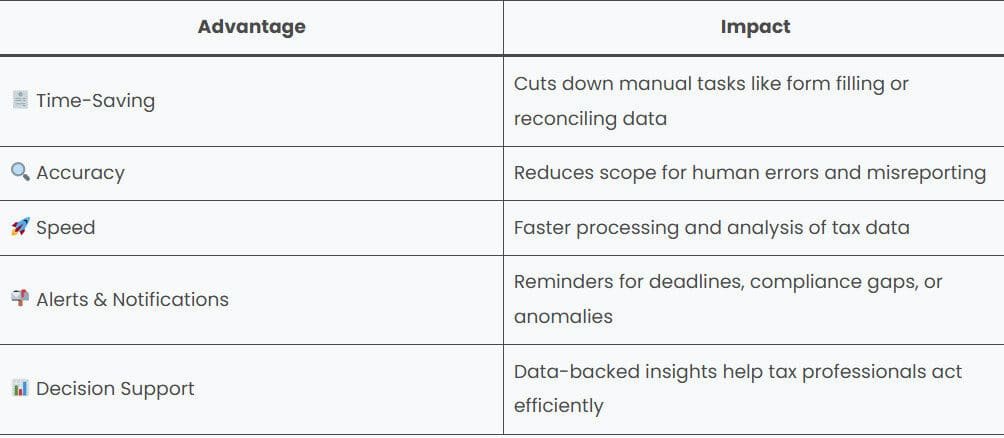
The adoption of AI in tax filing offers a multitude of advantages for all stakeholders:
- Increased Accuracy: By minimizing manual data entry and leveraging sophisticated algorithms, AI significantly reduces the risk of errors in tax returns, which can lead to penalties and audits.
- Enhanced Efficiency: Automation of repetitive and time-consuming tasks frees up valuable time for both taxpayers and tax professionals, allowing them to focus on more strategic financial planning.
- Improved Compliance: AI systems can stay up-to-date with the latest tax laws and regulations, helping to ensure that tax returns are always compliant with the most current requirements.
- Cost Savings: For businesses, the increased efficiency and accuracy provided by AI can translate into significant cost savings in their tax compliance efforts.
- Data-driven Insights: AI can analyze vast amounts of financial data to provide valuable insights that can inform better financial decision-making and tax planning.
The Challenges and Ethical Considerations of AI in Taxation
While the benefits of AI in tax compliance are undeniable, there are also a number of challenges and ethical considerations that need to be addressed.
Data Privacy and Security Concerns
The use of AI in taxation involves the collection and analysis of vast amounts of personal and financial data. This raises serious concerns about data privacy and security. It is essential that robust security measures are in place to protect this data from unauthorized access and misuse.
The ‘Black Box’ Problem: Lack of Transparency in AI Algorithms
Many AI algorithms are incredibly complex, making it difficult to understand how they arrive at their decisions. This “black box” problem can be a major concern in the context of taxation, as it can be difficult to challenge a decision that has been made by an AI algorithm.
The Risk of Algorithmic Bias
AI algorithms are only as good as the data they are trained on. If the training data is biased, the algorithm will also be biased. This can lead to unfair or discriminatory outcomes. It is essential to ensure that AI algorithms are trained on diverse and representative datasets to minimize the risk of bias.
The Need for a Skilled Workforce
The adoption of AI in taxation will require a new set of skills. Tax professionals will need to be proficient in data analytics, machine learning, and other AI-related technologies. It is essential that we invest in training and development to ensure that we have a skilled workforce that is capable of harnessing the full potential of AI.
Is AI replacing tax accountants?
While AI is automating many of the routine tasks traditionally performed by tax accountants, it is not expected to replace them entirely. Instead, the role of the tax professional is evolving. With AI handling the more tedious and data-intensive aspects of tax preparation, accountants can focus on higher-value services, such as:
- Strategic Tax Planning and Advisory: Providing expert advice on complex tax matters and helping clients develop long-term tax strategies.
- Financial Consulting: Offering broader financial guidance and insights based on a deeper understanding of a client’s financial situation.
- Resolving Complex Tax Issues: Handling intricate tax situations and representing clients in case of audits or disputes with tax authorities.
- Ensuring Ethical and Responsible AI Use: Overseeing the implementation and use of AI tools to ensure accuracy, fairness, and compliance with ethical standards.
The consensus among experts is that AI will be a powerful tool that augments the capabilities of tax professionals, rather than making them obsolete.
How is AI changing tax preparation?
AI is revolutionizing tax preparation by automating and enhancing various aspects of the process. For individuals and businesses, AI-powered software simplifies the filing process by:
- Automating Data Entry: AI algorithms can extract relevant financial data from various documents, such as receipts and invoices, significantly reducing manual data entry and the potential for errors.
- Providing Real-time Assistance: AI-driven chatbots and virtual assistants can offer instant answers to tax-related queries, guiding users through the filing process and helping them understand complex tax laws.
- Identifying Potential Deductions and Credits: By analyzing a user’s financial data, AI can identify potential deductions and credits they may be eligible for, maximizing their tax benefits.
- Personalizing the Experience: AI can tailor the tax preparation process to an individual’s specific financial situation, making it more intuitive and efficient.
What are the risks of using AI in tax compliance?
Despite its numerous benefits, the use of AI in tax compliance also presents certain risks and challenges that need to be addressed:
- Data Security and Privacy: Tax-related data is highly sensitive. The use of AI systems requires robust security measures to protect this information from breaches and unauthorized access.
- Algorithmic Bias: AI algorithms are only as unbiased as the data they are trained on. There is a risk that biases in the data could lead to unfair or discriminatory outcomes in tax assessments.
- Lack of Transparency (The “Black Box” Problem): The decision-making processes of some complex AI models can be difficult to understand, making it challenging to scrutinize and appeal their outcomes.
- Over-reliance on Technology: An excessive reliance on AI without proper human oversight can lead to the acceptance of erroneous or nonsensical results.
- Cost of Implementation: For smaller firms and individuals, the initial cost of adopting and integrating advanced AI systems can be a significant barrier.
How does AI help with tax audits and fraud detection?
AI is a game-changer for tax authorities in the areas of audits and fraud detection. Its capabilities include:
- Advanced Data Analysis: AI can analyze massive datasets from various sources to identify patterns, anomalies, and red flags that may indicate tax evasion or fraud. This allows for more targeted and effective audits.
- Predictive Analytics: By analyzing historical data, AI models can predict which taxpayers are at a higher risk of non-compliance, enabling tax authorities to proactively address potential issues.
- Real-time Monitoring: AI can monitor financial transactions in real-time to detect suspicious activities and potential fraud as they happen.
- Improved Efficiency of Audits: AI automates many of the manual and time-consuming tasks involved in the audit process, allowing auditors to focus on more complex aspects of an investigation.
- Enhanced Accuracy: The use of AI in analyzing financial records minimizes human error and leads to more accurate and reliable audit outcomes.
The Future of Tax: Predictions for a Hyper-Personalized and Automated Tax System
The future of tax is likely to be hyper-personalized and automated. Here are some predictions for what we can expect to see in the coming years:
The Rise of Real-time Taxation
With the increasing availability of real-time data, we are likely to see a move towards real-time taxation. This would involve the continuous calculation and collection of taxes throughout the year, rather than the current system of filing an annual tax return.
AI-Powered Tax Avatars for Personalized Guidance
In the future, we may see the emergence of AI-powered tax avatars that can provide personalized tax advice and guidance to taxpayers. These avatars would be able to answer questions, help with tax planning, and even file tax returns on behalf of the taxpayer.
Blockchain and AI: A Powerful Combination for Secure Transactions
The combination of blockchain and AI has the potential to create a highly secure and transparent tax system. Blockchain can be used to create a tamper-proof record of all transactions, while AI can be used to analyze this data and detect fraud.
The Evolving Role of Tax Professionals in the Age of AI
The role of tax professionals will evolve in the age of AI. While some of the more routine tasks will be automated, there will still be a need for human expertise in areas such as tax planning, advisory, and dispute resolution. Tax professionals will need to adapt to this new environment and develop new skills to remain relevant.
How to Prepare for the AI-Driven Tax Future: A Guide for Businesses and Individuals
The AI-driven tax future is coming, and it’s important to be prepared. Here are some steps that businesses and individuals can take to get ready:
Embrace Technology and Digital Transformation
The first step is to embrace technology and digital transformation. This means investing in AI-powered tax software, adopting digital payment methods, and staying up-to-date with the latest technological developments.
Invest in AI-Powered Tax Software
There are a number of AI-powered tax software solutions available that can help to simplify the tax filing process and reduce the risk of errors. It’s a worthwhile investment for any business or individual.
Stay Informed About the Latest Developments
The world of AI and taxation is constantly evolving. It’s important to stay informed about the latest developments and how they might impact you. This can be done by reading industry publications, attending webinars, and networking with other professionals in the field.
Seek Expert Guidance
If you’re not sure how to navigate the complexities of the AI-driven tax future, it’s a good idea to seek expert guidance. A qualified tax professional can help you to understand the implications of AI for your business or personal finances and develop a strategy to stay ahead of the curve.
Conclusion
AI – A Paradigm Shift in the World of Taxation The convergence of AI and taxation represents a paradigm shift in the way we think about and interact with the tax system. While there are certainly challenges to be addressed, the potential benefits of AI are immense. By embracing this technology and preparing for the changes to come, we can create a more efficient, transparent, and equitable tax system for all. The AI revolution is here, and it’s time to get on board.
FAQs
What is AI in tax compliance?
AI in tax compliance uses machine learning to automate tasks like data entry, analyze financial records for errors, and help identify patterns to ensure accuracy.
How does AI change tax filing?
AI-powered software speeds up tax filing by automatically pulling data from documents and flagging potential deductions or errors, making the process faster and more accurate.
Will AI replace tax accountants?
No, AI is not expected to replace tax accountants. It will handle routine tasks, allowing accountants to focus on complex advisory, strategic planning, and financial interpretation.
What are the main benefits of AI in tax?
The main benefits are increased accuracy by reducing human error, greater efficiency through automation, and better fraud detection by analyzing vast amounts of data.
How does AI help tax authorities?
AI helps tax authorities by analyzing millions of returns to spot anomalies and high-risk cases for audits, which helps in detecting tax evasion more effectively.
Is AI safe for submitting tax information?
Yes, reputable AI tax platforms use advanced encryption and security protocols to protect sensitive personal and financial data from unauthorized access.

He founded Finance and Tax Guide to simplify complex tax and accounting topics for Indian small businesses, entrepreneurs, and individual taxpayers.
His expertise includes:
• GST Registration and Return Filing
• Income Tax Return (ITR) Filing
• TDS and TCS Compliance
• Business Bookkeeping
• Financial Accounting
• Tax Planning for Small Businesses
Every article published on Finance and Tax Guideis based on practical accounting experience and current Indian tax laws to provide accurate,
easy-to-understand financial guidance.