Micro, Small, and Medium Enterprises (MSMEs) are the backbone of India’s economic engine. They contribute more than 30% to India’s GDP and employ millions. Yet, they face one persistent and painful problem: delayed payments from buyers.
Even MSMEs supplying to large, reputable corporate buyers often wait 45–120 days or more to receive payments. This gap creates working capital stress, disrupts cash flow, and forces entrepreneurs to rely on costly loans, credit cards, or informal borrowing.
But what if there was a smarter way?
A way to convert unpaid invoices into cash within days, without taking a loan, without pledging collateral, and often at lower interest rates than traditional credit?
That solution already exists – It’s called Invoice Discounting on TReDS (Trade Receivables Discounting System).
And surprisingly, many MSMEs still don’t know about it.
This blog is your ultimate guide to understanding how TReDS can unlock hidden working capital for your business—quickly, safely, and digitally.
What Is Invoice Discounting? (Simple Explanation)
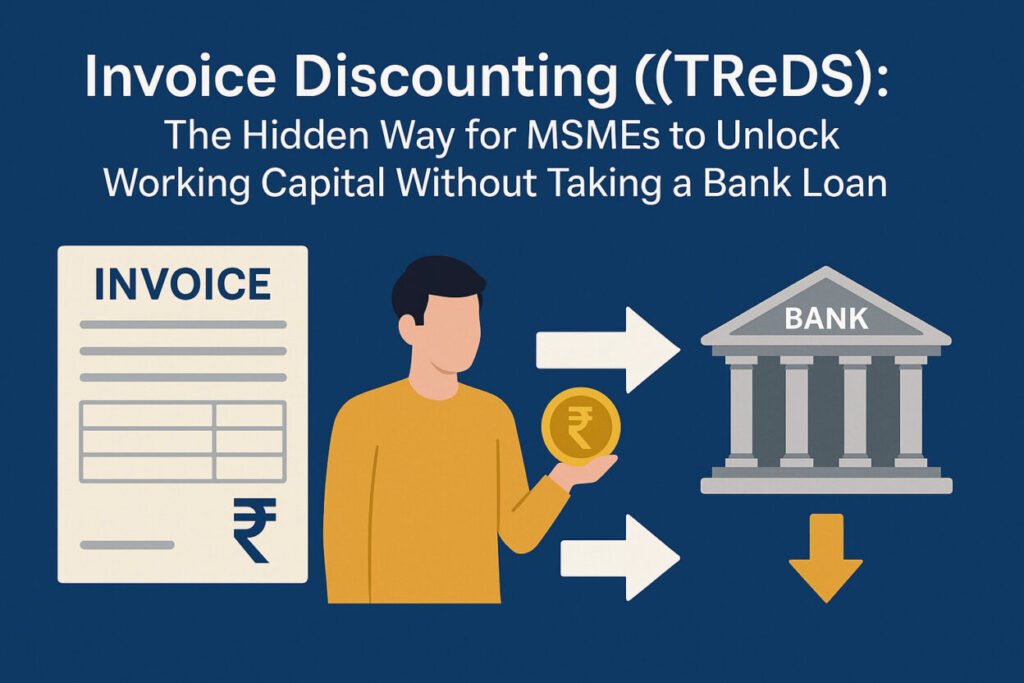
Invoice Discounting is a financing method where a business uses its unpaid invoices to get early payment from a financier (banks or NBFCs) before the actual due date.
Instead of waiting 60–90 days for a buyer to pay, the MSME receives funds immediately (minus a small discount fee).
How Invoice Discounting Works in One Line:
You sell your invoice → Financier pays you early → Buyer pays financier later.
Why It’s Not a Loan
- No collateral
- No EMI
- No debt added to balance sheet
- Approval is based on buyer’s credit strength, not the MSME’s
This is why it is one of the most powerful financial tools for MSMEs today.
What Is TReDS? Understanding the Government-Approved Platform
TReDS stands for Trade Receivables Discounting System, an RBI-regulated digital marketplace that enables MSMEs to discount their invoices with participating financiers.
Purpose of TReDS
- Help MSMEs get timely payments
- Improve working capital cycles
- Reduce dependency on loans
- Bring transparency and credibility to trade financing
Who Operates TReDS Platforms?
RBI has authorized specific institutions to run TReDS platforms in India.
(We will not mention individual platforms to avoid unnecessary brand reference.)
Each platform acts as a neutral marketplace connecting:
- MSME Sellers
- Corporate Buyers
- Banks/NBFC Financiers
Why TReDS Is Called the Hidden Way to Raise Working Capital
Although TReDS has been active for years, many MSMEs still rely on costly loans, overdrafts, or informal credit because they simply don’t know about invoice discounting—or they misunderstand it.
Here’s why TReDS is considered a hidden gem:
1. Collateral-Free Working Capital
You don’t need property, machinery, or personal guarantees.
Invoices themselves become the asset.
2. Financing Depends on Buyer’s Credit Rating
Even if the MSME has a low credit score or thin credit history, financing is still possible because lenders evaluate the buyer’s credibility.
3. Lower Cost Than Typical Loans
Interest rates can be significantly lower than:
- Term loans
- Overdraft facilities
- Credit cards
- Fintech loans
- Informal lending
4. Full Digital, Transparent, and Fast
No branch visits.
No paperwork chaos.
Everything happens on a secure online platform.
5. Zero Risk of Buyer Default
Once the buyer accepts the invoice on TReDS, it becomes a guaranteed payment obligation, reducing risk for financiers and sellers alike.
How Invoice Discounting Works on TReDS—Step-by-Step Process
Let’s break it down into the simplest form possible.
Step 1 – MSME Supplies Goods or Services
You deliver the product/service to the buyer as usual.
Step 2 – MSME Uploads Invoice on TReDS
You upload the invoice to the TReDS platform.
Step 3 – Buyer Confirms the Invoice
This is a crucial step.
Once the buyer validates the invoice, financiers know that payment is guaranteed on the due date.
Step 4 – Financiers Bid to Discount the Invoice
Banks and NBFCs compete by offering the lowest discount rate.
This benefits MSMEs because the cost of funding goes down due to competition.
Step 5 – MSME Accepts the Best Rate
You choose the most attractive offer.
Step 6 – Financier Pays MSME Immediately
You receive funds (usually within 24–72 hours).
Step 7 – Buyer Pays Financier on Due Date
The buyer pays the full invoice amount to the financier.
You don’t have to do anything after receiving the discounted amount.
Key Features of Invoice Discounting Through TReDS
1. 100% Digital Workflow
Right from invoice upload to fund disbursal.
2. Multiple Financiers
More competition → Better discount rates → Lower financing costs
3. No Follow-Ups for Payment
Financiers collect payment from the buyer—
You only focus on business.
4. Faster Cash Flow Cycles
Turn receivables into instant cash.
5. Strengthens MSME–Corporate Relationship
Buyers see MSMEs as stronger, more reliable partners.
Who Can Use TReDS? (Eligibility Criteria)
MSME Sellers
All registered MSMEs (manufacturing or service-based).
Corporate Buyers
Large companies from any industry with substantial procurement activity.
Government Departments / PSUs
Many government organizations are already on TReDS.
Banks & NBFCs
Registered financiers approved by RBI.
Why MSMEs Should Choose Invoice Discounting Over Bank Loans
1. No Loan Application Hassles
No documentation of:
- Balance sheets
- Bank statements
- ITR history
- Collateral valuation
2. No Additional Debt
Your balance sheet stays clean.
3. Uses Existing Business Transactions
Funding comes from your day-to-day invoices.
4. Instant Liquidity = Faster Growth
With quick working capital, you can:
- Buy more raw material
- Increase production
- Accept larger orders
- Pay vendors on time
- Offer better credit terms to customers
5. Removes Cash Flow Uncertainty
If your buyers regularly delay payments, invoice discounting becomes a life-saver.
Comparison Table: Invoice Discounting vs. Bank Loan
| Feature | Invoice Discounting | Bank Loan |
| Requires Collateral | ❌ No | ✔️ Yes (often) |
| Credit Check Based On | Buyer | MSME |
| Time to Get Funds | 1–3 Days | Weeks to Months |
| Impact on Balance Sheet | No debt | Increased liabilities |
| Process | Fully digital | Paper-heavy |
| Follow-up for Payment | Not needed | Required |
| Interest Cost | Competitive | Higher |
Invoice Discounting wins clearly for MSMEs needing predictable working capital.
Benefits of TReDS for MSMEs (In Detail)
1. Improves Cash Flow Stability
No more worrying about 60–90 day payment cycles.
This enables better monthly planning.
2. Reduces Working Capital Gap
Quick access to funds means smoother operations.
3. Strengthens Financial Health
- Better liquidity
- Higher turnover
- Improved creditworthiness
- Stronger vendor relationships
4. Encourages Timely Payments by Buyers
Buyers gain visibility and must adhere to timelines.
5. Boosts Growth and Expansion
Your business can take larger orders confidently.
Common Misconceptions About Invoice Discounting & TReDS
“It’s a Loan.”
No, it’s not. There is no EMI, no collateral, and no debt added.
“Only big companies can use it.”
Registered MSMEs are the primary beneficiaries.
“It is complicated.”
It is simpler than applying for an overdraft.
“My buyer might not approve my invoices.”
Most reputable buyers already support TReDS because it improves their supply chain efficiency.
TReDS vs. Traditional Bank Loans: A Quick Comparison
| Feature | Traditional Bank Loan | TReDS Invoice Discounting |
| Collateral | Required (Property/Assets) | Not Required |
| Time to Disburse | Weeks/Months | 24–48 Hours |
| Credit Rating | Based on MSME’s rating | Based on Buyer’s rating |
| Liability | MSME must repay | Without Recourse to MSME |
| Impact on Debt | Increases Liability | Off-Balance Sheet |
Risks or Limitations of Invoice Discounting (Balanced View)
Though beneficial, MSMEs should understand:
1. Buyer Participation Required
Invoice discounting cannot happen unless the buyer confirms the invoice.
2. Discount Fees Apply
While cheaper than loans, there is still a financing cost.
3. Limited to Post-Supply Financing
It does not fund raw material purchase unless invoices already exist.
4. Payment Responsibility
If a buyer disputes or rejects the invoice (rare after acceptance), transactions can get delayed.
How Invoice Discounting Helps India’s MSME Ecosystem
1. Reduces Dependency on Informal Lending
Brings MSMEs under formal credit channels.
2. Encourages Digital Transformation
All processes are electronic, reducing fraud.
3. Boosts Exports
Exporters can also discount receivables under specific programs, improving global competitiveness.
4. Supports Government’s Vision of Financial Inclusion
TReDS aligns with India’s goals of empowering MSMEs.
Future of Invoice Discounting & TReDS in India
1. Increasing Buyer Mandate
More corporates are joining as participation becomes essential for vendor management.
2. Integration With GST and E-Invoicing
Future systems may auto-verify invoices to eliminate fraud.
3. AI-Driven Risk Assessment
Financiers will offer better rates using real-time data.
4. Expansion to More Sectors
Logistics, healthcare, construction, and exports will benefit hugely.
Conclusion – Why TReDS Is the Most Powerful Yet Underused Tool for MSMEs
Invoice Discounting on TReDS is not just another financing method.
It is a growth catalyst—a way for MSMEs to unlock hidden capital trapped in receivables.
If you are an MSME struggling with:
- Long credit cycles
- Irregular cash flow
- Difficulty securing loans
- High financing costs
Then TReDS may be the exact solution you have been looking for.
It is safe, regulated, digital, transparent, and designed especially for MSMEs.
Most importantly—
It lets you finance growth without taking a loan.
Waiting 90 days for your own hard-earned money is a tax on your growth. Invoice Discounting (TReDS) isn’t just a financial tool; it’s a strategic move to decouple your operational costs from your clients’ payment schedules. By using this “hidden” channel, you can maintain a lean balance sheet while keeping your cash cycles short and efficient.
FAQs
Is my business eligible for TReDS?
Any Micro, Small, or Medium Enterprise (MSME) registered under the Udyam portal is eligible to register as a “Seller” on TReDS platforms.
Which are the approved TReDS platforms in India?
Currently, there are three RBI-authorized platforms:
Receivables Exchange of India Ltd (RXIL)
M1xchange
Invoicemart
Are there any hidden charges?
TReDS platforms charge a small registration fee and a transaction fee. The primary cost is the discount rate (interest), which is deducted from your payment.
Do I need the buyer’s consent?
Yes. For the auction to take place, the buyer must join the platform and approve the invoice digitally. Many large corporates are already mandatory registered on TReDS as per government norms.
Can I discount invoices for small retail sales?
TReDS is designed for B2B transactions where the buyer is a large corporate, PSU, or Government entity. It is not intended for B2C retail sales.