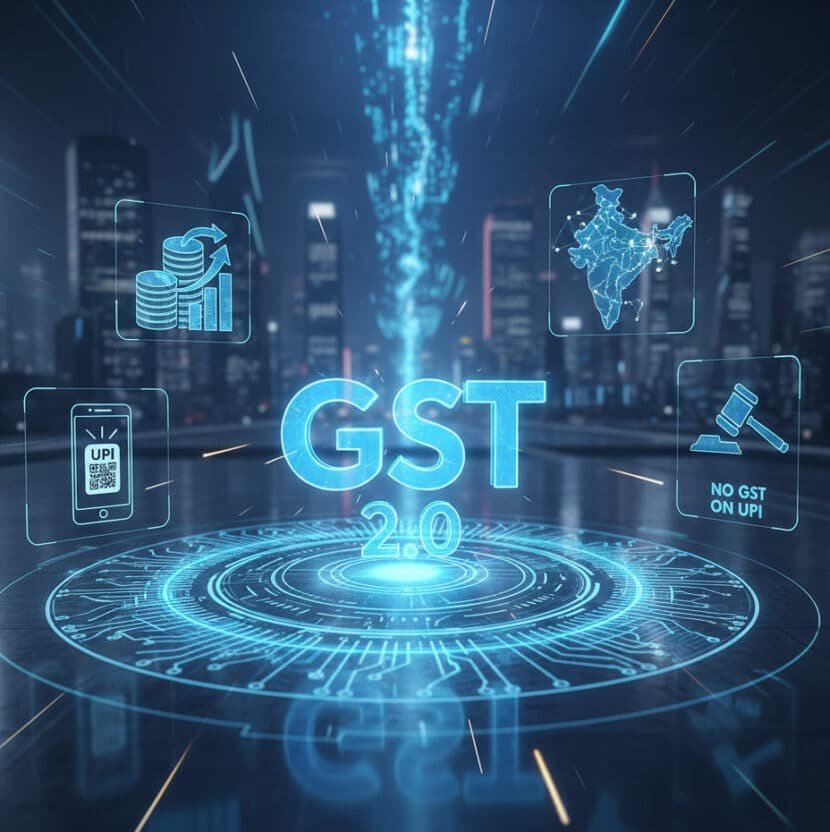
The Indian economy is standing on the cusp of another major tax reform, with GST new slabs being a key part of the discussion. After the historic implementation of the Goods and Services Tax (GST) in 2017, the government is now actively considering “GST 2.0” – a significant overhaul that proposes to streamline the current multi-layered tax structure into a simpler, two-slab system.
This isn’t just bureaucratic jargon; it’s a change that could fundamentally alter your monthly budget. From the price of your morning bread to the cost of your next smartphone, the ripple effects of this GST slab rationalization will be felt in every Indian household. But what exactly is this new system, and how will it translate into real-world savings or expenses for you, the common person?
This definitive guide will break down everything you need to know about the proposed GST 2.0. We’ll explore the current tax maze, unveil the blueprint for the new two-slab structure, and most importantly, analyze the tangible impact on your wallet. Let’s dive deep into the future of GST in India.
The Current GST Maze: Why Do We Need a Change?
To understand where we’re going, we first need to understand where we are. The current GST regime, while a massive improvement over the previous labyrinth of VAT, Service Tax, and Excise duties, is still quite complex. It operates on a multi-slab structure, primarily consisting of five rates:
- 0% (Exempt): This includes essential, unbranded food items like fresh milk, vegetables, atta, and services like healthcare and education.
- 5%: Applied to essentials like sugar, tea, coffee, packaged food items, and basic clothing.
- 12%: Covers items like butter, ghee, mobile phones, and certain processed foods.
- 18%: This is the standard rate that applies to a vast majority of goods and services, including electronics, soaps, toothpaste, restaurant bills, and most professional services.
- 28%: Reserved for luxury items and ‘sin’ goods, such as high-end cars, air conditioners, and tobacco products.
On top of these rates, there’s also a GST Compensation Cess on certain sin and luxury goods. While this system was designed to be progressive, it has created several challenges:
- Complexity and Confusion: For both businesses and consumers, figuring out the correct GST rate for different products can be confusing. This complexity often leads to classification disputes and compliance issues.
- Inverted Duty Structures: In some sectors, the tax on raw materials is higher than the tax on the finished product. This creates a cash-flow problem for businesses as they accumulate input tax credit (ITC) that they can’t fully utilize.
- Inflationary Pressures: The 12% and 18% slabs are often seen as being close enough to cause classification debates. Merging them could streamline the process and potentially lower the tax burden on many common-use items, helping to control inflation.
The need for GST slab rationalization isn’t just about making life easier; it’s about creating a more efficient, transparent, and economically sound indirect tax system for India.
Unveiling GST 2.0: The Proposed Two-Slab System
The buzz around GST 2.0 centers on a radical simplification: collapsing the current 5%, 12%, and 18% rates into just two standard rates. While the exact final rates are still under deliberation by the GST Council, the most discussed model proposes the following structure:
- A Lower Rate (likely 8-10%): This slab would cover many of the items currently in the 5% and 12% brackets. Think essential goods, basic services, and items of mass consumption.
- A Standard Rate (likely 18-20%): This would become the new default rate for most goods and services, absorbing the bulk of items currently taxed at 18% and some from the 12% slab.
- Exempt and High-Rate Slabs to Remain: The 0% slab for essential, unprocessed food items and critical services is expected to continue. Similarly, the 28% slab for luxury and sin goods (like luxury cars, pan masala, etc.) will likely be retained to ensure higher taxes on demerit goods.
So, the new structure would essentially look like this: 0%, 10%, 20%, and 28% (hypothetical rates for illustration). The core idea is to have one lower rate for essentials and one standard rate for everything else, with the exception of exempt and luxury categories.
What’s the Goal of This New System?
The government and the GST Council are aiming for several key benefits with this reform:
- Simplicity: A two-slab system is infinitely easier to understand, administer, and comply with.
- Reduced Disputes: Fewer slabs mean fewer classification disputes between businesses and tax authorities.
- Improved Efficiency: It will streamline the entire tax collection and ITC process, making the system more robust.
- Revenue Neutrality: The goal is to set the new rates in a way that the government’s overall tax collection remains the same (revenue neutral), avoiding a shock to the national exchequer.
The Big Question: How Will GST 2.0 Impact Your Monthly Budget?
This is the million-rupee question for every Indian household. The impact won’t be uniform; it will depend entirely on your consumption patterns. Let’s break down the potential effects on different categories of your household expenses.
1. Your Grocery and Kitchen Bill: A Mixed Bag
This is where things get interesting. Your monthly grocery bill is a mix of items from different tax slabs.
What Could Get Cheaper?
- Items moving from 12% to the new lower rate (e.g., 10%): You could see a slight price drop in products like butter, ghee, cheese, and processed foods like fruit juices. If a 1kg pack of ghee costs ₹600 (inclusive of 12% GST), the base price is ~₹536. At a new 10% rate, the final price would be ~₹590, a saving of ₹10 per pack. These small savings on multiple items can add up over a month.
What Could Get More Expensive?
- Items moving from 5% to the new lower rate (e.g., 10%): This is the change that could pinch your budget. Essentials like sugar, tea, coffee, spices, and packaged paneer, which are currently taxed at 5%, would see a significant tax jump. A ₹50 pack of tea (inclusive of 5% GST) has a base price of ~₹47.6. At a new 10% rate, the price would climb to ~₹52.4. While it seems small, the cumulative effect on your monthly ration will be noticeable.
What Will Remain Unchanged?
- The 0% Brigade: Your basic, unbranded essentials like fresh vegetables, fruits, milk, atta, rice, and pulses will likely remain exempt from GST. This is a crucial cushion for every household’s budget.
Verdict for Groceries: Expect a slight increase in your overall monthly grocery bill, as the price hike on 5% items might outweigh the savings on 12% items for a typical middle-class family.
2. Electronics and Home Appliances: Potential for Savings
This is one area where consumers might have a reason to cheer.
- The Current Situation: Most electronics – smartphones, laptops, TVs, refrigerators, and washing machines – currently fall under the 18% or 28% slabs (for items like ACs).
The GST 2.0 Effect:
- If the new standard rate is set at 18%, there would be no change for most electronics.
- However, if the government decides to merge the 12% and 18% slabs into a new, lower standard rate, say 17%, it could lead to direct savings.
- More significantly, there’s a long-standing demand to move some “essential” home appliances like TVs (up to a certain size) and refrigerators from the 28% slab to the standard rate. If this happens under GST 2.0, the price drop could be substantial. A refrigerator costing ₹35,000 (inclusive of 28% GST) would have a base price of ~₹27,343. If it moves to an 18% slab, the new price would be ~₹32,265 – a direct saving of nearly ₹2,700!
Verdict for Electronics: The impact hinges on the final standard rate and the reclassification of items from the 28% slab. There is a strong potential for prices to either remain stable or decrease, making big-ticket purchases more affordable.
3. Services: Dining Out, Travel, and More
From your restaurant bill to your phone bill, services form a big chunk of urban monthly spending. Most services are currently taxed at 18%.
- Restaurants: A standard non-AC restaurant bill currently attracts 5% GST (without ITC), while AC restaurants and those in high-end hotels fall under the 18% slab. The new system could simplify this. If the 18% slab is maintained or slightly reduced, you may not see a huge change. However, streamlining the rates could lead to more clarity.
- Telecom and Internet Bills: Currently at 18%, your mobile and Wi-Fi bills will only get cheaper if the new standard rate is set below 18%. A move to 20% would mean a slight increase in your monthly digital expenses.
- Travel: Air travel (economy class) and app-based cab services currently attract 5% GST. If these are moved to the new lower slab of 10%, your travel costs would directly increase. A ₹5,000 flight ticket would become ₹5,238 (approx).
- Insurance Premiums and Banking: These services are at 18%. The impact depends entirely on where the new standard rate settles.
Verdict for Services: This is a very sensitive area. An increase in the tax rate for services like travel and telecom could be unpopular, as these are no longer luxuries but essentials for the modern Indian. The government will have to tread carefully here.
4. Healthcare and Education: The Safety Net
Good news here. Core healthcare services (hospital room rent, doctor consultations) and educational services are currently in the 0% GST bracket, and this is almost certain to continue under the new GST rules. The government has consistently shielded these critical sectors from taxation to ensure affordability and accessibility for all.
However, it’s important to note that medicines are taxed (mostly at 5% and 12%). A re-jig of these slabs could slightly alter your pharmacy bills. Medicines currently at 5% could become more expensive if moved to a 10% slab.
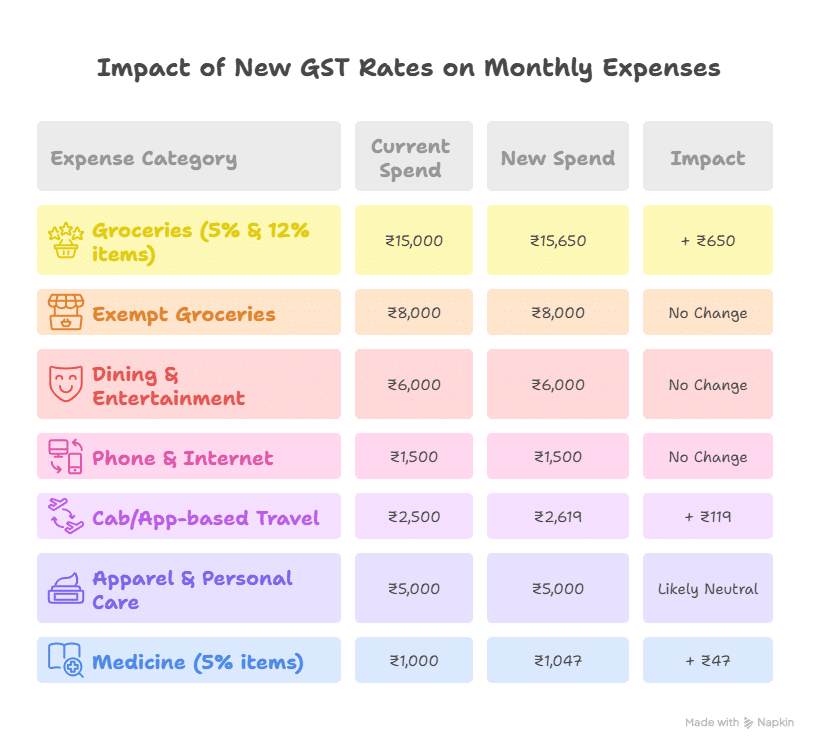
GST new slabs Monthly Budget: Before and After GST 2.0
Let’s put it all together with a sample monthly budget for a family of four.
| Expense Category | Current Monthly Spend (with Current GST) | Assumed New GST Rate | Potential New Monthly Spend | Impact |
| Groceries (5% & 12% items) | ₹15,000 | Moved to 10% | ₹15,650 | +₹650 |
| Exempt Groceries (Milk, Veggies) | ₹8,000 | 0% | ₹8,000 | No Change |
| Dining Out & Entertainment | ₹6,000 | Maintained at 18% | ₹6,000 | No Change |
| Phone & Internet Bills | ₹1,500 | Maintained at 18% | ₹1,500 | No Change |
| Cab/App-based Travel | ₹2,500 | 5% -> 10% | ₹2,619 | +₹119 |
| Apparel & Personal Care | ₹5,000 | 12% & 18% items averaged | ₹5,000 | Likely Neutral |
| Medicine (5% items) | ₹1,000 | 5% -> 10% | ₹1,047 | +₹47 |
| Total Monthly Expenses | ₹39,000 | ₹39,816 | ~+₹816 |
Disclaimer: This is a simplified, hypothetical calculation. The actual impact will vary widely based on your specific spending habits, the final rates decided by the GST Council, and which items are moved into which slabs.
The key takeaway is that for most middle-class families, the immediate impact of GST 2.0 could be a slight increase in the monthly budget, driven primarily by the rise in tax on essential goods currently in the 5% slab.
The Broader Picture: Pros and Cons for the Consumer and the Economy
While our focus is on the monthly budget, it’s crucial to understand the larger economic context of this proposed reform.
Potential Pros of GST 2.0
- ✅ Reduced Inflation in the Long Run: While there might be initial price shocks, a simpler system with fewer tax slabs is globally proven to be less inflationary over time. It reduces cascading effects and improves business efficiency, which can translate to lower prices for consumers.
- ✅ Greater Transparency: With just two main rates, it will be much easier for you, the consumer, to know how much tax you are paying on a product. This reduces the chances of being overcharged.
- ✅ Boost to the Economy: A simplified tax structure is a major plus for ‘Ease of Doing Business’. It encourages compliance, reduces litigation, and can attract more investment, leading to job creation and economic growth in the long term.
Potential Cons of GST 2.0
- ❌ Higher Burden on the Poor: The biggest criticism is that moving essential items from 5% to a higher slab (like 10%) would disproportionately affect lower-income households, as a larger portion of their income is spent on food and basic necessities.
- ❌ Initial Teething Problems: Any major tax system change comes with a period of adjustment. Businesses will need to update their software and accounting practices, which could lead to temporary disruptions.
- ❌ Risk of Revenue Shortfall: If the new rates are not calculated perfectly, there’s a risk of the government’s revenue falling short, which could impact public spending on infrastructure and social schemes.
Conclusion
The move towards a two-slab GST system is a significant and logical step in India’s tax reform journey. It promises a future of simplicity, transparency, and economic efficiency.
However, for the average consumer, the transition to GST 2.0 will require a period of adjustment. While the potential for savings on electronics and other big-ticket items is real, the likely increase in the cost of daily essentials is a valid concern that will directly impact your monthly budget.
The final shape of the new system rests with the GST Council. The success of this monumental reform will depend on their ability to strike a delicate balance: simplifying the tax structure while protecting the common person from inflationary shocks.
As a consumer, the best thing you can do is stay informed. Keep an eye on the announcements from the GST Council, understand how the changes will affect the products you buy most often, and be prepared to adjust your budget accordingly. The era of GST 2.0 is coming, and being prepared is the best way to navigate it.
FAQs
When will the new GST 2.0 two-slab system be implemented in India?
There is no official implementation date yet. The proposal is currently under review by the Group of Ministers (GoM) and will be debated and finalized by the GST Council. Most experts believe it could be rolled out sometime in 2025, but it depends on political consensus and economic conditions.
Will gold and jewellery become cheaper under the new GST system?
Gold and jewellery currently have a special GST rate of 3%. It is highly likely that this special rate will be maintained and kept separate from the standard two-slab structure. Therefore, you should not expect a major change in gold prices due to this specific reform.
Will my restaurant bills go up with GST 2.0?
It depends. Most restaurant services are currently taxed at 5% or 18%. If the new system has a lower slab at 10% and a standard slab at 18%, your bill might increase if you dine at places currently charging 5% GST. For places already charging 18%, the bill would remain the same. The goal is to simplify the taxation, not necessarily increase it across the board.
Will petrol and diesel come under the new GST system?
This is the billion-dollar question. While there is a strong demand from the industry to bring petrol and diesel under GST, it’s a complex decision due to the high revenue states earn from VAT on fuel. It is unlikely that petrol and diesel will be included in the initial rollout of the two-slab system. This reform is separate from the slab rationalization being discussed.
What is the main benefit of GST 2.0 for a common person?
In the short term, the benefits might seem mixed. However, in the long term, the primary benefit is a more efficient and less inflationary economy. A simpler tax system reduces business costs, which can eventually lead to more stable or even lower prices for goods and services. It also brings much-needed transparency, allowing you to clearly see the tax component on your purchases.
How will this new GST system affect small businesses?
For small businesses, the new system is expected to be a major relief. Fewer tax slabs mean significantly simpler compliance, easier accounting, and fewer classification errors. This reduces the administrative burden and costs associated with GST filings, allowing them to focus more on their core business operations.