If you run an import or export business in India, there is a specific ritual you probably perform every morning. Before you check your emails, before you have your first coffee, you check your phone for one number: the USD/INR exchange rate.
And depending on that number, your day either starts with a sigh of relief or a knot in your stomach.
It’s the hidden anxiety of international trade. You could run the tightest ship, have the best products, and negotiate the best deals, but an external force you have absolutely no control over—the currency market—can wipe out your profit margins overnight.
A sudden depreciation of the Rupee makes imports significantly more expensive. A sharp appreciation eats into the revenue of exporters. This volatility isn’t just a nuisance; it’s a fundamental business risk that can turn a profitable quarter into a loss-making one.
But here is the good news: you don’t have to be a passive victim of the forex markets. Just as you insure your warehouse against fire or your shipments against theft, you can insure your profits against currency fluctuation.
This is called Currency Hedging.
This guide is written for the business owner, not the Wall Street trader. We are going to strip away the complex jargon of finance and look at hedging as a practical, essential tool for stabilizing your business in an unstable world. By the end of this article, you will understand not just what hedging is, but how to implement a strategy that lets you sleep better at night, knowing your hard-earned margins are protected.
What Exactly is Currency Hedging? (The “Insurance” Analogy)
Let’s start by debunking a common myth: Currency hedging is NOT about trying to make money from currency movements. It is not speculation. In fact, it is the exact opposite.
Hedging is about removing uncertainty.
Think of it like car insurance. You don’t buy car insurance hoping you get into an accident so you can get a payout. You buy it so that if an accident happens, the financial impact doesn’t bankrupt you. You pay a small, known cost (the premium) to avoid a potentially massive, unknown cost.
Currency hedging works on the same principle. It involves taking a financial position today to “lock in” an exchange rate for a future date.
When you hedge, you are essentially saying, “I am happy with today’s rate (or a rate close to it), and I am willing to give up the chance that the rate might get better for me in the future, just so I can guarantee it won’t get worse.”
You are trading the potential for windfall gains for the certainty of protected margins. For most businesses operating on tight margins, that certainty is priceless.
Why Do Indian Businesses Need to Hedge? (The INR Context)
If the Indian Rupee was perfectly stable against major currencies like the USD, Euro, or Pound, this article wouldn’t need to exist. But as anyone trading in India knows, the Rupee is anything but stable.
The Historic Volatility of the Rupee
The Indian Rupee is classified as an emerging market currency. It is sensitive to a vast array of global and domestic factors:
- Crude Oil Prices: Since India imports a massive amount of its oil, high oil prices demand more dollars, weakening the Rupee.
- Global Interest Rates: When the US Federal Reserve raises interest rates, capital often flows out of emerging markets like India back to the US, depressing the Rupee.
- Domestic Inflation and RBI Policy: The Reserve Bank of India’s monetary policy plays a huge role in managing the currency’s value.
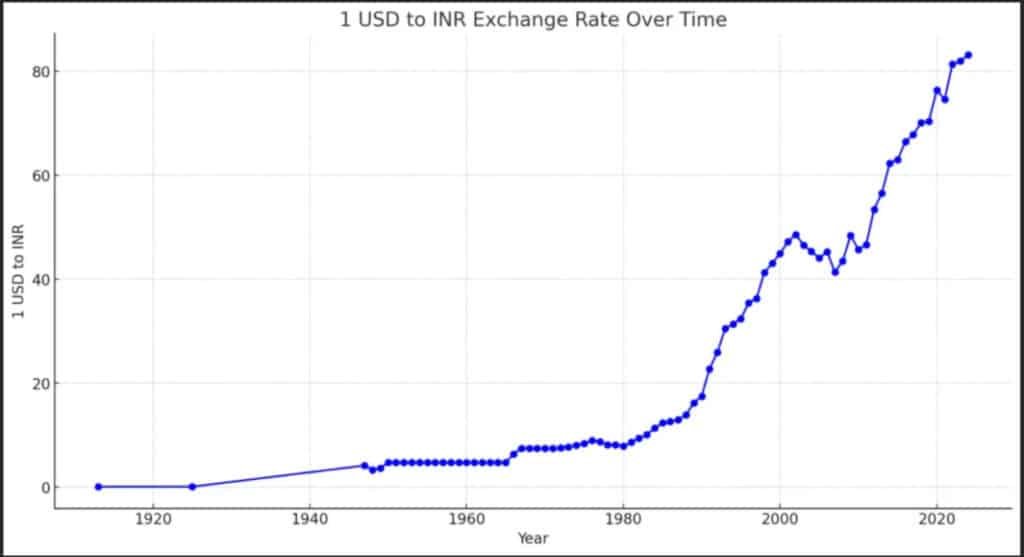
Historically, the long-term trend of the Rupee against the Dollar has been depreciating. However, in the short-to-medium term, it can swing wildly in both directions. It’s these swings that kill business planning.
The Impact on Importers: The Cost Squeeze
Let’s say you are an Indian importer buying machinery from Germany.
- You place an order today for €100,000, payable in 90 days.
- Today’s rate is 1 EUR = 90 INR. Your expected cost is ₹90,00,000. You price your final product based on this cost.
- Over the next three months, global events cause the Rupee to weaken.
- On payment day, the rate is 1 EUR = 95 INR.
- Your actual cost is now ₹95,00,000.
You just lost ₹5 Lakhs directly from your bottom line, purely because of exchange rate movement. If your net profit margin was thin to begin with, this deal might now be a loss.
The Impact on Exporters: The Revenue Shrink
Now, imagine you are an Indian software services exporter invoicing a client in the USA.
- You finish a project and invoice $100,000, expecting payment in 60 days.
- Today’s rate is 1 USD = 83 INR. You account for revenue of ₹83,00,000.
- Suddenly, foreign investment pours into India, strengthening the Rupee.
- When the payment arrives in 60 days, the rate is 1 USD = 80 INR.
- Your bank converts the dollars, and you receive only ₹80,00,000.
Your revenue just shrank by ₹3 Lakhs. Your costs (salaries, rent, electricity) stayed the same, paid in Rupees. That ₹3 Lakhs loss comes straight out of your profit.
The Danger of “Doing Nothing”
Many SME business owners practice what is known as “unhedged” trading. They simply convert currency at the spot rate (today’s market rate) whenever the payment is due or received.
This is not a strategy; it’s gambling. You are betting your business’s profitability that the exchange rate won’t move against you. In the long run, the market always wins that bet. “Doing nothing” is actively choosing to accept maximum risk.
Currency Hedging 101: The Toolkit (Your Strategies)
So, how do you stop gambling and start managing? Fortunately, there are established financial instruments designed specifically for this purpose. We will explore the most common ones used by Indian businesses, ranging from simple internal adjustments to bank-provided financial products.
1. Natural Hedging (The Simplest Form)
Before running to the bank to buy financial products, look inside your own business. A “natural hedge” occurs when your business structure naturally reduces currency risk without needing external contracts.
Matching Inflows and Outflows
Do you both import and export? If you earn USD from exports and also spend USD for imports, you have a natural hedge. Instead of converting your export earnings into Rupees and then buying Dollars later for imports, you can open an EEFC (Exchange Earners’ Foreign Currency) account in India. You keep your export earnings in dollars and use those same dollars to pay for your imports. You only convert the net difference.
Invoice in Your Local Currency (INR)
This is the ultimate hedge. If you can convince your overseas supplier to bill you in INR, or your overseas customer to pay you in INR, you have shifted the currency risk entirely to them.
While difficult to negotiate, especially with larger players in developed markets, the RBI has been pushing mechanisms to settle international trade in Rupees. It is always worth asking.
2. Forward Contracts (The Workhorse of Hedging)
For most SMEs, the Forward Contract is the most practical and commonly used hedging tool. It is simple, effective, and offered by almost every commercial bank in India.
How it Works
A Forward Contract is a customized agreement between you and your bank to buy or sell a specific amount of foreign currency on a specific future date at a predetermined fixed rate (the “Forward Rate”).
Let’s go back to our importer example:
- You owe €100,000 in 90 days. Today’s spot rate is 90 INR.
- You go to your bank today and book a “90-day Forward Contract to buy Euros.”
- The bank quotes you a forward rate of 90.50 INR (the forward rate usually includes a small premium or discount based on interest rate differentials between the two countries).
- The Lock-in: You sign the contract. You have now legally obligated yourself to buy €100,000 from the bank in exactly 90 days at the rate of 90.50.
The Outcome
It does not matter what happens in the currency market over the next three months.
- If the rate goes up to 95, you still buy at 90.50. You saved huge money.
- If the rate drops to 88, you still must buy at 90.50. You “lost” the opportunity to buy cheaper.
But remember, the goal wasn’t to get the best rate possible; the goal was certainty. By locking in at 90.50, you knew exactly what your cost would be and could budget accordingly.
Pros: High certainty, customizable dates and amounts, no upfront cost (usually just utilize bank lines). Cons: Zero flexibility. You must fulfill the contract, even if the market rate moves in your favor. You are locked in.
To better visualize how a forward contract removes uncertainty over time, let’s look at a diagram.
3. Currency Options (Insurance with a Choice)
If a Forward Contract is like a pre-paid purchase, a Currency Option is like true insurance.
An option gives you the right, but not the obligation, to buy or sell currency at a specific rate on a specific date.
Because you have a choice, you must pay an upfront fee for this privilege, called the Premium.
Types of Options:
- Call Option (For Importers): The right to buy foreign currency. You would buy a Call Option if you are afraid the foreign currency will get more expensive (Rupee depreciation).
- Put Option (For Exporters): The right to sell foreign currency. You would buy a Put Option if you are afraid the foreign currency will get cheaper (Rupee appreciation).
How it Works (The Exporter Example):
- You are an exporter expecting $100,000 in 3 months. Current spot is 83 INR. You are worried it might drop to 80 INR.
- You buy a Put Option from your bank to sell $100,000 at a “Strike Price” of 83 INR in 3 months.
- The bank charges you a premium upfront, say ₹50,000.
Scenario A: The Rupee strengthens (Bad for you). The spot rate on the expiry date drops to 80 INR.
- If you didn’t hedge, you would only get ₹80 Lakhs.
- But you have the option! You exercise your right to sell to the bank at your strike price of 83. You get ₹83 Lakhs. Your net proceed is ₹83 Lakhs minus the ₹50k premium. You are protected.
Scenario B: The Rupee weakens (Good for you). The spot rate on the expiry date goes up to 86 INR.
- If you had a Forward Contract, you would be forced to sell at 83.
- With an Option, you simply let the option expire worthless. You don’t exercise it. Instead, you sell your dollars in the open market at the higher rate of 86. You get ₹86 Lakhs minus the ₹50k premium you already paid.
Pros: Protects against downside risk while allowing you to participate in upside gains. Flexible. Cons: You must pay an upfront premium, which is a direct cost. If the market doesn’t move against you, that premium is a wasted cost (just like car insurance if you don’t crash).
To clearly understand the risk-reward profile of an option, let’s look at a payoff diagram.
4. Currency Futures (Exchange-Traded)
While Forwards and Options are usually ” Over-the-Counter” (OTC) contracts customized between you and your bank, Currency Futures are standardized contracts traded on exchanges like the NSE and BSE.
They work similarly to forwards—you lock in a rate for a future date—but they are standardized in terms of size and expiry dates. They are highly transparent and liquid.
However, futures require you to maintain a “margin” account and are subject to daily “mark-to-market” settlements, which can create cash flow headaches for smaller businesses. For most SMEs, bank-offered Forward Contracts are simpler to manage than exchange-traded futures.
Developing Your Hedging Policy: A Step-by-Step Guide
You don’t need a Ph.D. in finance to create a hedging policy. You just need a disciplined approach. Here is a four-step framework to get started.
Step 1: Identify Your True Exposure
Before you hedge, you need to know what you are hedging.
- Calculate your Net Exposure: Don’t just look at one invoice. Look at your total expected inflows and outflows over the next 3, 6, and 12 months in each currency.
- Identify the Timing: Knowing when the money is coming or going is crucial. A $50,000 payment due next week has a different risk profile than one due in six months.
- Factor in Natural Hedges: If you have offsetting flows, subtract them to find your net exposure.
Step 2: Determine Your Risk Tolerance (The “Sleep Test”)
This is subjective. How much loss can your profit margins absorb before your business is in trouble?
- If your margins are razor-thin (e.g., 5%), a 3% swing in currency could wipe out most of your profit. You need a high percentage of hedging (e.g., hedging 80-100% of your exposure).
- If your margins are fat (e.g., 30%), you might be able to tolerate more volatility and hedge less (e.g., 50%), or use Options to capture potential upside.
Step 3: Choose the Right Instrument
Now that you know your exposure and risk tolerance, choose your tool. Don’t overcomplicate it. For 90% of SMEs, plain vanilla Forward Contracts are the best starting point.
Here is a simple decision tree to help you decide which instrument might be best for a specific transaction.
Step 4: Execute, Monitor, and Review
Hedging is not a “set it and forget it” activity.
- Execution: Once you decide to hedge, call your bank’s treasury desk. Get quotes. Book the contract. Ensure the paperwork (under FEMA regulations) is in order.
- Monitor: Keep track of your hedges against your underlying trade exposures. If a shipment is delayed, you might need to “roll over” (extend) your forward contract, which comes at a cost.
- Review: Every quarter, sit down and review your policy. Did it work? Did you over-hedge? Did you under-hedge? The market changes, and your business changes; your policy should evolve too.
Common Mistakes to Avoid
Even smart business owners get hedging wrong. Here are the most common traps:
- Confusing Hedging with Speculation: This is the biggest sin. Don’t try to “beat the market.” If you book a forward contract at 83, and the rate goes to 85, don’t beat yourself up. You didn’t “lose” ₹2. You achieved your goal of locking in your budgeted cost. The moment you start regretting hedges because the market moved in your favor, you have started speculating mentally.
- Waiting for the “Perfect Rate”: “The Rupee is at 83.50 today. I’ll wait for it to hit 83.00 before I book a forward.” This is a classic trap. The market could just as easily move to 84.00. Hedging is about discipline, not timing the market.
- Ignoring the Costs: Hedging isn’t free. Forward rates include a premium/discount. Options have upfront premiums. Banks charge margins. Always calculate the “all-in cost” of the hedge to ensure it doesn’t eat up too much margin itself.
Working with Banks and Forex Advisors in India
In India, currency hedging is strictly regulated by the Reserve Bank of India (RBI) under the Foreign Exchange Management Act (FEMA). You cannot just hedge for the sake of it; you must have a genuine underlying commercial transaction (an export order or an import invoice).
- Documentation is Key: Your bank will require proof of the underlying transaction (purchase orders, invoices, shipping bills) before they can book a hedge for you.
- Build a Relationship with the Treasury Desk: Don’t just talk to your relationship manager. Ask to speak to the bank’s forex treasury dealers. They have their ears to the ground and can provide valuable market insights (though, again, don’t let their views turn you into a speculator).
- Shop Around: Banks make money on the “spread” (the difference between the rate they get and the rate they give you). Don’t blindly accept the first rate your bank quotes. If you have significant volumes, get quotes from two different banks to keep them honest.
Conclusion: Moving from Anxiety to Control
Running an import/export business is hard enough without having to worry about global macroeconomic forces wiping out your profits.
Currency hedging is not some dark financial art reserved for multinationals. It is a fundamental business discipline. It is the difference between hoping for a profit and locking one in.
Stop starting your mornings by anxiously checking the USD/INR rate. Implement a simple, disciplined hedging policy. It might not be the most exciting part of your business, but it will be the one that lets you sleep at night, knowing that whatever the Rupee does, your bottom line is secure.
FAQs
Is currency hedging expensive for small businesses?
The cost depends on the instrument. Forward Contracts typically have no upfront cost, but the forward rate will be different from the spot rate (this difference is the cost). Options have an upfront premium, which can be significant. For most SMEs, forward contracts are a very cost-effective way to manage risk.
Can I hedge if I don’t have a confirmed order yet?
Generally, under RBI regulations, you need a firm commitment like a Purchase Order or Proforma Invoice to book a contract. However, banks can offer facilities aimed at hedging “anticipated exposures” based on your past performance, but these require more documentation and approvals.
What happens if my shipment is delayed past the forward contract date?
This is a common scenario. You will need to contact your bank before the contract expires and ask for a “rollover.” The bank will cancel the old contract at the prevailing market rate and book a new one for a new date. Be aware that there is usually a cost or gain associated with the rate difference at cancellation, plus a fee from the bank.
Isn’t it better to just wait and convert currency at the spot rate?
Over a very long period (decades), the gains and losses from spot conversions might average out. But in the short term—the timeframe that matters for your cash flow and annual profits—it is highly risky. A single bad quarter due to a currency swing can cripple a small business. “Doing nothing” is a high-risk strategy.
My bank manager says the Rupee will strengthen. Should I listen and not hedge my imports?
Bank managers and treasury experts can offer informed opinions, but nobody can predict the future. Their forecast is just an educated guess. If your business cannot afford to be wrong about that guess, you should hedge regardless of their forecast. Stick to your hedging policy, not predictions.

He founded Finance and Tax Guide to simplify complex tax and accounting topics for Indian small businesses, entrepreneurs, and individual taxpayers.
His expertise includes:
• GST Registration and Return Filing
• Income Tax Return (ITR) Filing
• TDS and TCS Compliance
• Business Bookkeeping
• Financial Accounting
• Tax Planning for Small Businesses
Every article published on Finance and Tax Guideis based on practical accounting experience and current Indian tax laws to provide accurate,
easy-to-understand financial guidance.