The rise of Virtual CFO (vCFO) services has transformed how small and mid-sized businesses access financial leadership. Instead of hiring a full-time CFO—which can easily cost six figures—companies are choosing subscription-based Virtual CFO packages that bundle strategic finance support, reporting, forecasting, and advisory into predictable monthly fees.
But for accountants, bookkeepers, and finance consultants, one big challenge remains:
How do you structure a subscription-based Virtual CFO package that clients value—and happily pay for every month?
In this comprehensive guide, you’ll learn exactly how to design, price, package, and deliver Virtual CFO services that are scalable, profitable, and irresistible to growing businesses.
Why Subscription-Based Virtual CFO Services Are in High Demand
Before we break down pricing and deliverables, let’s understand why subscription models outperform hourly billing in the CFO advisory world.
1. Businesses Want Predictable, Transparent Pricing
Entrepreneurs hate unpredictable financial costs. A fixed subscription aligns with how they already purchase key services (like SaaS, payroll, legal, and HR support).
2. Recurring Revenue Creates Stability for You
A properly structured Virtual CFO subscription gives you:
- Monthly recurring revenue (MRR)
- More predictable workloads
- Better client retention
- Higher lifetime value (LTV)
This stability matters whether you’re a solo CFO consultant or building a full advisory firm.
3. Subscription Packages Allow You to Productize Your Expertise
Instead of selling hours, you’re selling an outcome: financial clarity, improved cash flow, increased profits, and better decision-making.
This approach:
- Removes the ceiling on your earning potential
- Eliminates scope creep through clear deliverables
- Creates scalability as you add systems, automation, and team support
4. Virtual CFO Services Solve Real Problems
Today’s business owners struggle with:
- Poor cash flow visibility
- Not understanding their numbers
- Slow month-end closings
- Inaccurate reports
- No forecasting or budgeting
- Financial blind spots
A subscription-based Virtual CFO package addresses all of these pain points.
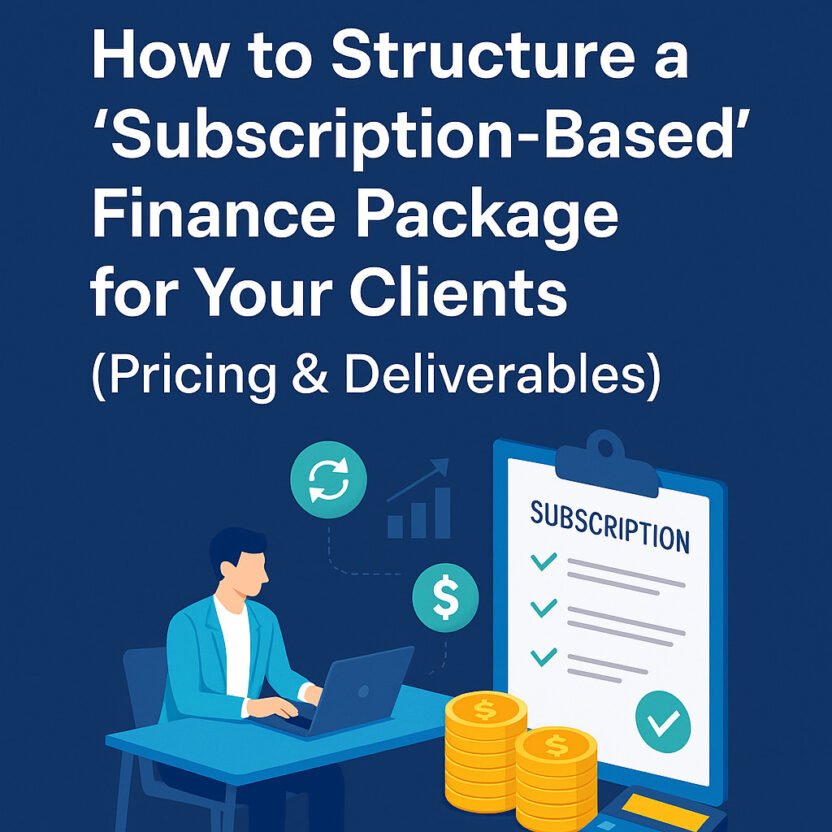
How to Design a Subscription-Based Virtual CFO Package
Your goal is to create tiered, scalable packages that clearly show increasing value at each level.
Below is a proven framework.
Step-1 Define Your Core Virtual CFO Deliverables
The best Virtual CFO packages include three categories of deliverables:
(A) Recurring Financial Management Deliverables
These include the routine, monthly essentials clients rely on:
Monthly Financial Reporting
- P&L (profit and loss)
- Balance sheet
- Cash flow statement
- Customized dashboards
- KPI scorecards
Monthly Strategy & Advisory Meetings
These meetings focus on:
- Performance review
- Cash flow analysis
- Budget vs. actuals
- Growth priorities
- Cost optimization opportunities
Cash Flow Planning & Management
- 13-week cash flow forecast
- Cash flow optimization recommendations
Forecasting & Budgeting
- Rolling forecasts
- Annual budgets
- Scenario planning (best case, worst case, expected case)
Finance System Optimization
- Improving workflows
- Implementing automation tools
- Dashboard setups
(B) Strategic Advisory Deliverables
Higher-tier subscription packages should include:
● Financial modeling
● Profit margin analysis
● Revenue forecasting
● Pricing strategy reviews
● Break-even analysis
● Operational efficiency audits
● Cost containment strategies
● Capital planning (loans, investments, fundraising)
● Board or investor-level reporting packages
These are high-value and justify premium pricing.
(C) CEO Partnership Deliverables
These deliverables position you as a strategic partner, not a spreadsheet operator:
- Unlimited email/slack support
- On-call financial guidance
- Investor call preparation
- Hiring decisions (financial impact analysis)
- Expansion planning
- Financial risk assessments
This is what separates a Virtual CFO from a bookkeeper or accountant.
Step-2 Build Tiered Subscription Packages
A high-performing Virtual CFO business usually offers three tiers:
1. Basic Subscription Package (Starter Advisory)
Best for: Small businesses under $500k–$1M revenue.
Includes:
- Monthly financial statements
- Monthly review call
- KPI dashboard (lite version)
- Cash flow overview
- Email support (limited)
Price Range:
$750 – $2,500 per month
2. Growth Subscription Package (Full vCFO Service)
Best for: Businesses $1M–$5M revenue.
Includes everything in Basic PLUS:
- Monthly forecasting
- Annual budgeting
- 13-week cash flow forecasting
- Profitability analysis
- Pricing strategy support
- Automated dashboard
- Team meeting participation
- Unlimited email support
Price Range:
$2,500 – $7,500 per month
3. Premium Subscription Package (Fractional CFO + Strategic Leadership)
Best for: Businesses $5M+ or those preparing for investment, acquisition, or rapid scaling.
Includes everything in Growth PLUS:
- Weekly CFO strategy meetings
- Fundraising support
- Investor-ready reporting
- Board meeting participation
- Deep financial modeling
- Department-level budgets
- Strategic hiring + growth planning
Price Range:
$7,500 – $15,000+ per month
This tier often includes custom pricing because each client’s needs differ.
Step-3 Decide What NOT To Include
To prevent scope creep, clearly exclude:
- Tax returns
- Bookkeeping
- Payroll processing
- HR compliance
- Accounts payable/receivable
- Audit preparation
- Legal services
If you offer these, price them separately or bundle into optional add-ons.
Step-4 Create Clear “Deliverables Lists” for Each Package
Clients should never be confused about what they’re paying for.
Use simple categories:
- What’s included
- What’s excluded
- What’s optional (add-ons)
Crystal-clear deliverables increase trust and reduce complaints.
Step-5 Create a Strong Virtual CFO Client Onboarding System
A smooth onboarding experience shows professionalism and builds confidence.
Your onboarding workflow should include:
1. Kickoff Strategy Call
Understand goals, challenges, KPIs, and priorities.
2. Document Collection
Financial statements
Bank statements
Loan documents
Payroll records
Subscription lists
Current budgets
3. Systems Audit
Analyze accounting software, chart of accounts, reporting workflows, and automation opportunities.
4. Clean-Up & Setup
This may include:
- Chart of accounts restructuring
- Dashboard setup
- Forecasting model build-out
5. First 90-Day Roadmap
This gives the CEO clarity and confidence in the process.
How to Price Virtual CFO Services (In Detail)
Your pricing should be based on:
1. Complexity of Work
Industries like manufacturing, construction, and SaaS require more advanced modeling.
2. Revenue Size
Larger companies = more transactions and deeper analysis.
3. Meeting Frequency
Weekly meetings demand a higher fee.
4. Urgency Level
Fast deadlines = premium pricing.
5. Depth of Strategy
Investor fundraising and M&A support significantly increase value.
Three Pricing Models for Virtual CFO Services
1. Fixed Monthly Subscription
This is the most common and easiest for clients to adopt.
Pros:
- Predictable recurring revenue
- Easy to scale
- Simplifies sales
Cons:
- Requires strict deliverable boundaries
2. Tiered Subscription Packages
Bronze / Silver / Gold structure.
Pros:
- Clients choose the level that fits their needs
- Allows clear upsells
Cons:
- Must be extremely well-defined
3. Custom Pricing (Quote-Based)
Used for high-growth, investor-backed, or complex companies
Pros:
- Maximum profitability
- Tailored services
Cons:
- Harder to standardize
What Makes a Virtual CFO Subscription Package Worth the Price?
1. Strategic insight—not just reporting
A great vCFO translates numbers into actions.
2. Predictive tools, not reactive spreadsheets
Forecasting and cash flow modeling provide real value.
3. Direct access to a financial expert
Clients pay for access, confidence, and guidance.
4. Consistency + communication
Regular meetings, clear dashboards, and timely reporting matter.
How to Sell Subscription-Based Virtual CFO Packages Successfully
1. Lead with Pain Points
Speak about:
- Cash flow chaos
- Poor decision-making
- No forecasting
- Unclear profitability
2. Use Value-Based Sales Language
Show the cost of NOT having a CFO.
Example:
A business losing $30k per month due to poor cash flow management will gladly pay $5k monthly for a vCFO who can fix it.
3. Offer Three Options
Studies show people choose the middle package most often.
4. Focus on Outcomes, Not Deliverables
Deliverables are the vehicle.
Outcomes are the transformation.
5. Show Before/After Examples
Demonstrate improved:
- Cash flow stability
- Profit margins
- Forecast accuracy
Should You Offer Month-to-Month or Annual Contracts?
You can offer both.
Month-to-Month
More flexible, easier to close.
Annual Subscription
Better for cash flow, higher commitment.
Offer a discount for upfront payment.
Add-On Services to Increase Revenue
These can significantly boost profit:
- Bookkeeping
- AP/AR management
- Payroll setup
- Loan application support
- SOP and system development
- CFO-level financial training for CEOs
- Pricing strategy workshops
A strong v CFO business earns 20–40% of revenue from add-ons.
Red Flags When Structuring a CFO Subscription Package
Avoid these pitfalls:
- Deliverables too vague
- Underpricing your expertise
- Becoming “available 24/7” without limits
- Taking on too many custom requests
- Mixing CFO-level work with bookkeeping work without proper pricing
Example of a Subscription-Based Virtual CFO Package (Template)
Basic Package – $1,500/month
- Monthly reporting
- KPI dashboard
- Monthly financial review call
- Email support (48-hour response)
Growth Package – $4,500/month
- Everything in Basic
- Forecasting & budgeting
- Cash flow management
- Strategic planning calls
- Pricing and profitability optimization
Elite Package – $9,500/month
- Everything in Growth
- Weekly strategy meetings
- Investor-ready financials
- Financial modeling
- Team budgeting
- Expansion planning guidance
Final Thoughts: The Future of Subscription-Based Virtual CFO Services
As businesses seek deeper insights and financial stability, the demand for Virtual CFO services continues to surge. The most successful advisors will be those who productize their expertise into clear, high-value subscription packages with predictable pricing and powerful deliverables.
By following this structure—defining deliverables, building tiered packages, pricing strategically, and emphasizing outcomes—you’ll create a Virtual CFO service model that is profitable, scalable, and highly attractive to your ideal clients.
FAQs
What does a Virtual CFO do?
A Virtual CFO provides strategic financial leadership, forecasting, reporting, cash flow management, and high-level financial guidance—without the full-time salary.
How much do Virtual CFO services cost?
Subscription packages typically range from $750 to $15,000+ per month, depending on company size, complexity, deliverables, and meeting frequency.
What should be included in a Virtual CFO subscription package?
Core deliverables include monthly financial reports, forecasting, cash flow management, KPI tracking, and CEO advisory meetings.
Do clients expect unlimited support?
No, set boundaries. Offer business-hour availability or response-time guarantees.
Can Virtual CFOs work with any industry?
Yes, but niche specialization often allows higher pricing and faster onboarding.
What tools should a Virtual CFO use?
Common tools include cloud accounting software, dashboard platforms, forecasting apps, and communication/project management tools.
How do I handle “One-Off” projects like M&A or Audit Support?
These should strictly be “out of scope.” Your engagement letter should list these as separate projects billed at a fixed fee (e.g., $5,000 for Audit Support) or a high hourly rate. Never bundle massive, unpredictable projects into a standard monthly subscription.
How many clients can one Virtual CFO handle?
This is the metric that matters. Generally, a single vCFO can handle:
8-10 “Growth” clients.
4-5 “Scaling” clients.
Or a mix. If you overload yourself, the quality drops, and churn spikes.
Do I need to be a CPA to offer Virtual CFO services?
Technically, no. CFO services are about future operational strategy, not just tax compliance. However, having a CPA or CMA designation adds significant credibility and allows you to sign off on certain financial documents that investors might require.