Choosing the right business structure in India is one of the most important decisions for any entrepreneur or startup founder. Your business structure affects taxation, compliance, liability, funding opportunities, growth potential, and long-term stability.
In this complete guide, we break down the five major types of business structures in India, along with their features, advantages, disadvantages, and a detailed comparison table.
This SEO-friendly article includes keywords like business structures in India, LLP vs Pvt Ltd, sole proprietorship, partnership firm, HUF taxation, making it ideal for ranking on search engines.
Types of Business Structures in India
1. Sole Proprietorship
A sole proprietorship is the simplest form of business where a single individual owns and manages everything.
Key Features
- No separate legal identity
- Zero formal registration
- Unlimited personal liability
- Minimal compliance
- Taxed as individual income
Best For
Freelancers, shop owners, small businesses, home-run businesses.
2. Limited Liability Partnership (LLP)
An LLP blends the flexibility of a partnership with the liability protection of a company.
Key Features
- Separate legal entity
- Partners’ liability is limited
- Moderate compliance
- Annual filing required
- Profits taxed at 30% + cess
Best For
Consultants, professionals, medium-sized service companies, bootstrapped startups.
3. Partnership Firm
A partnership firm is run by two or more persons sharing profits and responsibilities.
Key Features
- No separate legal existence
- Unlimited liability
- Requires partnership deed
- Audit required beyond limits
- Low compliance
Best For
Family businesses, small groups of partners, traditional businesses.
4. Private Limited Company (Pvt Ltd)
A Private Limited Company is the most popular structure for startups and scalable businesses.
Key Features
- Separate legal entity
- Limited liability for shareholders
- Mandatory annual audits
- Strict compliance
- Easy to raise capital
Best For
Startups, tech companies, investor-backed businesses, fast-growing companies.
5. Hindu Undivided Family (HUF)
An HUF is a family-based business entity recognized under Hindu Law for tax benefits.
Key Features
- Separate tax entity
- Managed by Karta
- Limited external funding
- Useful for tax planning
Best For
Families with shared ancestral assets and combined income sources.
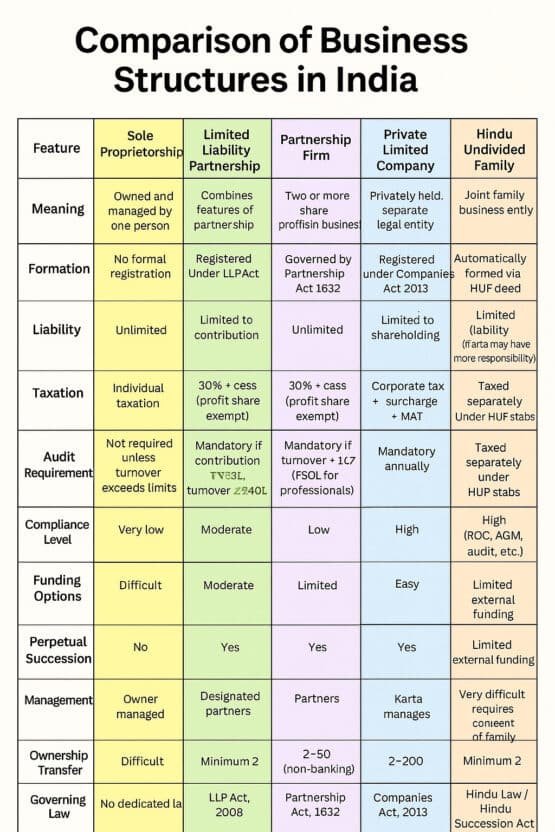
Comparison Table: Business Structures in India
| Feature | Sole Proprietorship | LLP (Limited Liability Partnership) | Partnership Firm | Private Limited Company | HUF (Hindu Undivided Family) |
|---|---|---|---|---|---|
| Meaning | Owned & managed by one person | Partnership + company hybrid | Two or more partners | Privately held legal entity | Joint family business entity |
| Legal Status | No separate entity | Separate legal entity | Not separate | Separate legal entity | Separate tax/legal entity |
| Formation | No formal registration | Registered under LLP Act 2008 | Governed by Partnership Act 1932 | Registered under Companies Act 2013 | Automatically formed via HUF deed |
| Liability | Unlimited | Limited to contribution | Unlimited | Limited to shareholding | Limited liability (Karta may have more responsibility) |
| Taxation | Individual taxation | 30% + cess (profit share exempt) | 30% + cess (profit share exempt) | Corporate tax + surcharge + MAT | Taxed separately under HUF slabs |
| Audit Requirement | Not required unless turnover exceeds limits | Mandatory if contribution ≥ ₹25L or turnover ≥ ₹40L | Mandatory if turnover > ₹1Cr (₹50L for professionals) | Mandatory annually | Mandatory if income exceeds limits |
| Compliance Level | Very low | Moderate | Low | High (ROC, AGM, audit, etc.) | Moderate |
| Funding Options | Difficult | Moderate | Limited | Easy (equity + loans) | Limited external funding |
| Perpetual Succession | No | Yes | No | Yes | Yes |
| Management | Owner managed | Designated partners | Partners | Board of Directors | Karta manages |
| Ownership Transfer | Difficult | Easy | Needs partners’ consent | Restricted transfer of shares | Very difficult; requires consent of family |
| Members Required | One | Minimum 2 | 2–50 (non-banking) | 2–200 | Minimum 2 |
| Governing Law | No dedicated law | LLP Act, 2008 | Partnership Act, 1932 | Companies Act, 2013 | Hindu Law / Hindu Succession Act |
Which Business Structure Should You Choose?
| Goal | Recommended Structure |
|---|---|
| Lowest compliance, small business | Sole Proprietorship |
| Limited liability + low compliance | LLP |
| Small traditional partnership | Partnership Firm |
| Startup funding, scalability | Pvt Ltd Company |
| Family income optimization | HUF |
Sole Proprietorship: The Solo Journey
This is the simplest form of business.
- Meaning & Structure: The business is owned and managed by one person, and there is no separate legal entity. The owner and the business are essentially the same.
- Liability: Unlimited personal liability. Your personal assets are at risk for business debts.
- Taxation: Taxed as the individual income of the owner.
- Formation: No formal registration required, usually formed by simply starting a business.
- Compliance: Minimal paperwork and maintenance.
- The Drawback: Difficult to raise funds and a lack of perpetual succession (it ends with the owner’s death/incapacity).
Partnership Firm: Sharing the Load
A classic choice for two or more individuals starting a business together.
- Meaning & Structure: Two or more share profits in a business; it’s not separate from the partners.
- Liability: Generally unlimited liability for the partners.
- Taxation: Flat 30% + cess; profit share is exempt for partners.
- Formation & Governing Law: Governed by the Indian Partnership Act, 1932.
- Audit: Mandatory if turnover exceeds ₹1 Cr (₹50L for professionals).
- Perpetual Succession: No; ends with the partner’s death unless otherwise agreed.
Limited Liability Partnership (LLP): The Best of Both Worlds
A hybrid structure combining the flexibility of a partnership with the limited liability of a company.
- Meaning & Structure: A body corporate with perpetual succession and a distinct identity.
- Liability: Limited to contribution; personal assets are protected.
- Taxation: Flat 30% + cess; profit share is exempt for partners.
- Formation: Registered under the LLP Act, 2008 with an agreement.
- Compliance: Must file Annual Return and Statement of Accounts.
- Key Advantage: Easier to raise funds than a traditional partnership and it has perpetual succession (it continues regardless of partner changes).
| Feature | Partnership Firm | Limited Liability Partnership (LLP) |
| Liability | Unlimited | Limited to contribution |
| Perpetual Succession | No | Yes |
| Governing Law | Indian Partnership Act, 1932 | LLP Act, 2008 |
Private Limited Company (Pvt Ltd): The Corporate Structure
The most popular choice for startups looking for growth, funding, and legal separation.
- Meaning & Structure: A privately held, limited liability, separate legal entity, managed by directors.
- Liability: Limited to shareholding; personal assets are secure.
- Taxation: Corporate tax rates + surcharge + MAT.
- Formation: Registered under the Companies Act, 2013. Requires DIN, DSC, MoA, etc.
- Compliance: High compliance: ROC filings, AGMs, etc. Mandatory Audit.
- Funding & Transferability: Can raise capital via equity and loans. Shares are restricted in transfer.
- No. of Members: Minimum 2, Maximum 200.
Hindu Undivided Family (HUF): The Unique Structure
A distinct structure for joint family pooling of assets.
- Meaning & Structure: Joint family pooling assets for tax benefit. Distinct legal entity, headed by the Karta, and governed by Hindu Law.
- Liability: Limited, but the Karta’s assets may be liable in some cases.
- Taxation: Taxed separately under individual slabs (with deductions).
- Formation: Automatically formed; needs HUF Deed, PAN, and bank account.
- Key Advantage: Can pool assets but limited external funding options.
- Perpetual Succession: Yes; continues with new members.
| Feature | Sole Proprietorship | LLP | Pvt Ltd |
| Liability | Unlimited Personal | Limited to Contribution | Limited to Shareholding |
| Separate Entity | No | Yes | Yes |
| Perpetual Succession | No | Yes | Yes |
| Taxation | Individual Income Tax | Flat 30% + Cess | Corporate Tax |
| Compliance | Minimal | Mandatory Filing | High Compliance (ROC, AGMs) |
| Funding | Difficult | Easier than Partnerships | Can raise Equity Capital |
Conclusion
Each business structure in India has its own strengths. For long-term scalability, Private Limited Company and LLP remain the most preferred. For simpler setups, Sole Proprietorship or Partnership Firms work well. For tax-saving by families, HUF is ideal.
FAQs
Frequently Asked Questions — Business Structures in India (2025)
What are the main types of business structures in India?
The primary business structures in India are Sole Proprietorship, Partnership Firm, Limited Liability Partnership (LLP), Private Limited Company, and Hindu Undivided Family (HUF).
Which business structure is best for startups in India?
A Private Limited Company is usually best for startups because it offers limited liability, easier fundraising, credibility with investors, and scalability. LLPs can be a good alternative for small teams seeking limited liability with fewer compliances.
What is the simplest business structure to start in India?
A Sole Proprietorship is the simplest to start—no formal registration is required, compliance is minimal, and taxation is as individual income. However, it carries unlimited personal liability.
What is the difference between an LLP and a Private Limited Company?
Both are separate legal entities. LLPs offer limited liability to partners with moderate compliance and are suited for professionals; Private Limited Companies have higher compliance, easier access to investor funding, and are ideal for scalable startups.
Is LLP better than a Partnership Firm?
Generally yes—LLP provides limited liability protection, perpetual succession, and more credibility compared to a traditional partnership firm where partners have unlimited liability.
Can a single person start an LLP in India?
No. An LLP requires a minimum of two partners. If you want to start alone, consider a Sole Proprietorship or a One Person Company (OPC) under the Companies Act.
What is the tax rate for different business structures in India?
Sole Proprietorship: taxed as individual income. Partnership & LLP: generally taxed at ~30% + cess (profit share exempt). Private Limited Company: corporate tax + surcharge + MAT as applicable. HUF: taxed as a separate entity under individual slabs.
Does a Private Limited Company require a compulsory audit?
Yes. A statutory audit is mandatory annually for a Private Limited Company regardless of turnover, which is one reason compliance levels are higher than partnerships or proprietorships.
What is an HUF and who can create it?
A Hindu Undivided Family (HUF) is a family-based entity formed under Hindu law for pooling family assets and tax planning. Any Hindu, Sikh, Buddhist, or Jain family can form an HUF; it is typically managed by the Karta.
Which business structure has the highest compliance requirements?
Private Limited Companies have the highest compliance due to ROC filings, board meetings, annual general meetings (AGM), statutory audits, accounting and record-keeping obligations.
Which business structure makes it easiest to raise funding?
Private Limited Companies are the easiest structure to raise investor funding (angel, VC, PE) and bank loans because of formal shareholding, governance, and legal clarity.
Can a business structure be changed later?
Yes. Common conversions include Proprietorship to Pvt Ltd, Partnership to LLP, and LLP to Pvt Ltd. Each conversion involves legal procedures, documentation, and potential tax implications.