Section 69 of the Income Tax Act, 1961 relates to unexplained investments — an important anti-tax evasion clause in Indian tax legislation. It confers powers on the Income Tax Officer to consider undisclosed/unexplained investments so treated as income which is liable to tax, if an assessee does not give satisfactory explanation of the source of such investments.
What is Section 69?
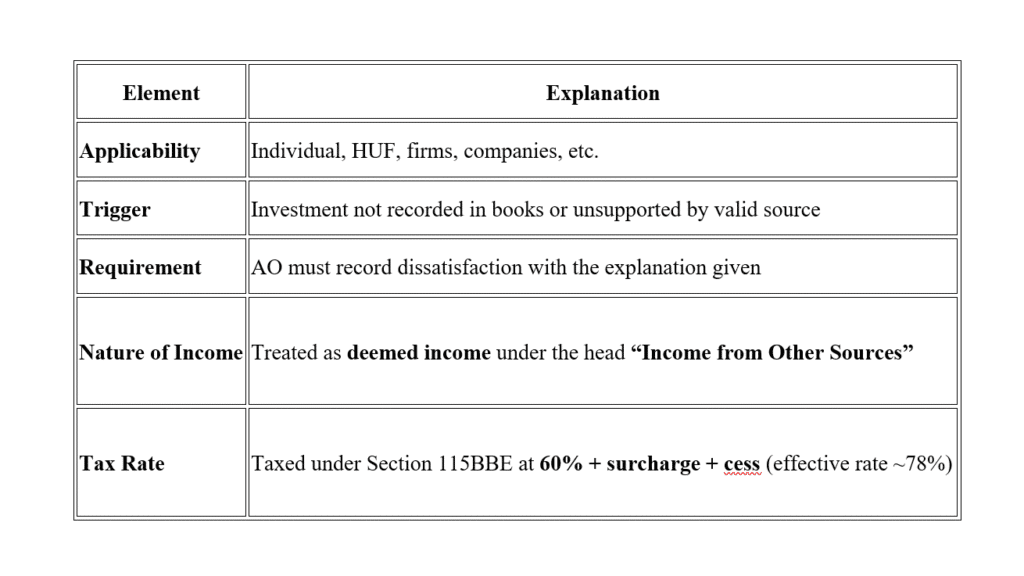
Section 69 of the Income Tax Act, 1961, deals with “Unexplained Investments” – any investments made by a taxpayer that are not recorded in books of accounts and for which no source of income is provided.
- Objective: To tax undisclosed money used for investments.
- Applicability: When investments are found during surveys, searches, or scrutiny.
🔹 Example
- Mr. X buys a property worth ₹50 lakhs but cannot explain the source.
- The Income Tax (IT) Department treats this as unexplained income and taxes it under Section 69.
When Does Section 69 Apply?
Section 69 applies if:
✅ Investment is not recorded in books (if books are maintained).
✅ Taxpayer cannot explain the source (or explanation is unsatisfactory).
✅ Investment is not declared in ITR.
⚠️ Exceptions:
- If the investment is from an exempt source (e.g., gifts, inheritance).
- If the taxpayer provides valid proof (bank statements, loan documents).
Key Conditions for Taxability
For an amount to be taxed under Section 69, the IT Department must establish:
- Existence of investment (property, gold, shares, etc.).
- No recording in books (if books are maintained).
- No satisfactory explanation of the source.
🔹 Example:
- A taxpayer owns gold worth ₹20 lakhs but has no records of purchase.
- The IT Department can treat this as unexplained investment and tax it.
How Does the IT Department Assess Unexplained Investments?
- Survey/Search: IT officials find undisclosed assets.
- Notice Issued: Taxpayer is asked to explain the source.
- Assessment:
- If explanation is valid → No tax.
- If no proof → Added to income under Section 69.
Burden of Proof: Taxpayer vs. IT Department
| Party | Responsibility |
| IT Department | Must prove investment exists & is unrecorded. |
| Taxpayer | Must provide source (loan, savings, sale of assets, etc.). |
⚠️ If taxpayer fails to explain, the amount is taxed as income.
Difference Between Section 69 and Section 68
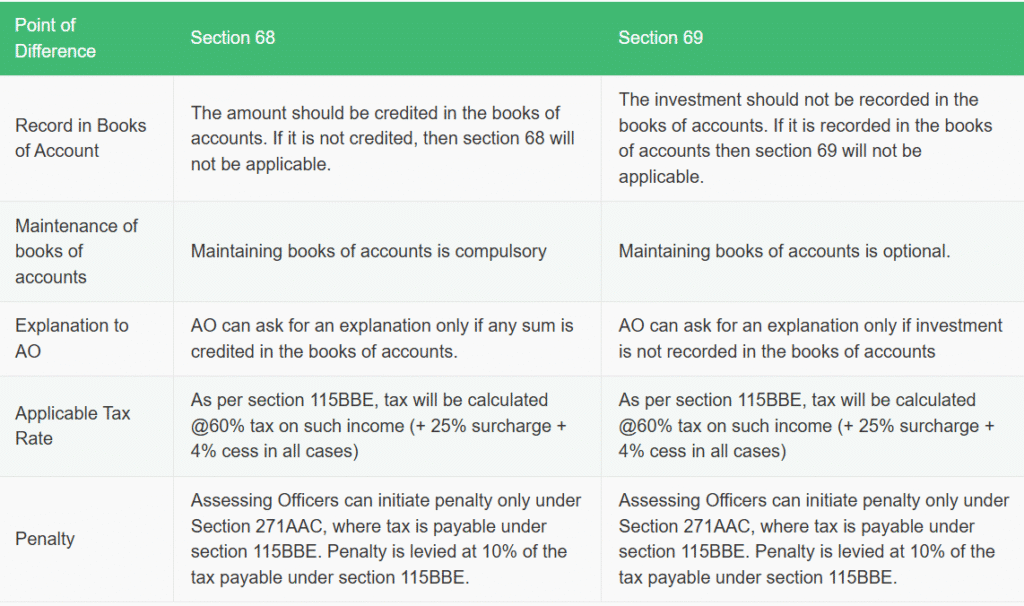
Tax Rate & Penalties Under Section 69
- Tax Rate: Unexplained investments are taxed at normal slab rates (up to 30%).
- Penalty: Up to 100% of tax evaded (under Section 271(1)(c)).
- Interest: 12% p.a. under Section 234A/B.
🔹 Example:
- Unexplained investment: ₹10 lakhs
- Tax @30%: ₹3 lakhs
- Penalty (if applied): Up to ₹3 lakhs
- Total liability: ₹6 lakhs
How to Avoid Section 69 Notices?
✔️ Maintain proper books (if required).
✔️ Declare all investments in ITR.
✔️ Keep proof (bank statements, receipts, loan docs).
✔️ Explain large transactions (gifts, inheritance).
Difference Between Section 69, 69A, 69B, 69C
| Section | Applies To |
| 69 | Unexplained investments |
| 69A | Unexplained money/jewellery (found in possession) |
| 69B | Undisclosed investments (value higher than recorded) |
| 69C | Unexplained expenses (no source of funds) |
Case Laws & Examples
- Kumar Exports vs. CIT (2009):
- Mere suspicion is not enough; IT Dept must prove concealment.
- Punjab Tractors Ltd Case:
- If books are not maintained, Section 69 does not apply.
🔹 Example:
- A businessman shows ₹5 lakh income but owns ₹1 crore property.
- If he cannot explain the source, ₹95 lakh is taxable under Section 69.
Conclusion
- Section 69 targets unexplained investments to curb black money.
- Taxpayers must keep records to avoid penalties.
- Legal advice is recommended if facing a Section 69 notice.
Pro Tip: Always disclose all assets in ITR and maintain proof of sources!
Need help with tax notices? Consult with us!
FAQs
Does Section 69 apply to cash deposits in bank accounts?
No, cash deposits are usually covered under Section 69A. Section 69 deals specifically with investments.
Can agricultural income be shown as the source of investment?
Yes, but documentary evidence like land records, sale receipts, etc. must support it.
Is it applicable only to individuals?
No, Section 69 applies to all taxpayers, including individuals, HUFs, companies, firms, etc.
What if the investment is made in the name of a relative?
The beneficial ownership is considered. If you provided the funds, you must explain the source.