Choosing the right business structure is one of the most critical decisions for entrepreneurs, consultants, startups, and SMEs in India. In 2025, this choice has become even more significant because of recent surcharge and cess updates introduced in the latest Finance Bill.
While LLP (Limited Liability Partnership) and Private Limited Company {LLP vs Pvt Ltd} remain the two most preferred structures, business owners often ask:
👉 Which is more tax-efficient in 2025?
👉 Has the new surcharge and cess revision changed the equation?
👉 Is LLP still better for small teams?
👉 Is Private Limited still best for high-growth startups?
👉 What structure helps save more tax after the latest updates?
This deeply researched, human-written guide breaks down every difference, especially focusing on tax efficiency, compliance cost, ownership flexibility, and 2025 regulatory changes.
Let’s begin.
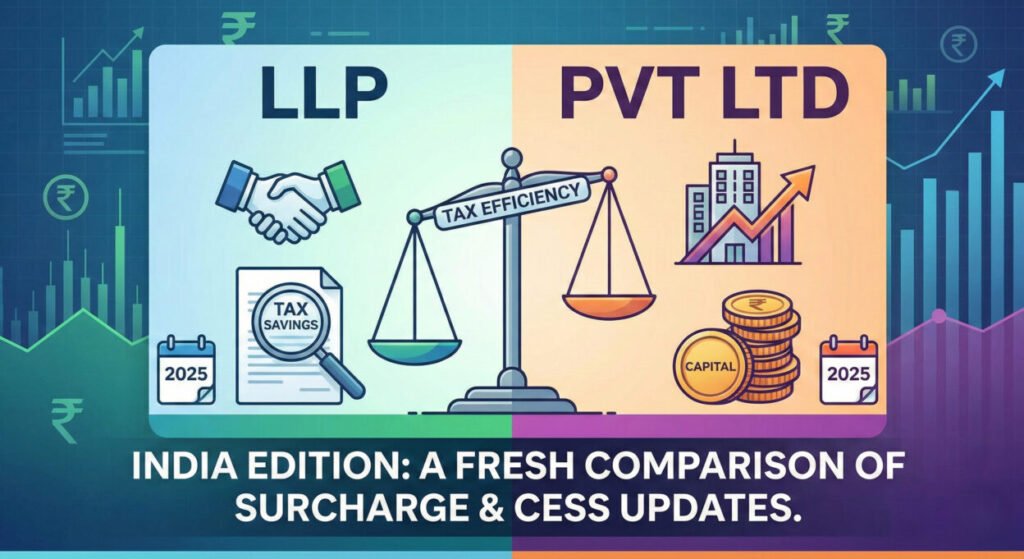
Understanding LLP vs. Pvt Ltd in 2025: A Quick Refresher
What is an LLP?
An LLP (Limited Liability Partnership) is a hybrid structure combining the operational flexibility of a partnership with the limited liability of a company.
Key characteristics of an LLP
- Partners have limited liability
- No restriction on maximum partners
- Fewer compliance requirements
- Best for consulting firms, freelancers, small businesses, family-owned operations
What is a Private Limited Company?
A Private Limited Company (Pvt Ltd) is a structured corporate entity with shareholders and directors, regulated by the Companies Act, 2013.
Key characteristics of Pvt Ltd
- Preferred by investors and VCs
- Mandatory statutory audits
- Corporate taxation norms apply
- Suitable for startups, fast-scaling businesses, technology companies
The 2025 Update What Changed in Surcharge & Cess?
The Government of India introduced several updates in the latest Financial Year 2024–25 Budget that impact corporate tax, surcharge slabs, cess calculation, and compliance thresholds.
Major changes that affect LLPs
- LLPs continue to be taxed at a flat 30%
- Surcharge updated to 12% for taxable income above the threshold
- Health & Education Cess remains at 4%
Major changes that affect Pvt Ltd Companies
- The corporate tax rate remains:
- 22% for domestic companies (no MAT applicable)
- 15% for manufacturing companies registered after Oct 2019
- Surcharge rates revised for certain income brackets
- Cess remains 4%
Why these updates matter in 2025
Because the tax outflow for LLP vs Private Limited has changed slightly based on turnover, profit margin, and applicability of surcharge.
LLP vs Pvt Ltd Tax Comparison 2025 – The Deep-Dive
This is the most important section for anyone trying to minimise taxes and maximise profitability.
Taxation Structure – LLP
| Particulars | LLP Taxation 2025 |
|---|---|
| Basic Income Tax | 30% |
| Surcharge | 12% (if income > threshold) |
| Cess | 4% |
| Dividend Distribution Tax | Not applicable |
| Partners’ Remuneration | Allowed as deduction (subject to conditions) |
| Profit withdrawal | Tax-free in hands of partners |
Why LLP can be more tax-efficient
- No double taxation
- Partners can withdraw profit without paying additional tax
- Ideal for low to medium-income businesses
Taxation Structure – Private Limited (2025)
| Particulars | Pvt Ltd Taxation 2025 |
|---|---|
| Normal Corporate Tax | 22% (no exemptions) |
| Optional Manufacturing Rate | 15% |
| Surcharge | 7% to 10% (income bracket based) |
| Cess | 4% |
| Dividend Tax | Dividend taxed at shareholder’s slab rate |
| MAT | Not applicable for 22%/15% regime |
Why Pvt Ltd is attractive for growing companies
- Lower effective tax rate for high profits
- Suitable for companies expecting external funding
- Tax benefits on ESOPs for startups
LLP vs Pvt Ltd: Tax Efficiency Comparison After 2025 Updates
To offer clarity, let’s compare the effective tax burden.
Effective Tax Outflow — LLP vs Pvt Ltd
Scenario 1: Profits up to ₹50 lakhs
| Structure | Effective Tax | Notes |
|---|---|---|
| LLP | ~30% + cess | Higher base rate |
| Pvt Ltd | ~22% + cess | More tax efficient |
👉 For profits below ₹50 lakhs, Pvt Ltd is more tax efficient.
Scenario 2: Profits between ₹50 lakhs – ₹1 crore
| Structure | Effective Tax |
|---|---|
| LLP | 30% + 12% surcharge + cess |
| Pvt Ltd | 22% + 7% surcharge + cess |
👉 Pvt Ltd continues to remain more efficient in this slab.
Scenario 3: Profits above ₹1 crore
| Structure | Effective Tax |
|---|---|
| LLP | Highest tax incidence due to 30% base rate |
| Pvt Ltd | Lower tax due to 22% base rate |
👉 Pvt Ltd is significantly more tax-friendly for high-profit companies.
Non-Tax Considerations That Influence the Decision (2025)
Compliance Requirements
| Parameter | LLP | Private Limited |
|---|---|---|
| Statutory Audit | Only if turnover > ₹40 lakhs | Mandatory |
| ROC Filings | Minimal | Extensive |
| Annual Cost | Low | High |
Summary
- LLP = low compliance cost
- Pvt Ltd = high compliance but better governance structure
Funding & Investment
| Factor | LLP | Pvt Ltd |
|---|---|---|
| Venture Capital | Not preferred | Highly preferred |
| ESOPs | Not allowed | Allowed |
| Equity dilution | Not flexible | Highly flexible |
Ownership Flexibility
LLP
- Partners directly manage operations
- Profit-sharing ratios flexible
Private Limited
- Separation of ownership and management
- Shares can be transferred
LLP vs Pvt Ltd in 2025 Which One Should You Choose?
Choose LLP if…
- You run a small or medium consulting firm
- You want minimal compliance burden
- You want to withdraw profits without extra tax
- You do not need external investors
Choose Pvt Ltd if…
- You plan to scale rapidly
- You need investment or bank funding
- You expect profits above ₹50 lakhs
- You want to build a structured corporate entity
2025 Tax Rules Impact Key Takeaways
- Pvt Ltd companies continue to enjoy lower tax rates
- LLPs face a higher flat tax impact
- Profit withdrawal is tax-free in LLPs
- Dividends in Pvt Ltd are taxed in shareholder hands
- Surcharge updates slightly impact high-income companies
The Core Dilemma: Structure vs. Strategy
Before we open the tax rulebook, we need to understand the structural DNA of these two entities.
The Private Limited Company (Pvt Ltd) is the poster child of the corporate world. It is treated as a separate legal person distinct from its owners. It can hold property, sue, be sued, and crucially, it can issue stock. This makes it the only viable vehicle for startups seeking Venture Capital (VC) funding. Investors want equity, and you can’t give them equity in an LLP easily.
The Limited Liability Partnership (LLP) is a hybrid. It offers the limited liability protection of a company (your personal house isn’t at risk if the business fails) but maintains the operational flexibility of a partnership. It is less rigid. There are no mandatory board meetings, no shareholders, and significantly less paperwork.
The “Human” Choice
- Choose Pvt Ltd if: You are building a scalable startup, plan to raise VC money, or want to keep profits inside the company for growth.
- Choose LLP if: You are a service provider (agency, consultant, developer), a family business, or a bootstrapped founder who wants to take profits home every year.
The 2025 Tax Showdown: Headline Rates vs. Real Outflow
This is where the confusion happens. Most founders look at the “Headline Tax Rate” and assume the Pvt Ltd is the winner. Let’s break down why that is a dangerous assumption in 2025.
1. The Private Limited Advantage (Section 115BAA)
Since the corporate tax cuts, domestic companies can opt for Section 115BAA. This is a game-changer that allows companies to forego certain exemptions in exchange for a lower rate.
- Base Tax Rate: 22%
- Surcharge: Flat 10% (irrespective of income level)
- Health & Education Cess: 4%
- Effective Tax Rate: 25.168%
If you are a new manufacturing company (registered after Oct 2019 and starting production before March 2024), you might even hit 17.16% under Section 115BAB.
Visually, 25.17% looks much better than 30%. But wait.
2. The LLP Reality (Flat Rate)
LLPs do not get the benefit of slab rates or the reduced 22% corporate rate.
- Base Tax Rate: Flat 30% on every rupee of profit.
- Surcharge: 12% (Only applies if Total Income > ₹1 Crore).
- Health & Education Cess: 4% on Tax + Surcharge.
- Effective Tax Rate (Income < ₹1 Cr): 31.2%
- Effective Tax Rate (Income > ₹1 Cr): 34.944%
At a glance, the LLP seems to be losing. It pays roughly 6% to 9% more tax on profits than a Pvt Ltd.
3. The “Double Taxation” Trap
Here is the catch that ruins the Pvt Ltd party for many small business owners: Getting the money out.
In a Pvt Ltd, the company pays 25.17% tax. The remaining money belongs to the company, not you. To get it into your personal bank account, you must declare a Dividend.
- Dividends are taxable in your personal hands at your slab rate.
- If you are a high earner, you are likely in the 30% slab (plus surcharge).
- Total Tax Load: Company Tax (25.17%) + Personal Tax on Dividend (up to 35.8%). The combined tax impact can exceed 50%.
In an LLP, the structure is “Single Layer Taxation.”
- The LLP pays ~31.2% tax.
- Profit Distribution: The post-tax profit distributed to partners is 100% Tax-Free under Section 10(2A).
- Once the LLP pays the tax, the money is yours. No dividend tax. No confusion.
Mathematical Scenarios: Who Wins?
Let’s run the numbers for a generic scenario to see who actually saves money.
Scenario A: The “Bootstrapped” Founder
- Profit before Tax: ₹50 Lakhs.
- Goal: Founder wants to take all money home.
Option 1: Pvt Ltd (New Regime)
- Corporate Tax: ₹50L * 25.168% = ₹12,58,400.
- Remaining Cash: ₹37,41,600.
- Dividend Distribution: To take this home, you declare a dividend.
- Personal Tax (Assume 30% slab + 4% cess): ₹37,41,600 * 31.2% = ₹11,67,379.
- Total Tax Paid: ₹12.58L + ₹11.67L = ₹24.25 Lakhs.
- Total Effective Tax: ~48.5%
Option 2: LLP
- LLP Tax: ₹50L * 31.2% (30% + 4% cess, No Surcharge) = ₹15,60,000.
- Remaining Cash: ₹34,40,000.
- Distribution: Withdrawn by partners Tax-Free.
- Total Tax Paid: ₹15.60 Lakhs.
- Total Effective Tax: 31.2%
Winner: LLP. By a massive margin. In this scenario, the Pvt Ltd structure destroys nearly half your wealth in taxes.
Scenario B: The “High Growth” Startup
- Profit before Tax: ₹2 Crores.
- Goal: Reinvest everything into marketing and hiring. No withdrawals.
Option 1: Pvt Ltd
- Tax: 25.168% on ₹2 Cr = ₹50.33 Lakhs.
- Money available for reinvestment: ₹1.49 Crores.
Option 2: LLP
- Tax: 30% + 12% SC + 4% Cess = ~34.94%.
- Tax Amount: ~₹69.88 Lakhs.
- Money available for reinvestment: ₹1.30 Crores.
Winner: Pvt Ltd. If you leave the money in the company, the lower corporate rate wins because you avoid the second layer of dividend tax.
Compliance and “Hidden” Costs in 2025
Tax isn’t just what you pay the government; it’s also what you pay your Chartered Accountant (CA).
Pvt Ltd: The High Maintenance Vehicle
A Private Limited company is high maintenance.
- Audit: Mandatory every year, regardless of turnover.
- Filings: AOC-4, MGT-7, DIR-3 KYC.
- Meetings: 4 Board Meetings, 1 AGM (with Minutes strictly maintained).
- Cost: Expect to pay ₹25,000 – ₹50,000+ per year in compliance fees alone, even with zero turnover.
LLP: The Low Maintenance Workhorse
- Audit: Only required if Turnover > ₹40 Lakhs OR Capital Contribution > ₹25 Lakhs. (Many small LLPs avoid audits for years).
- Filings: Form 11 and Form 8.
- Meetings: No mandatory board meetings or AGMs.
- Cost: Generally 30-40% cheaper to maintain than a Pvt Ltd.
Final Verdict LLP vs Pvt Ltd (2025 Tax Efficiency Winner)
If tax efficiency alone is considered:
For low profits (< ₹50 lakh):
➡️ Pvt Ltd wins
For medium profits (< ₹1 crore):
➡️ Pvt Ltd still wins
For high profits (> ₹1 crore):
➡️ Pvt Ltd wins decisively
But…
If your goal is simplicity, low compliance, and easy profit withdrawal, then:
➡️ LLP remains a strong contender in 2025
Your final choice must consider tax + compliance + growth + funding + ownership structure.
FAQs
Which is more tax-efficient in 2025 LLP or Private Limited?
Private Limited is generally more tax-efficient because of the 22% corporate tax rate, compared to LLP’s flat 30% rate.
Does LLP still offer tax benefits in 2025?
Yes. LLP allows profit withdrawal without extra tax, making it favorable for small teams and professional firms.
Has the surcharge update affected LLPs more than Pvt Ltd companies?
Yes. LLPs face a 12% surcharge, while Pvt Ltd companies face lower surcharge brackets.
Does Pvt Ltd pay tax on dividends?
The company doesn’t pay DDT, but shareholders must pay tax based on their personal income slab.
Which is better for startups in 2025?
Pvt Ltd is better due to funding flexibility, ESOPs, and lower corporate tax.
Which is easier to maintain: LLP or Private Limited?
LLP is easier and cheaper due to low compliance requirements.
Can an LLP be converted into a Private Limited in 2025?
Yes, the MCA still allows conversion under specific conditions.
Can I convert my LLP to a Pvt Ltd later if I get funding?
Yes, you can. However, the process (“Chapter XXI conversion”) is tedious, involves capital gains tax implications on the transfer of assets, and takes 3-6 months. If you are sure you will raise VC funding in 1-2 years, start as a Pvt Ltd. If funding is a “maybe,” start as an LLP.
Does the new Section 194T apply to drawings/profit share?
The language of Section 194T covers payments like salary, remuneration, interest, commission, or bonus. It generally does not apply to the share of profit withdrawn, as profit share is exempt under Sec 10(2A), but you must deduct TDS on the remuneration (salary) paid to partners.
How does the Surcharge impact me if my income is exactly ₹50 Lakhs?
At ₹50 Lakhs income:
Pvt Ltd (115BAA): You pay 10% Surcharge.
LLP: You pay Nil Surcharge. The LLP is significantly more efficient at this income level.
Can I pay myself a salary in a Pvt Ltd to save tax?
Yes, Directors’ Remuneration is a valid expense. However, it is taxed as “Salary” in your personal return (slab rates). It attracts TDS under Section 192. It is a good way to save Corporate Tax, but you have to balance it against your personal tax liability.
Which entity is better for valid visa/immigration purposes?
Generally, a Private Limited Company is recognized globally and may carry slightly more prestige for immigration or business visa applications compared to an LLP, although both are legal corporate entities.