For decades, the soaring glass towers of commercial real estate (CRE) were the playground of the ultra-wealthy and institutional giants. The average investor was locked out by a “velvet rope” of multi-million dollar price tags.
Today, that rope has been cut.
The rise of Fractional Ownership vs REITs (Real Estate Investment Trusts) has democratized the sector, turning “trophy assets” like Grade-A office spaces and luxury warehouses into accessible retail investments. But as these two giants clash for space in your portfolio, which one actually delivers?
Both promise passive income, diversification, and asset-backed security—but they differ fundamentally in returns, liquidity, control, taxation, risks, and how the underlying properties are managed.
In this comprehensive guide, we strip away the jargon to compare yields, lock-in periods, and tax treatments in the ultimate showdown of fractional ownership vs. REITs.
The Rise of Alternative Commercial Real Estate Investments
Investors today want real estate exposure without the hassles of full property ownership—no tenants, no maintenance, no negotiations. At the same time, they want stable yields, inflation-hedged returns, and tangible assets backing their investments.
Fractional Ownership and REITs have emerged as two powerful solutions:
- Fractional Ownership gives investors partial ownership of a real commercial property.
- REITs offer exposure to real estate through publicly listed or privately managed trusts.
Both methods democratize commercial real estate, but their mechanics—and results—are worlds apart.
What Is Fractional Ownership?
Fractional ownership allows multiple investors to co-own a commercial property—like an office floor, warehouse, retail outlet, or pre-leased Grade A building.
How it works:
- A property is purchased and legally structured into digital shares or SPV units.
- Investors buy fractional units proportional to their capital.
- They earn rental income, capital appreciation, and sometimes profit share when the property is sold.
Key characteristics:
- Direct ownership of a physical CRE asset
- 8–10%+ average rental yield
- 12–18% IRR potential in high-quality assets
- Ideal for investors seeking real asset ownership and predictable income
Fractional platforms often handle leasing, tenant management, and maintenance, making it genuinely passive.
What Are REITs?
A Real Estate Investment Trust (REIT) is a company that owns and operates income-producing properties. Investors buy shares of the trust, not the properties themselves.
How REITs work:
- REITs pool money from thousands of investors
- They invest in diversified portfolios: offices, malls, data centers, logistics parks, hotels
- REIT investors earn dividends (90% of income must be distributed)
- Shares trade like stocks—easy to buy and sell
Key characteristics:
- 5–7% dividend yields on average
- High liquidity
- Market-linked pricing (volatility)
- Excellent for investors seeking passive exposure to CRE
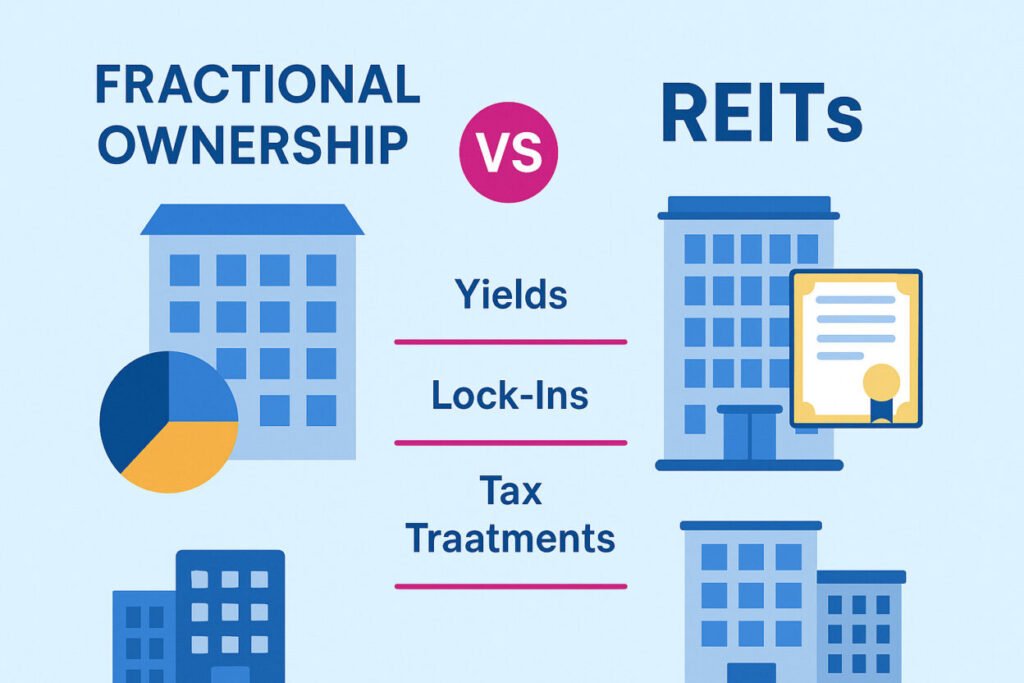
Fractional Ownership vs. REITs: Key Differences (Quick Overview)
| Feature | Fractional Ownership | REITs |
|---|---|---|
| Type of Ownership | Direct share of a property | Shares of a company owning properties |
| Avg Yield | 8–10% rental + appreciation | 5–7% dividend |
| Lock-in | 3–6 years | No lock-in (listed REITs) |
| Liquidity | Medium (secondary resale) | High (stock market) |
| Taxation | Pass-through in SPVs | Dividend + capital gains tax |
| Control & Transparency | High (property-level) | Low (portfolio-level) |
| Volatility | Low (property-based) | High (market-based) |
| Risk Profile | Asset-specific | Market & interest-rate driven |
Comparing Yields: Which Gives Better Returns?
Fractional Ownership Yields
Fractional investments typically focus on pre-leased Grade A commercial assets, which offer:
- 8–10% rental yield
- 6–10% yearly capital appreciation
- Total 12–18% IRR depending on market cycles
Because investors own the property directly, they participate in:
- Rental escalations
- Capital appreciation during sale
- Premiums from high-demand micro-markets
REIT Yields
Listed REITs in most markets offer:
- 5–7% annual dividend yield
- 3–6% capital appreciation, depending on interest rates, leasing cycles, and stock market movement
REITs must distribute 90% of earnings, making them attractive—but yields fluctuate with share price volatility.
Winner: Fractional Ownership higher yields in most cases.
Lock-In Periods: Which Is More Flexible?
Fractional Ownership Lock-Ins
Fractional ownership usually comes with:
- 3–6 year lock-in
- Early exit allowed through resale (depends on buyer demand)
This is because properties aren’t sold frequently and require a defined investment cycle.
REIT Lock-Ins
Publicly listed REITs:
- No lock-in at all
- Can be bought or sold instantly like any stock
Private REITs may have limited liquidity, but listed ones are very flexible.
⭐ Winner: REITs—best liquidity and no mandatory lock-in.
Tax Treatment: Which Saves You More Money?
Taxation in Fractional Ownership
Most fractional CRE investments are structured using SPVs (Special Purpose Vehicles), where income passes directly to investors.
Taxation applies as:
- Rental income → Individual tax slab
- Capital gains (long-term) → lower capital gains tax
- Depreciation benefits may apply (depending on structure)
Investors avoid double taxation because SPVs act as pass-through entities.
Taxation in REITs
REITs have complex tax structures:
- Dividends may be tax-free or taxable, depending on underlying SPV debt levels
- Capital gains taxed similarly to equity
- Some distributions (like interest) are taxed as regular income
Investors benefit from equity tax rules but lose transparency over expenses and income types.
⭐ Winner: Fractional Ownership—more tax-efficient for rental income and capital gains.
Liquidity Comparison
Fractional Ownership Liquidity
- Medium liquidity
- Exit possible only when:
- Another investor buys your share, or
- Property reaches end of tenure
Some platforms provide resale marketplaces but liquidity varies by asset.
REIT Liquidity
- Extremely high
- Buy or sell anytime during trading hours
- Instant settlement
⭐ Winner: REITs.
Transparency & Control
Fractional Ownership
Investors get:
- Property inspection rights
- Detailed rent rolls
- Tenant agreements
- Maintenance reports
- Quarterly updates
Because you own part of a real asset, the transparency is property-specific.
REITs
Investors see:
- Annual reports
- Portfolio summaries
- Market-driven performance
But they cannot track or inspect individual properties.
⭐ Winner: Fractional Ownership—superior transparency and control.
Asset Quality & Diversification
Fractional Ownership
You own a stake in one property, making returns dependent on:
- Tenant stability
- Location micro-market performance
- Lease duration
REITs
You automatically get diversification across:
- 10–50 buildings
- Different cities
- Multiple tenants
⭐ Winner: REITs built-in diversification reduces risk.
Fees & Costs
Fractional Ownership Fees
May include:
- Acquisition fee
- Management fee
- Exit fee
- Platform service costs
However, these fees often justify better asset curation and management.
REIT Fees
- Minimal transaction fees (brokerage)
- Internal management expenses already deducted before dividends
⭐ Winner: REITs for lower visible fees.
Risk Comparison
Fractional Ownership Risks
- Tenant default
- Vacancy during exit
- Property-specific issues
- Liquidity constraints
But property value tends to remain stable even in downturns.
REIT Risks
- Stock market volatility
- Interest rate sensitivity
- Regulatory changes
- Market sentiment swings
REIT prices can drop even when properties perform well.
⭐ Winner: Fractional Ownership—lower volatility and asset-based stability.
Which Investor Profile Suits Which Option?
Fractional Ownership Is Ideal For:
- Investors seeking high yields
- Those wanting direct property exposure
- Long-term investors (3–6 years)
- Investors who prefer stability over liquidity
REITs Are Ideal For:
- Investors wanting flexible entry/exit
- Beginners exploring real estate with small amounts
- People who prefer stock-based liquidity
- Investors who do not need control over asset selection
Round 1: The Yield War Rental Income vs. Dividends
When investing in commercial real estate, the primary goal is often passive income. Here is how the yields stack up.
Fractional Ownership: High-Octane Yields
Fractional ownership typically focuses on single assets with high-quality tenants (e.g., global banks or tech firms).
- Target Yield: Often ranges from 8% to 11% annually.
- The Edge: Because you have direct exposure to the rent paid by the tenant, the “leakage” to administrative overhead is lower. You capture the full strength of the lease.
REITs: Lower, but Diversified Payouts
REITs are legally mandated to distribute at least 90% of their taxable income to shareholders.
- Target Yield: Typically ranges from 5% to 7% annually.
- The Catch: REITs manage large portfolios and have significant management costs. While safer due to diversification, the net yield is usually lower than a well-picked fractional asset.
The Verdict: If you are chasing maximum cash flow, Fractional Ownership wins on pure yield performance.
Round 2: The Lock-in Period & Liquidity Trap
Commercial real estate is famously illiquid, but these two models handle the “exit” very differently.
The REIT Advantage: Instant Liquidity
REITs are listed on stock exchanges. If you need cash tomorrow, you can sell your units with the click of a button. There is no official “lock-in” period. This makes REITs an excellent tool for investors who might need their capital back at short notice.
The Fractional Reality: A Test of Patience
Fractional ownership is a private investment. While most platforms offer a resale marketplace, selling your “fraction” can take weeks or even months.
- Typical Lock-in: Platforms often suggest a 3 to 5-year horizon.
- The Risk: In a market downturn, finding a buyer for your specific property fraction may be difficult.
Round 3: Tax Treatment—The Silent Profit Eater
What you earn is secondary to what you keep. Tax treatments vary wildly between these two structures.
Taxation on Fractional Ownership
Because you hold a stake in an SPV, the income is treated as Rental Income.
- Pros: You can often claim standard deductions (like 30% for repairs and maintenance) and depreciation, which can significantly lower your taxable income.
- Cons: If you sell after a few years, you are subject to Long-Term Capital Gains (LTCG) tax, which varies by jurisdiction.
Taxation on REITs
REIT payouts are a mix of dividends, interest, and capital repayment.
- The Complexity: Taxability depends on the “character” of the distribution. In some jurisdictions, dividends are tax-free if the REIT has not opted for a concessional tax regime. Interest, however, is often taxed at your individual slab rate.
Comparative Summary: At a Glance
| Feature | Fractional Ownership | REITs |
| Asset Exposure | Specific single property | Diversified portfolio |
| Minimum Investment | Moderate (often $10k – $25k) | Very Low (price of 1 unit) |
| Annual Yield | 8% – 11% | 5% – 7% |
| Liquidity | Low (Secondary market) | High (Stock Exchange) |
| Control | High (Choose the building) | Low (Trust manager decides) |
Real-World Example Scenarios
Scenario 1: Investor Seeking High Rental Income
- Fractional ownership → 9% gross yield
- REIT → 5.5% dividend yield
Winner: Fractional Ownership
Scenario 2: Investor Needing Liquidity
- Fractional → Limited resale
- REIT → Instant exit
Winner: REIT
Scenario 3: Investor Worried About Market Volatility
- Fractional → Stable, property-backed
- REIT → Stock market fluctuation
Winner: Fractional Ownership
Scenario 4: Investor with Small Capital (< $100)
- Fractional → Minimums higher
- REIT → Very low entry threshold
Winner: REIT
Final Verdict: Fractional Ownership vs REITs?
Both vehicles democratize commercial real estate, but your choice should depend on your investment goals:
Choose Fractional Ownership if you want:
✔ Higher rental yields
✔ Property-backed stability
✔ Direct ownership benefits
✔ Better long-term IRR
Choose REITs if you want:
✔ High liquidity
✔ Small-ticket investment
✔ Instant exit
✔ Diversified exposure
In pure yield-to-risk ratio, Fractional Ownership typically outperforms REITs, while REITs win in liquidity and convenience.
A balanced portfolio may include both, giving you stable income + liquidity.
The Final Call: Which Should You Choose?
The battle between Fractional Ownership and REITs isn’t about which is “better”—it’s about which matches your financial “tempo.”
- Choose REITs if you value liquidity, want to start small, and prefer a professional manager to handle the headaches.
- Choose Fractional Ownership if you have a longer time horizon, want to build a legacy of specific trophy assets, and are hunting for double-digit yields.
FAQs
Which gives higher returns: Fractional Ownership or REITs?
Fractional ownership usually provides 8–10% yields + appreciation, while REITs offer 5–7% yields. So fractional investments typically outperform.
Are REITs safer than fractional investments?
REITs offer diversification, but they are exposed to stock market volatility. Fractional ownership is safer in terms of price stability, but carries individual property risk.
Is Fractional Ownership safer than REITs?
Safety is subjective. REITs offer diversification safety (if one tenant leaves, the portfolio survives). Fractional ownership offers tangible safety (you know exactly which building you own). REITs are more regulated by stock exchange authorities, making them slightly more transparent for retail investors.
Can I use Fractional Ownership for tax-saving?
Yes, primarily through depreciation and standard rental income deductions. However, it is not a “tax-saving instrument” like some government bonds. Always consult a tax professional before investing.
Which is better for a first-time investor?
REITs. The low entry barrier and high liquidity make them the “starter kit” for commercial real estate exposure. Once you understand the dynamics of the commercial market, moving into Fractional Ownership allows for higher targeted returns.
Do REIT prices fluctuate like stocks?
Yes. Even if the underlying real estate is stable, REIT unit prices can drop due to stock market sentiment, interest rate hikes, or global economic news. Fractional ownership is generally insulated from daily stock market volatility.