In today’s fast-evolving business landscape, success is no longer measured in financial terms alone. A new paradigm has emerged, one that places a premium on corporate responsibility, ethical practices, and long-term sustainability. At the heart of this transformation lies Environmental, Social, and Governance (ESG) reporting, a powerful tool that enables companies to transparently communicate their performance in these critical areas.
This comprehensive guide will take you on a deep dive into the world of ESG reporting. We’ll explore what it is, why it matters, and how you can leverage it to build a more resilient, reputable, and successful business. We’ll unpack the leading frameworks, navigate the challenges, and provide you with a step-by-step roadmap to creating a world-class ESG report.
What is ESG Reporting and Why Does It Matter?
At its core, ESG reporting is the disclosure of data and information related to a company’s environmental, social, and corporate governance performance. It provides a holistic view of a company’s operations, going beyond traditional financial metrics to assess its impact on the world.
The Three Pillars of ESG
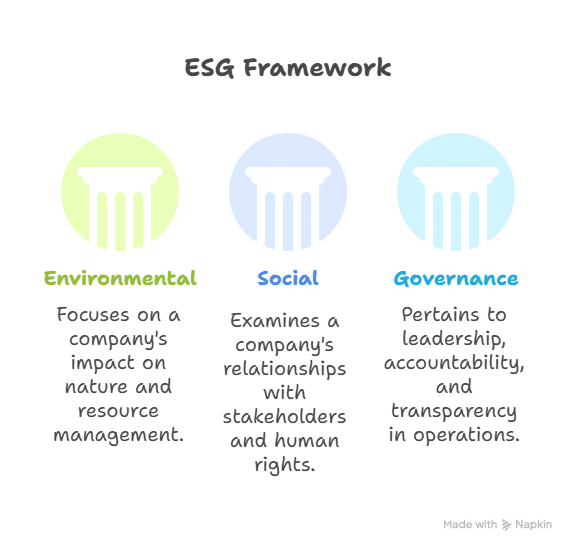
To truly understand ESG, we need to break it down into its three constituent pillars:
Environmental
This pillar encompasses a company’s impact on the natural world. Key areas of focus include:
- Climate Change: Greenhouse gas (GHG) emissions, carbon footprint, and strategies for mitigation and adaptation.
- Natural Resources: Water usage, biodiversity, and land use.
- Pollution and Waste: Waste management, recycling, and efforts to reduce pollution.
- Environmental Opportunities: Investments in renewable energy, green technologies, and sustainable products.
Social
The social pillar examines a company’s relationships with its stakeholders, including its employees, customers, and the communities in which it operates. Key considerations include:
- Human Capital: Labor practices, employee health and safety, diversity and inclusion, and employee engagement.
- Product Liability: Product safety and quality, data privacy, and ethical marketing.
- Stakeholder Opposition: Community relations, and social impact assessments.
- Social Opportunities: Access to healthcare, education, and other essential services.
Governance
The governance pillar refers to the systems and processes that a company has in place to manage itself, make effective decisions, and comply with the law. Key aspects of governance include:
- Corporate Governance: Board composition and diversity, executive compensation, shareholder rights, and internal controls.
- Corporate Behavior: Business ethics, anti-corruption policies, and tax transparency.
- Cybersecurity: Data security and privacy.
The Growing Importance of ESG Reporting
ESG reporting is no longer a niche activity for a handful of environmentally conscious companies. It has become a mainstream business imperative, driven by a confluence of factors:
- Investor Demand: Investors are increasingly using ESG data to inform their investment decisions. They recognize that strong ESG performance is a proxy for good management and a sign of a company’s long-term resilience.
- Regulatory Pressure: Governments and regulatory bodies around the world are introducing new laws and regulations that mandate ESG disclosure.
- Customer and Employee Expectations: Consumers and employees are more likely to support companies that share their values and are committed to making a positive impact on the world.
- Risk Management: ESG reporting helps companies identify and manage a wide range of risks, from climate-related risks to reputational risks.
ESG Reporting Landscape: A Guide to the Top Frameworks
One of the biggest challenges in ESG reporting is the proliferation of different frameworks and standards. While a universally accepted global standard has yet to emerge, several leading frameworks have gained widespread adoption.
The Global Reporting Initiative (GRI)
The GRI is the most widely used ESG reporting framework in the world. It provides a comprehensive set of standards that can be used by any organization, regardless of its size, sector, or location. The GRI Standards are divided into three series:
- Universal Standards: These apply to all organizations and cover topics such as governance, strategy, and stakeholder engagement.
- Sector Standards: These are designed for specific sectors, such as oil and gas, and provide guidance on the most material topics for that sector.
- Topic Standards: These cover specific ESG topics, such as climate change, human rights, and anti-corruption.
The Sustainability Accounting Standards Board (SASB)
The SASB is another popular ESG reporting framework, particularly in the United States. Unlike the GRI, which is designed for a broad range of stakeholders, the SASB is specifically focused on the needs of investors. The SASB has developed a set of industry-specific standards that identify the most financially material ESG issues for each industry.
The Task Force on Climate-related Financial Disclosures (TCFD)
The TCFD was established by the Financial Stability Board to develop a set of recommendations for consistent, comparable, and reliable climate-related financial disclosures. The TCFD recommendations are structured around four thematic areas:
- Governance: The organization’s governance around climate-related risks and opportunities.
- Strategy: The actual and potential impacts of climate-related risks and opportunities on the organization’s businesses, strategy, and financial planning.
- Risk Management: The processes used by the organization to identify, assess, and manage climate-related risks.
- Metrics and Targets: The metrics and targets used to assess and manage relevant climate-related risks and opportunities.
Other Key Frameworks and Standards
In addition to the GRI, SASB, and TCFD, there are several other important ESG reporting frameworks and standards, including:
- The Carbon Disclosure Project (CDP): A global disclosure system that enables companies, cities, states, and regions to measure and manage their environmental impacts.
- The International Integrated Reporting Council (IIRC): A global coalition of regulators, investors, companies, standard setters, the accounting profession, and NGOs that has developed the Integrated Reporting Framework.
- The Corporate Sustainability Reporting Directive (CSRD): A new EU directive that will require all large companies to report on their ESG performance.
The Benefits of ESG Reporting
ESG reporting is not just about compliance and risk management. It can also be a powerful tool for creating value and driving business success.
Enhanced Brand Reputation and Customer Loyalty
In an increasingly crowded marketplace, a strong ESG proposition can be a powerful differentiator. Companies that are transparent about their ESG performance and can demonstrate a genuine commitment to sustainability are more likely to attract and retain customers.
Attracting and Retaining Talent
The next generation of talent is looking for more than just a paycheck. They want to work for companies that are making a positive impact on the world. A strong ESG program can help you attract and retain the best and brightest talent.
Improved Financial Performance
A growing body of research shows a positive correlation between strong ESG performance and financial performance. Companies that manage their ESG risks and opportunities effectively are more likely to be successful in the long run.
Increased Access to Capital
Investors are increasingly using ESG data to inform their investment decisions. Companies with strong ESG performance are more likely to attract investment and have a lower cost of capital.
The Challenges of ESG Reporting
While the benefits of ESG reporting are clear, there are also a number of challenges that companies need to overcome.
The Lack of a Universal Standard
As we’ve already discussed, there is no single, universally accepted ESG reporting standard. This can make it difficult for companies to know which framework to use and for investors to compare the ESG performance of different companies.
Data Collection and Management
Collecting and managing ESG data can be a complex and time-consuming process. ESG data is often spread across different departments and systems, and it can be difficult to ensure its accuracy and consistency.
The Evolving Regulatory Landscape
The regulatory landscape for ESG reporting is constantly evolving. New laws and regulations are being introduced all the time, and it can be difficult for companies to keep up with the latest requirements.
The Risk of Greenwashing
Greenwashing is the practice of making false or misleading claims about the environmental benefits of a product, service, or company. As ESG reporting becomes more mainstream, there is a growing risk of greenwashing. It’s important for companies to be transparent and authentic in their ESG reporting to avoid this pitfall.
How to Write an ESG Report: A Step-by-Step Guide
Now that we’ve covered the basics of ESG reporting, let’s take a look at how to create a world-class ESG report.
Step 1: Define Your Purpose and Audience
The first step is to define the purpose of your ESG report and identify your target audience. Are you reporting to investors, customers, employees, or a combination of all three? Your purpose and audience will determine the content and format of your report.
Step 2: Conduct a Materiality Assessment
A materiality assessment is a process for identifying the most important ESG issues for your company and its stakeholders. This is a critical step in the ESG reporting process, as it will help you focus your efforts on the issues that matter most.
Step 3: Choose a Reporting Framework
Once you’ve identified your material ESG issues, you need to choose a reporting framework. As we’ve discussed, there are a number of different frameworks to choose from. The best framework for your company will depend on your industry, your stakeholders, and your reporting objectives.
Step 4: Collect and Analyze Your Data
The next step is to collect and analyze your ESG data. This will likely involve working with a number of different departments across your organization, including finance, human resources, and operations.
Step 5: Write and Design Your Report
Once you’ve collected and analyzed your data, you can start to write and design your report. Your report should be clear, concise, and easy to understand. It should also be visually appealing and engaging.
Step 6: Get Your Report Assured
To enhance the credibility of your ESG report, you may want to get it assured by a third party. Assurance is a process of independent verification that can help to ensure the accuracy and reliability of your data.
Step 7: Share and Promote Your Report
The final step is to share and promote your report. You can share your report on your website, in your annual report, and on social media. You should also consider submitting your report to ESG rating agencies and other relevant organizations.
The Future of ESG Reporting
The world of ESG reporting is constantly evolving. Here are a few of the key trends to watch in the years to come:
Greater Standardization
There is a growing demand for a single, globally accepted ESG reporting standard. A number of different initiatives are underway to develop such a standard, and it’s likely that we will see greater convergence in the years to come.
Increased Use of Technology
Technology will play an increasingly important role in ESG reporting. Companies will use technology to automate data collection, improve data quality, and create more engaging and interactive reports.
A Greater Focus on Impact
There will be a greater focus on measuring the real-world impact of a company’s ESG initiatives. This will require companies to move beyond simply reporting on their activities and to start measuring their outcomes.
The Rise of the “S” in ESG
The social pillar of ESG has often been overlooked in the past. However, there is a growing recognition of the importance of social issues, such as diversity and inclusion, human rights, and employee well-being. We can expect to see a greater focus on the “S” in ESG in the years to come.
ESG Reporting in India: The BRSR Framework
India is one of the leading emerging economies in the world, and it is also at the forefront of the ESG reporting movement. The Securities and Exchange Board of India (SEBI) has introduced the Business Responsibility and Sustainability Reporting (BRSR) framework, which is mandatory for the top 1000 listed companies in India.
The BRSR framework is a comprehensive reporting framework that covers a wide range of ESG issues. It is aligned with the GRI and other leading international frameworks, and it is helping to drive the adoption of ESG reporting in India.
Conclusion
ESG reporting is no longer a “nice to have.” It is a business imperative. Companies that embrace the ESG imperative will be better positioned to create long-term value for their shareholders, their stakeholders, and society as a whole.
This guide has provided you with a comprehensive overview of the world of ESG reporting. We hope that it has been helpful and informative. If you have any questions, please don’t hesitate to contact us.
FAQs
What is the difference between ESG and sustainability?
Sustainability is a broad concept that refers to the ability of a company to operate in a way that meets the needs of the present without compromising the ability of future generations to meet their own needs. ESG is a more specific framework that is used to measure and report on a company’s performance in three key areas: environmental, social, and governance.
What is the difference between ESG reporting and integrated reporting?
ESG reporting is the disclosure of data and information related to a company’s environmental, social, and corporate governance performance. Integrated reporting is a more holistic approach to reporting that combines financial and non-financial information to provide a more complete picture of a company’s performance.
Who is responsible for ESG reporting in a company?
ESG reporting is a cross-functional effort that requires the involvement of a number of different departments, including finance, human resources, legal, and communications. The ultimate responsibility for ESG reporting typically lies with the company’s board of directors and senior management.
How often should a company report on its ESG performance?
Most companies report on their ESG performance on an annual basis. However, some companies are now starting to report on their ESG performance on a more frequent basis, such as quarterly or even in real-time.
What are the benefits of getting an ESG report assured?
Getting an ESG report assured by a third party can help to enhance the credibility and reliability of your data. It can also provide you with valuable feedback on how to improve your ESG reporting process.