Finance and Tax Guide

Financing

Currency Hedging
Financing

Currency Hedging 101: Protecting Import/Export Profits from a Volatile Rupee

If you run an import or export business in India, there is a specific ritual you probably perform every morning. Before you check your emails, before you have your first coffee, you check your phone for one number: the USD/INR exchange rate. And depending on that number, your day either starts with a sigh of relief or a knot in your stomach. It’s the hidden anxiety of international trade. You could run the tightest ship, have the best products, and negotiate the best deals, but an external force you have absolutely no control over—the currency market—can wipe out your profit margins overnight. A sudden depreciation of the Rupee makes imports significantly more expensive. A sharp appreciation eats into the revenue of exporters. This volatility isn’t just a nuisance; it’s a fundamental business risk that can turn a profitable quarter into a loss-making one. But here is the good news: you don’t have to be a passive victim of the forex markets. Just as you insure your warehouse against fire or your shipments against theft, you can insure your profits against currency fluctuation. This is called Currency Hedging. This guide is written for the business owner, not the Wall Street trader. We are going to strip away the complex jargon of finance and look at hedging as a practical, essential tool for stabilizing your business in an unstable world. By the end of this article, you will understand not just what hedging is, but how to implement a strategy that lets you sleep better at night, knowing your hard-earned margins are protected. What Exactly is Currency Hedging? (The “Insurance” Analogy) Let’s start by debunking a common myth: Currency hedging is NOT about trying to make money from currency movements. It is not speculation. In fact, it is the exact opposite. Hedging is about removing uncertainty. Think of it like car insurance. You don’t buy car insurance hoping you get into an accident so you can get a payout. You buy it so that if an accident happens, the financial impact doesn’t bankrupt you. You pay a small, known cost (the premium) to avoid a potentially massive, unknown cost. Currency hedging works on the same principle. It involves taking a financial position today to “lock in” an exchange rate for a future date. When you hedge, you are essentially saying, “I am happy with today’s rate (or a rate close to it), and I am willing to give up the chance that the rate might get better for me in the future, just so I can guarantee it won’t get worse.” You are trading the potential for windfall gains for the certainty of protected margins. For most businesses operating on tight margins, that certainty is priceless. Why Do Indian Businesses Need to Hedge? (The INR Context) If the Indian Rupee was perfectly stable against major currencies like the USD, Euro, or Pound, this article wouldn’t need to exist. But as anyone trading in India knows, the Rupee is anything but stable. The Historic Volatility of the Rupee The Indian Rupee is classified as an emerging market currency. It is sensitive to a vast array of global and domestic factors: Historically, the long-term trend of the Rupee against the Dollar has been depreciating. However, in the short-to-medium term, it can swing wildly in both directions. It’s these swings that kill business planning. The Impact on Importers: The Cost Squeeze Let’s say you are an Indian importer buying machinery from Germany. You just lost ₹5 Lakhs directly from your bottom line, purely because of exchange rate movement. If your net profit margin was thin to begin with, this deal might now be a loss. The Impact on Exporters: The Revenue Shrink Now, imagine you are an Indian software services exporter invoicing a client in the USA. Your revenue just shrank by ₹3 Lakhs. Your costs (salaries, rent, electricity) stayed the same, paid in Rupees. That ₹3 Lakhs loss comes straight out of your profit. The Danger of “Doing Nothing” Many SME business owners practice what is known as “unhedged” trading. They simply convert currency at the spot rate (today’s market rate) whenever the payment is due or received. This is not a strategy; it’s gambling. You are betting your business’s profitability that the exchange rate won’t move against you. In the long run, the market always wins that bet. “Doing nothing” is actively choosing to accept maximum risk. Currency Hedging 101: The Toolkit (Your Strategies) So, how do you stop gambling and start managing? Fortunately, there are established financial instruments designed specifically for this purpose. We will explore the most common ones used by Indian businesses, ranging from simple internal adjustments to bank-provided financial products. 1. Natural Hedging (The Simplest Form) Before running to the bank to buy financial products, look inside your own business. A “natural hedge” occurs when your business structure naturally reduces currency risk without needing external contracts. Matching Inflows and Outflows Do you both import and export? If you earn USD from exports and also spend USD for imports, you have a natural hedge. Instead of converting your export earnings into Rupees and then buying Dollars later for imports, you can open an EEFC (Exchange Earners’ Foreign Currency) account in India. You keep your export earnings in dollars and use those same dollars to pay for your imports. You only convert the net difference. Invoice in Your Local Currency (INR) This is the ultimate hedge. If you can convince your overseas supplier to bill you in INR, or your overseas customer to pay you in INR, you have shifted the currency risk entirely to them. While difficult to negotiate, especially with larger players in developed markets, the RBI has been pushing mechanisms to settle international trade in Rupees. It is always worth asking. 2. Forward Contracts (The Workhorse of Hedging) For most SMEs, the Forward Contract is the most practical and commonly used hedging tool. It is simple, effective, and offered by almost every commercial bank in India. How


Zero-Based Budgeting
Financing

Zero-Based Budgeting (ZBB): Why Companies Are Ditching “Incremental Budgeting” in High Inflation

This is called incremental budgeting. And for a long time, in stable economies with predictable 2% inflation, it worked “good enough.” It was easy, it required minimal friction, and it kept the wheels turning. But we are no longer living in stable times. We are operating in an economic landscape defined by volatility and, most critically, high inflation. In this new reality, relying on last year’s numbers as a baseline for next year’s spending isn’t just lazy budgeting; it’s financial negligence. The assumptions that held true twelve months ago are now obsolete. Supply chains are snarled, energy costs are erratic, and labor costs are surging. When the very foundation of your costs is shifting like quicksand, simply adding 10% to last year’s budget doesn’t account for reality. It just compounds past inefficiencies while failing to address present dangers. This realization is triggering a massive shift in the corporate finance world. CFOs and business leaders are realizing that to survive—and even thrive—during this inflationary period, they need a radical departure from the status quo. They are ditching the comfort of incrementalism and embracing the rigors of a returning champion: Zero-Based Budgeting (ZBB). ZBB is not a new concept, but its relevance has never been greater. It’s a methodology that demands you start from scratch—zero—every single cycle. Every dollar spent must be justified on its own merits today, not simply because it was spent yesterday. In this extensive deep dive, we will explore why the old guard of incremental budgeting is failing under inflationary pressure, what Zero-Based Budgeting truly entails (and why it has a bad reputation), and how companies are successfully implementing ZBB to regain control, discover hidden value, and navigate the stormy seas of high inflation. Understanding the Old Guard: The Comfort Trap of Incremental Budgeting Before we understand why ZBB is the necessary solution, we must first deeply understand the problem it solves. Why has incremental budgeting been the dominant standard for so long, and what are its inherent flaws? The “Last Year Plus X%” Mentality Incremental budgeting is beguilingly simple. The premise is that the current budget is a stable foundation. The company is operating, lights are on, and products are shipping. Therefore, the budget for the upcoming year should be the current year’s actual spend, adjusted for known factors. Typically, these factors are: It sounds reasonable. It’s efficient in terms of time spent budgeting. It doesn’t rock the boat. Department heads know the drill: if you got $1 million last year, ask for $1.1 million this year, expect to get cut back to $1.05 million, and everyone goes home happy. Why It Worked in Stable Times We cannot fault companies for relying on this method for decades. In an environment where inflation hovers around 2% annually, year-over-year variances are minimal. The “historical base” of spend is a reliable predictor of the future. If your office rent increased by 3% a year for ten years straight, incremental budgeting handles that perfectly. If raw material costs were hedged and stable, there was no need to reinvent the wheel every twelve months. Furthermore, incremental budgeting is politically easy. It avoids difficult conversations. By accepting the previous year’s base as “approved,” management doesn’t have to challenge the existence of entire departments or legacy projects every year. It maintains organizational peace. The Hidden Dangers of Incrementalism (Even Without Inflation) However, even in the best of times, incremental budgeting is deeply flawed. It is an approach that inherently fosters mediocrity and inefficiency. The “Use It or Lose It” Phenomenon Perhaps the most damaging psychological effect of incremental budgeting is the end-of-year spending spree. Because budgets are based on the previous year’s actual spend, managers are terrified of coming in under budget. If a manager saves $50,000 through efficiency in Q3, they know that if they return that money to the company treasury, their baseline budget for next year will be cut by $50,000. Their reward for efficiency is a smaller empire next year. So, what happens in November and December? They buy new office furniture they don’t need. They pre-pay vendors. They attend expensive conferences. They ensure every dime is spent to protect their baseline. Incremental budgeting actively punishes frugality. Cementing Inefficiencies Incrementalism assumes that the baseline spend is necessary and efficient. It almost never is. Imagine a company subscription to a legacy software platform that costs $100,000 a year. Five years ago, it was vital. Today, only three people log into it because the company migrated to a newer cloud solution. Under incremental budgeting, that $100,000 is part of the “base.” It gets approved automatically, perhaps even with a 3% price hike added. No one questions its existence because they are only looking at the increment, not the base. Over time, these layers of sediment build up—outdated processes, redundant roles, unused tools—all cemented into the budget because no one ever asks, “Do we still need this?” The Inflation Catalyst: Why “Business as Usual” is Now Broken If incremental budgeting was inefficient in stable times, it is downright dangerous in times of high inflation. The economic environment we face today has shattered the assumptions that make incrementalism feasible. When Historical Data Becomes Irrelevant The core premise of incremental budgeting is that the past predicts the future. High inflation destroys that premise. When inflation goes from 2% to 8% or 10%, the historical baseline becomes meaningless. Last year’s $1 million budget might only buy $900,000 worth of goods and services today. If you simply apply a standard “plus 5%” increase to a department’s budget when the actual costs of their inputs—energy, logistics, specialized labor—have risen by 15%, you are effectively handing them a massive budget cut. You are setting them up to fail. Conversely, some costs might not rise at all. Applying a blanket inflationary increase across all departments overfunds some areas while starving others. The lack of granularity in incremental budgeting makes it impossible to manage real-time inflationary pressures precisely. The Spiral of Rising Input Costs Consider a manufacturing firm. In a

REITs vs. Physical Property
Financing

REITs vs Physical Property: A Tax and Yield Comparison for Corporate Investors

For corporate treasurers, CFOs, and investment committees, deploying capital efficiently is a never-ending challenge. In an economic landscape defined by fluctuating interest rates and inflationary pressures, the search for resilient yield is paramount. Real estate has long been the cornerstone asset class for institutional-grade stability and income generation. However, the “how” of real estate investing is just as critical as the “what.” The traditional dichotomy—owning tangible bricks and mortar versus holding paper shares in real estate companies—presents a complex decision matrix for corporate entities. It is not merely a question of preference; it is a calculation based on liquidity needs, risk appetite, operational capacity, and, perhaps most critically, tax implications. This is not a guide for the retail investor looking to park a few thousand dollars. This is a strategic deep dive into the trenches of REITs vs Physical Property: A Tax and Yield Comparison for Corporate Investors. We will strip away the generalizations to look at how these two distinct vehicles impact the corporate balance sheet and bottom line. Understanding the Core Contenders from a Corporate Perspective Before analyzing yield and tax, we must establish the fundamental structural differences between these two asset types when held within a corporate structure. The nature of the asset dictates its treatment by tax authorities and the market. Defining Direct Physical Property Ownership Direct ownership is exactly what it sounds like. Your corporation (or a special purpose subsidiary created for liability ring-fencing) holds the deed to a commercial asset an office building, an industrial warehouse, a multi-family complex, or retail center. For a corporation, this means the asset sits on the balance sheet. The income derived is rental income, which is generally treated as active business income (depending on the level of management involvement). The corporation is solely responsible for asset management, leasing, maintenance, capital expenditures (CapEx), and eventual disposition. It provides total control but demands significant operational bandwidth. Defining Real Estate Investment Trusts (REITs) A Real Estate Investment Trust (REIT) is a company that owns, operates, or finances income-producing real estate. Modelled after mutual funds, REITs pool the capital of numerous investors. Crucially, for a company to qualify as a REIT (in the US and many similar international jurisdictions), it must meet strict criteria, most notably the requirement to distribute at least 90% of its taxable income to shareholders annually in the form of dividends. For a corporate investor, buying shares in a publicly traded REIT is purchasing a security, not a property deed. The asset on your balance sheet is equity stock. You have zero operational control over the underlying properties. You are essentially outsourcing the real estate expertise to the REIT’s management team and accepting a passive income stream in return. The Corporate Context: Why This Isn’t Retail Investing Why does the distinction between a corporate investor and an individual matter? The Yield Battle: Income Generation Mechanisms The primary attraction of real estate is yield—the regular income stream the asset generates. However, the source and stability of that yield differ vastly between REITs and physical assets. Analyzing REIT Yields: The Dividend mandate REITs are yield-generating machines by design. Because of the 90% distribution requirement mentioned earlier, they are often referred to as “pass-through” entities. They don’t pay corporate tax at the REIT level so long as they distribute their income. The Yield Mechanic: The yield comes in the form of quarterly (sometimes monthly) dividend payments. Analyzing Physical Property Yields: Net Operating Income (NOI) The yield from physical property is derived from Net Operating Income (NOI). This is the rental income remaining after all operating expenses (property taxes, insurance, maintenance, utilities, property management fees) have been paid—but before debt service and income taxes. The Yield Mechanic: The “Cap Rate” (Capitalization Rate), calculated as NOI divided by the property’s purchase price, is the standard measure of unlevered yield. Growth Potential: Appreciation vs. Reinvestment Yield is income today; growth is income tomorrow. The Critical Deep Dive: Tax Implications for Corporate Investors Disclaimer: The following information is for illustrative purposes regarding general corporate taxation principles, particularly framed around the US tax code as a baseline. Tax laws vary significantly by jurisdiction and are subject to change. Corporate investors must consult with qualified tax counsel regarding their specific situation. This is where the comparison becomes most complex. The tax treatment of these two asset classes can dramatically alter the “after-tax return” profile for a corporation. Taxation of REIT Dividends for Corporations For individual investors, REIT taxation is complicated because dividends can be classified as ordinary income, capital gains, or return of capital. For corporate investors, the picture is slightly different. Generally, REIT dividends received by a corporation are treated as ordinary income and are subject to the standard corporate tax rate. Crucially, corporate investors usually cannot claim the Dividends Received Deduction (DRD) on typical REIT dividends. The DRD is designed to prevent triple taxation when one corporation pays dividends to another. However, because the REIT entity itself generally pays no corporate tax (due to the pass-through nature), the IRS does not allow the receiving corporation to deduct those dividends. Taxation of Physical Property Income Income derived from direct property ownership is treated as corporate revenue. It flows into the company’s general P&L. On the surface, this is taxable at the corporate rate. However, physical ownership offers a massive advantage: Deductibility. Because the corporation owns the asset, it can deduct all operating expenses, interest payments on mortgages (subject to certain limits based on EBITDA), and property taxes. These deductions significantly shrink the taxable base of the rental income. The Power of Depreciation: Physical Property’s “Phantom Expense” This is perhaps the single biggest tax differentiator and the primary reason many corporations opt for direct ownership. Depreciation is a non-cash expense that the tax code allows property owners to take annually to account for the theoretical “wear and tear” of the building over time (land is not depreciable). Supercharging Depreciation with Cost Segregation Sophisticated corporate investors use “Cost Segregation Studies.” Instead of depreciating the whole building over

SME IPO in India
Financing

SME IPO in India (2026 Complete Guide): Eligibility, Process, Costs, Benefits, Risks & Case Studies

Small and Medium Enterprises (SMEs) are the backbone of India’s economic growth. Over the past decade, SMEs have increasingly turned to the capital markets especially SME IPO in India to raise funds, expand operations, improve governance, and gain credibility. More than 240+ SME IPOs have taken place in the last three years alone, with several being oversubscribed 50x, 100x, or even 300x. This shows the enormous interest from investors and the growing trust in India’s SME ecosystem. If you’re an SME founder, investor, consultant, or financial professional, this is your ultimate reference for 2026. An SME IPO in India offers a streamlined avenue for small and medium enterprises to access capital markets with reduced compliance burdens. The SME IPO process involves several steps, including meeting SME IPO eligibility criteria and completing the necessary documentation outlined in the BSE SME IPO checklist. Key considerations include understanding the SME IPO cost and the numerous SME IPO benefits, which encompass enhanced visibility and improved access to funding. For 2026, the SME IPO landscape is expected to evolve further, reflecting trends and regulatory changes that will shape the future of SME financing through platforms like NSE Emerge. What Is an SME IPO? An SME IPO (Small and Medium Enterprise Initial Public Offering) is a process through which an SME offers its shares to the public for the first time and gets listed on the SME platform of stock exchanges — NSE Emerge or BSE SME. It allows SMEs to raise capital for: An SME IPO is specifically designed for small and medium companies with lower compliance requirements, simplified procedures, and cost-efficient listing norms compared to a Mainboard IPO. SME Exchanges in India: NSE Emerge & BSE SME India has two dedicated platforms for SME IPOs: a) NSE Emerge b) BSE SME Both platforms allow eligible SMEs to raise funds from the public with easier listing norms. SME IPO vs Mainboard IPO: Key Differences Feature SME IPO Mainboard IPO Issue Size ₹1 crore to ₹25–30 crore (typical) ₹50 crore to ₹10,000+ crore Regulatory Requirements Simplified Strict & heavy Compliance Costs Lower Higher Investor Base Retail, HNIs, a few institutions Domestic & global institutions Listing SME exchange (NSE Emerge/BSE SME) Mainboard exchange Market Maker Mandatory? Yes No Liquidity Moderate High Migration Option Yes (after meeting conditions) Not applicable SME IPOs are designed for quicker, more flexible, and less expensive capital raising. Latest SME IPO Market Trends in India (2023–2025) This is where your blog beats competitors — they do not provide updated trends. Key Market Highlights (2023–2025) Why SME IPOs are becoming popular Eligibility Criteria for SME IPO (Updated 2025) To list on NSE Emerge or BSE SME, SMEs must meet certain requirements. Basic Eligibility Criteria Merchant Banker Requirements SME must appoint a SEBI-registered Merchant Banker who conducts: Documents Required for SME IPO This is another unique section not fully covered by your competitors. Key Documents Include: Step-by-Step SME IPO Process (Complete Guide) This is one of the most important sections for ranking — presented in a user-friendly flow. Step 1: Feasibility Check Company evaluates whether IPO is suitable. Before spending a rupee, you must conduct an internal “health check.” Step 2: Appoint a Merchant Banker They lead the entire IPO journey. This is your most critical hiring decision. The Merchant Banker (Lead Manager) is the quarterback who will guide you through the entire process. Step 3: Due Diligence & Documentation Financial, legal, operational checks. This is the “cleaning up” phase where your company’s affairs are scrutinized. Step 4: Drafting of Prospectus (DRHP & RHP) Merchant banker prepares offer documents. The Merchant Banker prepares the Draft Red Herring Prospectus (DRHP). Step 5: Exchange Application Submitted to NSE/BSE for approval. Unlike Mainboard IPOs, SME IPOs are filed directly with the Stock Exchange (BSE or NSE), not SEBI. Step 6: Listing Approval Exchanges may ask questions or clarifications. The Stock Exchange officials will scrutinize your DRHP. Step 7: IPO Marketing & Roadshows Company presents its story to investors. Step 8: Offer Opens to Public Investors subscribe. The IPO opens for public bidding, typically for 3 to 5 working days. Step 9: Allotment & Refunds Shares allotted, refunds processed. Once the issue closes, the Registrar to the Issue takes over. Step 10: Listing on SME Exchange Company begins trading on NSE Emerge or BSE SME. The moment of truth! SME IPO cost in India Cost varies depending on: Typical Cost Range: ₹60 lakh to ₹1.5 crore depending on issue size & complexity. Benefits of SME IPO Competitors list very basic points — here is a detailed one. a) Access to growth capital Immediate funds for expansion, working capital, or acquisitions. b) Enhanced brand visibility Stock market listing increases customer and investor confidence. c) Better corporate governance Improves transparency, discipline, and compliance. d) Improved creditworthiness Banks treat listed SMEs more favorably. e) Liquidity for shareholders Founders can partially exit or monetize shares. f) ESOP potential Attract skilled employees. g) Higher valuation Public markets often value SMEs at a premium. h) Merger & acquisition advantage Listed companies can use shares for acquisitions. Risks & Challenges of SME IPO You will rank higher because this section is rarely covered properly. a) High compliance burden Quarterly reporting, audits, disclosures. b) Market volatility risk IPO success depends on market cycles. c) Liquidity concerns SME stocks often have lower trading volumes. d) Costs may be heavy for small firms e) Pressure on management Promoters must meet market expectations. f) Fake demand or manipulated volumes Some SMEs face scrutiny for inflated subscriptions. Real Case Studies of SME IPOs in India This section gives your blog originality. Case Study 1: A Manufacturing SME – Oversubscribed 120x Case Study 2: A Tech SME – Oversubscribed 300x Case Study 3: SME IPO That Underperformed When Should an SME Consider an IPO? An SME should consider IPO when: An IPO is not suitable if: Expert Tips for a Successful SME IPO Tip 1: Clean up financials Avoid inconsistencies or sudden spikes. Tip 2: Choose a strong merchant banker They

Supply Chain Finance
Financing

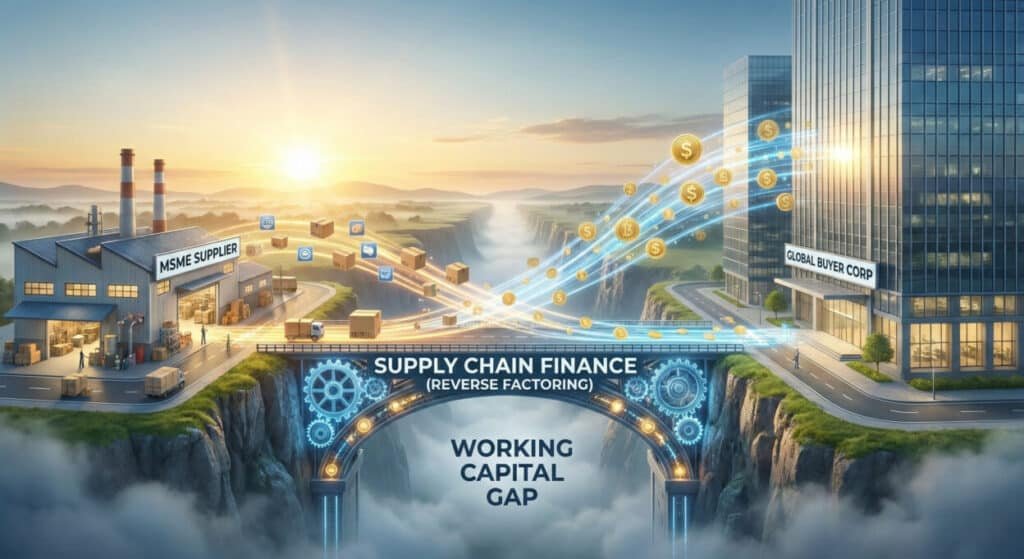
Supply Chain Finance (Reverse Factoring): How It Works and Why It’s Booming for MSMEs

Let’s be honest about the hardest part of running a Micro, Small, or Medium Enterprise (MSME). It usually isn’t making the product or finding the customer. It’s waiting to get paid. The “working capital gap” is the silent killer of small businesses. You deliver excellent goods to a large corporate client today, but their standard payment terms might mean you don’t see that cash for 60, 90, or even 120 days. In the meantime, you still have payroll, raw material costs, and utilities to cover. For decades, MSMEs have been stuck between a rock and a hard place: either choke on cash flow constraints or take out expensive, high-interest bank loans just to survive until invoice maturity. But the financial landscape is shifting rapidly. There is a solution that is currently booming globally, reshaping how small businesses manage liquidity without taking on traditional debt. It goes by two main names: Supply Chain Finance (SCF) or, more specifically, Reverse Factoring. This isn’t just another buzzword. It’s a fundamental shift in corporate treasury that turns the traditional payment dynamic on its head. In this comprehensive guide, we are going to deep-dive into what Supply Chain Finance (Reverse Factoring) really is, the exact mechanics of how a transaction works, why it is utterly different from old-school factoring, and why it has become the lifeline for MSMEs in the current economic climate. What Exactly is Supply Chain Finance (Reverse Factoring)? To understand why this is revolutionary, we first need to understand the traditional problem. In a standard B2B relationship, credit flows down the supply chain. The small supplier essentially extends credit to the large buyer by allowing them to pay later. This puts the financial burden on the weakest link in the chain—the MSME. Supply Chain Finance (Reverse Factoring) is a financial arrangement that flips this dynamic. It is a set of technology-based business and financing processes that link the various parties in a transaction—buyer, seller, and financing institution—to lower financing costs and improve business efficiency. At its core, Reverse Factoring allows a supplier to receive early payment on their invoices from a third-party financier (like a bank or fintech), not based on their own creditworthiness, but based on the stronger credit rating of their large buyer. The Core Concept: Leveraging the Giant’s Strength Think of it this way: A massive multinational corporation (let’s call them “MegaCorp”) has an impeccable credit rating. Banks trust them implicitly. A small component manufacturer (let’s call them “Apex Parts MSME”) does not have that same financial muscle. When Apex needs a loan, they pay high interest rates because they are seen as higher risk. In a Reverse Factoring setup, the financing is centered around MegaCorp. Because MegaCorp promises to pay the invoice eventually, the bank is willing to lend money against that invoice at a very low rate—a rate reflective of MegaCorp’s risk, not Apex’s risk. Apex gets paid immediately (minus a tiny fee), and MegaCorp gets to keep its cash longer. The Key Players in the SCF Ecosystem A successful Supply Chain Finance program always involves three, and sometimes four, key parties. It is crucial to understand the role of each: How Supply Chain Finance Works: A Step-by-Step Mechanism While the concept sounds simple, the execution requires a sophisticated digital handshake between all parties. Let’s walk through the lifecycle of an invoice in a typical Reverse Factoring scenario involving our fictional companies, “MegaCorp” (Buyer) and “Apex Parts MSME” (Supplier). The Pre-Requisite Phase: Setup and Onboarding Before any transaction happens, MegaCorp decides to launch an SCF program. They partner with a bank and a technology platform. MegaCorp then invites its strategic suppliers, including Apex Parts, to join the platform. Apex agrees to the terms and is onboarded digitally. The Transaction Phase: From Invoice to Cash Once the program is live, here is how a typical transaction flows. Step 1: Delivery and Invoicing Apex Parts MSME manufactures a batch of components and delivers them to MegaCorp. Following standard procedure, Apex issues an invoice for $10,000 with standard payment terms of net-90 days. Apex uploads this invoice into MegaCorp’s supplier portal or sends it via EDI (Electronic Data Interchange). Step 2: Invoice Approval by the Buyer This is the critical trigger point. MegaCorp receives the goods and verifies the invoice. Once they confirm everything is correct, they mark the invoice as “Approved for Payment” in their ERP system. This approval is digitally transmitted to the SCF Platform. By approving the invoice, MegaCorp is essentially giving an irrevocable promise to pay that $10,000 on day 90. This promise is the “gold standard” collateral the whole system rests on. Step 3: The Offer to the Supplier The SCF platform now notifies Apex Parts MSME: “Good news! Your invoice for $10,000 has been approved by MegaCorp. It is due in 90 days. However, would you like to be paid tomorrow for a small fee based on MegaCorp’s credit rate?” The platform will show Apex the exact calculations. For example, it might offer $9,950 tomorrow instead of $10,000 in three months. Step 4: The Supplier Opts In for Early Payment Apex Parts needs cash now for payroll. They log into the platform and click “Accept Early Payment.” Note: Suppliers are usually under no obligation to take early payment on every invoice. They can choose which invoices to finance based on their immediate cash flow needs. Step 5: The Financier Provides Liquidity The SCF platform instructs the associated bank (The Funder) to transfer the discounted amount ($9,950 in our example) directly to Apex Parts MSME’s bank account. Apex now has their cash on day 5, rather than day 90. Their working capital cycle is drastically shortened. Step 6: Final Settlement Ninety days later, on the original invoice maturity date, MegaCorp pays the full invoice amount ($10,000) directly to the bank/funder. The transaction is closed. MegaCorp held onto their cash for the full 90 days. Apex got paid immediately. The bank made $50 profit with very low risk. Supply Chain Finance vs. Traditional Factoring: Clearing

Cybersecurity
Financing

Cybersecurity Insurance for Finance Firms: Is Your Coverage Actually Enough for a Ransomware Attack?

The ink is dry on the policy, and the premium—likely significantly higher than last year—has been paid. The board of directors breathes a collective sigh of relief, believing that if the worst happens, the firm is finally insulated from risk. However, in the high-stakes world of financial services, where data is gold and trust is currency, a dangerous disconnect often remains. Many executives view their insurance as a catch-all safety net, failing to realize that without aligning the policy strictly with their technical cybersecurity posture, they may be holding a contract full of holes, exclusions, and sub-limits that leaves them financially crippled when a ransomware attack actually strikes. This guide is a reality check. We are going beyond the glossy brochures to dissect the harsh truths of cybersecurity insurance for finance firms in the age of sophisticated ransomware. It’s time to determine if your policy is a genuine shield or merely an expensive illusion. The Financial Sector’s Ransomware Bullseye: Why the Threat is Different for You Before digging into policy specifics, it is crucial to understand why financial firms face a uniquely hostile threat landscape. You are not just another target; you are the preferred target. The Concentration of Liquid Assets and Sensitive Data Cybercriminals are, at their core, pragmatic business people. They go where the money is. Financial institutions hold vast reserves of liquid capital and, perhaps more importantly, incredibly sensitive Non-Public Personal Information (NPI). Unlike a retailer that might lose credit card numbers (which are cancelable), finance firms hold social security numbers, tax returns, investment strategies, and M&A data. This data has immense longevity and value on the dark web. The sheer potential for immediate financial payout makes finance firms the “whales” of the ransomware hunting ground. The “Double Extortion” Game Changer The days of “spray and pray” ransomware attacks—where criminals encrypt data and hope for a few bitcoins—are largely over for high-value targets. Today, it’s about sophisticated, human-operated ransomware campaigns utilizing “double extortion.” The ransom note now carries two threats: pay to unlock your systems, and pay to prevent us from leaking your stolen data publicly. Many finance firms discover that their cybersecurity insurance policy was built for scenario #2, but woefully inadequate for scenario #1. The costs associated with a massive data breach—regulatory fines, class-action lawsuits, and reputational damage—often vastly dwarf the ransom demand itself. The Regulatory Pressure Cooker Financial firms operate under a microscope. The SEC, FINRA, NYDFS, GDPR, and various international bodies have stringent requirements regarding data protection and incident reporting. A ransomware attack isn’t just an IT issue; it’s an immediate regulatory crisis. The clock starts ticking on mandatory notifications the moment an incident is discovered. If your insurance provider is slow to respond, or if your policy doesn’t cover the immense legal costs of regulatory investigations, you are fighting a two-front war with one hand tied behind your back. Deconstructing Your Policy: The “Fine Print” Traps That Lead to Denials This is where the rubber meets the road. When you purchased your policy, you likely focused on the aggregate limit—perhaps $10 million or $50 million in coverage. That number is often meaningless in the face of a real ransomware event due to how modern policies are structured. Here are the most common traps hidden in the dense legalese of cybersecurity insurance contracts. The Sub-Limit Shell Game This is the single biggest shock for most finance firms post-attack. Your policy might state an aggregate limit of $20 million. However, buried in the declarations page are “sub-limits” for specific types of losses. It is shockingly common to see a $20 million policy hold a sub-limit of only $250,000 or $500,000 for “Cyber Extortion Payments” (the actual ransom). Carriers do this to manage their exposure to soaring ransom demands. If hackers demand $5 million, and you only have a $250k sub-limit, your firm is on the hook for the remaining $4.75 million out of pocket. Furthermore, look for sub-limits on: If these costs are capped too low, you will burn through your coverage within the first week of an incident. Business Interruption: The Hidden Bleed For a financial trading firm or a bank, downtime is catastrophic. Every second systems are offline translates to massive, quantifiable losses. While most policies offer “Business Interruption” (BI) coverage, proving the loss and getting paid is notoriously difficult. The Waiting Period Hurdle Almost all BI coverage comes with a “waiting period”—a deductible measured in time rather than dollars. A typical waiting period is 12 to 24 hours. This means you absorb 100% of the losses for the first full day or two of the outage. For a high-frequency trading firm, the losses sustained in the first 24 hours could exceed the entire policy limit, yet none of it would be covered. Proof of Loss and “System Failure” vs. “Security Event” Carriers require rigorous proof that the income lost was directly tied to the cyber event and not general market conditions. Furthermore, some policies differentiate between a “security event” (a hack) and a “system failure” (an accidental IT crash). If the ransomware attack causes cascading internal system failures that aren’t technically part of the hack itself, the carrier may argue those losses fall under a less generous coverage section. The “Failure to Maintain” Exclusion Clause This is currently the carriers’ favorite weapon for denying claims. Cyber insurance is no longer a passive purchase; it is an active contract requiring you to maintain specific security standards. The policy will almost certainly contain language stating that coverage is contingent upon the insured maintaining “minimum required security controls.” If you attested on your application that you have Multi-Factor Authentication (MFA) implemented across all remote access points, but post-breach forensics reveal that one legacy server or a third-party vendor portal did not have MFA enabled—and that was the entry point—the carrier can deny the entire claim based on misrepresentation or failure to maintain standards. In the eyes of the insurer, you voided the warranty on the car by not changing the oil. Social Engineering

Green Fintech
Financing

Rise of “Green Fintech”: Investing in Eco-Friendly Financial Solutions

When you picture “finance,” you might think of Wall Street, complex charts, and stock tickers. For decades, the industry’s primary color was the black of a balanced ledger. Today, that’s changing. The most important color in finance is, without a doubt, green. We are standing at the intersection of two powerful forces: a technological revolution (Fintech) and an existential necessity (sustainability). The climate crisis is no longer a distant problem; it’s an immediate economic reality. And to solve it, we need to move trillions of dollars. But how? How do we fund a solar farm, track a company’s real carbon footprint, or empower an individual to invest their retirement savings in a way that actually helps the planet? The answer is Green Fintech. This isn’t just a niche trend. It’s the beginning of a fundamental rewiring of the global financial system. The sustainable finance market is already valued at over $4.18 trillion and is projected to skyrocket to $28.71 trillion by 2033. This is not just a guide to a new financial sector. This is a map to the future of money. In this deep dive, we’ll cover what “Green Fintech” is, the revolutionary technologies making it possible, the massive opportunities for investing in eco-Friendly financial solutions, and—most importantly—how you can navigate the very real risks of “greenwashing” to make a real impact. What is Green Fintech? (And What It’s Not) Before we dive in, let’s clear up the jargon. It’s simple. Green Fintech is the use of financial technology to support and advance environmental sustainability. It’s the engine that powers green finance. If “Green Finance” is the goal (funding a sustainable world), “Green Fintech” is the high-tech toolkit that gets us there. It takes the old, clunky systems of banking and investing and makes them transparent, accessible, and laser-focused on positive environmental outcomes. Green Fintech vs. Sustainable Finance vs. ESG You’ll hear these terms used interchangeably, but they’re not the same. Understanding the difference is your first step to becoming a smart green investor. Why Now? The Tsunami of Demand Green Fintech isn’t rising in a vacuum. It’s a direct response to a “perfect storm” of global trends: The Core Components: How Green Fintech is Changing the World Green Fintech isn’t one single thing. It’s an ecosystem of different technologies and applications. Let’s break down the most important ones you’ll encounter. 1. Green Digital Payments & Sustainable Banking This is the Green Fintech you can touch and feel. It’s about changing our daily relationship with money. Carbon Footprint Tracking The old way: You get a credit card statement that just shows dollars and cents. The Green Fintech way: You have an app that shows you the estimated CO2 impact of every single purchase you make in real-time. This technology, often integrated via APIs, transforms your bank account from a simple ledger into a personal sustainability tool. Eco-Friendly Cards & Banking Neobanks (digital-only banks) are leading this charge. They offer bank accounts and debit cards with a green promise. 2. Green Investments & Wealth Management (Democratizing Impact) This is the category that’s exploding. For the first time, everyday people can easily participate in investing in eco-friendly financial solutions that were once reserved for massive institutions. Sustainable Robo-Advisors These are AI-driven investment platforms that automatically build and manage a portfolio for you based on your financial goals and your values. You can tell it, “I want to invest for retirement, but only in companies with strong environmental records,” and the algorithm does the rest. Green Crowdfunding Platforms These platforms cut out the middleman entirely. They allow you to invest directly in specific, vetted, green projects, like a new solar energy installation in Africa or a sustainable agriculture project in Asia. 3. The “Engine Room”: AI, Blockchain, and Big Data This is the “tech” in “Fintech.” These back-end technologies are the real game-changers, solving the biggest problem in sustainability: data and trust. AI for ESG Risk Analysis A company can claim it’s green in its glossy annual report, but is it? AI algorithms can now scan unstructured data—satellite imagery, news reports, social media, and even sensor data from IoT devices—to find the truth. An AI can, for example, analyze satellite photos to see if a company is actually reforesting an area it claimed to, or if its factories are emitting pollutants. This moves ESG data from “self-reported” to “verified.” Blockchain for Unmatched Transparency This is arguably the “killer app” for Green Fintech. Blockchain, the technology behind cryptocurrencies, is a distributed, immutable ledger. In simple terms: it’s a public record book that cannot be secretly changed. This has two revolutionary uses: 4. Green RegTech & Reporting As of 2025-2026, mandatory ESG reporting is the new reality. This is a huge headache for companies. Green RegTech (Regulatory Technology) is the B2B software that helps companies automatically track, manage, and report their environmental data to regulators, saving them time and protecting them from penalties. The Multi-Trillion Dollar Opportunity: Investing in Eco-Friendly Financial Solutions This is where you come in. The transition to a green economy is the single greatest investment opportunity of our lifetime. But how do you, as an individual or business, get started? Why Invest? Beyond Just Feeling Good Let’s be clear: this isn’t charity. This is smart investing. Steps to Guide: How You Can Start Investing Today You have more options than ever. Here’s a breakdown from simplest to most advanced. Step 1: The Retail Investor (Your Bank Account & Retirement) Step 2: Direct Investments (Stocks & Bonds) Step 3: Pooled Investments (ETFs & Funds) This is the most popular method. Instead of picking single stocks, you buy a “basket” of them. Step 4: The High-Impact Investor (REITs & Crowdfunding) The Elephant in the Room: Challenges & The “Greenwashing” Epidemic It’s not all sunshine and solar panels. The single biggest threat to this entire sector is greenwashing. The Great Deception: What is Greenwashing? Greenwashing is the act of misleading consumers and investors about a company’s or product’s environmental benefits. It’s a

predictive analytics for budget
Accounting, Financing

How to Use predictive analytics for budget 2026 : The Ultimate Guide

Let’s be honest. For most finance leaders, the annual budgeting process is a necessary evil. ( predictive analytics for budget ) It’s a grueling, months-long marathon of wrangling spreadsheets, chasing department heads, and debating assumptions. You and your team spend countless hours meticulously crafting a financial plan for the next 12 months. And then, by February, it’s already obsolete. A new competitor enters the market. A critical supply chain link breaks. A sudden shift in consumer behavior or a new piece of legislation throws all your careful assumptions out the window. Your beautifully crafted budget, the one that was supposed to be your company’s North Star, is now nothing more than a historical document. This is the fundamental failure of traditional budgeting. It’s a static snapshot in a world that is anything but. It’s like trying to navigate a winding mountain road at night by only looking in the rearview mirror. As we rocket toward 2026, this broken process isn’t just inefficient; it’s a critical business liability. We’re operating in an era of unprecedented volatility. Economic uncertainty, rapid AI disruption, and intense pressure to “do more with less” mean that “what we did last year + 5%” is a recipe for disaster. Enter predictive analytics. This isn’t just another tech buzzword. It’s a fundamental shift in how we plan, forecast, and run our businesses. It’s the difference between guessing what’s around the corner and using a high-powered GPS that models the traffic, weather, and road conditions ahead. This article isn’t just a high-level overview. It’s your comprehensive, 5,000-word playbook for building a smarter, more resilient, and truly predictive 2026 budget. We’ll cover the why, the what, and the how—from the specific models you can use to the real-world challenges you’ll face. The Great Divide: Why Traditional Budgeting Fails in 2026 Before we build the new, we have to be brutally honest about why the old is broken. The traditional budgeting process, born in an era of relative stability, is fundamentally unequipped for the 21st century. Its flaws are no longer just annoyances; they are anchors holding your business back. The “Rearview Mirror” Problem The most glaring flaw in traditional budgeting is its reliance on historical data. The entire process is often a negotiation based on last year’s actuals. “You spent $100,000 on marketing last year, so this year you get $105,000.” This approach makes one massive, fatal assumption: that the future will look just like the past. In 2026, that assumption is laughable. Basing your 2026 budget on 2025 data is like planning a cross-country trip using a map from 1990. You’re missing all the new highways, all the permanent road closures, and all the new destinations. The Time and Resource Drain Let’s talk about the process itself. For most FP&A (Financial Planning & Analysis) teams, “budget season” is a synonym for “misery.” A 2023 McKinsey study noted that finance teams can spend 20% to 30% of their time just on number-crunching and manual data aggregation. This is a catastrophic waste of your most valuable asset: your team’s strategic brainpower. Instead of analyzing trends, partnering with business units, and identifying growth opportunities, your best people are stuck in spreadsheet hell, correcting formula errors, and reconciling conflicting versions of the truth. Human Touch: We’ve all been there. It’s 10 PM on a Tuesday, and you’ve found a #REF! error in a spreadsheet that links to 15 other tabs, and the entire budget is now unbalanced. This manual, error-prone process isn’t just slow; it’s fragile. The “Set It and Forget It” Trap After months of work, the budget is finally approved. Everyone breathes a sigh of relief, the document is saved to a shared drive, and… it’s largely ignored. Because it’s static, the budget becomes a tool for judgment, not a tool for navigation. Departments are measured against a number they all know is wrong. This creates a toxic culture of “hitting the number” rather than “making the right decision.” When a real-time event happens—say, a 20% spike in raw material costs—the budget is useless. You can’t adjust it. You can’t model the ripple effects. You’re flying blind, forced to make gut-feel decisions. This is where predictive analytics flips the script entirely. What Is Predictive Analytics, Really? (Beyond the Buzzwords) Now that we’ve established the “why,” let’s clarify the “what.” “Predictive analytics” sounds complex, but the concept is simple. Simple Definition: Predictive analytics is the practice of using data (both historical and current) combined with statistical techniques, machine learning (ML), and artificial intelligence (AI) to find hidden patterns and forecast what is likely to happen next. It’s the engine behind Netflix recommendations (“people who watched this also liked…”), a credit card fraud alert (“this transaction seems unusual…”), and, increasingly, the modern finance department. How It’s Different from Simple Forecasting You might be thinking, “We already do forecasting. How is this different?” It’s a great question. The difference is in the complexity and the output. Traditional Forecasting Predictive Analytics Traditional forecasting tells you what might happen. Predictive analytics tells you why it will happen and what you can do to change it. The “Why”: Unlocking the Tangible Benefits of a Smarter Budget Moving to a predictive model isn’t just an IT upgrade. It’s a strategic transformation that delivers clear, tangible benefits. This is what you show your CEO and board when you ask for the investment. Benefit 1: Achieve Surgical Accuracy in Your Forecasts This is the most obvious win. By analyzing more data points and understanding complex, non-linear relationships, predictive models are simply more accurate than human-driven, spreadsheet-based forecasts. A retail company, for example, can move beyond simple seasonality. It can build a model that predicts demand for a specific product in a specific store by factoring in: This level of accuracy, as shown in case studies, can reduce inventory costs by 20% or more and cut stockouts by 30%, directly impacting the bottom line. Benefit 2: Move from Reactive to Proactive with “What-If” Scenarios This is where the budget becomes

Funding Sources
Financing

Beyond the Bank: 5 Alternative Funding Sources for Startups in 2026

The last decade has triggered a revolution in financial technology and investment models. A new ecosystem of alternative funding sources has exploded, one that’s built for startups. These modern funding sources don’t care about your real estate holdings; they care about your monthly recurring revenue (MRR), your customer acquisition cost (CAC), and the passion of your community. They don’t want to just give you a loan; they want to align with your growth. If you’re a founder who’s tired of hearing “no” from traditional lenders, this guide to alternative funding sources is for you. We are going deep on the five most powerful funding sources available to startups today, moving far beyond the bank. We’ll cover how they work, who they’re for, the critical pros and cons, and how to choose the right one for you. Forget the bank. Let’s get your business funded. The “Bank Problem”: Why Traditional Loans and Startups Don’t Mix Before we explore the alternatives, let’s officially diagnose the problem. Why is it that a business that’s growing 20% month-over-month can get rejected for a loan, while a stagnant, 30-year-old laundromat gets approved? It boils down to three core mismatches. The Collateral & Profitability Paradox Banks operate on a simple principle: “What can we take if you stop paying?” This is called collateral. For a restaurant, it’s the kitchen equipment. For a real estate developer, it’s the land. What’s the collateral for a SaaS (Software-as-a-Service) company? The code? The brand? To a bank, these are intangible and worthless in a liquidation. Furthermore, banks want to see profitability. They want to look at your tax returns from the last 2-3 years and see a stable, positive net income. But startups are designed to be unprofitable in their early years. Every dollar of revenue (and investment) is strategically reinvested into growth—hiring developers, marketing, and acquiring customers. To a bank, your high-growth, cash-burning model isn’t a sign of ambition; it’s a giant, flashing red light of risk. The Pace Mismatch: “We’ll Get Back to You in 90 Days” The startup world moves at the speed of light. An opportunity you spot today is gone by next month. You need capital now to hire that key engineer, launch a critical marketing campaign, or double down on a channel that’s working. The traditional bank loan process is a slow-motion nightmare of paperwork, committee meetings, and endless underwriting. It can take 60, 90, or even 120 days to get a “yes” or “no.” By the time you get the money (if you get it at all), your competitors have already captured the market you were aiming for. Startups need speed. Banks offer bureaucracy. The Curse of Personal Guarantees and Covenants Let’s say you do get approved. The bank will almost certainly demand a Personal Guarantee (PG). This is the big one. It means that if your business (the LLC or C-Corp you legally created to protect yourself) fails, the bank can come after your personal assets. Your house. Your car. Your savings. On top of that, they’ll saddle the loan with covenants—strict rules you have to follow. These might include things like maintaining a certain debt-to-income ratio or barring you from taking on any other debt. These covenants can strangle your ability to be flexible and agile, which is the entire point of being a startup. This is why “alternative funding” exists. It’s a new school of thought that values growth over history and data over collateral. Alternative 1 : Revenue-Based Financing (RBF) This is, in my opinion, one of the most significant and founder-friendly innovations of the last decade, especially for existing digital businesses. What is Revenue-Based Financing? In simple terms, Revenue-Based Financing (RBF) is a cash advance based on your future revenue. It’s not a loan, and it’s not equity. Here’s the model: An RBF provider (like Clearco, Pipe, or Founderpath) connects to your business’s financial systems—your payment processor (Stripe, Shopify), your accounting software (QuickBooks), and your ad accounts (Google, Facebook). They use AI to analyze your real-time performance: your monthly revenue, your growth rate, your churn, and your customer acquisition costs. Based on this data, they offer you a lump sum of cash today. How do you pay it back? This is the magic. You don’t have a fixed monthly payment. Instead, you agree to pay back a small percentage (e.g., 5% – 15%) of your daily or weekly revenue until the cash advance, plus a flat fee, is repaid. Example: You are never “underwater.” The repayments ebb and flow with your cash flow. Who is Revenue-Based Financing For? RBF is not for idea-stage startups. You must have revenue. It’s ideal for: The general rule of thumb is that you need at least 6-12 months of operating history and a minimum of $10,000 – $20,000 in monthly revenue to qualify. The Deep Dive: Pros and Cons of RBF PRO: Absolutely Zero Equity Dilution This is the number one reason founders love RBF. You sell zero percent of your company. You don’t get a new boss, you don’t add a new member to your board, and you don’t give up control. That $100,000 investment from an angel might cost you 20% of your company; the $100,000 from RBF costs you only the pre-agreed fee. You keep 100% of your upside. PRO: Flexible, Aligned Repayments As the example showed, this is a massive benefit. A traditional bank loan demands $5,000 on the 1st of the month, whether you made $50,000 or $5,000. RBF scales with you. This protects your cash flow and makes it a true growth partner. If your sales dip, your repayment dips, giving you breathing room. PRO: Insanely Fast Access to Capital Because RBF is data-driven, the underwriting process is automated. You can apply in the morning (by connecting your accounts) and often have a term sheet by the afternoon and cash in your bank account within 24-48 hours. When you need to scale an ad campaign this week, nothing beats RBF. CON: It’s Not “Cheap” Money

Embedded Finance
Financing

What is “Embedded Finance”? Why Your Next Business Loan Might Come from Shopify, Not a Bank

There was no application. No dusty banker’s office, no three-inch-thick file of paperwork, no anxious 60-day waiting period. Just a simple offer based on the sales data you already generate. You click, accept the terms, and the money is in your business account by Friday. Welcome to the world of Embedded Finance. If you haven’t heard the term, you’ve definitely experienced it. It’s the “Buy Now, Pay Later” (BNPL) option from Klarna or Afterpay at checkout. It’s the Uber app seamlessly paying for your ride without you ever pulling out a card. It’s the Tesla app offering you car insurance based on your real-time driving habits. And, most critically for entrepreneurs, it’s Shopify, Amazon, or even your accounting software offering you a business loan. This isn’t just a minor convenience. It’s a fundamental re-wiring of the entire financial industry. The old idea of a bank as a separate place you go is dissolving. Instead, banking is becoming a seamless thing you do right at the point of need. This post is your deep dive. We’re going to cover exactly what “Embedded Finance” is, why it’s happening now, and explore the central, game-changing question: Why your next business loan might come from Shopify, not a traditional bank. What is “Embedded Finance”? Decoding the Buzzword Let’s get the jargon out of the way first, because “Embedded Finance” sounds far more complicated than it is. A Simple Definition: Banking Where You Are At its core, Embedded Finance is the integration of a financial service or tool (like a loan, a payment, or insurance) into a non-financial company’s website, app, or business process. Think of it this way: The bank isn’t gone, but it has become invisible. It’s running in the background, with its technology “embedded” directly into the service you’re already using. How Does it Actually Work? (The Magic of APIs) This “invisibility” is made possible by a piece of technology called an API (Application Programming Interface). You can think of an API as a secure messenger. The result? You get a pre-approved loan offer in seconds, not months. The platform you love (Shopify) gets to offer you a valuable new feature, and the bank gets a new customer without spending a dime on marketing. It’s Not Just Loans: The Embedded Finance Ecosystem Business loans are just one, powerful example. The true scope of embedded finance is massive and already touches multiple parts of your life and business. Embedded Payments This is the most common form. When you store your credit card in your Amazon account, or when your Starbucks app just knows how to pay, that’s an embedded payment. The complex process of “authorization” and “settlement” is hidden, making the purchase frictionless. Embedded Insurance Ever bought a plane ticket and been offered travel insurance on the checkout page? That’s embedded insurance. The airline has partnered with an insurer to offer you a relevant product at the exact moment you’re thinking about your trip’s risks. Embedded Lending (BNPL and More) “Buy Now, Pay Later” is the superstar of embedded lending on the consumer side. But on the business side, it’s services like Shopify Capital, Square Capital, and Amazon Lending that are the real giants. The “Shopify Capital” Case Study: Why Your E-commerce Platform is Now a Lender To truly understand the power of this shift, let’s look at the perfect example: Shopify Capital. Shopify is not a bank. It doesn’t want to be a bank. It wants to be the absolute best, stickiest, most indispensable platform for running an e-commerce business. And what’s the single biggest barrier to growing an e-commerce business? Access to capital. The Old Way: Applying for a Traditional Bank Loan Imagine you’re “Sarah,” a Shopify merchant selling handmade leather goods. You have a breakout holiday season and sell out of everything. You know you could double your business next year, but you need $30,000 to buy raw materials and hire a part-time helper now. She goes to her local bank. The conversation goes something like this: Sarah leaves frustrated, unable to grow. The bank, using its 50-year-old risk model, saw a “risky” applicant. The New Way: An Offer from Your Dashboard Now, let’s replay this with embedded finance. The financing is perfectly aligned with her actual business cash flow. It’s a Win-Win-Win This model is revolutionary because everyone benefits. Why Your Next Business Loan Might Come from Shopify, Not a Bank The shift from a traditional bank to a platform like Shopify isn’t just a minor trend; it’s a fundamental change in how creditworthiness is understood. The simple answer to “why” is that Shopify understands your business better and faster than a bank ever could. A bank sees your past. A platform sees your present and can accurately predict your future. This difference is built on three pillars: the power of real-time data, the convenience of context, and the systemic failures of the old banking model. The Power of Data: The Ultimate Unfair Advantage For decades, the entire banking system has been built on a specific, and now outdated, set of data points. Platforms have created an entirely new, and far more predictive, data model. Traditional Banks See a “Snapshot.” When you walk into a traditional bank, you are handed a folder. The loan officer will ask for documents that represent a static, historical snapshot of your business: This model is fundamentally backward-looking. A tax return from 2024 tells the bank nothing about the viral TikTok campaign you ran last month. It doesn’t see that your customer return rate has dropped to near-zero or that your average order value has doubled. This old model is why, according to numerous financial studies, a primary reason for loan denial is an “insufficient operating history”—many banks simply won’t talk to you until you’re at least two years old. Platforms See a “Movie.” Shopify, in contrast, isn’t watching a snapshot; it’s watching a live-streaming, high-definition movie of your business, 24/7. It sees every single thing: Using this rich, dynamic data, Shopify’s AI

Scroll to Top