Finance and Tax Guide

Financing

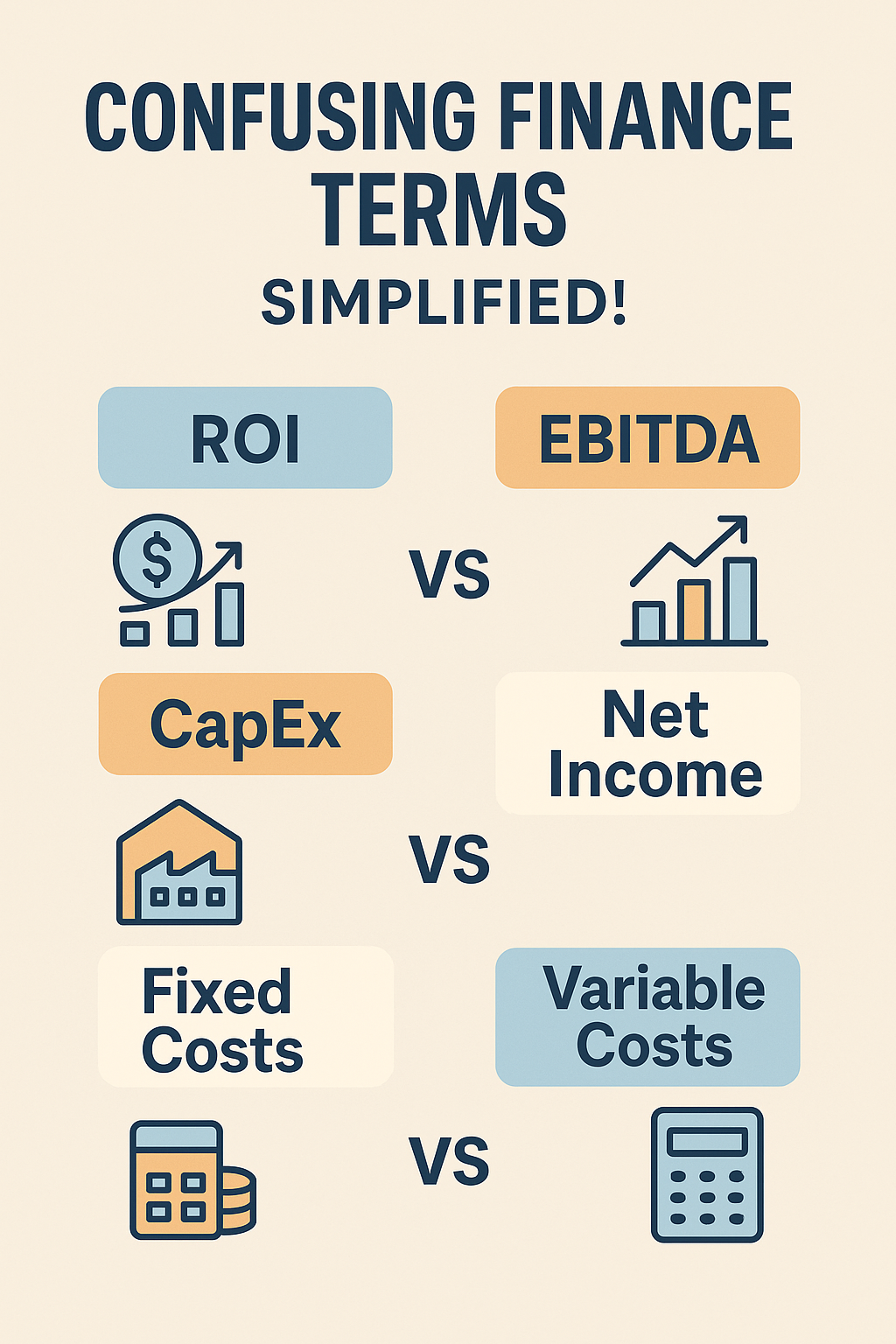
confusing finance terms
Financing

20 Confusing Finance Terms Explained Simply – Unlock Financial Confidence

Understanding key financial terms is essential whether you’re a finance student, entrepreneur, or just managing your own budget. However, the jargon can often be confusing. In this guide, we’ve simplified 20 commonly Confusing Finance Terms to help you navigate the financial world with confidence. To help, I compiled a quick guide to 20 commonly confused finance terms, including: Each pair is explained in simple terms so you can make better business, budgeting, and investment decisions with confidence. Fixed Costs vs. Variable Costs Fixed Costs : Stays the same regardless of production. (Rent, Salaries)Variable Costs : Changes with Production volume. (Raw material, Electricity) Profit vs. Revenue Profit : What’s left after deducting all expences from Revenue. (Revenue – Costs)Revenue : Total money earned from sales before expenses. Accrual vs. Cash Accounting Accrual : Record transactions when they occur, even if cash hasn’t moved in or out.Cash Accounting : Record transactions only when money is received or paid. Assets vs. Liabilities Assets : What a company owns that adds value. (Cash, Property, Equipements)Liabilities : What a company owes to others. (Loans, Bills, Debt) 5.ROI vs. ROE ROI : Measures how much profit an investment generates compared to its investment.ROE : Evaluates profitability by comparing net income to shareholders’ equity. EBITDA vs. Net Income EBITDA : Earning before interest, Taxes, Depreciation & Amortization, used to assess operational performance.Net Income : Final profit after deducting all costs, taxes and expenses. CapEx vs. OpEx CapEx : Money spent on acquiring or upgrading long- term assets. (Building, Machines)OpEx : Ongoing costs required to run a business. (Rent, Salaries, Utilities) Market Cap vs. Enterprise Value Market Cap : The total value of a company’s outstanding shares Stock price × Total Shares OutstandingEnterprise Value : Market Cap + Debt – CashRepresents a company’s total value. Gross Margin vs. Net Margin Gross Margin : Revenue minus direct costs of production (COGS) gives Gross Profit Gross Margin = Gross Profit ÷ RevenueNet Margin : Net Profit percentage after deducting all operating expenses, interest and taxes. Net Margin = Net Profit ÷ Revenue Financial vs. Operating Leverage Financial : Using borrowed money (Debt) to Finance operation and growth.Operating Leverage : The impact of fixed costs on a company’s profitability. FAQs

What is ITR? || Types of ITR Forms || Who Should File? ||
Financing

What is ITR? || Types of ITR Forms || Who Should File? ||

ITR (Income Tax Return) is a form where you tell the government how much money you earned in a year, how much tax you have already paid, and whether you need to pay more tax or get a refund. Think of it like a report card for your income that you submit to the Income Tax Department every year. Types of ITR Forms & Who Should File? There are different ITR forms for different people. Let’s break it down: ITR-1 (Sahaj) – For Salaried Employees Who should file? ✅ Example: ITR-2 – For People with Capital Gains & More Income Sources Who should file? ✅ Example: ITR-3 – For Business Owners & Professionals Who should file? ✅ Example: ITR-4 (Sugam) – For Small Business Owners & Freelancers Under Presumptive Tax Who should file? ✅ Example: ITR-5 – For Partnership Firms & LLPs Who should file? ✅ Example: ITR-6 – For Companies Who should file? ✅ Example: ITR-7 – For Trusts, NGOs, and Political Parties Who should file? ✅ Example: Why Should You File ITR? (Benefits in Simple Words) If you don’t file ITR on time and your income is taxable, you may have to pay a penalty of up to ₹10,000. If too much tax is deducted from your salary or bank interest, you can get it back by filing an ITR. Banks ask for ITR when you apply for a home loan, car loan, or personal loan. It helps them check your financial status. If you want to travel abroad, many countries like the USA, UK, Canada, and Australia askfor ITR proof. If you make a loss in the stock market or business, you can adjust it in future years by filing ITR. Conclusion If you are earning money, you should file the correct ITR form to stay compliant with the law and enjoy benefits like tax refunds, loan approvals, and hassle-free financial transactions. Would you like help in choosing the right ITR form for yourself? Overview and summary in corporate language Types of ITR (Income Tax Return) in India Income Tax Returns (ITR) are forms that taxpayers use to declare their income, deductions, and taxes paid to the Income Tax Department. Different types of ITR forms are prescribed based on the source of income and category of the taxpayer. Types of ITR Forms ITR Form Applicable To Income Sources Example & Uses ITR-1(Sahaj) Individuals (Resident) Salary, Pension, One House Property, Interest Income (Total income ≤ ₹50 lakh) Example: A salaried employee earning ₹30 lakh annually files ITR-1. ITR-2 Individuals & HUFs (Hindu Undivided Families) Salary, Pension, House Property, Capital Gains, Foreign Income Example: An individual earning from salary & selling stocks files ITR-2. ITR-3 Individuals & HUFs (Having Business/Profession) Income from Business/Profession, Salary, Capital Gains Example: A doctor running a clinic and earning from shares files ITR-3. ITR-4(Sugam) Individuals, HUFs, Firms (Opting for PresumptiveTaxation) Business Income (under Sections 44AD, 44AE, 44ADA), Salary, Pension Example: A shop owner opting for presumptive taxation files ITR-4. ITR-5 Partnership Firms, LLPs, AOPs, BOIs Business & Other Incomes Example: A partnership firm running a restaurant files ITR-5. ITR-6 Companies (Except Those Claiming Exemption under Section 11) Business Income Example: A private limited IT company files ITR-6. ITR-7 Trusts, Political Parties, Institutions Income under Sections 139(4A) to 139(4D) Example: A charitable trust registered under Section 80G files ITR 7.

"Valuation Methods: 9 Powerful Techniques to Accurately Estimate Asset Value"
Financing

“Valuation Methods: 9 Powerful Techniques to Accurately Estimate Asset Value”

Valuation methods are techniques used to estimate the value of an asset, company, or investment. There are several approaches, and the right method depends on the context, the type of asset, and the data available. Here are the most common valuation methods. 1. Income Approach (Discounted Cash Flow – DCF) What It Means Imagine you want to buy a lemonade stand, but instead of just paying for it, you think about how much money it will make in the future. You’ll want to know how much money you expect the stand to earn each year and how much that money is worth today. Example If the lemonade stand is expected to make $100 every year for the next 5 years, and you want to figure out how much that’s worth today (because money today is worth more than the same amount of money in the future), you’d discount those future earnings. This helps you decide if paying $300 for the stand is a good deal. When Used This is useful when a business makes money regularly, like a small company or rental property. 2. Market Approach (Comparable or Multiples) What It Means This method compares your lemonade stand to others that are similar. If a similar lemonade stand sold for $500, you might think yours is worth about the same. Example If there are three other lemonade stands nearby, and they all sell for $500, you can use that price to estimate your stand’s value. It’s like buying a used car and checking what similar cars have sold for. When Used This is great for when there are lots of similar businesses or assets around, like houses or businesses in the same industry. 3. Asset-Based Approach What It Means This method looks at what you own and subtracts what you owe. Think about how much the things you have (like lemonade supplies, cups, etc.) are worth and subtract any debts or obligations. Example If you own a lemonade stand worth $200, plus $50 of lemonade supplies, but you owe $30, your total value would be $220 ($200 + $50 – $30). When Used This is helpful for businesses that aren’t making much money but have valuable assets, or in situations where you might need to sell everything quickly (like bankruptcy). 4. Cost Approach What It Means This looks at how much it would cost to replace your lemonade stand. If you want to know how much it costs to build a new stand from scratch, you’d figure out the cost of materials and time. Example If it costs $150 to set up a new lemonade stand (with all the materials), and the stand you have is old but still useful, you might subtract some value for wear and tear. When Used This is used for things like buildings or machines where the cost to rebuild or replace is important. 5. Precedent Transactions (Comparable Transactions) What It Means This method is about looking at previous sales of similar businesses or assets to estimate the value of your stand. It’s like asking, “How much did similar lemonade stands sell for in the past?” Example If someone sold a similar lemonade stand for $400 last year, that can give you an idea of how much yours might be worth if you were to sell it now. When Used This is common in buying and selling businesses, especially in mergers or acquisitions. 6. Real Options Valuation What It Means This is like having an option to make choices in the future based on how things turn out. If your lemonade stand does well, maybe you can decide to open more stands or add new products. Example If you can choose to expand your stand if business goes well, the value of that option to expand in the future could add extra value today. When Used This is used for businesses with a lot of uncertainty or flexibility, like tech startups or businesses with big growth potential. 7. Liquidation Value What It Means If you had to sell everything and close your lemonade stand today, how much could you get by selling off the equipment and supplies? This is the “quick sell” price. Example If you were going out of business and sold your stand and supplies for $100, that would be its liquidation value. When Used This is used when a business is shutting down or going bankrupt. 8. Adjusted Present Value (APV) What It Means This method breaks down the value of your lemonade stand into two parts: one part is how much it’s worth if it was fully paid for (no debt), and the other part is the extra value you get because you have a loan (like tax savings on interest). Example If you borrowed money to start your lemonade stand and you can deduct the interest you pay on the loan from taxes, this will add extra value to your stand. APV helps you calculate both the business’s value and the extra value from borrowing money. When Used This is used in more complicated business situations, especially when companies are using debt in their operations. 9. Sum of the Parts (SOTP) What It Means If your lemonade stand is part of a bigger company, you would value each part separately and add them up. For example, if you own multiple types of businesses (like a lemonade stand and a cupcake shop), you calculate the value of each business separately and then combine them to get the total. Example If the lemonade stand is worth $200 and the cupcake shop is worth $400, the total value of your business would be $600. When Used This is useful when a company has different types of businesses or assets, like a conglomerate or a company with multiple divisions. Conclusion Each of these methods is useful in different situations, depending on what you’re valuing and what information is available. For example, if you’re buying a company with predictable profits, you might use the
Scroll to Top