Finance and Tax Guide

Accounting

predictive analytics for budget
Accounting, Financing

How to Use predictive analytics for budget 2026 : The Ultimate Guide

Let’s be honest. For most finance leaders, the annual budgeting process is a necessary evil. ( predictive analytics for budget ) It’s a grueling, months-long marathon of wrangling spreadsheets, chasing department heads, and debating assumptions. You and your team spend countless hours meticulously crafting a financial plan for the next 12 months. And then, by February, it’s already obsolete. A new competitor enters the market. A critical supply chain link breaks. A sudden shift in consumer behavior or a new piece of legislation throws all your careful assumptions out the window. Your beautifully crafted budget, the one that was supposed to be your company’s North Star, is now nothing more than a historical document. This is the fundamental failure of traditional budgeting. It’s a static snapshot in a world that is anything but. It’s like trying to navigate a winding mountain road at night by only looking in the rearview mirror. As we rocket toward 2026, this broken process isn’t just inefficient; it’s a critical business liability. We’re operating in an era of unprecedented volatility. Economic uncertainty, rapid AI disruption, and intense pressure to “do more with less” mean that “what we did last year + 5%” is a recipe for disaster. Enter predictive analytics. This isn’t just another tech buzzword. It’s a fundamental shift in how we plan, forecast, and run our businesses. It’s the difference between guessing what’s around the corner and using a high-powered GPS that models the traffic, weather, and road conditions ahead. This article isn’t just a high-level overview. It’s your comprehensive, 5,000-word playbook for building a smarter, more resilient, and truly predictive 2026 budget. We’ll cover the why, the what, and the how—from the specific models you can use to the real-world challenges you’ll face. The Great Divide: Why Traditional Budgeting Fails in 2026 Before we build the new, we have to be brutally honest about why the old is broken. The traditional budgeting process, born in an era of relative stability, is fundamentally unequipped for the 21st century. Its flaws are no longer just annoyances; they are anchors holding your business back. The “Rearview Mirror” Problem The most glaring flaw in traditional budgeting is its reliance on historical data. The entire process is often a negotiation based on last year’s actuals. “You spent $100,000 on marketing last year, so this year you get $105,000.” This approach makes one massive, fatal assumption: that the future will look just like the past. In 2026, that assumption is laughable. Basing your 2026 budget on 2025 data is like planning a cross-country trip using a map from 1990. You’re missing all the new highways, all the permanent road closures, and all the new destinations. The Time and Resource Drain Let’s talk about the process itself. For most FP&A (Financial Planning & Analysis) teams, “budget season” is a synonym for “misery.” A 2023 McKinsey study noted that finance teams can spend 20% to 30% of their time just on number-crunching and manual data aggregation. This is a catastrophic waste of your most valuable asset: your team’s strategic brainpower. Instead of analyzing trends, partnering with business units, and identifying growth opportunities, your best people are stuck in spreadsheet hell, correcting formula errors, and reconciling conflicting versions of the truth. Human Touch: We’ve all been there. It’s 10 PM on a Tuesday, and you’ve found a #REF! error in a spreadsheet that links to 15 other tabs, and the entire budget is now unbalanced. This manual, error-prone process isn’t just slow; it’s fragile. The “Set It and Forget It” Trap After months of work, the budget is finally approved. Everyone breathes a sigh of relief, the document is saved to a shared drive, and… it’s largely ignored. Because it’s static, the budget becomes a tool for judgment, not a tool for navigation. Departments are measured against a number they all know is wrong. This creates a toxic culture of “hitting the number” rather than “making the right decision.” When a real-time event happens—say, a 20% spike in raw material costs—the budget is useless. You can’t adjust it. You can’t model the ripple effects. You’re flying blind, forced to make gut-feel decisions. This is where predictive analytics flips the script entirely. What Is Predictive Analytics, Really? (Beyond the Buzzwords) Now that we’ve established the “why,” let’s clarify the “what.” “Predictive analytics” sounds complex, but the concept is simple. Simple Definition: Predictive analytics is the practice of using data (both historical and current) combined with statistical techniques, machine learning (ML), and artificial intelligence (AI) to find hidden patterns and forecast what is likely to happen next. It’s the engine behind Netflix recommendations (“people who watched this also liked…”), a credit card fraud alert (“this transaction seems unusual…”), and, increasingly, the modern finance department. How It’s Different from Simple Forecasting You might be thinking, “We already do forecasting. How is this different?” It’s a great question. The difference is in the complexity and the output. Traditional Forecasting Predictive Analytics Traditional forecasting tells you what might happen. Predictive analytics tells you why it will happen and what you can do to change it. The “Why”: Unlocking the Tangible Benefits of a Smarter Budget Moving to a predictive model isn’t just an IT upgrade. It’s a strategic transformation that delivers clear, tangible benefits. This is what you show your CEO and board when you ask for the investment. Benefit 1: Achieve Surgical Accuracy in Your Forecasts This is the most obvious win. By analyzing more data points and understanding complex, non-linear relationships, predictive models are simply more accurate than human-driven, spreadsheet-based forecasts. A retail company, for example, can move beyond simple seasonality. It can build a model that predicts demand for a specific product in a specific store by factoring in: This level of accuracy, as shown in case studies, can reduce inventory costs by 20% or more and cut stockouts by 30%, directly impacting the bottom line. Benefit 2: Move from Reactive to Proactive with “What-If” Scenarios This is where the budget becomes


Accountant
Accounting

The Accountant’s New Job: From Bookkeeper to Strategic AI Advisor

Remember the classic image of the accountant? Perhaps it’s a person with a green visor, head down, buried in a mountain of paper ledgers. Or maybe it’s the modern-day version: a “numbers person” who lives in a world of complex spreadsheets, emerging only at month-end to report the (historical) facts. For decades, this was the stereotype—and in many cases, the reality. The accountant was a historian, a meticulous record-keeper, a guardian of compliance. Their job was to answer the question, “What happened?” Today, that job is disappearing. Let’s be honest—the word “AI” in the context of accounting can be terrifying. You’ve seen the headlines: “AI will replace 80% of accounting tasks,” “Bookkeepers are becoming obsolete,” “The machines are coming for your job.” And in a way, they’re right. The bookkeeper part of the job—the manual data entry, the tedious reconciliations, the rote report generation—is being automated at a breathtaking pace. AI-powered tools can now scan invoices, categorize transactions, and even perform complex calculations in the blink of an eye, with fewer errors than their human counterparts. If your value proposition is built only on being a fast and accurate bookkeeper, your job is at risk. But here’s the crucial truth those sensationalist headlines miss: This is not an obituary for the accounting profession. It’s a catalyst for its most significant evolution in a century. The automation of the “what” is finally freeing accountants to focus on the “so what,” the “why,” and the “what if.” The machines are taking the computation out of the job, leaving behind the cognition. They are taking the “bookkeeper” and leaving room for the “advisor.” Welcome to the accountant’s new job: the Strategic AI Advisor. This isn’t a futuristic fantasy. This is the new reality for accountants who want to thrive, not just survive. This 5,000-word guide is your roadmap. We will explore what this new role is, why it’s so critical, the skills you need to build, and a practical plan to make the transition from historian to visionary. The Great Shift: Why “Bookkeeper” Is No Longer Enough To understand where we’re going, we must first appreciate where we’ve been and why the ground is shaking beneath our feet. A Look Back: The Accountant as Historian For the better part of a century, the accountant’s primary role was one of stewardship and compliance. Business was slower. Data was scarce and manual. The sheer effort required to simply collect and verify financial data consumed the vast majority of the finance department’s time. The monthly close was a heroic, multi-week scramble of ticking, tying, and cross-footing. The annual audit was a painstaking process of statistical sampling, hoping to catch material misstatements. In this world, the accountant’s value was in their precision and reliability. They were the trusted source of truth, delivering a report that said, “Here is what happened last quarter.” This historical perspective was valuable, but it was inherently reactive. By the time the data was compiled, the opportunity to act on it was often long gone. The Tipping Point: From Automation to Intelligence The first wave of change wasn’t AI; it was automation. Spreadsheets, like Excel, were the first shot. Suddenly, calculations that took hours could be done in seconds. Then came accounting software—QuickBooks, Sage, and others—that moved the ledgers from paper to the PC. The next leap was the cloud. Cloud accounting platforms (Xero, QuickBooks Online) connected the bank, the invoices, and the reports in real-time. This was a massive improvement, but it was still just faster bookkeeping. Accountants were still spending a huge amount of time on data entry and categorization. Now, we are in the midst of the second, more profound wave: intelligence. Artificial Intelligence (AI) and Machine Learning (ML) are not just faster; they are smarter. They don’t just follow rules; they learn patterns. This simple difference is revolutionary. AI is now capably handling the most time-consuming parts of the bookkeeping workflow: This is the “AI-pocalypse” for the traditional bookkeeper. The tasks that once formed the bedrock of a junior accountant’s career are now, effectively, a software feature. The Rise of the Strategic AI Advisor If a robot is doing the books, what’s left for the human? Everything that matters. The Strategic AI Advisor is the human-centric role that emerges when the drudgery of data collection is gone. This new role is built on a simple premise: Data is useless. Insights are priceless. AI is fantastic at producing data. It can churn out reports, dashboards, and metrics at a scale no human could. But it’s terrible at a few key things: That is the accountant’s new job. What is a Strategic AI Advisor (in an Accounting Context)? Let’s be clear: this role does not mean you need to be a data scientist or know how to code in Python. A Strategic AI Advisor is a finance expert who leverages AI-driven insights to help a business make better, faster, and more confident decisions. Think of it this way: See the difference? The advisor uses the AI’s “what” to build a forward-looking, actionable “what if” scenario. Moving from “What” to “Why” and “What If” The new accounting workflow is not about replacing the human; it’s about augmenting the human. AI acts as a tireless junior analyst, and the accountant is the seasoned partner who directs the work and presents the findings. Your job is no longer to create the reports. Your job is to question them. This is the core of the advisory role. You are the financial storyteller, the business partner, the strategic thinker. The New Toolbox: Core Competencies for the Modern Accountant Making this shift requires a new setat of skills. For decades, technical proficiency (knowing the tax code, mastering GAAP) was 90% of the job. Today, that’s table stakes. The new “super-accountants” will be masters of two distinct, yet complementary, skill sets. Beyond the Numbers: The Indispensable “Human” Skills These are the skills that AI cannot replicate. They are the new currency of the profession, and they are

ESG Reporting
Accounting

ESG Reporting : A 5-Step Guide to Prepare for Mandatory Sustainability

For the better part of a decade, Environmental, Social, and Governance (ESG) reporting has lived in a gray area. It was a “nice-to-have,” a powerful tool for brand enhancement, and a genuine passion for mission-driven founders. Companies produced glossy sustainability reports, stakeholders applauded, and investors who cared about the “triple bottom line” took notice. But the whispers have become a roar. The era of voluntary, often vague, and self-congratulatory ESG reporting is definitively over. We have crossed a global tipping point. We are now in the age of mandatory sustainability disclosures. For business leaders—CFOs, COOs, legal counsels, and board members—this shift is as seismic as the introduction of IFRS or GAAP accounting standards. The questions are no longer “if” you should report, but “how,” “what,” and “when.” And the “when” is, for many, now. This isn’t just a problem for sustainability departments. This is a core challenge for finance, operations, and C-suite strategy. The data will need to be as robust, verifiable, and “finance-grade” as your quarterly earnings. The risks of non-compliance aren’t just fines; they are loss of investor confidence, supply chain disruption, and irrelevance in a market that has fundamentally changed its definition of “value.” Who is This Guide For? This guide is for the leaders who are now on the front lines of this transformation. You might be: If you are staring at this new mountain of regulation and wondering where to even begin, you are in the right place. This is not a high-level “why” article. This is a practical, 5-step “how-to” guide for preparing your organization for the new reality of mandatory disclosure. What is ESG, and Why Has it Suddenly Become Mandatory? Before we build the house, let’s make sure the foundation is solid. While most leaders are familiar with the term, the scope of ESG has expanded dramatically, and understanding this scope is critical to understanding the new rules. A Quick Refresher: Deconstructing ‘E’, ‘S’, and ‘G’ ESG is a framework for assessing a company’s performance and risk in three key areas: Environmental This is the most mature and data-heavy pillar. It covers your direct and indirect impact on the planet. Key Metrics: Greenhouse Gas (GHG) emissions (Scopes 1, 2, and 3), water usage, waste management, energy consumption, and impact on biodiversity. Social This pillar covers how you manage relationships with your people—both internal and external. Key Metrics: Diversity, Equity & Inclusion (DE&I) data, employee health and safety, labor practices in your supply chain, data privacy and security, and community engagement. Governance This is the internal “rulebook” of the company. It’s about how you are led, managed, and held accountable. Key Metrics: Board composition and diversity, executive compensation, shareholder rights, political contributions, and policies on bribery and corruption. The “Alphabet Soup” of Regulators: The Forces Driving the Change For years, companies used a “pick your own adventure” approach to reporting, choosing from frameworks like GRI, SASB, or TCFD. This created a system that was confusing for investors and impossible to compare, opening the door for “greenwashing.” Regulators have stepped in to end the confusion. A global consolidation is underway, and it’s built on a simple premise: sustainability disclosure should be as rigorous, consistent, and reliable as financial disclosure. The Global View: IFRS S1 and S2 Standards In 2023, the IFRS Foundation’s International Sustainability Standards Board (ISSB) released its first two standards: IFRS S1 (general sustainability) and IFRS S2 (climate-related disclosures). This is the big one. Just as IFRS created a global language for accounting, it is now creating a global baseline for sustainability, connecting it directly to financial value. In Europe: The Corporate Sustainability Reporting Directive (CSRD) The CSRD is arguably the most ambitious and far-reaching regulation in the world. It replaces the previous NFRD and will require over 50,000 companies to provide detailed, audited sustainability data. It also introduces the concept of “double materiality” (which we’ll cover in Step 1), forcing companies to report not only on how sustainability issues affect their business, but also on how their business affects the world. In the U.S.: The SEC’s Climate-Related Disclosure Rule After much debate, the SEC finalized its rule in March 2024. It requires public companies to disclose extensive climate-related information in their financial filings (like 10-Ks). This includes material climate-related risks, strategies, and, for many, their GHG emissions. The message is clear: climate risk is financial risk. The “Domino Effect”: Why This Affects Everyone It’s tempting to think, “We’re not a public company in Europe, so we’re safe.” This is a critical mistake.The new rules (especially CSRD) have a massive “supply chain” component. Large companies (like a BMW or a Unilever) must report on the emissions and ESG practices of their entire value chain. This means they will be sending mandatory, detailed, and data-heavy ESG questionnaires to all their suppliers—which could be your medium-sized, private business.If you cannot provide this data, you risk being designed out of their supply chain. Your compliance is now a prerequisite for their business.The game has changed. Readiness is no longer an option; it’s a condition for survival. The 5-Step Guide to Prepare for Mandatory Sustainability Disclosures Now we move from the “why” to the “how.” The task ahead can feel overwhelming, but it is manageable when broken down into a logical, step-by-step process. This 5-step framework is designed to build a compliant, strategic, and long-lasting ESG reporting function. Step 1: Conduct a “Double Materiality” Assessment (Find Your Focus) If you take only one thing away from this guide, let it be this: Do not start by collecting data. It’s the most common mistake. A well-intentioned team will try to boil the ocean, chasing hundreds of “possible” ESG metrics. This wastes time, burns out the team, and delivers a report that is 1,000 pages wide and one inch deep. Your first step is not data collection. It is focus. You must professionally determine what is material to your business. What is a Materiality Assessment? In traditional finance, “materiality” is a well-understood concept: it’s any information that,

AI in Accounting
Accounting

AI in Accounting: 5 Repetitive Tasks You Can Automate in 2026

Let’s be honest. How much of your last week was spent actually advising clients or guiding your company’s financial strategy? And how much was spent just… processing? Chasing down invoices. Manually matching line items in a bank reconciliation. Nudging employees to submit expense reports. Keying in data from a dozen different PDF formats. This is the “grind” of accounting. It’s necessary, it’s meticulous, but it’s not the reason you entered this profession. It’s repetitive, it’s a bottleneck, and in a world of instant data, it’s a competitive liability. For years, we’ve heard the whisper (and sometimes the shout) that “AI is coming for your job.” But here in late 2025, on the cusp of 2026, the reality is clear and far less threatening: AI isn’t here to replace the accountant. It’s here to replace the clerk inside every accountant. It’s a tool of augmentation, not replacement. It’s an assistant that handles the repetitive, low-value work, freeing you—the human expert—to do the high-value work that clients and companies are desperate for: analysis, forecasting, and strategic advisory. Recent industry studies back this up. A 2025 survey from Accountancy Age found that 81% of accountants report AI boosts their productivity, and a staggering 93% are already using AI to enhance their strategic advisory roles. The question is no longer if you should adopt AI, but how you can leverage it to stop being a data processor and start being the strategic partner you were trained to be. In this ultimate guide, we will break down the 5 most repetitive, time-consuming tasks in accounting and show you exactly how AI is automating them in 2026. Why 2026 is the Tipping Point for AI in Accounting Why is this conversation so much more urgent now than it was in 2023? The technology has finally caught up to the promise. We’ve moved past simple “Robotic Process Automation (RPA)”—which just mimicked keystrokes—into a new era of cognitive AI. The Maturity of Generative AI and Intelligent Automation The generative AI tools that exploded into public view (like ChatGPT, Copilot, and Gemini) have now been integrated directly into the accounting software stack you already use. This leap is possible because of two technologies: Boosting Your E-E-A-T (Experience, Expertise, Authoritativeness, Trustworthiness) For years, accountants have been the gold standard of E-E-A-T, the very factors Google uses to rank content and establish trust. The irony? Manually performing these repetitive tasks in 2026 actually hurts your E-E-A-T. Why? Because it’s slow and prone to human error. When you’re manually keying data, you will make mistakes. When you’re rushing a month-end close, you will miss things. AI-powered automation removes these variables. Adopting AI in 2026 isn’t a threat to your credibility; it’s essential for maintaining it. Task 1: Taming the AP Inbox Automated Data Entry & Invoice Processing This is the big one. The single greatest time-sink in most finance departments. The endless stream of PDFs, scans, and emails that all need to be manually entered, coded, and approved. The Pain Point: “Drowning in Invoices” The traditional accounts payable (AP) workflow is a series of manual bottlenecks. Every step is a potential point of failure. A keystroke error. A miscoded expense. A lost email. A missed early payment discount. The 2026 AI Solution: Intelligent Document Processing (IDP) In 2026, dedicated AP automation tools (like BILL, Dext, or Vic.ai) and even the built-in features of major ERPs (like Sage Intacct or QuickBooks Online) use AI to make this process “touchless.” You simply forward all invoices to a dedicated email address. The AI takes it from there. How it Works in 2026: Beyond Basic OCR This isn’t the “Optical Character Recognition (OCR)” of five years ago. This is Intelligent Document Processing (IDP). Real-World Wins: 3-Way Matching and Fraud Detection The real power isn’t just data entry; it’s validation. The AI automatically performs a 2-way or 3-way match. This AI-first process also acts as a powerful fraud detector. It flags duplicate invoice numbers, vendor bank details that suddenly change, and invoices that just feel anomalous compared to historical trends. Task 2: Conquering the Close AI-Powered Bank Reconciliation Ah, the month-end close. That frantic, coffee-fueled scramble to match thousands of transactions in the bank feed against the general ledger. It’s a puzzle where the pieces never quite seem to fit. The Pain Point: The “Month-End Matching Game” For decades, this process has been a manual nightmare. You download a CSV or link a bank feed, and then you click… “OK.” “OK.” “OK.” …for hours. You’re looking for that one $45.12 transaction that was entered as $45.21. You’re trying to figure out why a single $5,000 deposit from Stripe matches 14 different invoices. You’re creating manual journal entries for bank fees, interest, and other minor adjustments. It’s tedious, and it’s the primary reason closing the books takes days, not hours. The 2026 AI Solution: Continuous, Real-Time Reconciliation In 2026, AI treats reconciliation not as a month-end event, but as a continuous, real-time process. The “month-end close” is becoming a legacy concept. Modern accounting platforms now use sophisticated matching algorithms that go far beyond just looking for the same dollar amount. How it Works in 2026: Learning from Your Corrections The AI doesn’t just match exact numbers. Real-World Wins: A “Soft Close” Every Day Because the AI is reconciling transactions daily, you no longer have to wait until the 5th of the next month to know where you stand. You achieve a “daily soft close.” Your financial statements are 99% accurate, every single day. When a client or your CEO asks, “How did we do last month?” you can answer them on the first day of the new month, not the tenth. This speed is the difference between reporting history and making it. Task 3: Ending the “Shoebox” Smart Expense Management If AP is the biggest time-sink, expense reports are the most annoying. Chasing down executives for crumpled receipts, deciphering handwriting, and cross-referencing a 20-page PDF on “Travel & Expense Policy.” The Pain Point: Chasing Receipts and Policing

ESG Reporting
Accounting

The Ultimate Guide to Sustainability ESG Reporting : 2025

In today’s fast-evolving business landscape, success is no longer measured in financial terms alone. A new paradigm has emerged, one that places a premium on corporate responsibility, ethical practices, and long-term sustainability. At the heart of this transformation lies Environmental, Social, and Governance (ESG) reporting, a powerful tool that enables companies to transparently communicate their performance in these critical areas. This comprehensive guide will take you on a deep dive into the world of ESG reporting. We’ll explore what it is, why it matters, and how you can leverage it to build a more resilient, reputable, and successful business. We’ll unpack the leading frameworks, navigate the challenges, and provide you with a step-by-step roadmap to creating a world-class ESG report. What is ESG Reporting and Why Does It Matter? At its core, ESG reporting is the disclosure of data and information related to a company’s environmental, social, and corporate governance performance. It provides a holistic view of a company’s operations, going beyond traditional financial metrics to assess its impact on the world. The Three Pillars of ESG To truly understand ESG, we need to break it down into its three constituent pillars: Environmental This pillar encompasses a company’s impact on the natural world. Key areas of focus include: Social The social pillar examines a company’s relationships with its stakeholders, including its employees, customers, and the communities in which it operates. Key considerations include: Governance The governance pillar refers to the systems and processes that a company has in place to manage itself, make effective decisions, and comply with the law. Key aspects of governance include: The Growing Importance of ESG Reporting ESG reporting is no longer a niche activity for a handful of environmentally conscious companies. It has become a mainstream business imperative, driven by a confluence of factors: ESG Reporting Landscape: A Guide to the Top Frameworks One of the biggest challenges in ESG reporting is the proliferation of different frameworks and standards. While a universally accepted global standard has yet to emerge, several leading frameworks have gained widespread adoption. The Global Reporting Initiative (GRI) The GRI is the most widely used ESG reporting framework in the world. It provides a comprehensive set of standards that can be used by any organization, regardless of its size, sector, or location. The GRI Standards are divided into three series: The Sustainability Accounting Standards Board (SASB) The SASB is another popular ESG reporting framework, particularly in the United States. Unlike the GRI, which is designed for a broad range of stakeholders, the SASB is specifically focused on the needs of investors. The SASB has developed a set of industry-specific standards that identify the most financially material ESG issues for each industry. The Task Force on Climate-related Financial Disclosures (TCFD) The TCFD was established by the Financial Stability Board to develop a set of recommendations for consistent, comparable, and reliable climate-related financial disclosures. The TCFD recommendations are structured around four thematic areas: Other Key Frameworks and Standards In addition to the GRI, SASB, and TCFD, there are several other important ESG reporting frameworks and standards, including: The Benefits of ESG Reporting ESG reporting is not just about compliance and risk management. It can also be a powerful tool for creating value and driving business success. Enhanced Brand Reputation and Customer Loyalty In an increasingly crowded marketplace, a strong ESG proposition can be a powerful differentiator. Companies that are transparent about their ESG performance and can demonstrate a genuine commitment to sustainability are more likely to attract and retain customers. Attracting and Retaining Talent The next generation of talent is looking for more than just a paycheck. They want to work for companies that are making a positive impact on the world. A strong ESG program can help you attract and retain the best and brightest talent. Improved Financial Performance A growing body of research shows a positive correlation between strong ESG performance and financial performance. Companies that manage their ESG risks and opportunities effectively are more likely to be successful in the long run. Increased Access to Capital Investors are increasingly using ESG data to inform their investment decisions. Companies with strong ESG performance are more likely to attract investment and have a lower cost of capital. The Challenges of ESG Reporting While the benefits of ESG reporting are clear, there are also a number of challenges that companies need to overcome. The Lack of a Universal Standard As we’ve already discussed, there is no single, universally accepted ESG reporting standard. This can make it difficult for companies to know which framework to use and for investors to compare the ESG performance of different companies. Data Collection and Management Collecting and managing ESG data can be a complex and time-consuming process. ESG data is often spread across different departments and systems, and it can be difficult to ensure its accuracy and consistency. The Evolving Regulatory Landscape The regulatory landscape for ESG reporting is constantly evolving. New laws and regulations are being introduced all the time, and it can be difficult for companies to keep up with the latest requirements. The Risk of Greenwashing Greenwashing is the practice of making false or misleading claims about the environmental benefits of a product, service, or company. As ESG reporting becomes more mainstream, there is a growing risk of greenwashing. It’s important for companies to be transparent and authentic in their ESG reporting to avoid this pitfall. How to Write an ESG Report: A Step-by-Step Guide Now that we’ve covered the basics of ESG reporting, let’s take a look at how to create a world-class ESG report. Step 1: Define Your Purpose and Audience The first step is to define the purpose of your ESG report and identify your target audience. Are you reporting to investors, customers, employees, or a combination of all three? Your purpose and audience will determine the content and format of your report. Step 2: Conduct a Materiality Assessment A materiality assessment is a process for identifying the most important ESG issues

Fraud Triangle
Accounting

The Ultimate Guide to Forensic Accounting and Fraud Detection

In a world driven by numbers, where fortunes are made and lost in the blink of an eye, the integrity of financial data is paramount. Yet, beneath the polished surface of balance sheets and income statements, a darker world of deception often lurks. From multi-billion dollar corporate scandals that topple giants to intricate cyber-frauds that vanish with digital dust, financial crime is more sophisticated than ever. But who stands guard against this rising tide of deceit? Who are the detectives of the financial world, the bloodhounds who can sniff out a single fraudulent entry among millions? Enter the Forensic Accountant. This is not your typical bean-counter’s tale. Forget the dusty ledgers and monotonous calculations. We are diving headfirst into the thrilling, high-stakes world of forensic accounting and fraud detection. This comprehensive guide will take you behind the scenes, exploring the skills, techniques, and real-life dramas that define this critical profession. Whether you’re a student aspiring to a dynamic career, a business owner aiming to protect your assets, or simply a curious mind, prepare to be captivated. What Exactly is Forensic Accounting? More Than Just Crunching Numbers At its core, forensic accounting is the specialized practice of combining accounting, auditing, and investigative skills to examine the finances of an individual or business. The term “forensic” itself means “suitable for use in a court of law.” This is the key differentiator: the findings of a forensic accountant are intended to be used in legal proceedings. Think of it this way: a traditional accountant is like a family doctor, performing regular check-ups to ensure a company’s financial health. A forensic accountant is the specialist surgeon, called in when there’s a critical issue—a suspicion of fraud, a legal dispute, or a financial crime that needs to be dissected and understood. The Forensic Accountant vs. The Traditional Auditor: A Tale of Two Mindsets While both roles involve scrutinizing financial records, their objectives and mindsets are worlds apart. Feature Traditional Auditor Forensic Accountant Objective To express an opinion on the fairness of financial statements. To determine if fraud has occurred and to quantify the loss. Scope A general review of financial data. Specific, targeted investigation of a particular issue. Mindset Professional skepticism. “Proof of wrongdoing” mindset. Assumes nothing. Techniques Sampling and testing of transactions. In-depth analysis, interviews, evidence gathering. Reporting Audit report to stakeholders. Detailed report and expert testimony for legal proceedings. The Two Pillars of Forensic Accounting: Investigation and Litigation Support The work of a forensic accountant typically falls into two major categories, each serving a distinct purpose in the pursuit of financial truth. Investigative Accounting: Following the Money Trail This is the reactive side of the profession. When a “red flag” is raised—perhaps a whistleblower’s tip, an anonymous letter, or an anomaly discovered during a routine audit—the forensic accountant is deployed. Their mission is to investigate allegations of fraud, such as: Litigation Support: The Accountant in the Courtroom Litigation support involves providing assistance and expertise in legal matters. Here, the forensic accountant acts as a financial expert, helping to resolve disputes and presenting complex financial information in a clear, understandable way. Their services are crucial in cases such as: The Psychology of Deceit: Understanding the Fraud Triangle To catch a fraudster, you must first understand what drives them. Why do seemingly ordinary, trusted employees or executives cross the line into criminal behavior? Criminologist Donald R. Cressey developed a powerful model to explain this: the Fraud Triangle. It posits that for fraud to occur, three elements must be present. Pressure: The Motivation Behind the Crime This is the “why.” The individual feels a non-shareable financial pressure. This could be: Opportunity: The Opening to Commit the Act This is the “how.” The individual perceives a clear opportunity to commit the fraud, conceal it, and avoid being caught. This often arises from: Rationalization: The Justification for the Dishonesty This is the internal “it’s okay because…” conversation. The fraudster justifies their actions to themselves, allowing them to maintain their self-image as an honest person. Common rationalizations include: A forensic accountant keeps the Fraud Triangle in mind during an investigation. It helps them identify potential suspects, understand motives, and pinpoint weaknesses in a company’s defenses. The Forensic Accountant’s Arsenal: Skills and Superpowers Becoming a successful forensic accountant requires a unique blend of left-brain analytics and right-brain creativity. It’s not just about being good with numbers; it’s about seeing the story behind the numbers. The Essential Skill Set: Are You a Financial Detective in the Making? The Techniques of the Trade: Uncovering Hidden Truths Forensic accountants use a variety of powerful techniques and technologies to follow the digital and paper trails left by fraudsters. Data Analytics and Computer Forensics In today’s digital age, the smoking gun is rarely a piece of paper; it’s a string of data on a server. Forensic accountants use sophisticated software to analyze vast amounts of electronic data (a process known as e-discovery). They can: The Art of the Interview Beyond the data, the human element is key. A forensic accountant conducts interviews to gather information, corroborate evidence, and assess credibility. They might interview the whistleblower, co-workers, and, eventually, the suspect themselves. These are not casual chats; they are strategically planned conversations designed to elicit crucial information. The Investigation Blueprint: A Step-by-Step Guide to a Forensic Audit Every forensic investigation is unique, but it generally follows a structured process to ensure that all evidence is collected legally and that the findings are robust and defensible. Step 1: Accepting the Engagement and Planning It all starts with a meeting. The forensic accountant meets with the client (a company’s board, lawyers, etc.) to understand the nature of the suspicion. They define the scope of the investigation: What is the alleged fraud? Who is involved? What is the time period in question? Based on this, they develop a detailed investigation plan. Step 2: Gathering Evidence This is the heart of the investigation. The team collects all relevant information, which can include: Crucially, they must maintain a meticulous chain

Indian Accounting Standards
Accounting

Latest Amendments to Indian Accounting Standards (Ind AS) – 2025

The Ministry of Corporate Affairs (MCA) introduced a series of amendments to the Companies (Indian Accounting Standards) Rules (commonly referred to as “Ind AS amendments”) in 2024 that became effective for many reporting entities in FY 2024–25. These amendments targeted a number of core standards — particularly on financial instruments, disclosures, insurance contracts, lease accounting (sale-and-leaseback), and the classification of liabilities as current or non-current — and introduced new disclosure requirements (for example, supplier finance / reverse factoring). The goal: improve transparency, reduce diversity in practice, and align certain Ind AS paragraphs more closely with the international references while addressing India-specific issues. Why these amendments matter: users, preparers and auditors These amendments matter for three core reasons: Timeline & scope: When the amendments were notified and who is affected The principal amendments were notified in mid-2024 (around August–September 2024) via the Companies (Indian Accounting Standards) Amendment Rules, 2024. Some clarifying or relief amendments followed later in 2024 as stakeholders raised implementation challenges. Applicability varies by amendment (some are effective immediately for annual reporting periods beginning on or after specific dates), but many of the changes were explicitly applicable for reporting periods beginning on or after April 1, 2024 (i.e., FY 2024–25), or with disclosure/application guidance expected for the FY 2024–25 year. Users should consult the specific MCA notifications and the ICAI Compendium for exact effective dates and transitional provisions. Key amendment areas (high level) Below are the high-level topics that saw meaningful change or clarifying guidance in the 2024 amendments: Deep dive: Financial instruments (Ind AS 32 / 107 / 109) Classification and presentation changes The amendments clarified substance-over-form issues that often arise for instruments with multiple components (e.g., convertible instruments, loan commitments with linked derivatives). One clear objective: reduce divergent accounting where economically similar instruments were being classified differently. The amendments updated certain definitions and presentation rules to help companies decide whether an instrument is debt, equity or contains embedded features requiring bifurcation. Practical takeaways include stricter analysis on settlement mechanics, contingent settlement outcomes and conversion mechanics. Disclosure expectations Ind AS 107 amendments reinforced the need to disclose: nature and extent of risks from financial instruments; exposures from complex arrangements (such as supplier finance); judgments and changes in models/assumptions; and quantitative reconciliations for fair value hierarchies (level 1–3). Entities should be ready to provide detailed reconciliations and sensitivity analyses where significant estimation uncertainty exists. Big-4 implementation notes flagged that disclosures are not just a compliance exercise — they must be granular enough for an informed reader. Practical examples Prepare examples tying the new classification outcomes to effects on leverage ratios and interest coverage metrics — these are what users look at most. Deep dive: Insurance contracts (Ind AS 117 and related clarifications) Measurement and recognition changes The amendments around Ind AS 117 focused on the measurement of insurance contract liabilities, the allocation between claims and service components, and the interaction with financial instruments. Key points include the requirement to consider future cash flows more granularly and to reflect margins for contractual service where applicable. There was also emphasis on separate recognition of claims incurred and subsequent remeasurement where patterns of cash flows change. These clarifications can affect profit emergence and liabilities on the balance sheet for insurers. Presentation & portfolio-level considerations Insurers must revisit their portfolio groupings and ensure consistent application of the measurement model across similar contracts. The amendments encourage transparent presentation of insurance revenue, insurance service expenses and insurance finance income/expenses to avoid conflation of operating and financing results. Examples and impacts for insurers Insurers should re-run models and reconcile changes to retained earnings and OCI (if applicable) under the new measurement expectations. Deep dive: Leases (Ind AS 116) — sale and leaseback clarifications When a sale is recognised The amendments clarified the sale recognition criteria in sale-and-leaseback transactions, aligning the assessment with the control transfer principles used elsewhere in Ind AS (i.e., whether control of the asset has transferred to the buyer). The guidance includes handling situations where a sale is conditional or where the buy-back or repurchase price is set at a level that effectively retains control. If a sale is recognised, the seller-lessee accounts for the leaseback under Ind AS 116 (right-of-use asset and lease liability). Accounting when sale not recognised Where the criteria for a sale are NOT met, the transaction must be accounted for as a financing arrangement. Under this outcome, the asset remains on the seller-lessee’s balance sheet and the proceeds are recorded as a liability (financing). The amendments made clear indicators (economic substance tests) that help determine which accounting path to follow. Practical checklist for leases Entities with significant property transactions should reconcile prior practice to the clarified approach and explain changes in their notes. Current vs non-current classification (Ind AS 1): covenants and settlement Covenant assessment & remedies One of the most consequential amendments was clarifying when a liability subject to a covenant can still be presented as non-current. The key test: whether the entity has an unconditional right at the reporting date to defer settlement for at least 12 months. If a covenant breach has occurred but the lender has agreed (before the reporting date) not to demand immediate repayment, the liability may still be non-current. However, if the lender’s waiver is only after the reporting date, it is a subsequent event and the liability is current. These fine distinctions can change a company’s working capital presentation and covenant compliance story. Presentation implications Classification affects liquidity metrics, current ratio, and covenant calculations — all things lenders and rating agencies scrutinize. Entities must therefore maintain detailed timelines of covenant breaches, waivers, and communication with creditors, and carefully document facts and management judgments. Example walkthrough Supplier finance arrangements: disclosure and cash flow presentation What to disclose Supplier finance (reverse factoring) arrangements can obscure true trade payables and short-term financing. The amendments require explicit disclosure of the nature of such arrangements, their impact on liabilities, the amounts outstanding, and how they are presented in cash flow statements (i.e., whether repayments

Accounting Information Systems
Accounting

The Ultimate Guide to Accounting Information Systems (AIS)-2025

In today’s fast-paced and data-driven business world, making informed decisions is not just an advantage; it’s a necessity for survival. Businesses, regardless of their size or industry, are constantly seeking ways to streamline their operations, enhance efficiency, and gain a competitive edge. At the heart of this quest lies a critical component that often operates behind the scenes but is fundamental to a company’s success: the Accounting Information System (AIS). If you’re a business owner, a budding entrepreneur, an accounting professional, or a student of business, understanding the ins and outs of Accounting Information Systems is crucial. This comprehensive guide will walk you through every aspect of AIS, from its basic definition to its future trends. By the end of this post, you’ll have a deep understanding of what an AIS is, why it’s so important, and how you can leverage it to drive your business forward. What is an Accounting Information System (AIS)? An Accounting Information System (AIS) is a structured system that a business uses to collect, store, manage, process, retrieve, and report its financial data. It’s a framework that brings together various components, including people, procedures, data, software, and hardware, to create a cohesive and efficient accounting function. Think of an AIS as the central nervous system of a company’s financial health. It captures all the financial transactions and events, processes them into useful information, and then communicates that information to a wide range of users, including management, investors, creditors, and regulatory agencies. The Core Purpose of an AIS The primary purpose of an Accounting Information System is to provide timely and accurate financial information to decision-makers. This information is essential for a variety of tasks, such as: How AIS Transforms Raw Data into Meaningful Information An AIS works by following a systematic process to transform raw financial data into meaningful information. This process typically involves the following steps: The Critical Importance of AIS in Modern Business In today’s competitive landscape, an effective Accounting Information System is not a luxury; it’s a necessity. Here’s why an AIS is so critical for modern businesses: Enhancing Decision-Making with Quality Information The quality of business decisions is directly linked to the quality of the information on which they are based. An AIS provides decision-makers with accurate, relevant, and timely financial information, empowering them to make strategic choices that can drive the business forward. For example, a sales manager can use an AIS to analyze sales trends and identify the most profitable products, while a production manager can use it to monitor costs and identify areas for improvement. Streamlining Business Processes and Improving Efficiency An AIS can automate many of the manual and repetitive tasks associated with accounting, such as data entry, calculations, and report generation. This automation not only saves time and reduces the risk of human error but also frees up accounting professionals to focus on more strategic and value-added activities, such as financial analysis and planning. Ensuring Compliance and Simplifying Audits Businesses are subject to a wide range of laws and regulations, and non-compliance can result in hefty fines and penalties. An AIS helps businesses stay compliant by maintaining a complete and accurate record of all financial transactions. It also simplifies the audit process by providing auditors with easy access to the information they need. The 6 Key Components of an Accounting Information System An Accounting Information System is a complex system with several interconnected components. Understanding these components is essential for designing, implementing, and managing an effective AIS. The six key components of an AIS are: 1. People: The Users of the System The people are the most important component of an AIS. They are the ones who use the system to perform their jobs, and they include accountants, bookkeepers, managers, and executives. The success of an AIS depends on the skills, knowledge, and commitment of its users. 2. Procedures and Instructions: The Framework of Operations The procedures and instructions are the rules and guidelines that govern the operation of the AIS. They define how data is collected, processed, stored, and reported. Well-defined procedures and instructions are essential for ensuring the consistency, accuracy, and reliability of the financial information. 3. Data: The Lifeblood of the AIS The data is the raw material that is fed into the AIS. It includes all the financial transactions and events that occur in the business, such as sales, purchases, payments, and receipts. The quality of the information generated by the AIS is directly dependent on the quality of the data that is put into it. 4. Software: The Engine of the System The software is the set of computer programs that are used to process the data and generate the information. There are many different types of accounting software available, ranging from simple off-the-shelf packages for small businesses to complex enterprise resource planning (ERP) systems for large corporations. 5. Information Technology Infrastructure: The Hardware and Network The information technology (IT) infrastructure is the hardware and network that support the AIS. This includes computers, servers, printers, and the network that connects them. A reliable and secure IT infrastructure is essential for the smooth operation of the AIS. 6. Internal Controls: Safeguarding the System and Data Internal controls are the policies and procedures that are put in place to safeguard the assets of the business, ensure the accuracy and reliability of the financial information, and promote operational efficiency. Internal controls are a critical component of an AIS, as they help to prevent and detect fraud and errors. The Fundamental Functions of an Accounting Information System An Accounting Information System performs several fundamental functions that are essential for the financial management of a business. These functions include: Data Collection and Storage The first and most basic function of an AIS is to collect and store data about the financial activities of the business. This data is collected from various sources, such as source documents (e.g., invoices, receipts) and electronic data capture devices (e.g., point-of-sale scanners). The collected data is then stored in a

Indian Accounting Standards
Accounting

Latest Amendments to Indian Accounting Standards (Ind AS): A Comprehensive Guide for FY 2025-26

In the dynamic world of finance and accounting, staying ahead of the curve is not just an advantage; it’s a necessity. Indian Accounting Standards (Ind AS) are constantly evolving to align with global best practices, enhance transparency, and provide a clearer picture of a company’s financial health. The Ministry of Corporate Affairs (MCA) has recently notified a series of amendments to Ind AS that will significantly impact how companies prepare and present their financial statements. Whether you’re a seasoned chartered accountant, a finance professional, or a business owner, understanding these changes is crucial for ensuring compliance and making informed decisions. This comprehensive guide will walk you through the key amendments to Ind AS, breaking down the complexities into easy-to-understand insights. We’ll explore the implications of these changes, provide practical guidance, and help you navigate the evolving landscape of Indian accounting. Section 1: Decoding the 2025 Amendments (Second Amendment Rules) The Companies (Indian Accounting Standards) Second Amendment Rules, 2025, have introduced some pivotal changes that will be effective from April 1, 2025. Let’s delve into the specifics. Navigating the Nuances of Liability Classification (Ind AS 1) One of the most significant amendments is to Ind AS 1, Presentation of Financial Statements, which refines the classification of liabilities as current or non-current. Current vs. Non-Current Liabilities: A Deeper Dive The amendment provides much-needed clarity on how to classify liabilities, particularly when the right to defer settlement is subject to certain conditions. A liability is classified as non-current only if the entity has a substantive right to defer settlement for at least twelve months after the reporting period. This right must have substance and be in existence at the end of the reporting period. What Does This Mean in Practice? This change requires a more careful assessment of the terms of loan agreements and other liabilities. Companies will need to evaluate whether their right to defer settlement is unconditional or if it depends on meeting certain covenants. The Covenant Clause: A Game-Changer for Lenders and Borrowers The amendment introduces specific guidance on the impact of covenants on liability classification. If a company is required to comply with certain covenants on or before the reporting date, and it fails to do so, the liability may need to be reclassified as current, even if the original maturity date is more than twelve months away. The Impact on Financial Ratios This change can have a significant impact on a company’s financial ratios, such as the current ratio and the debt-to-equity ratio. It’s crucial for companies to proactively monitor their compliance with covenants to avoid any surprises at the year-end. Illuminating Supplier Finance Arrangements (Ind AS 7 & 107) In a move to enhance transparency, the amendments to Ind AS 7, Statement of Cash Flows, and Ind AS 107, Financial Instruments: Disclosures, introduce new disclosure requirements for supplier finance arrangements. What are Supplier Finance Arrangements? Supplier finance arrangements, also known as reverse factoring, are financing arrangements where a financial institution agrees to pay a company’s suppliers on its behalf. These arrangements can have a significant impact on a company’s cash flows and working capital management. New Disclosure Requirements: Transparency is Key The amendments require companies to disclose qualitative and quantitative information about their supplier finance arrangements. This includes: Tackling International Tax Reforms (Ind AS 12) The amendment to Ind AS 12, Income Taxes, is a response to the global tax landscape, particularly the Pillar Two model rules developed by the OECD. Understanding the Pillar Two Model Rules The Pillar Two model rules aim to ensure that large multinational enterprises (MNEs) pay a minimum level of tax on their income arising in each jurisdiction where they operate. Impact on Multinational Corporations Companies that are part of MNE groups with a global turnover of more than €750 million will be affected by this amendment. They will be required to: Section 2: The 2025 Amendments (First Amendment Rules) The Companies (Indian Accounting Standards) Amendment Rules, 2025, have also brought in a key change to Ind AS 21, effective from April 1, 2025. Addressing Currency Exchangeability Issues (Ind AS 21) The amendment to Ind AS 21, The Effects of Changes in Foreign Exchange Rates, provides guidance on how to determine the spot exchange rate when a currency is not exchangeable. The Challenge of Non-Exchangeable Currencies In some cases, a company may operate in a country where the local currency is not freely convertible into other currencies. This can make it challenging to translate foreign currency transactions and balances. New Guidance on Estimating Spot Exchange Rates The amendment provides a framework for estimating the spot exchange rate when a currency lacks exchangeability. This involves using an observable exchange rate that meets certain criteria, such as being for a currency that is exchangeable into the functional currency. Section 3: A Look Back at the 2024 Amendments The Companies (Indian Accounting Standards) Amendment Rules, 2024, introduced a new standard on insurance contracts and made consequential amendments to other standards. Revolutionizing Insurance Accounting (Ind AS 117) Ind AS 117, Insurance Contracts, has replaced the earlier standard, Ind AS 104, and has brought about a fundamental change in the way insurance contracts are accounted for. Key Features of the New Standard Ind AS 117 introduces a new measurement model for insurance contracts, which is based on a “building block” approach. This model requires insurers to: Impact on the Insurance Sector This new standard has had a profound impact on the insurance industry. It has led to significant changes in the financial statements of insurance companies, providing a more transparent and comparable view of their performance and financial position. Aligning with the New Insurance Standard The introduction of Ind AS 117 necessitated amendments to several other standards to ensure consistency. These include: Section 4: Key Takeaways from the 2023 Amendments The amendments in 2023 also brought some important clarifications and changes. Materiality Matters (Ind AS 1) The amendment to Ind AS 1 replaced the term “significant accounting policies” with “material accounting policies.” This change emphasizes the

Financial vs Management Accounting
Accounting

Difference Between Financial Accounting vs Management Accounting – The Ultimate Guide

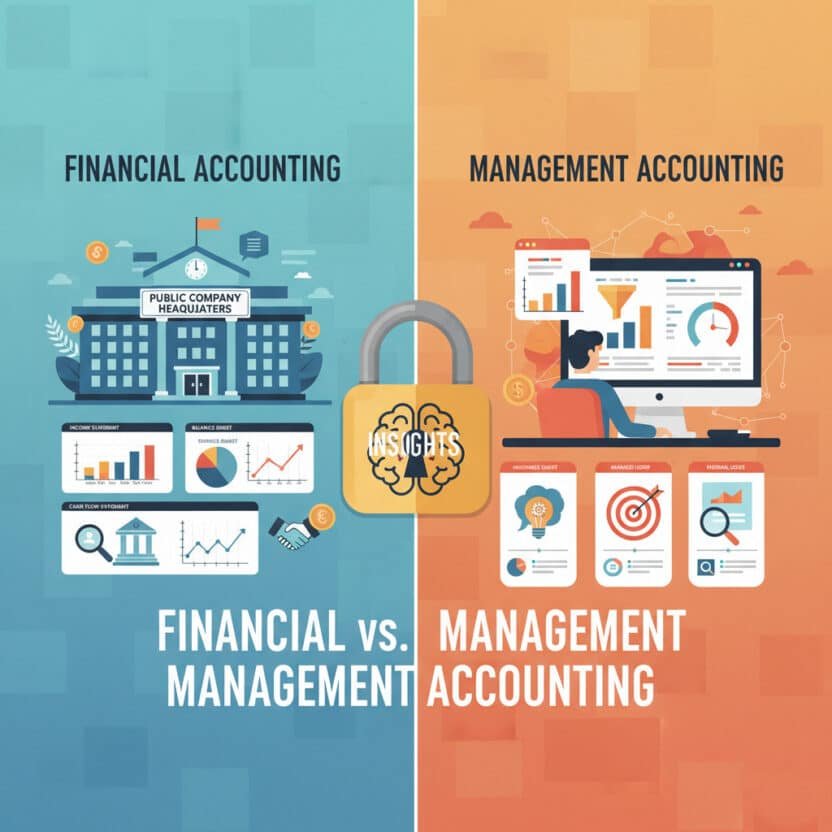
Two of the most critical perspectives are financial vs management accounting. While they might sound similar, they serve vastly different purposes. Welcome, business owners, entrepreneurs, and aspiring financial professionals! In the dynamic world of business, understanding your numbers is paramount to success. But did you know there are different ways to look at those numbers? This comprehensive guide will explore the difference between financial accounting and management accounting. We’ll delve into their definitions, characteristics, key distinctions, and why your business needs both to thrive. So, grab a cup of coffee, and let’s demystify the world of accounting! What is Financial Accounting? Financial accounting is the process of recording, summarizing, and reporting a company’s business transactions through financial statements. Think of it as the official storyteller of your company’s financial history. Definition and Purpose The primary purpose of financial accounting is to provide accurate and consistent information to external stakeholders. These are individuals and entities outside your company who have an interest in its financial performance. Key Characteristics of Financial Accounting The Core Financial Statements Financial accounting culminates in the preparation of several key financial statements: What is Management Accounting? Management accounting, also known as managerial accounting, is the process of identifying, measuring, analyzing, interpreting, and communicating financial information to managers for the pursuit of an organization’s goals. It’s the “insider’s view” of the company’s finances. Definition and Purpose The main goal of management accounting is to provide internal decision-makers with the information they need to make informed business decisions, plan for the future, and control operations. Key Characteristics of Management Accounting Common Management Accounting Reports Management accounting generates a wide variety of reports, including: The Key Differences: Financial vs Management Accounting Now that we have a foundational understanding of both, let’s dive into the key difference between financial accounting and management accounting. Basis of Comparison Financial Accounting Management Accounting Users External stakeholders (investors, creditors, etc.) Internal management Time Focus Historical (past-oriented) Future-oriented Rules Governed by GAAP/IFRS No fixed rules; based on management needs Scope Focuses on the company as a whole Focuses on specific segments or departments Report Frequency Periodically (quarterly, annually) As needed (daily, weekly, monthly) Level of Detail Highly aggregated Very detailed Objectivity Objective and verifiable Subjective and relevant Legal Requirement Mandatory for public companies Optional Users of Information As the table shows, this is the most significant difference between financial accounting and management accounting. Financial accounting provides a standardized view for those outside the company, while management accounting offers a customized perspective for those inside. Time Focus Financial accounting is like looking in the rearview mirror, while management accounting is like looking at the road ahead through the windshield. One tells you where you’ve been, and the other helps you decide where to go. Rules and Regulations The strict adherence to GAAP or IFRS in financial accounting ensures that all companies are speaking the same financial language. Management accounting, on the other hand, is like a private conversation within the company, so it can use its own shorthand and focus on what’s most important to the decision-makers. Scope and Nature of Information Financial accounting paints a broad picture of the entire organization’s financial health. Management accounting, however, can zoom in on a specific product line, a single department, or even an individual project to provide granular insights. Similarities Between Financial and Management Accounting Despite their many differences, it’s important to recognize that financial and management accounting are not entirely separate. They share some common ground: Why Both are Crucial for Business Success A common misconception is that businesses need to choose between financial and management accounting. The truth is, a successful business needs both to thrive. Financial Accounting for Investor Confidence Financial accounting is your company’s face to the world. Accurate and transparent financial reporting builds trust with investors, lenders, and other stakeholders, which is essential for securing funding and maintaining a positive public image. Management Accounting for Strategic Decisions Management accounting is the engine that drives your business forward. It provides the insights you need to make smart, data-driven decisions that will lead to growth and profitability. Career Paths in Financial and Management Accounting The difference between financial accounting and management accounting also extends to the career paths available in each field. Financial Accounting Careers Management Accounting Careers Conclusion Understanding the difference between financial accounting and management accounting is not just for accountants; it’s essential for anyone involved in business. Financial accounting provides a clear and accurate picture of your company’s past performance, while management accounting gives you the tools to shape its future. By leveraging the strengths of both, you can build a more resilient, profitable, and successful business. I hope this in-depth guide has clarified the difference between financial accounting and management accounting. FAQs

Scroll to Top