Inflation is more than a macroeconomic trend—it’s a psychological trigger. When prices rise and economic uncertainty dominates headlines, many business owners instinctively hoard cash, delay investment, and resist strategic moves that could create future growth.
While traditional financial advice focuses on numbers, ratios, and forecasts, behavioral finance helps us understand the deeper truth: people don’t make financial decisions logically—they make them emotionally.
At the center of these emotions lies Loss Aversion, one of the most powerful behavioral biases ever documented. It shapes perception, distorts risk assessment, and often leads business owners to make choices that feel safe today but cost them significantly tomorrow.
This article takes a deep dive into why business owners hoard cash during inflation, the psychology behind it, and most importantly, how advisors can guide clients toward healthier, more profitable financial decision-making.
What Is Behavioral Finance and Why Does It Matter in Inflationary Periods?
Behavioral finance examines how emotions, cognitive biases, and social dynamics shape financial choices. Unlike classical economics—which assumes people behave rationally—behavioral finance acknowledges that uncertainty triggers instinctive responses rooted in human psychology.
Inflation amplifies these responses. When the cost of living rises and markets become volatile, the brain defaults to threat detection mode. Business owners start thinking less about growth and more about protection.
Three behavioral factors matter most here:
1. Threat Sensitivity Increases During Inflation
The brain interprets inflation as a loss of control. Cash reserves appear to be the only “safe” asset—even though they lose purchasing power.
2. Risk Perception Becomes Distorted
Inflation magnifies uncertain outcomes, making business owners fear investment even if the long-term benefits outweigh the short-term risks.
3. Decision Paralysis Sets In
With too many conflicting variables—prices rising, demand fluctuating, supply chain unpredictability—many decision-makers default to doing nothing, believing inaction avoids loss.
This is where Loss Aversion comes into play.
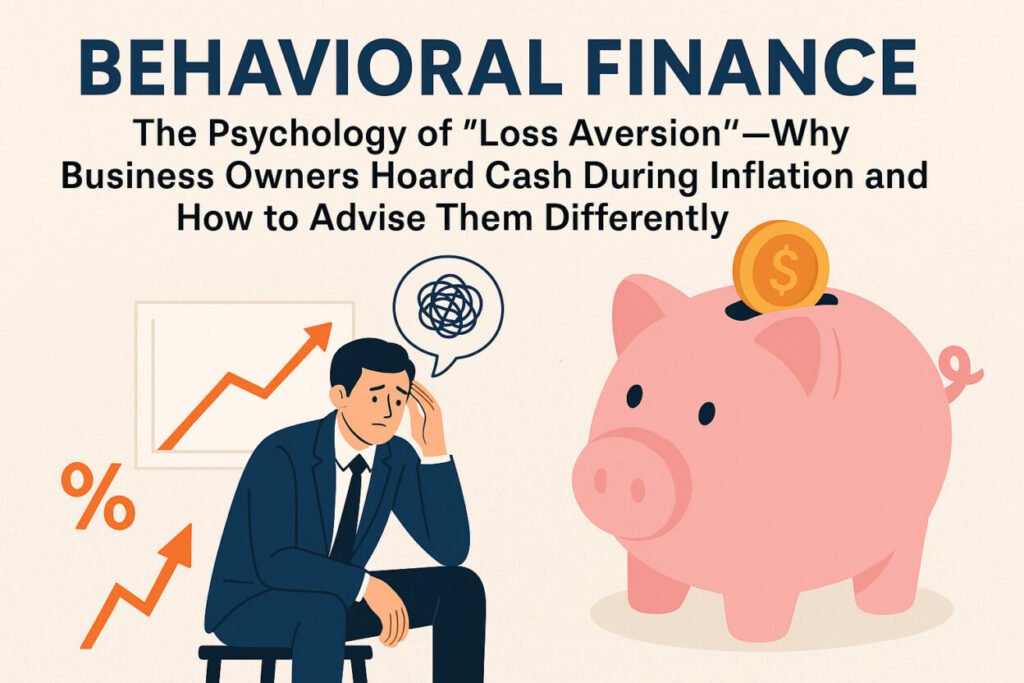
Understanding Loss Aversion: The Psychological Core of Cash Hoarding
Loss aversion is a cornerstone principle in behavioral finance:
People feel the pain of losses twice as intensely as the pleasure of equivalent gains.
This means:
- Losing $10,000 hurts more than gaining $10,000 feels good.
- Business owners fear making a wrong decision far more than they value making a profitable one.
- During inflation, every financial move looks like a potential loss, so holding cash becomes a psychological “safe haven.”
Let’s break down the cognitive mechanisms behind this behavior.
Why Loss Aversion Intensifies During Inflation
1. Inflation Makes Money Feel Scarcer
Even if revenue remains stable, business owners feel poorer because their dollars buy less. This illusion of scarcity activates survival instincts.
2. Cash Feels Like Control
In uncertain environments, liquid money appears to offer freedom and flexibility. Owners think:
“If things get worse, at least I have cash.”
Ironically, keeping too much cash during inflation guarantees real loss, since inflation erodes purchasing power.
3. Loss Aversion Causes Overestimation of Worst-Case Scenarios
Business owners often imagine dramatic negative outcomes that are statistically unlikely, such as complete market collapse or sudden bankruptcy.
4. Familiarity Bias Reinforces Cash Hoarding
People prefer assets they understand. Cash is familiar. Investments, expansion, automation, or hiring during inflation feel unfamiliar—and therefore risky.
Psychological Patterns Seen in Business Owners During Inflation
Advisors often observe these predictable patterns:
- Delaying strategic hiring despite operational strain
- Avoiding technology investments
- Cutting marketing budgets excessively
- Rejecting opportunities simply because “now is not a safe time”
- Holding cash far beyond reasonable liquidity reserves
- Hyper-focusing on short-term survival rather than long-term value
These decisions stem not from poor business sense, but from cognitive biases triggered by real or perceived threats.
Why Hoarding Cash Feels Safe—But Isn’t Always Rational
From a behavioral standpoint, hoarding cash provides psychological comfort. But from a financial standpoint, it carries hidden risks.
1. Inflation Erodes Value
If inflation is 6%, cash loses 6% of its purchasing power annually.
Hoarding may feel safe, but financially, it ensures a slow and silent loss.
2. Missed Opportunities Cost More Than Small Losses
During inflation, many competitors retreat. This creates rare chances to:
- Acquire talent at competitive rates
- Negotiate better supplier deals
- Expand market share
- Invest in efficiency improvements
Not acting can be more harmful than making the wrong move.
3. Cash Hoarding Creates Strategic Rigidity
Businesses that cling to liquidity often:
- Halt innovation
- Slow decision-making
- Lose competitive momentum
- Struggle to adapt to rapid changes
4. Hoarding Can Signal Fear to Employees and Stakeholders
When leaders make fear-driven decisions, teams sense instability—reducing morale and productivity.
How Advisors Can Guide Business Owners Differently (Based on Behavioral Finance Principles)
Traditional advice like “diversify your investments” or “focus on growth” falls flat during inflation because it ignores the emotional reality of the business owner.
To influence decisions effectively, advisors must address the psychology first, then the strategy.
Step 1 – Acknowledge the Fear Before Offering Analysis
Do not begin with spreadsheets. Begin with empathy.
Say things like:
“It makes sense that inflation feels risky right now.”
“Your caution shows responsible leadership.”
When business owners feel understood, they become open to guidance.
Step 2 – Reframe Loss Aversion into “Opportunity Cost Awareness”
Instead of focusing on potential losses, shift the conversation toward losses that happen from inaction.
For example:
- “Holding too much cash guarantees a 5–10% annual loss due to inflation.”
- “What is the cost of not upgrading equipment this year?”
- “What opportunities are your competitors seizing while others stand still?”
This subtle reframing reduces psychological resistance.
Step 3 – Present Options in Simple, Limited Choices
Behavioral research shows that too many options paralyze decision-making.
Offer two or three well-structured alternatives, such as:
- A conservative plan
- A balanced plan
- A growth-oriented plan
Business owners feel more in control, not overwhelmed.
Step 4 – Use Scenario Planning to Reduce Fear of the Unknown
Show owners what happens under:
- mild inflation
- moderate inflation
- severe inflation
Highlight that the balanced or growth strategy performs better in most realistic scenarios.
Step 5 – Introduce “Safe-to-Fail Experiments”
Instead of asking business owners to commit to 100% of a strategy, suggest small steps:
- test one new marketing channel
- automate one department
- hire one operational specialist
- invest in one piece of technology
These micro-investments build confidence and reduce loss aversion.
Step 6 – Create a Cash Allocation Framework That Feels Safe
Most owners hoard cash because they lack a structured liquidity plan.
Help them calculate:
- emergency operating reserves
- tax reserves
- expansion reserves
- investment capital
Once they see cash in buckets, they stop overprotecting all of it.
Strategic Financial Recommendations That Work During Inflation
Business owners need clarity, not vague encouragement. Here are evidence-based strategies aligned with behavioral finance:
1. Maintain 3–6 Months of Operating Liquidity
This satisfies the safety instinct without over-hoarding.
2. Channel Excess Cash Into Inflation-Resistant Assets
Depending on the business type:
- equipment that increases productivity
- real estate
- inventory (strategically purchased)
- automation tools
- marketing systems that multiply revenue
These reduce long-term cost pressure.
3. Prioritize Pricing Power and Value Elevation
The best inflation defense is strong pricing power—achieved through:
- branding
- exceptional customer experience
- niche positioning
Advisors should help clients justify price increases confidently.
4. Invest in Efficiency Instead of Expansion Alone
Efficiency investments often bring:
- higher margins
- reduced labor dependency
- predictable output
- long-term resilience
Business owners find these decisions emotionally easier because they reduce, rather than increase, perceived risk.
The Advisor’s Mindset: Become a Behavioral Guide, Not a Financial Lecturer
Your ultimate role is to bridge the gap between emotion and strategy.
Advisors who succeed during inflation do three things consistently:
- Validate fear without reinforcing it
- Simplify decisions without restricting autonomy
- Turn psychological biases into strategic advantages
Loss aversion doesn’t disappear—but with the right approach, it becomes manageable.
Conclusion
Business owners hoard cash during inflation not because they are irrational, but because they are human. Their behavior stems from:
- fear of losing control
- mental overestimation of risk
- emotional attachment to liquidity
- cognitive biases that amplify worst-case thinking
Advisors who recognize these patterns can redirect fear-driven decisions into strategic, growth-oriented actions.
Understanding behavioral finance—especially the power of loss aversion—is no longer optional.
It’s the key to delivering meaningful advice in uncertain times.
FAQs
What is loss aversion in behavioral finance?
Loss aversion is the psychological bias where people feel the pain of losses more intensely than the pleasure of equivalent gains. This often leads to overly cautious financial decisions.
Why do business owners hoard cash during inflation?
Because inflation creates uncertainty, business owners hoard cash to maintain a sense of control and reduce perceived risk—even though hoarding causes long-term value loss.
Is hoarding cash during inflation a smart strategy?
Up to a point, yes – holding 3–6 months of reserves is wise. Beyond that, excessive hoarding reduces purchasing power and creates missed opportunities.
How can advisors help owners overcome loss aversion?
By validating fears, simplifying decision options, reframing opportunity cost, using scenario planning, and introducing small-scale “safe-to-fail” experiments.
What investments make sense during inflation?
Efficiency tools, automation, selective hiring, strategic inventory, real estate, and high-impact marketing often provide strong inflation-adjusted returns.
Is behavioral finance important for advising businesses?
Absolutely. Understanding psychology enables advisors to influence decision-making more effectively than financial data alone.

He founded Finance and Tax Guide to simplify complex tax and accounting topics for Indian small businesses, entrepreneurs, and individual taxpayers.
His expertise includes:
• GST Registration and Return Filing
• Income Tax Return (ITR) Filing
• TDS and TCS Compliance
• Business Bookkeeping
• Financial Accounting
• Tax Planning for Small Businesses
Every article published on Finance and Tax Guideis based on practical accounting experience and current Indian tax laws to provide accurate,
easy-to-understand financial guidance.