Employee Stock Options (ESOPs) are often positioned as a powerful wealth-building tool—especially in startups, tech companies, and fast-growing organizations. They offer employees the chance to own equity, contribute to growth, and participate in the upside.
But here’s the hidden truth most employees don’t discover until it’s too late:
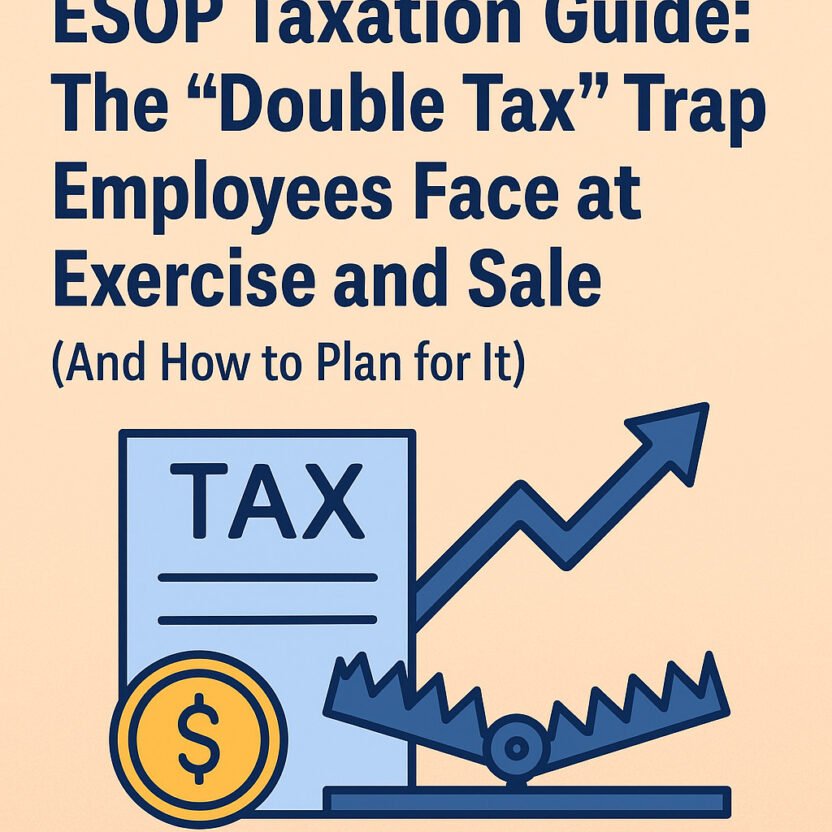
ESOPs can create a painful “double tax” trap—first at exercise and again at sale—leading to large, unexpected tax bills.
The complexity stems from a phenomenon known as the “Double Tax Trap.” Unlike a standard salary, where you are taxed once when you get paid, ESOPs are taxed at two distinct, often expensive stages. Without a clear ESOP taxation guide, you risk losing over 50% of your gains to the government.
This guide breaks down exactly how ESOP taxation works, why the double tax trap happens, and how smart planning can save employees thousands (sometimes lakhs) in taxes.
What is an ESOP?
An Employee Stock Option Plan (ESOP) allows employees to buy company shares at a fixed price—instead of the market price—after completing a vesting period.
It’s designed as:
- a retention tool,
- a reward system, and
- a wealth-creation incentive.
However, ESOPs are not free shares; they are options that must be exercised, and exercising triggers taxation.
Before diving into the tax trap, it is essential to understand the lifecycle of an Employee Stock Option. An ESOP is not a share of stock today; it is a right to buy a share in the future at a locked-in price, known as the Exercise Price or Strike Price.
- Grant Date: The day the company gives you the options. No tax is due here.
- Vesting Period: The time you must work before you own the right to use the options.
- Exercise Date: The day you actually buy the shares at the Exercise Price.
- Sale Date: The day you sell your shares for cash.
How to Plan for ESOP Taxation: 5 Expert Strategies
Strategic planning can turn a tax liability into a wealth-building machine. Here is how sophisticated investors manage their ESOPs.
1. Timing the Exercise in a “Low Income” Year
Since the exercise perquisite is added to your salary, try to exercise options during a year when your other income might be lower—perhaps during a sabbatical, a career transition, or when you aren’t receiving a large performance bonus. This keeps you in a lower tax bracket.
2. The “Early Exercise” Strategy
If your company allows “early exercise” (exercising before options are fully vested), you can buy the shares when the FMV is nearly identical to the Exercise Price. This results in a $0 perquisite tax today and starts the clock on the holding period for Long-Term Capital Gains immediately.
3. Holding for Long-Term Capital Gains (LTCG)
Patience pays. By holding your shares for the required period (usually 1 year for listed or 2 years for unlisted companies), you move from a high salary tax rate to a much lower LTCG rate. This single move can save you 15-20% in taxes.
4. Splitting Sales Across Financial Years
If you have a large block of shares to sell, don’t sell them all on December 31st. By splitting the sale between the end of one financial year and the start of the next, you spread the capital gain across two years, potentially staying under tax thresholds or utilizing annual exemptions.
5. Utilizing Tax Credits and DTAA (For Global Employees)
If you work for a US-based company but live in India or Europe, you might be subject to withholding in both countries. Ensure you leverage Double Taxation Avoidance Agreements (DTAA) to claim foreign tax credits so you don’t actually pay twice on the same income.
| Feature | Stage 1: Exercise | Stage 2: Sale |
| Tax Type | Perquisite (Salary Income) | Capital Gains Tax |
| Taxable Amount | FMV – Exercise Price | Sale Price – FMV at Exercise |
| Tax Rate | Your Income Tax Slab | 10% – 20% (Long Term) or Slab/15% (Short Term) |
| Cash Impact | Out-of-pocket (Cash outflow) | Proceeds received (Cash inflow) |
Key ESOP Terms Every Employee Must Know
Before diving into the tax trap, let’s understand the terminology.
2.1 Grant Date
The date the company offers ESOPs to the employee.
2.2 Vesting
ESOPs unlock gradually—often over 3–4 years. Only vested options can be exercised.
2.3 Exercise
The moment you convert ESOP options into real company shares by paying the exercise price.
2.4 Exercise Price (Strike Price)
The fixed price at which you buy ESOP shares.
2.5 Fair Market Value (FMV)
The market price of the share on the date you exercise your options.
2.6 Sale
When you sell your exercised shares—either privately, in a buyback, secondary sale, or after IPO.
Understanding these terms is crucial because taxation applies at two different stages:
exercise and sale.
Understanding the ESOP Taxation Lifecycle
ESOP taxation occurs in two major stages:
Stage 1: Tax at Exercise
You pay tax on the difference between FMV and exercise price.
This difference is treated as salary income.
Stage 2: Tax at Sale
You pay capital gains tax on the appreciation after exercise.
This two-step taxation is what leads to the double tax trap.
Why Does the “Double Tax” Trap Happen?
The “double tax” trap occurs because:
- At exercise, tax is charged even if you haven’t sold the shares.
- At sale, tax is charged again on the profit earned after exercise.
This means you’re taxed:
- once when you acquire shares, and
- again when you sell them.
The problem becomes worse because:
- the first tax is treated as salary income, which is taxed at the highest slab rate
- the employee must pay out of pocket for this tax
- sometimes shares decline in value later, but the employee already paid a huge tax at exercise
This can turn ESOPs into a liability rather than an asset.
ESOP Exercise Tax: The Pain Point
At exercise, you pay tax on:
(FMV – Exercise Price) × Number of Shares
This is considered a perquisite / salary income.
Why This Hurts
- You owe tax before receiving any cash.
- The tax is deducted from salary or must be paid separately.
- If you don’t have cash reserves, exercise becomes impossible.
Who Faces the Highest Burden?
Employees at:
- high-growth startups
- companies with high share valuations
- employees in high tax brackets
- employees with thousands of shares
ESOP Sale Tax Explained
When you sell shares, you pay capital gains tax on:
Sale Price – FMV at Exercise
The rate depends on:
- whether shares are listed or unlisted,
- holding period,
- long-term vs short-term capital gains rules.
Employees often misunderstand this part and underestimate the second tax.
How the Double Tax Trap Erodes Your Wealth
The problem compounds when:
- FMV rises significantly
- exercise happens early
- sale opportunity is uncertain
- employees cannot liquidate shares
- share prices fall after exercise
Imagine paying taxes on a high valuation only to see the share price crash later.
This is real wealth destruction, and many employees have experienced it.
Real-World Numerical Example (Very Important)
Let’s assume:
- Exercise Price: $5
- FMV at Exercise: $50
- Number of Shares: 5,000
- Tax Rate: 35%
- Sale Price (Two scenarios): $100 and $40
Step 1: Tax at Exercise
Perquisite gain = (50 – 5) × 5,000 = $225,000
Tax @ 35% = $78,750 out of pocket
You paid $78,750 BEFORE selling anything.
Step 2: Tax at Sale
Scenario A: Sale at $100
Capital gain = (100 – 50) × 5,000 = $250,000
Capital gains tax (20%) = $50,000
Total tax paid = $128,750
Scenario B: Sale at $40 (Down Round)
Capital gain = (40 – 50) = negative
No capital gains tax
BUT YOU ALREADY PAID $78,750 at exercise on a valuation that no longer exists.
This is the double tax nightmare.
How to Plan for ESOP Taxes (Smart, Legal Strategies)
1 Don’t Exercise All ESOPs at Once
Phased exercise helps control:
- cash outflow
- tax slabs
- valuation risks
2 Exercise Only When Liquidity Is Expected
Ideal timing:
- during a buyback
- during a secondary sale
- before an IPO with clear timeline
Avoid exercising too early.
3 Negotiate for a Cashless Exercise (If Possible)
Some companies allow:
- cashless exercise
- exercise using sale proceeds
This eliminates out-of-pocket tax burdens.
4 Understand Your Company’s ESOP Policy Clearly
Ask these questions:
- Is FMV rising quickly?
- When is the next buyback?
- Are secondary sales allowed?
- What is the exit strategy?
5 Set Aside a Tax Fund
If you must exercise early, create a “tax savings reserve”.
6 Avoid Exercising Shares With Very High FMV
A high FMV increases perquisite tax dramatically.
Timing matters more than volume.
7 Consult a Tax Planner
Every ESOP situation is unique.
A professional can optimize your tax burden significantly.
Common Mistakes Employees Make With ESOPs
Mistake 1: Exercising too early
Employees exercise just because options vest, without considering taxation.
Mistake 2: Ignoring FMV trends
A rising or inflated FMV can create huge tax liabilities.
Mistake 3: Selling too late
Waiting too long may reduce sale price after paying taxes at a higher valuation.
Mistake 4: Not asking for company guidance
Most employees ignore discussions about liquidity planning.
Mistake 5: Not understanding tax classification
Salary tax vs capital gains tax behave very differently.
Mistake 6: Not planning for cash needed to exercise
Exercise cost + tax cost can be overwhelming.
ESOP Tax Strategies for Startup Employees
Startup ESOPs are both an opportunity and a risk.
1 Wait for a Clear Exit Event
The smartest strategy is to exercise only when liquidity is near.
2 Take Advantage of Early Exercise (If Offered)
Early exercise may qualify for:
- lower FMV
- lower tax
- long-term capital gains
But only if your company supports it.
3 Understand Buyback Rules
Buybacks are common and offer:
- guaranteed liquidity
- tax optimization
- predictable cash flow
4 Don’t Treat ESOPs as Guaranteed Money
Only exercise what you can afford to lose.
ESOP Planning Checklist
Use this checklist before exercising:
✔ Do I understand the tax at exercise?
✔ Do I have enough cash to pay the tax?
✔ Is there a clear sale opportunity?
✔ What is the FMV trend?
✔ Am I in the highest tax bracket?
✔ Should I exercise partially instead of all at once?
✔ Should I consult a tax advisor before acting?
✔ Can my company allow cashless exercise or delayed tax deduction?
✔ Are secondary sales happening in the company?
If the answer to these questions isn’t clear, delay exercise.
Conclusion
ESOPs can be life-changing—but only when employees understand how taxation works.
The double tax trap is real, and thousands of employees unknowingly fall into it every year.
However, with smart planning—timing the exercise, understanding FMV trends, waiting for liquidity events, and structuring your finances—you can turn ESOPs into a powerful wealth-creation tool instead of a tax burden.
FAQs
Can I avoid the perquisite tax by not exercising?
Yes. If you never exercise the options, you never trigger the perquisite tax. However, options usually expire after you leave a company, so you must decide if the stock is worth the tax cost.
What happens if the stock price falls after I exercise?
This is the danger of the “Double Tax Trap.” You will have paid income tax on the higher FMV. If you sell later at a lower price, you will have a Capital Loss, which you can use to offset other capital gains, but you cannot “refund” the income tax already paid.
Are there any tax deferrals for startups?
In certain jurisdictions (like India under Section 192(1C)), employees of eligible startups can defer the exercise tax for up to 5 years, or until they leave the company or sell the shares. Always check if your company qualifies as a “DPIIT-recognized” startup.
Is the FMV determined by the company or the market?
For listed companies, FMV is the market closing price. For unlisted startups, FMV is determined by a registered Merchant Banker or certified valuer through a formal valuation report.
Do I pay tax when the options are granted to me?
No. There are no tax implications on the grant date or during the vesting period. Taxation only begins the moment you decide to exercise.

He founded Finance and Tax Guide to simplify complex tax and accounting topics for Indian small businesses, entrepreneurs, and individual taxpayers.
His expertise includes:
• GST Registration and Return Filing
• Income Tax Return (ITR) Filing
• TDS and TCS Compliance
• Business Bookkeeping
• Financial Accounting
• Tax Planning for Small Businesses
Every article published on Finance and Tax Guideis based on practical accounting experience and current Indian tax laws to provide accurate,
easy-to-understand financial guidance.