Over the past decade, India has witnessed an explosive rise in the number of ultra-high-net-worth individuals (UHNWIs). With increasing global investments, cross-border structures, and multi-generational wealth planning needs, family offices have become central to managing private capital.
For years, the default destinations for Indian wealth were Singapore and Dubai—two global hubs known for tax clarity, sophisticated financial markets, and robust regulatory environments.
But a new trend is emerging: India’s wealthiest families are re-domesticating capital and setting up family offices in GIFT City, a tax-advantaged, globally integrated financial enclave designed to rival the world’s top financial centers.
This shift is not temporary—it represents a structural change in how Indian wealth is created, managed, and transferred across generations.
The Rise of GIFT City as India’s Global Financial Hub
GIFT City (Gujarat International Finance Tec-City), located between Ahmedabad and Gandhinagar, is India’s first International Financial Services Centre (IFSC).
It is designed as a foreign jurisdiction within India, offering benefits comparable to international hubs while keeping capital closer to home.
Why the Indian Government Built an IFSC
GIFT City was built to:
- Stop Indian capital from flowing to foreign jurisdictions
- Provide a globally competitive regulatory ecosystem
- Enable seamless cross-border investments
- Bring offshore financial businesses back to India
In essence, GIFT City is India’s answer to global competition—an economic zone designed specifically to keep India’s money in India while giving investors the advantages traditionally found only abroad.
Why Family Offices Matter And Why They Are Choosing GIFT City
A family office goes far beyond investment management. It handles taxation, estate planning, philanthropy, governance, private equity, succession, luxury assets, and even family constitutions.
Historically, wealthy Indian families set up structures abroad due to advantages in:
- Tax neutrality
- Estate planning laws
- Cross-border investment freedom
- Regulatory clarity
- Professional service ecosystems
But today, GIFT City offers all of these—plus the advantage of location, cost, and strategic control.
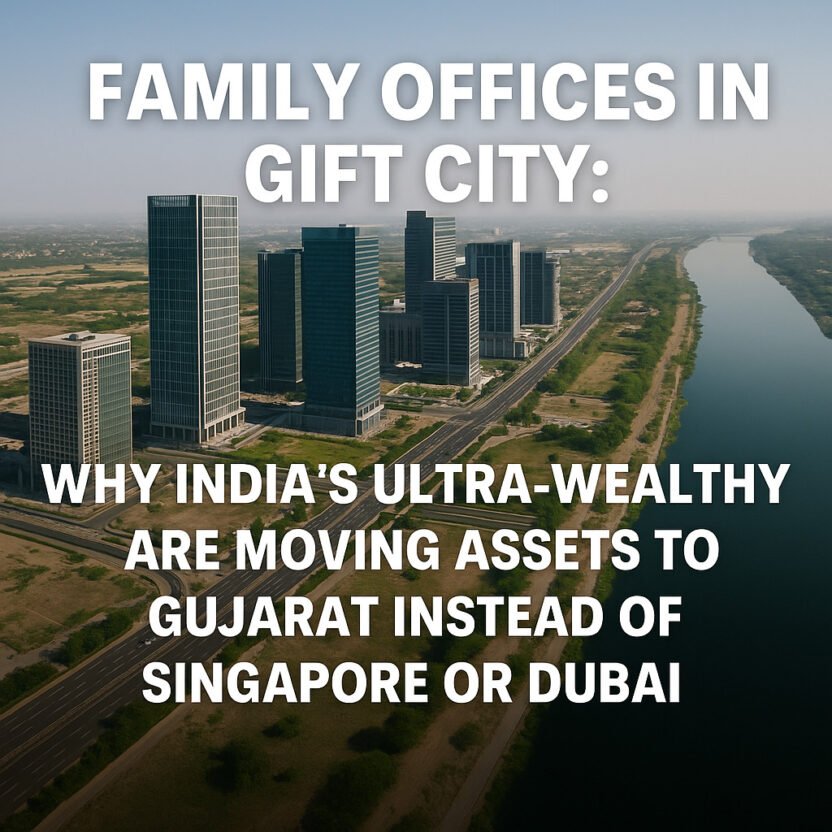
Top Reasons India’s Ultra-Wealthy Are Moving Family Offices to GIFT City
Below is the most comprehensive breakdown of why GIFT City is becoming the preferred headquarters for India’s wealth.
1. Unmatched Tax Benefits for Family Offices
GIFT City offers some of the most attractive tax incentives in Asia.
Key Tax Advantages Include:
- 100% tax exemption on business income for 10 out of 15 years
- No capital gains tax on many types of transactions
- No stamp duty on fund transfers within GIFT City
- No GST on financial services provided to offshore clients
- Virtually zero tax leakage on global investments
Compared to Singapore, which has recently tightened tax residency rules, and Dubai, which introduced corporate tax in 2023, GIFT City now looks even more competitive.
2. Liberalized Regulations Tailored for Global Wealth
India created a separate regulator—the International Financial Services Centres Authority (IFSCA)—specifically for GIFT City.
Why this matters:
- Regulations are simpler and more flexible
- Decision-making is faster
- Licensing frameworks are built for innovation
- Family offices get clear rules for global allocation
This is very different from India’s domestic regulatory maze and is a major reason for the shift.
3. Seamless Global Investment Access
A GIFT City family office can invest across:
- Global equities
- Private equity
- Venture capital
- Debt instruments
- Real estate
- Structured products
- Alternative assets
Using freely convertible foreign currency accounts, they can deploy capital globally with minimal friction—similar to an offshore entity.
This offers the best of both worlds: global access with Indian governance and transparency.
4. Lower Operating Costs Compared to Singapore or Dubai
Running a family office in GIFT City can cost 30–60% less than operating in major hubs abroad, because:
- Employee costs are lower
- Real estate and office leases are cheaper
- Professional services (legal, audit, compliance) are cost-effective
- Travel and operational burden is reduced
Cost matters, especially for family offices handling a few hundred million dollars rather than multi-billion dollar empires.
5. India’s Wealth Is Growing Faster Than Any Other Major Economy
India is creating millionaires at an unprecedented speed.
Factors driving domestic wealth creation:
- Booming startup ecosystem
- Rising private equity activity
- Growing corporate valuations
- Surge in new-age entrepreneurs
- Increasing financialization of household assets
This economic momentum is prompting families to keep capital at home, where opportunities are strongest.
6. Stronger Control and Compliance Comfort
Many wealthy Indians have become cautious about:
- Global scrutiny
- Cross-border transaction regulations
- Anti-money laundering reviews
- Substance requirements in foreign jurisdictions
GIFT City offers:
- Legal predictability
- Transparency
- Protection under Indian laws
- Familiar compliance requirements
Families feel safer keeping assets in India while still enjoying global access.
7. Facilitation of Succession & Estate Planning Within India
India lacks a formal estate tax—but many foreign jurisdictions do not.
For instance:
- Assets held in the U.S. may attract estate tax up to 40%.
- Assets held abroad through poorly structured vehicles can trigger unintended tax events.
GIFT City simplifies the process of:
- Trust formation
- Succession planning
- Inter-generational wealth transfers
Families also appreciate that planning is aligned with Indian cultural preferences and legal frameworks.
8. India’s Push to Become a Global Financial Hub
GIFT City is not an experiment—it is a flagship national project with political backing and long-term vision.
The government continues to:
- Simplify rules
- Provide tax incentives
- Invite global banks and asset managers
- Build infrastructure
- Encourage fintech innovation
As a result, GIFT City is acquiring real economic gravity, attracting:
- Global banks
- Hedge funds
- Insurance companies
- Aircraft leasing firms
- Asset managers
- Legal and consulting firms
This booming ecosystem makes GIFT City a natural home for family offices.
Comparing GIFT City with Singapore and Dubai
Below is a realistic, ground-level comparison from a family office perspective.
Taxation Comparison
| Feature | GIFT City | Singapore | Dubai |
|---|---|---|---|
| Corporate Tax | 0% for 10 yrs | 17% (with incentives) | 9% corporate tax (from 2023) |
| Capital Gains | Mostly exempt | Exempt (conditions apply) | Exempt |
| Dividend Tax | Exempt | Exempt | Exempt |
| GST/VAT | Zero for offshore | 8% GST | 5% VAT |
| Personal Income Tax | Regular Indian tax | 0% | 0% |
GIFT City now offers the strongest tax incentives among the three.
Regulatory & Ecosystem Comparison
| Feature | GIFT City | Singapore | Dubai |
|---|---|---|---|
| Regulatory speed | Fast | Moderate | Fast |
| Global banking infrastructure | Growing | Very strong | Very strong |
| Family office ecosystem | Rapidly expanding | Mature | Mature |
| Minimum substance requirements | Reasonable | Increasing | Increasing |
Singapore recently tightened residency rules for family offices, while Dubai introduced corporate tax. GIFT City’s rules are currently most favorable for Indian-origin wealth.
Why GIFT City Beats Singapore and Dubai for Indian Wealth
While Singapore and Dubai provide excellent global access, GIFT City offers something they cannot: The “Onshore-Offshore” Advantage.
1. Superior Tax Efficiency and Holiday Benefits
Singapore has a corporate tax rate of roughly 17%, and while Dubai was historically tax-free, it recently introduced a 9% corporate tax. In contrast, GIFT City offers a 100% income tax exemption for any 10 consecutive years out of a 15-year block.
- Zero Transaction Taxes: No Securities Transaction Tax (STT), No Commodities Transaction Tax (CTT), and No Stamp Duty on IFSC exchanges.
- GST Exemptions: Services provided to and by FIFs in the IFSC are generally exempt from Goods and Services Tax.
- Capital Gains: Significant exemptions exist for non-residents and specialized structures within the zone.
2. Lower Operational Costs
The “Cost of Doing Business” in GIFT City is approximately one-fifth of that in Singapore or Dubai. Rent for Category-A office space, administrative overheads, and the cost of skilled local financial talent are significantly lower in Gandhinagar, allowing family offices to allocate more capital toward investments rather than high upkeep.
3. Exemption from Stringent “ODI” Rules
Domestic family offices in India are often hamstrung by the Overseas Direct Investment (ODI) regime, which requires cumbersome disclosures and restricts investments in unlisted entities. GIFT City acts as a legal “detour.” By channeling funds through an FIF, families can invest up to 50% of their net worth into global unlisted assets without the compliance friction of the mainland RBI rules.
The Strategic Shift: From Capital Outflow to Capital Control
Bypassing Currency Volatility
The Indian Rupee has seen long-term headwinds against the US Dollar. By maintaining assets in a foreign currency account within GIFT City (e.g., USD, EUR, GBP), Indian families can hedge against currency depreciation while remaining within the Indian legal ecosystem.
Succession Planning Made Simple
GIFT City allows for various legal structures like LLPs, Companies, and Contributory Trusts. This flexibility is vital for multi-generational wealth preservation. It allows patriarchs and matriarchs to define governance rules that apply across global assets, all while being governed by a regulator (IFSCA) that understands Indian family dynamics far better than a foreign authority would.
Proximity and Lifestyle
For a Mumbai or Delhi-based HNI, GIFT City is a short flight away. The development of high-speed rail and expanded airport connectivity means patriarchs can visit their wealth managers and return home the same day—a convenience Singapore and Dubai simply cannot replicate.
Regulatory Stability: The IFSCA Edge
The biggest risk with offshore hubs is “Regulatory Creep.” Changes in foreign tax treaties or geopolitical shifts can suddenly make a Singapore structure less viable. GIFT City is a sovereign-backed initiative. The Government of India has extended tax holidays until 2030 and continually updates the Finance Bill (like the 2025 updates for OTC derivatives) to ensure GIFT City remains the “preferred base” for Indian capital.
What Types of Family Offices Are Moving to GIFT City?
1. Traditional Business Families
Many long-standing industrial families are shifting treasury operations and investment arms to GIFT City to:
- Optimize tax efficiency
- Manage surplus liquidity
- Build global portfolios
2. Startup Founders & Tech Entrepreneurs
After large liquidity events (IPOs, acquisitions), founders prefer:
- Hassle-free global investing
- Low regulatory friction
- Access to VC/PE opportunities from India
3. NRI Families Returning Capital to India
NRIs are rethinking holding structures abroad due to:
- Compliance burdens
- Residency rules
- High maintenance costs
GIFT City offers NRI-friendly frameworks for investing and repatriation.
4. Next-Generation Wealth Holders
Younger family members are more global, tech-savvy, and investment-driven.
They appreciate GIFT City’s openness to:
- Alternatives
- Global equities
- Digital assets (in restricted forms)
- Fintech platforms
Challenges & Misconceptions About GIFT City
No emerging ecosystem is perfect. Let’s address common concerns.
1. “Is the ecosystem mature enough?”
While GIFT City is newer than Dubai or Singapore, it is growing faster than any other IFSC in Asia, with rapid inflows of:
- Banks
- Fund managers
- Insurers
- Professional services firms
The past three years have seen exponential growth.
2. “Is the regulatory environment stable?”
Yes.
IFSCA is structured for:
- Stability
- Innovation
- Alignment with global standards
India has strong political commitment to building a world-class IFSC.
3. “Can GIFT City match the lifestyle appeal of Singapore or Dubai?”
Lifestyle is subjective—but family offices primarily care about:
- Tax structure
- Investment freedom
- Operational simplicity
- Regulatory clarity
Many families keep personal residences abroad while shifting their financial structures to GIFT City.
The Future of GIFT City: What Lies Ahead for Family Offices
India is aiming for:
- $30+ trillion economy by 2050
- A top 3 global wealth hub
- A leading market for private capital
GIFT City will be central to:
- Offshore fund management
- Global banking in India
- Private wealth hubs
- Fintech innovation
- Cross-border settlements
Many experts believe GIFT City will become Asia’s fastest-growing financial center over the next decade.
Conclusion – Why GIFT City Is Becoming the New Magnet for India’s Wealth
The movement of family offices to GIFT City is not simply tax arbitrage—it reflects a new confidence in India.
Families want:
- Control
- Clarity
- Global access
- Cost efficiency
- Legacy planning
- A stable base for future generations
GIFT City delivers all of this, while keeping wealth within India’s financial ecosystem. As more UHNWIs set up shop in Gujarat, the momentum will attract global professionals, institutions, and innovation—creating a self-reinforcing cycle of growth.
GIFT City has effectively “onshored the offshore.” By offering a common-law regulatory environment, world-class smart infrastructure, and unmatched tax benefits, Gujarat is successfully poaching the assets that were once destined for Singapore and Dubai. For India’s ultra-wealthy, moving assets to GIFT City isn’t just a trend—it’s a sophisticated financial evolution.
GIFT City isn’t merely competing with Singapore or Dubai—it is emerging as the preferred home base for Indian wealth in a globalized world.
FAQs
Can a resident Indian individual invest in GIFT City family offices?
Yes, but they are generally limited to the $250,000 annual limit under the LRS route. However, qualifying Indian entities (90% family-owned) can contribute up to 50% of their net worth into a Family Investment Fund (FIF) in GIFT City.
What is the minimum investment for a GIFT City FIF?
A Family Investment Fund must accumulate a minimum corpus of USD 10 million within three years of registration.
Is there a tax on dividends in GIFT City?
Dividends paid by units in GIFT City to non-residents are subject to a concessional withholding tax of 10% (plus surcharge), which is often lower than mainland rates.
How does GIFT City compare to Dubai for real estate investment?
Dubai remains a global leader for physical real estate, but GIFT City provides a superior gateway for institutional real estate exposure through AIFs and REITs, with much lower entry costs and higher regulatory transparency within the Indian context.
Can a family office in GIFT City invest globally?
Yes. GIFT City entities can open foreign currency accounts and invest globally with minimal restrictions.
What is the minimum capital requirement?
Requirements vary by structure, but family investment funds and trusts can be set up with reasonable thresholds.

He founded Finance and Tax Guide to simplify complex tax and accounting topics for Indian small businesses, entrepreneurs, and individual taxpayers.
His expertise includes:
• GST Registration and Return Filing
• Income Tax Return (ITR) Filing
• TDS and TCS Compliance
• Business Bookkeeping
• Financial Accounting
• Tax Planning for Small Businesses
Every article published on Finance and Tax Guideis based on practical accounting experience and current Indian tax laws to provide accurate,
easy-to-understand financial guidance.