Merchant exporting continues to be one of the strongest pillars of India’s export ecosystem. Whether you are a new exporter or a seasoned player, GST provisions—especially the 0.1% concessional rate for merchant exporters—play a huge role in optimizing cash flow, reducing tax burden, and improving competitiveness in global markets.
However, many merchant exporters still face challenges such as delayed refunds, incorrect documentation, mismatch issues, or misinterpretation of conditions. This leads to blocked working capital and compliance headaches.
This complete guide explains everything in simple, human language—from eligibility to documentation, from invoicing requirements to the refund claim process, and from common mistakes to best practices.
Let’s dive deep into the full framework of Merchant Exports & GST
What is Merchant Export Under GST?
A merchant exporter is a trader who buys goods from domestic suppliers and exports them without any manufacturing or major processing. They act as intermediaries between domestic suppliers and foreign buyers.
Under GST, merchant exporters get a special benefit: they can procure goods at a concessional rate of 0.1%, instead of the normal GST rate, provided they meet specific conditions.
This scheme helps merchant exporters reduce tax costs and avoid working capital blockage.
What is the 0.1% Concessional GST Rate?
The government introduced a reduced GST rate of 0.1% for supplies made by domestic sellers to registered merchant exporters. Instead of 12%, 18%, or 28% tax rates, the supplier charges only 0.1% CGST + 0.1% SGST, or 0.1% IGST, depending on the type of supply.
How It Works
Instead of paying the standard GST rate (e.g., 18%) on your purchase, you only pay 0.1% (0.05% CGST + 0.05% SGST, or 0.1% IGST).
Example:
- Standard Scenario: You buy goods worth ₹10,00,000. GST @ 18% = ₹1,80,000. Total Outflow = ₹11,80,000.
- Concessional Scenario: You buy goods worth ₹10,00,000. GST @ 0.1% = ₹1,000. Total Outflow = ₹10,01,000.
You instantly save ₹1,79,000 in working capital.
Why Was the 0.1% Rate Introduced?
Before this scheme was introduced, exporters had to pay the full GST rate upfront and then claim a refund. This created liquidity issues and long waiting periods.
The 0.1% concessional rate ensures:
- Minimal tax outflow
- Smoother business operations
- Faster turnaround
- Lower risk of refund disputes
Eligibility Criteria for Merchant Exporters to Avail 0.1% GST Rate
To avail the benefit, the following must be fulfilled:
1. The Buyer Must be a Registered Merchant Exporter
A valid GSTIN is mandatory.
2. The Supplier Must Be a Registered Person
Only registered suppliers can issue 0.1% invoices.
3. The Merchant Exporter Must Export Goods Within 90 Days
Export of goods must occur within 90 days from the date of invoice.
4. The Merchant Exporter Must Provide a Copy of LUT/Bond to Supplier
The exporter should supply:
- Copy of Letter of Undertaking (LUT)
- Export purchase order
- Undertaking that goods will be exported
5. The Supplier Must Report the Supply in GSTR-1
Correct reporting under Table 6 is essential.
Conditions Suppliers Must Fulfill for the 0.1% GST Rate
1. Issue the Invoice with 0.1% GST Clearly Mentioned
The invoice must include:
- Reference to notification for concessional rate
- Merchant exporter’s GSTIN
- Nature of supply
2. Obtain Required Supporting Documents from Merchant Exporter
This usually includes:
- LUT copy
- Export order copy
- Declaration for merchant exports
3. Report Supplies Accurately in Monthly Returns
Any mismatch may delay refund for supplier or exporter.
Documentation Required for Merchant Exports Under 0.1% GST Rate
Correct documentation is the most crucial part of merchant exports.
Mandatory Documents Include:
- Purchase order from foreign buyer
- Purchase order placed with domestic supplier
- LUT (Letter of Undertaking)
- Invoice issued by supplier at 0.1% GST
- Shipping bill / Bill of Lading
- Export General Manifest (EGM)
- Bank realization certificate (if required for refund)
- Proof of export within 90 days
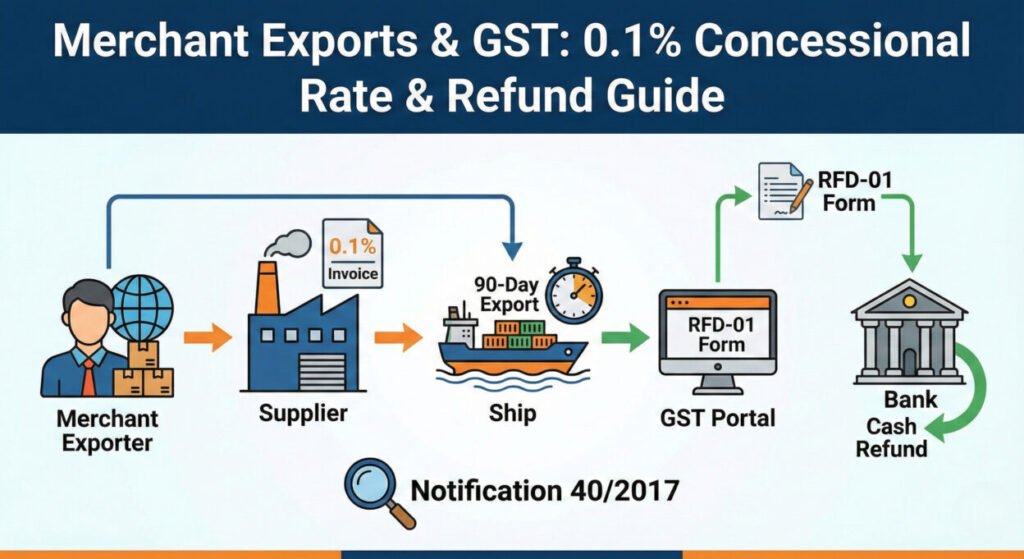
Step-by-Step Procedure to Procure Goods at 0.1% Concessional Rate
Step 1 – Merchant Exporter Obtains a Valid LUT
This is filed online on the GST portal and is valid for the financial year.
Step 2 – Place an Order with Domestic Supplier
The purchase order should mention:
- That goods are meant for export
- Exporter’s GSTIN
- Export order reference number
Step 3 – Provide Supplier Required Documents
This includes the LUT and declaration.
Step 4 – Supplier Issues Invoice at 0.1% GST
The supplier must reference the concessional rate notification.
Step 5 – Merchant Exporter Exports Goods Within 90 Days
Shipment documents and EGM must be properly filed.
GST Refunds Available for Merchant Exports
Merchant exporters are eligible for two types of refunds:
1. Refund of Input Tax Credit (ITC)
If exporters purchase goods at normal GST rates, not the concessional 0.1%.
2. Refund of IGST Paid on Export
If exports are made with payment of IGST instead of LUT.
But when purchasing under 0.1% scheme, the exporter typically exports under LUT, meaning no IGST is paid at export, and refund relates mainly to:
- Unutilized ITC (if any)
- Mistakenly paid taxes
- Excess balance in cash ledger
How to Claim GST Refund for Merchant Exports (2025 Updated Process)
Step 1: Ensure GSTR-1 and GSTR-3B Are Correctly Filed
Refunds get delayed mostly due to mismatches.
Step 2: File Refund Application in Form GST RFD-01
Select the correct category:
- “Refund of unutilized ITC on account of exports without payment of tax”
- or other relevant category
Step 3: Upload Supporting Documents
Typical documents include:
- Invoice wise details
- Shipping bill
- EGM copy
- Payment realization (for certain refund types)
Step 4: Track Refund Status Online
The portal now provides faster processing and auto-validation.
Step 5: Refund Credited to Bank Account
After validation, refund is processed into the registered bank account.
Common Mistakes That Delay Refunds (And How to Avoid Them)
1. Incorrect Invoice Reporting by Supplier
Mismatch between GSTR-1 and GSTR-3B affects the merchant exporter.
2. Missing LUT Filing
Exporting without LUT leads to non-compliance.
3. Exporting After 90 Days
This disqualifies 0.1% benefit.
4. Wrong HSN or Tax Rate
Even minor errors create refund blocks.
5. Not Matching Invoice Value with Shipping Bill Value
Variations result in system mismatch.
Best Practices for Smooth Merchant Export GST Compliance
Maintain a Compliance Calendar
Avoid missing LUT renewal or return deadlines.
Use Export-Focused Accounting Software
Ensures auto-mapping of documents and reduces manual errors.
Train Staff on Export Procedures
Human error is the biggest reason behind non-compliance.
Regularly Reconcile Supplier Invoices
GSTR-2A/2B must match purchases.
Maintain Clear Audit Trails
Keep all documents easily accessible for GST audit requirements.
Invoicing Requirements for 0.1% GST Supplies
What Must Be Included in the Supplier’s Invoice?
The invoice must clearly mention:
- “Supply meant for export under Notification at concessional rate of 0.1%”
- Merchant exporter’s details
- HSN code and quantity
- GST rate: 0.1%
- Place of supply
This ensures authenticity and protects from audit disputes.
Timeline of Events in Merchant Export Transactions
Below is the typical timeline:
Day 0 – Purchase Order Issued
Merchant exporter places order with domestic supplier.
Day 1-7 – Supplier Issues Invoice & Dispatches Goods
GST applied @ 0.1%.
Within 90 Days – Export Must Occur
Shipping bill filed.
Monthly – Supplier Files Returns
GSTR-1 and GSTR-3B must reflect the transaction.
Monthly/Quarterly – Exporter Claims Refund
Depending on refund category.
Final Thoughts : GST Benefits for Merchant Exporters Are Powerful, If Used Correctly
The 0.1% concessional GST scheme is one of the most effective incentives for Indian merchant exporters. It reduces working capital pressure, improves competitiveness, and ensures seamless exporting.
However, the benefits can be enjoyed only with proper compliance:
✔ Accurate documentation
✔ Timely exports
✔ Consistent return filing
✔ Correct refund claims
By implementing the practices mentioned in this guide, you can run merchant exports smoothly while maximizing GST benefits.
The Merchant Export 0.1% scheme is one of the most powerful tools in the GST regime for maintaining healthy cash flow. It allows you to compete globally by reducing your upfront costs.
However, “Great power comes with great responsibility.” The burden of proof lies on you to show that the goods were exported within 90 days and that the paperwork links the export back to the supplier.
My final advice: If you are a high-volume merchant exporter, automate your tracking. Ensure every PO is tagged with the 0.1% condition and set alerts for the 80th day from the invoice date to ensure you never miss that 90-day deadline.
Disclaimer: This article is for informational purposes only and does not constitute legal advice. GST laws are subject to amendments; please consult a chartered accountant for your specific business case.
FAQs
Can I export to Nepal or Bhutan under this scheme?
Yes, exports to Nepal and Bhutan are treated as zero-rated supplies. However, payment is often received in INR. As long as the goods cross the border and you have proof of export, you can avail the 0.1% scheme.
What if I have multiple suppliers for one export shipment?
You can procure goods from Supplier A, B, and C at 0.1%. You can consolidate them at a registered warehouse and export them. However, the 90-day clock starts ticking individually for each invoice. The goods from Supplier A must leave within 90 days of Supplier A’s invoice.
Does the 0.1% rate apply to services?
No. Notification 40/2017 applies strictly to the supply of taxable goods. It does not apply to services.
My supplier is refusing to charge 0.1% because they don’t trust me to export in 90 days. What do I do?
This is a common commercial issue. If the supplier is worried about liability, you can offer them an indemnity bond or a post-dated cheque for the differential tax amount. Alternatively, you can pay the full 18% GST and claim the full refund yourself (standard export model), but this blocks your working capital.
Can I claim a refund of capital goods ITC under this scheme?
No. When you claim a refund of unutilized ITC (because you exported under LUT), the formula for “Net ITC” excludes Input Tax Credit availed on Capital Goods. You only get a refund of the GST paid on inputs (goods) and input services.

He founded Finance and Tax Guide to simplify complex tax and accounting topics for Indian small businesses, entrepreneurs, and individual taxpayers.
His expertise includes:
• GST Registration and Return Filing
• Income Tax Return (ITR) Filing
• TDS and TCS Compliance
• Business Bookkeeping
• Financial Accounting
• Tax Planning for Small Businesses
Every article published on Finance and Tax Guideis based on practical accounting experience and current Indian tax laws to provide accurate,
easy-to-understand financial guidance.