Remember the classic image of the accountant?
Perhaps it’s a person with a green visor, head down, buried in a mountain of paper ledgers. Or maybe it’s the modern-day version: a “numbers person” who lives in a world of complex spreadsheets, emerging only at month-end to report the (historical) facts.
For decades, this was the stereotype—and in many cases, the reality. The accountant was a historian, a meticulous record-keeper, a guardian of compliance. Their job was to answer the question, “What happened?”
Today, that job is disappearing.
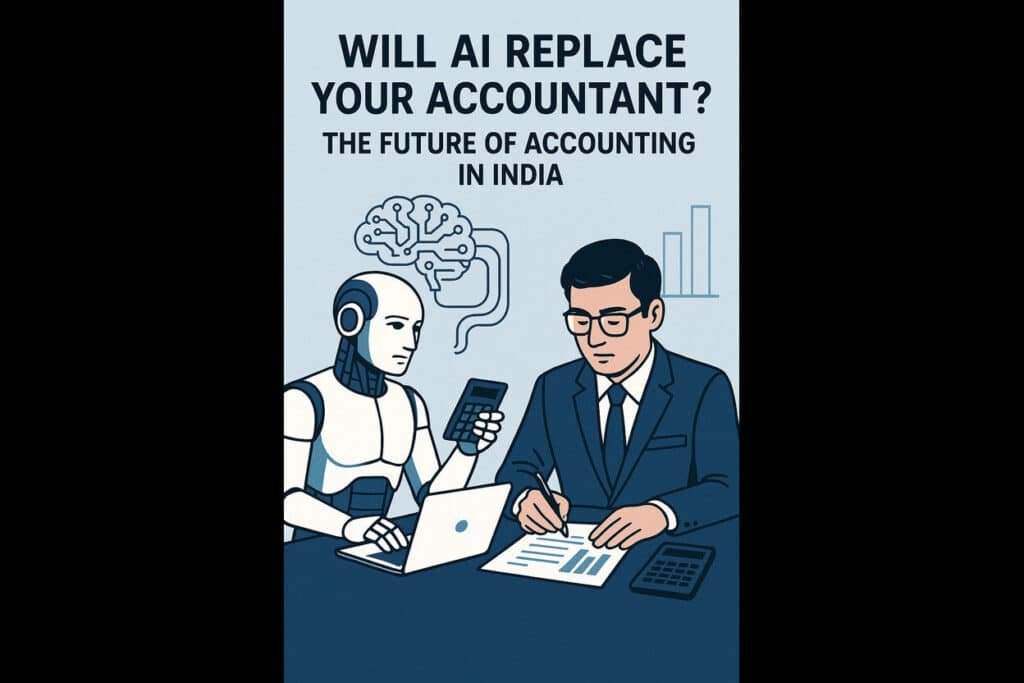
Let’s be honest—the word “AI” in the context of accounting can be terrifying. You’ve seen the headlines: “AI will replace 80% of accounting tasks,” “Bookkeepers are becoming obsolete,” “The machines are coming for your job.”
And in a way, they’re right. The bookkeeper part of the job—the manual data entry, the tedious reconciliations, the rote report generation—is being automated at a breathtaking pace. AI-powered tools can now scan invoices, categorize transactions, and even perform complex calculations in the blink of an eye, with fewer errors than their human counterparts.
If your value proposition is built only on being a fast and accurate bookkeeper, your job is at risk.
But here’s the crucial truth those sensationalist headlines miss: This is not an obituary for the accounting profession. It’s a catalyst for its most significant evolution in a century.
The automation of the “what” is finally freeing accountants to focus on the “so what,” the “why,” and the “what if.”
The machines are taking the computation out of the job, leaving behind the cognition. They are taking the “bookkeeper” and leaving room for the “advisor.”
Welcome to the accountant’s new job: the Strategic AI Advisor.
This isn’t a futuristic fantasy. This is the new reality for accountants who want to thrive, not just survive. This 5,000-word guide is your roadmap. We will explore what this new role is, why it’s so critical, the skills you need to build, and a practical plan to make the transition from historian to visionary.
The Great Shift: Why “Bookkeeper” Is No Longer Enough
To understand where we’re going, we must first appreciate where we’ve been and why the ground is shaking beneath our feet.
A Look Back: The Accountant as Historian
For the better part of a century, the accountant’s primary role was one of stewardship and compliance. Business was slower. Data was scarce and manual. The sheer effort required to simply collect and verify financial data consumed the vast majority of the finance department’s time.
The monthly close was a heroic, multi-week scramble of ticking, tying, and cross-footing. The annual audit was a painstaking process of statistical sampling, hoping to catch material misstatements.
In this world, the accountant’s value was in their precision and reliability. They were the trusted source of truth, delivering a report that said, “Here is what happened last quarter.” This historical perspective was valuable, but it was inherently reactive. By the time the data was compiled, the opportunity to act on it was often long gone.
The Tipping Point: From Automation to Intelligence
The first wave of change wasn’t AI; it was automation.
Spreadsheets, like Excel, were the first shot. Suddenly, calculations that took hours could be done in seconds. Then came accounting software—QuickBooks, Sage, and others—that moved the ledgers from paper to the PC. The next leap was the cloud. Cloud accounting platforms (Xero, QuickBooks Online) connected the bank, the invoices, and the reports in real-time.
This was a massive improvement, but it was still just faster bookkeeping. Accountants were still spending a huge amount of time on data entry and categorization.
Now, we are in the midst of the second, more profound wave: intelligence.
Artificial Intelligence (AI) and Machine Learning (ML) are not just faster; they are smarter. They don’t just follow rules; they learn patterns.
- An automation tool follows a rule: “If an invoice is from ‘Staples,’ code it to ‘Office Supplies’.”
- An AI tool learns a pattern: “I’ve scanned this invoice. The layout, vendor, and line items look like an ‘Office Supply,’ and I see you’ve coded 99% of similar invoices this way. I’ve coded it for you. Is this correct?”
This simple difference is revolutionary. AI is now capably handling the most time-consuming parts of the bookkeeping workflow:
- Data Capture: Tools like Dext or AutoEntry use Optical Character Recognition (OCR) and AI to read invoices and receipts, extracting the data with no human typing.
- Bank Reconciliation: AI-powered bank feeds learn to categorize recurring transactions, turning a day-long ordeal into a 30-minute review.
- Expense Reporting: AI can scan receipts, check them against company policy, and flag anomalies for review, all before a manager ever sees it.
This is the “AI-pocalypse” for the traditional bookkeeper. The tasks that once formed the bedrock of a junior accountant’s career are now, effectively, a software feature.
The Rise of the Strategic AI Advisor
If a robot is doing the books, what’s left for the human?
Everything that matters.
The Strategic AI Advisor is the human-centric role that emerges when the drudgery of data collection is gone. This new role is built on a simple premise: Data is useless. Insights are priceless.
AI is fantastic at producing data. It can churn out reports, dashboards, and metrics at a scale no human could. But it’s terrible at a few key things:
- It doesn’t understand the context behind the numbers.
- It can’t tell a story with the data.
- It can’t sit across from a stressed-out business owner and build trust.
- It can’t exercise judgment or navigate ambiguity.
That is the accountant’s new job.
What is a Strategic AI Advisor (in an Accounting Context)?
Let’s be clear: this role does not mean you need to be a data scientist or know how to code in Python.
A Strategic AI Advisor is a finance expert who leverages AI-driven insights to help a business make better, faster, and more confident decisions.
Think of it this way:
- The Bookkeeper reports: “We spent $10,000 on software last month.”
- The Accountant (Controller) analyzes: “Our software spend is 15% over budget, driven by three new unapproved contracts.”
- The Strategic AI Advisor advises: “Our AI-powered expense tool flagged a 30% rise in redundant software subscriptions. By consolidating these three platforms, we can save $50,000 annually. Furthermore, our analysis of usage data suggests we can downgrade the entire team to a ‘pro’ tier, saving an additional $20,000. Here is the implementation plan.”
See the difference? The advisor uses the AI’s “what” to build a forward-looking, actionable “what if” scenario.
Moving from “What” to “Why” and “What If”
The new accounting workflow is not about replacing the human; it’s about augmenting the human. AI acts as a tireless junior analyst, and the accountant is the seasoned partner who directs the work and presents the findings.
Your job is no longer to create the reports. Your job is to question them.
- The AI flags a 10% dip in gross margin for Product B.
- Your job is to ask “Why?”
- You dig in. You use AI-powered analytics tools to cross-reference sales data with supply chain data.
- You discover the “why”: A new shipping-parts supplier increased costs, but the price wasn’t updated in the system.
- You then move to “What if?”
- “What if we find an alternative supplier? What if we raise the price by 3%? What if we bundle Product B with Product A?”
- You use AI-driven forecasting models to scenario-plan each option, presenting a clear, data-backed recommendation to management.
This is the core of the advisory role. You are the financial storyteller, the business partner, the strategic thinker.
The New Toolbox: Core Competencies for the Modern Accountant
Making this shift requires a new setat of skills. For decades, technical proficiency (knowing the tax code, mastering GAAP) was 90% of the job. Today, that’s table stakes. The new “super-accountants” will be masters of two distinct, yet complementary, skill sets.
Beyond the Numbers: The Indispensable “Human” Skills
These are the skills that AI cannot replicate. They are the new currency of the profession, and they are where you should focus your primary development.
Critical Thinking and Problem-Solving
AI can find the anomaly, but it can’t (yet) tell you if it’s a a data-entry error, a one-time event, or the beginning of a disastrous market trend. The advisor’s job is to be the chief skeptic, to connect disparate dots, and to separate statistical noise from strategic signals. This is about deep, analytical thought.
Communication and Data Storytelling
This may be the single most important skill. You can have the most brilliant insight in the world, but if you can’t explain it simply and persuasively, it’s useless. You must be able to translate complex financial data into a compelling narrative for a non-financial audience.
Forget the 50-page spreadsheet. Think the 5-slide presentation with a clear story:
- The Situation: “Here’s where we are.”
- The Problem/Opportunity: “Here’s what the data is showing us (the ‘why’).”
- The Options: “Here are the 3 paths we can take.”
- The Recommendation: “Here’s the path we believe is best, and why.”
- The Next Steps: “Here’s what we need to do to make it happen.”
Empathy and Relationship-Building
An advisor is, first and foremost, a trusted partner. You are moving from the back office to the front office, sitting at the table with the CEO, the Head of Sales, and the COO. This requires empathy. You need to understand their challenges, their goals, and their fears. Trust is not built on data; it’s built on human connection, reliability, and a genuine desire to help them succeed.
Strategic Foresight
Historians look backward. Advisors look forward. This skill involves absorbing data from outside the general ledger. What are the macro-economic trends? What are your competitors doing? What new regulations are coming? Your job is to combine this external context with the company’s internal financial data to provide proactive, forward-looking guidance.
The “Tech-Savvy” Myth vs. Reality
Here’s a sigh of relief for many: You do not need to become a coder.
The “tech-savvy” accountant myth has scared off too many people. You don’t need to know how to build the AI; you need to know how to use it. You don’t build the car; you learn how to drive it.
What You Do Need: AI Literacy
AI Literacy is the new computer literacy. It’s the ability to:
- Understand the Concepts: Know the difference between basic automation, machine learning, and generative AI.
- Ask Good Questions: The quality of your AI’s output depends entirely on the quality of your input (your “prompt”). An advisor knows how to ask specific, insightful questions of the data.
- Know the Limitations: You must be the “human in the loop.” You need to know when the AI is likely to be wrong (“hallucinating”) and when its output needs to be challenged.
- Ensure Ethical Use: You are the guardian of data privacy and integrity. You must understand the ethical implications of using these powerful tools.
Mastering the Stack: From Cloud to BI
Your new technology stack isn’t just an accounting program. It’s an ecosystem of tools that talk to each other.
- The Core: Cloud accounting (QBO, Xero, NetSuite) is the non-negotiable hub.
- The Inputs: AI-powered capture tools (Dext, AutoEntry, Ramp) feed the hub.
- The Analysis: Business Intelligence (BI) tools (Power BI, Tableau, Looker) or advanced reporting tools (Fathom, Syft) sit on top of the hub.
Your job is to understand how to pull data from the core and use the analysis tools to ask questions and find patterns. This is where you’ll spend most of your “tech” time—not in code, but in powerful, user-friendly analytics dashboards.
How AI is Radically Reshaping Core Accounting Functions
This transformation isn’t just theoretical. It’s happening right now, and it’s changing the day-to-day work of every finance function. The strategic advisor must understand this new landscape to guide the business.
Audit and Assurance: The AI-Powered X-Ray
The Old Way: The annual audit was based on statistical sampling. Auditors would test a small percentage of transactions and extrapolate their findings to the whole. It was a necessary but flawed system—you could only hope to catch the needle in the haystack.
The New Way: AI is the ultimate needle-finder. Auditors can now load 100% of a company’s general ledger—millions of transactions—into an AI platform. The AI doesn’t sample. It reads everything.
The accountant’s new job in audit is no longer to find the anomaly; the AI does that in seconds. The new job is to investigate the countless anomalies the AI flags.
- The AI flags a journal entry posted at 3:00 AM on a Sunday by an employee who doesn’t normally do that.
- It flags a vendor who shares a bank account with an employee.
- It spots a pattern of invoices all just $1 under the a-approval threshold.
The auditor evolves from a sampler to a forensic investigator and a risk consultant. They spend their time on high-level analysis, risk assessment, and advising clients on internal controls, which is infinitely more valuable.
Tax: From Compliance to Strategic Planning
The Old Way: The tax accountant’s year was a cycle of “busy seasons.” It was a heroic effort of data collection and form-filling to meet a government deadline. The work was 90% compliance.
The New Way: AI is rapidly automating compliance. It can pull data from the GL, categorize it according to tax law, and populate the draft returns. Generative AI can even interpret new, complex tax legislation and summarize its impact on the business.
This frees the tax professional to become a true Tax Advisor.
- Instead of just reporting on a transaction, they advise on the structure of the transaction before it ever happens.
- They run complex, AI-powered “what if” scenarios for R&D tax credits, optimal legal entity structures, and cross-border tax implications.
- They move from being a cost of compliance to a partner in value creation, proactively finding legal ways to optimize tax strategy throughout the year, not just in April.
Financial Planning & Analysis (FP&A): The New Heart of Strategy
The Old Way: The FP&A team (often just the controller in a smaller business) spent 80% of their time just trying to build the forecast. They would export data to Excel, manually link spreadsheets, and spend weeks chasing department heads for their “best guess” on a budget. The final forecast was often static, obsolete the moment it was published.
The New Way: This is perhaps the area most supercharged by AI. This is the strategic advisor’s home turf.
- Predictive Forecasting: AI can analyze years of historical data, layer in external factors (weather, economic indicators, seasonal trends), and produce a forecast that is more accurate and dynamic than any human-built model.
- Scenario Planning on the Fly: The advisor’s job is to use these tools in real-time. The CEO asks, “What happens to our cash flow if our biggest supplier raises prices 10% and we lose the new sales lead in Texas?” In the old days, that was a one-week project. Today, the advisor adjusts two variables in the AI model and has a data-backed answer in 10 minutes.
The FP&A professional is no longer a “spreadsheet jockey.” They are the strategic co-pilot to the CEO, managing the financial cockpit of the entire business.
Client Advisory Services (CAS): The Virtual CFO
The Old Way: For small businesses, the local CPA was the person who did their taxes and maybe “cleaned up” their QuickBooks once a quarter. True strategic advice (a CFO) was a luxury reserved for large corporations.
The New Way: The AI-powered tech stack (cloud GL, data capture, BI tools) has democratized strategic finance. A small, tech-savvy accounting firm can now offer “Virtual CFO” services to dozens of small businesses, at a fraction of the cost of a full-time hire.
This “Client Advisory Services” or CAS model is the fastest-growing segment of public accounting. The Strategic AI Advisor works with their small business clients monthly, not annually. They present a curated dashboard, explaining cash flow, analyzing profitability per-product, and advising on everything from pricing to hiring to expansion. They are the outsourced, on-demand strategic partner, and their value is a world away from the old compliance-based bean counter.
The Practical Roadmap: Your 5-Step Transition from Bookkeeper to Advisor
This all sounds good. But how do you do it? How do you go from being underwater in debits and credits to sitting in the strategy room?
It’s a process. It doesn’t happen overnight. But it is 100% achievable.
Step 1: Acknowledge and Audit (Yourself)
The first step is a mental one. You must acknowledge that the shift is real and stop resisting it. Stop defending the old way of doing things. Stop seeing AI as a threat and start seeing it as your personal leverage.
Then, perform an honest audit of your own time.
- For one week, track your tasks in 15-minute increments.
- At the end of the week, put every task into one of two buckets: “Rote” (repetitive, rules-based, could be automated) or “Cognitive” (strategic, interpretive, requires judgment).
- Be brutal. “Matching bank transactions” is Rote. “Building the budget spreadsheet” is Rote. “Answering a manager’s question about their budget” is Cognitive.
- Your goal is simple: Eliminate, automate, or delegate everything in the “Rote” bucket. This is your new mission. The time you free up is the time you will invest in the next steps.
Step 2: Embrace Continuous Learning (The “Upskill” Imperative)
The time you just saved? Re-invest it in yourself. You need to close the gap between your current skills and the skills of the Strategic AI Advisor.
- Go wide on Tech: You don’t need to be an expert. You need to be conversant. Take the 1-hour “Intro to Power BI” course. Watch a 30-minute YouTube demo of Dext. Ask your accounting software rep for a demo of their new AI features.
- Go deep on “Human” Skills: This is where you really invest. Read a book on data storytelling (like Storytelling with Data by Cole Nussbaumer Knaflic). Take an online course on critical thinking. Join a Toastmasters club to practice your public speaking. These “soft” skills will provide the hardest ROI in your career.
- Follow the Right People: Curate your LinkedIn or X (Twitter) feed. Follow the thinkers, the tech companies, and the accounting leaders who are doing this. Immerse yourself in the conversation.
Step 3: Implement and Experiment (Start Small, Start Now)
You can’t become an advisor by only reading. You have to do.
- Find Your “One Thing”: Pick one rote process that drives you crazy. Just one. Is it expense reporting? Is it month-end accruals?
- Find the Tool: Research one tool to fix it. Ask your peers. Google it. Do a free trial.
- Implement and Master It: Implement that one tool for your own workflow. Learn it inside and out. Break it, fix it, and become the local expert.
- Document the Win: After 3 months, document the ROI. “This one tool saved me 8 hours of work per month.”
- Roll it Out: Now, take that win to your boss or your first client. “I saved 8 hours a month with this. I’d like to roll it out to the whole team. The 8 hours I saved, I used to build this new cash flow forecast model.”
This “start small, get a win, scale” approach is how you build momentum and, more importantly, prove your value.
Step 4: Redefine Your Value Proposition (And Your Price)
As your skills change, so must the way you communicate your value.
- For Public Accountants: Stop billing by the hour. Hourly billing rewards inefficiency. It’s the bookkeeper’s model. Move to a fixed-fee or value-based subscription model. You’re not selling “hours”; you’re selling “outcomes.” You are selling “financial peace of mind,” “a strategic partner,” “20% growth in profitability.” Clients will happily pay $2,000/month for an advisor who saves them $10,000. They will fight you over a $200/hour bill for data entry.
- For In-House Accountants: Stop being the “Department of No.” Start being the “Department of ‘Yes, If…'” Proactively seek projects outside the month-end close. Ask to sit in on the sales meeting. Build a model of customer profitability and take it to the head of sales. You must insert yourself into the strategic conversation. Don’t wait to be invited.
Step 5: Become the Translator
This is the ultimate form of the Strategic AI Advisor. You are the human bridge. You stand between the C-Suite (who want to “use AI” but don’t know what it means) and the powerful, complex AI systems.
You are the one who can:
- Translate Business Needs into Data Questions: The CEO says, “I feel like our cash flow is too tight.” You translate that to the AI: “Run a 12-month rolling cash flow forecast, modeling the impact of our average DSO slipping by 5, 10, and 15 days.”
- Translate AI Output into Business Action: The AI gives you the model. You translate it for the CEO: “You’re right. The data shows if our collections slip by just 5 days, we’ll be in a credit-line-draw situation by October. I recommend we implement a new automated collections-reminder system and offer a 2% discount for early payment. Here’s the projected impact.”
This translator—this human-in-the-loop—is the most valuable, most secure, and most irreplaceable job in the future of finance.
The Elephant in the Room: Ethical Considerations and Human Oversight
This new, AI-powered world is not without its risks. The Strategic AI Advisor must also be the firm’s Ethical Guardian. As we delegate more and more to the machines, these issues become paramount.
- The “Black Box” Problem: Some advanced AI models are a “black box“—even their creators don’t know exactly how they reach a conclusion. As an accountant, you are accountable for the numbers. You must demand “explainable AI” (XAI) from your vendors, and you must always be ableto sanity-check the AI’s output against your own judgment.
- Data Privacy and Security: The AI is only as good as the data it’s fed. And in accounting, that data is exceptionally sensitive. The advisor must be a leader in data governance, ensuring that client and company data is secure, private, and used responsibly.
- Bias in, Bias Out: An AI trained on biased historical data will produce biased future results. For example, if an AI is trained on historical loan-approval data that was biased, it will perpetuate that bias. The accountant must be the human check, looking for and challenging these digital-age prejudices.
- The Final Say: The AI is a co-pilot. It can suggest a path, but it cannot be accountable for the decision. The human accountant must always have the final say. The professional judgment, the ethical compass, the legal and fiduciary responsibility—that remains, and will always remain, with you.
Conclusion
The profession of accounting is not dying. It’s being reborn.
The “accountant’s new job” is to let the robots do the robotic work. We are being automated up the value chain. We are being freed from the drudgery of the past to focus on the strategic, advisory work that humans are uniquely suited for.
The bookkeeper was a historian, paid for their precision. The Strategic AI Advisor is a visionary, paid for their judgment.
This transition is not optional. It is not a question of if this will happen, but when you will adapt. The accountants who lean in, who embrace the new tools, and who invest in their “human” skills will find themselves in the most exciting, most valuable, and most rewarding role of their careers.
The machines are here. They are here to help. They are ready to do the crunching.
Your new job is to do the thinking.
Go get started.
MANDATORY DISCLAIMER: This article is for informational and educational purposes only. The information provided is based on general tax principles and common digital nomad challenges up to 2025. Tax laws are complex, change frequently, and are highly specific to your individual circumstances (your nationality, income, family, and travel patterns). This article does not constitute legal or financial advice. Before making any financial decisions, you must consult with a qualified, cross-border tax professional who understands your specific situation.
FAQs
Is AI really going to take my accounting job?
AI is going to take your tasks, not necessarily your job. It will automate the repetitive, rules-based tasks like data entry, reconciliation, and basic report generation. If your entire job is composed of those tasks, then yes, that job is at high risk. However, for most accountants, this is an opportunity. It frees you from the “bookkeeper” work to focus on the “advisor” work—analysis, strategy, problem-solving, and client-facing communication, which AI cannot do.
What is the single most important skill I should learn right now?
Outside of your core accounting knowledge, the single most important skill is data storytelling and communication. You can have the best AI-driven insights in the world, but they are worthless if you cannot communicate them in a simple, persuasive, and actionable way to a non-financial audience. Learn how to take complex data and build a clear narrative that leads to a smart business decision.
I’m not “good with technology.” Can I still succeed as an advisor?
Yes. There is a myth that you need to be a “tech whiz.” You don’t. You don’t need to know how to code. You just need to have AI literacy and a curious mindset. Can you use a smartphone? Can you learn a new app? Then you can learn to use modern accounting tools. The new platforms are designed to be user-friendly. Your value is not in being an IT expert; it’s in being an accounting expert who knows how to use the tools, ask the right questions, and interpret the results.
What’s the difference between automation and AI?
This is a key distinction.
Automation is about following rules. “If this, then that.” Example: An automation rule that codes every invoice from “AT&T” to the “Utilities” expense account. It’s fast, but it’s “dumb.”
Artificial Intelligence (AI) is about learning patterns. An AI tool will look at the AT&T invoice, read the line items, compare it to thousands of other utility bills, and conclude that it belongs in the “Utilities” account. It’s “smart” and gets smarter over time. AI can handle exceptions and ambiguity that would break a simple automation rule.
How do I convince my boss (or my clients) to invest in this new technology and my new advisory role?
You don’t “sell” them on the abstract idea. You show them the results. Start small (as outlined in Step 3 of the roadmap). Pick one small, manual process. Find a free trial for a tool to automate it. Do it on your own time if you have to. Then, go to your boss or client with concrete data: “This manual report used to take me 4 hours. By using this tool, I can now do it in 15 minutes. With the 3.75 hours I saved, I analyzed our top 10 customers and found a profitability issue we need to discuss.”

He founded Finance and Tax Guide to simplify complex tax and accounting topics for Indian small businesses, entrepreneurs, and individual taxpayers.
His expertise includes:
• GST Registration and Return Filing
• Income Tax Return (ITR) Filing
• TDS and TCS Compliance
• Business Bookkeeping
• Financial Accounting
• Tax Planning for Small Businesses
Every article published on Finance and Tax Guideis based on practical accounting experience and current Indian tax laws to provide accurate,
easy-to-understand financial guidance.