Finance and Tax Guide

Tax

Merchant Exports GST
Tax

Merchant Exports & GST: A Complete Guide to the 0.1% Concessional Rate and How to Claim the Refund Correctly

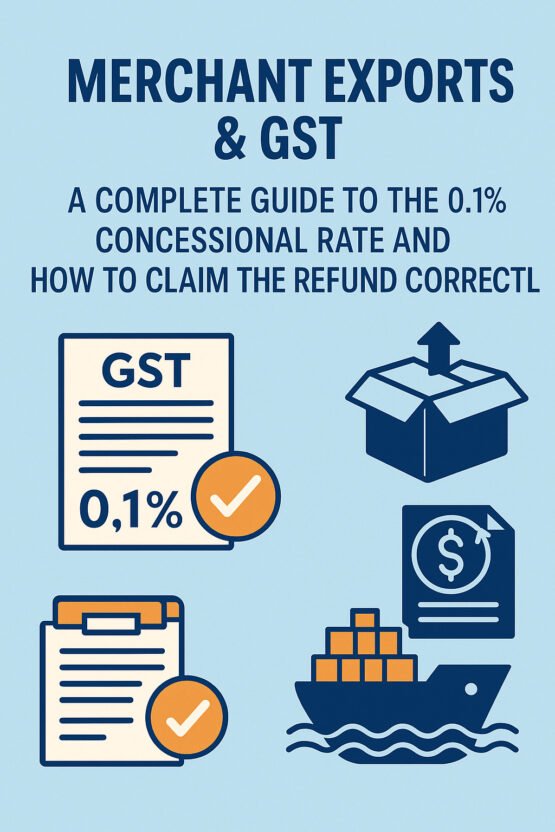
Merchant exporting continues to be one of the strongest pillars of India’s export ecosystem. Whether you are a new exporter or a seasoned player, GST provisions—especially the 0.1% concessional rate for merchant exporters—play a huge role in optimizing cash flow, reducing tax burden, and improving competitiveness in global markets. However, many merchant exporters still face challenges such as delayed refunds, incorrect documentation, mismatch issues, or misinterpretation of conditions. This leads to blocked working capital and compliance headaches. This complete guide explains everything in simple, human language—from eligibility to documentation, from invoicing requirements to the refund claim process, and from common mistakes to best practices. Let’s dive deep into the full framework of Merchant Exports & GST What is Merchant Export Under GST? A merchant exporter is a trader who buys goods from domestic suppliers and exports them without any manufacturing or major processing. They act as intermediaries between domestic suppliers and foreign buyers. Under GST, merchant exporters get a special benefit: they can procure goods at a concessional rate of 0.1%, instead of the normal GST rate, provided they meet specific conditions. This scheme helps merchant exporters reduce tax costs and avoid working capital blockage. What is the 0.1% Concessional GST Rate? The government introduced a reduced GST rate of 0.1% for supplies made by domestic sellers to registered merchant exporters. Instead of 12%, 18%, or 28% tax rates, the supplier charges only 0.1% CGST + 0.1% SGST, or 0.1% IGST, depending on the type of supply. How It Works Instead of paying the standard GST rate (e.g., 18%) on your purchase, you only pay 0.1% (0.05% CGST + 0.05% SGST, or 0.1% IGST). Example: You instantly save ₹1,79,000 in working capital. Why Was the 0.1% Rate Introduced? Before this scheme was introduced, exporters had to pay the full GST rate upfront and then claim a refund. This created liquidity issues and long waiting periods.The 0.1% concessional rate ensures: Eligibility Criteria for Merchant Exporters to Avail 0.1% GST Rate To avail the benefit, the following must be fulfilled: 1. The Buyer Must be a Registered Merchant Exporter A valid GSTIN is mandatory. 2. The Supplier Must Be a Registered Person Only registered suppliers can issue 0.1% invoices. 3. The Merchant Exporter Must Export Goods Within 90 Days Export of goods must occur within 90 days from the date of invoice. 4. The Merchant Exporter Must Provide a Copy of LUT/Bond to Supplier The exporter should supply: 5. The Supplier Must Report the Supply in GSTR-1 Correct reporting under Table 6 is essential. Conditions Suppliers Must Fulfill for the 0.1% GST Rate 1. Issue the Invoice with 0.1% GST Clearly Mentioned The invoice must include: 2. Obtain Required Supporting Documents from Merchant Exporter This usually includes: 3. Report Supplies Accurately in Monthly Returns Any mismatch may delay refund for supplier or exporter. Documentation Required for Merchant Exports Under 0.1% GST Rate Correct documentation is the most crucial part of merchant exports. Mandatory Documents Include: Step-by-Step Procedure to Procure Goods at 0.1% Concessional Rate Step 1 – Merchant Exporter Obtains a Valid LUT This is filed online on the GST portal and is valid for the financial year. Step 2 – Place an Order with Domestic Supplier The purchase order should mention: Step 3 – Provide Supplier Required Documents This includes the LUT and declaration. Step 4 – Supplier Issues Invoice at 0.1% GST The supplier must reference the concessional rate notification. Step 5 – Merchant Exporter Exports Goods Within 90 Days Shipment documents and EGM must be properly filed. GST Refunds Available for Merchant Exports Merchant exporters are eligible for two types of refunds: 1. Refund of Input Tax Credit (ITC) If exporters purchase goods at normal GST rates, not the concessional 0.1%. 2. Refund of IGST Paid on Export If exports are made with payment of IGST instead of LUT. But when purchasing under 0.1% scheme, the exporter typically exports under LUT, meaning no IGST is paid at export, and refund relates mainly to: How to Claim GST Refund for Merchant Exports (2025 Updated Process) Step 1: Ensure GSTR-1 and GSTR-3B Are Correctly Filed Refunds get delayed mostly due to mismatches. Step 2: File Refund Application in Form GST RFD-01 Select the correct category: Step 3: Upload Supporting Documents Typical documents include: Step 4: Track Refund Status Online The portal now provides faster processing and auto-validation. Step 5: Refund Credited to Bank Account After validation, refund is processed into the registered bank account. Common Mistakes That Delay Refunds (And How to Avoid Them) 1. Incorrect Invoice Reporting by Supplier Mismatch between GSTR-1 and GSTR-3B affects the merchant exporter. 2. Missing LUT Filing Exporting without LUT leads to non-compliance. 3. Exporting After 90 Days This disqualifies 0.1% benefit. 4. Wrong HSN or Tax Rate Even minor errors create refund blocks. 5. Not Matching Invoice Value with Shipping Bill Value Variations result in system mismatch. Best Practices for Smooth Merchant Export GST Compliance Maintain a Compliance Calendar Avoid missing LUT renewal or return deadlines. Use Export-Focused Accounting Software Ensures auto-mapping of documents and reduces manual errors. Train Staff on Export Procedures Human error is the biggest reason behind non-compliance. Regularly Reconcile Supplier Invoices GSTR-2A/2B must match purchases. Maintain Clear Audit Trails Keep all documents easily accessible for GST audit requirements. Invoicing Requirements for 0.1% GST Supplies What Must Be Included in the Supplier’s Invoice? The invoice must clearly mention: This ensures authenticity and protects from audit disputes. Timeline of Events in Merchant Export Transactions Below is the typical timeline: Day 0 – Purchase Order Issued Merchant exporter places order with domestic supplier. Day 1-7 – Supplier Issues Invoice & Dispatches Goods GST applied @ 0.1%. Within 90 Days – Export Must Occur Shipping bill filed. Monthly – Supplier Files Returns GSTR-1 and GSTR-3B must reflect the transaction. Monthly/Quarterly – Exporter Claims Refund Depending on refund category. Final Thoughts : GST Benefits for Merchant Exporters Are Powerful, If Used Correctly The 0.1% concessional GST scheme is one of the most effective incentives

LLP vs Pvt Ltd
Tax

LLP vs Pvt Ltd(2025): A Fresh Comparison of Tax Efficiency After the Latest Surcharge and Cess Updates

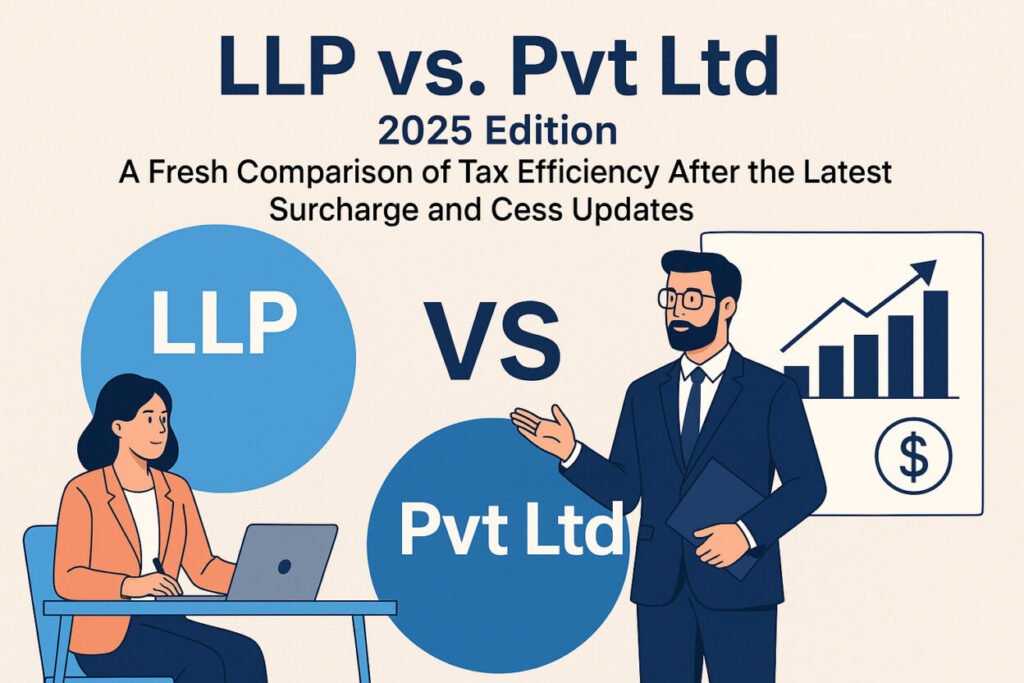
Choosing the right business structure is one of the most critical decisions for entrepreneurs, consultants, startups, and SMEs in India. In 2025, this choice has become even more significant because of recent surcharge and cess updates introduced in the latest Finance Bill. While LLP (Limited Liability Partnership) and Private Limited Company {LLP vs Pvt Ltd} remain the two most preferred structures, business owners often ask: 👉 Which is more tax-efficient in 2025?👉 Has the new surcharge and cess revision changed the equation?👉 Is LLP still better for small teams?👉 Is Private Limited still best for high-growth startups?👉 What structure helps save more tax after the latest updates? This deeply researched, human-written guide breaks down every difference, especially focusing on tax efficiency, compliance cost, ownership flexibility, and 2025 regulatory changes. Let’s begin. Understanding LLP vs. Pvt Ltd in 2025: A Quick Refresher What is an LLP? An LLP (Limited Liability Partnership) is a hybrid structure combining the operational flexibility of a partnership with the limited liability of a company. Key characteristics of an LLP What is a Private Limited Company? A Private Limited Company (Pvt Ltd) is a structured corporate entity with shareholders and directors, regulated by the Companies Act, 2013. Key characteristics of Pvt Ltd The 2025 Update What Changed in Surcharge & Cess? The Government of India introduced several updates in the latest Financial Year 2024–25 Budget that impact corporate tax, surcharge slabs, cess calculation, and compliance thresholds. Major changes that affect LLPs Major changes that affect Pvt Ltd Companies Why these updates matter in 2025 Because the tax outflow for LLP vs Private Limited has changed slightly based on turnover, profit margin, and applicability of surcharge. LLP vs Pvt Ltd Tax Comparison 2025 – The Deep-Dive This is the most important section for anyone trying to minimise taxes and maximise profitability. Taxation Structure – LLP Particulars LLP Taxation 2025 Basic Income Tax 30% Surcharge 12% (if income > threshold) Cess 4% Dividend Distribution Tax Not applicable Partners’ Remuneration Allowed as deduction (subject to conditions) Profit withdrawal Tax-free in hands of partners Why LLP can be more tax-efficient Taxation Structure – Private Limited (2025) Particulars Pvt Ltd Taxation 2025 Normal Corporate Tax 22% (no exemptions) Optional Manufacturing Rate 15% Surcharge 7% to 10% (income bracket based) Cess 4% Dividend Tax Dividend taxed at shareholder’s slab rate MAT Not applicable for 22%/15% regime Why Pvt Ltd is attractive for growing companies LLP vs Pvt Ltd: Tax Efficiency Comparison After 2025 Updates To offer clarity, let’s compare the effective tax burden. Effective Tax Outflow — LLP vs Pvt Ltd Scenario 1: Profits up to ₹50 lakhs Structure Effective Tax Notes LLP ~30% + cess Higher base rate Pvt Ltd ~22% + cess More tax efficient 👉 For profits below ₹50 lakhs, Pvt Ltd is more tax efficient. Scenario 2: Profits between ₹50 lakhs – ₹1 crore Structure Effective Tax LLP 30% + 12% surcharge + cess Pvt Ltd 22% + 7% surcharge + cess 👉 Pvt Ltd continues to remain more efficient in this slab. Scenario 3: Profits above ₹1 crore Structure Effective Tax LLP Highest tax incidence due to 30% base rate Pvt Ltd Lower tax due to 22% base rate 👉 Pvt Ltd is significantly more tax-friendly for high-profit companies. Non-Tax Considerations That Influence the Decision (2025) Compliance Requirements Parameter LLP Private Limited Statutory Audit Only if turnover > ₹40 lakhs Mandatory ROC Filings Minimal Extensive Annual Cost Low High Summary Funding & Investment Factor LLP Pvt Ltd Venture Capital Not preferred Highly preferred ESOPs Not allowed Allowed Equity dilution Not flexible Highly flexible Ownership Flexibility LLP Private Limited LLP vs Pvt Ltd in 2025 Which One Should You Choose? Choose LLP if… Choose Pvt Ltd if… 2025 Tax Rules Impact Key Takeaways The Core Dilemma: Structure vs. Strategy Before we open the tax rulebook, we need to understand the structural DNA of these two entities. The Private Limited Company (Pvt Ltd) is the poster child of the corporate world. It is treated as a separate legal person distinct from its owners. It can hold property, sue, be sued, and crucially, it can issue stock. This makes it the only viable vehicle for startups seeking Venture Capital (VC) funding. Investors want equity, and you can’t give them equity in an LLP easily. The Limited Liability Partnership (LLP) is a hybrid. It offers the limited liability protection of a company (your personal house isn’t at risk if the business fails) but maintains the operational flexibility of a partnership. It is less rigid. There are no mandatory board meetings, no shareholders, and significantly less paperwork. The “Human” Choice The 2025 Tax Showdown: Headline Rates vs. Real Outflow This is where the confusion happens. Most founders look at the “Headline Tax Rate” and assume the Pvt Ltd is the winner. Let’s break down why that is a dangerous assumption in 2025. 1. The Private Limited Advantage (Section 115BAA) Since the corporate tax cuts, domestic companies can opt for Section 115BAA. This is a game-changer that allows companies to forego certain exemptions in exchange for a lower rate. If you are a new manufacturing company (registered after Oct 2019 and starting production before March 2024), you might even hit 17.16% under Section 115BAB. Visually, 25.17% looks much better than 30%. But wait. 2. The LLP Reality (Flat Rate) LLPs do not get the benefit of slab rates or the reduced 22% corporate rate. At a glance, the LLP seems to be losing. It pays roughly 6% to 9% more tax on profits than a Pvt Ltd. 3. The “Double Taxation” Trap Here is the catch that ruins the Pvt Ltd party for many small business owners: Getting the money out. In a Pvt Ltd, the company pays 25.17% tax. The remaining money belongs to the company, not you. To get it into your personal bank account, you must declare a Dividend. In an LLP, the structure is “Single Layer Taxation.” Mathematical Scenarios: Who Wins? Let’s run the numbers for a generic scenario

Transfer Pricing for Startups
Tax

Transfer Pricing for Startups: When Does Your Cross-Border Service Become Taxable?

Your startup, born in a garage or a co-working space just two years ago, is scaling. You have a brilliant core team at your headquarters in the US (or UK, or Australia), and to keep up with development demands and manage costs, you’ve hired an incredibly talented team of developers in India or Eastern Europe. You set up a small legal entity there to employ them. Every month, your HQ wires money to the foreign entity to cover salaries and office rent, plus a little extra margin so that subsidiary shows a small profit locally. It seems efficient. It seems smart. Until the tax authority sends a letter. They want to know how you calculated that “little extra margin.” They are asking about your “Transfer Pricing Documentation.” Suddenly, the dream of global expansion feels like a bureaucratic nightmare. If this scenario makes you sweaty, you are not alone. Most founders assume transfer pricing is a problem reserved for giants like Apple, Google, or Coca-Cola moving billions through tax havens. That assumption is dangerous. The digital economy has changed the game. Today, a ten-person SaaS company can have a global footprint that triggers complex international tax rules. The central question that gets most startups into trouble is this: Transfer Pricing for Startups: When Does Your Cross-Border Service Become Taxable? This guide isn’t a dense academic paper. It is a practical, human-to-human deep dive into the reality of running a modern, cross-border startup without accidentally inviting the taxman to take a bigger slice of your pie than necessary. Let’s decode the jargon and get down to business. What Exactly is Transfer Pricing and Why Should a Startup Care? Before we determine when you get taxed, we need to agree on what we are talking about. In the simplest terms, “transfer pricing” refers to the prices charged when one part of a company sells goods, services, or intellectual property to another part of the same company located in a different country. If your US parent company buys software development services from your Polish subsidiary, the price the US company pays the Polish company is the “transfer price.” Why do governments care? Because that price determines how much profit is reported in the US versus how much profit is reported in Poland. The US tax authority (the IRS) wants the price to be low, so the US company has higher profits to tax. The Polish tax authority wants the price to be high, so the Polish subsidiary has higher revenue and profits to tax locally. Transfer pricing rules exist to stop companies from artificially shifting profits from high-tax countries to low-tax countries just to avoid paying their fair share. The Myth: “We Are Too Small for This” This is the biggest trap for early-stage companies. Founders often think, “We aren’t profitable yet, so who cares about profit shifting?” Tax authorities care. A lot. Even if your startup is burning cash overall, your individual subsidiaries might need to show a profit based on the services they provide to HQ. Furthermore, many countries have “de minimis” thresholds (minimum amounts to trigger rules) that are shockingly low. In some jurisdictions, the moment you have a single intercompany transaction across a border, the rules apply, regardless of the dollar value. Ignoring this doesn’t make it go away; it just compounds the interest and penalties on the eventual tax bill. The “Arm’s Length Principle” Explained (No Jargon) The entire global transfer pricing framework rests on one foundation concept: The Arm’s Length Principle. It sounds technical, but it’s actually intuitive. It means: You must treat your foreign subsidiary the same way you would treat an unrelated third party. Imagine your startup needs a new website. If you only pay your subsidiary $10,000 (just enough to cover their costs) because you want to keep the cash at HQ, the foreign tax authority will say, “Wait a minute. An independent company wouldn’t do this work for barely break-even. You are underpaying them to shift profits out of our country. We are going to tax you as if you had paid $50,000.” Conversely, if you pay them $200,000 to shift cash out of HQ’s country, HQ’s tax authority will disallow that expense, saying, “You overpaid your related party. You can only deduct a fair market value.” The Arm’s Length Principle is the referee trying to ensure the game is fair, even though you own both teams playing. The Reality Risks: Double Taxation and Penalties What happens if you get this wrong? The worst-case scenario isn’t just paying back taxes; it’s double taxation. Let’s go back to the US HQ and Polish subsidiary example. Result: That same $100k of value is taxed once in Poland and again in the US. Add to this the aggressive penalties for “non-compliance” or failure to maintain documentation, which can sometimes exceed the actual tax owed, and you can see why this is a boardroom issue, not just an accounting issue. The Trigger Point: When Does Your Cross-Border Service Become Taxable? Now we arrive at the core question of our focus keyword: Transfer Pricing for Startups: When Does Your Cross-Border Service Become Taxable? The answer isn’t a specific date on the calendar. It’s triggered by the nature of your relationships and activities. It becomes taxable the moment value crosses a border between related entities. To understand this, we must break down the components. Identifying “Related Parties” (It’s Broader Than You Think) Transfer pricing only applies to “controlled transactions” between “associated enterprises” or “related parties.” Usually, this is obvious: A parent company owns 100% of a subsidiary. They are related. But in the startup world, it can get murky. The definition of “control” varies by country. It doesn’t always require >50% shareholding. If you have two entities in different countries and there is significant common influence over both, assume they are related parties until a tax professional tells you otherwise. Defining “Cross-Border Services” in the Digital Age In the old days, transfer pricing was about shipping physical widgets across

Startup India Registration
Tax

Startup India Registration: The Tax Benefits You Are Likely Missing (Section 80-IAC Updates)

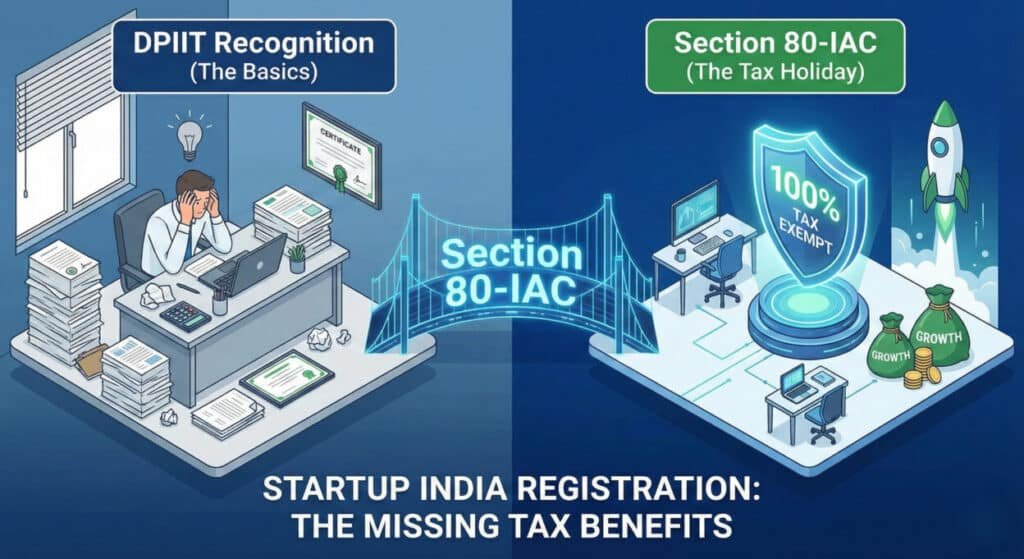
Let’s be honest for a second: running a startup in India is an adrenaline sport. You are juggling product-market fit, hiring, fundraising, and customer acquisition. Somewhere at the bottom of that endless to-do list is “Tax Compliance.” Most founders I speak to comfortably tell me, “Oh, we are sorted. We did the Startup India registration last year.” But when I ask if they are claiming the Section 80-IAC 100% tax holiday, the room usually goes quiet. Here is the harsh reality: 99% of startups confuse “DPIIT Recognition” with “Tax Exemption.” They are not the same thing. By confusing the two, thousands of eligible Indian startups are leaving millions of rupees on the table—money that could have been reinvested into growth, hiring, or R&D. If you are a founder, a CFO, or just an exhausted entrepreneur trying to save money, this guide is for you. We are going to dismantle the confusion around Startup India Registration, dive deep into the mysterious Section 80-IAC, and look at the critical updates for 2024-2025 that you absolutely need to know. The Great Confusion: DPIIT Recognition vs. Section 80-IAC Before we get into the “how-to,” we need to fix the biggest misconception in the Indian startup ecosystem. When you register on the Startup India Portal and get that fancy certificate with a “DIPP” number, you have achieved DPIIT Recognition. This is a great first step. It opens doors to: But it does NOT give you the income tax holiday. To get the tax holiday (where you pay zero income tax for 3 years), you need to clear a second, much harder level: The Inter-Ministerial Board (IMB) Certification. Think of it like this: If you only have the first one, you are still paying taxes. What Exactly is Section 80-IAC? Section 80-IAC of the Income Tax Act, 1961, is arguably the most powerful fiscal incentive for Indian entrepreneurs. The Core Benefit It allows an “Eligible Startup” to avail of a 100% deduction of the profits and gains derived from the eligible business. This means if your startup makes a profit of ₹5 Crores, your taxable income is effectively treated as ZERO. The “3 out of 10” Rule You don’t have to take this exemption immediately. You can choose any 3 consecutive assessment years out of the first 10 years from your incorporation. Why is this strategic? Most startups bleed money in the first few years (Years 1-4). It makes no sense to claim a tax holiday when you have no profit to tax. You can “save” this benefit for Years 7, 8, and 9 when you (hopefully) hit hockey-stick growth and are generating substantial profits. Eligibility Criteria: Do You Qualify? The government doesn’t hand out tax holidays to just anyone. To apply for Section 80-IAC, you must meet a strict checklist. 1. Entity Type You must be a Private Limited Company or a Limited Liability Partnership (LLP). 2. Age of the Company Your startup must have been incorporated on or after April 1, 2016. 3. Turnover Limits Your annual turnover should not exceed ₹100 Crores in any financial year since incorporation. 4. The “Innovation” Factor (The Dealbreaker) This is where most applications get rejected. Your startup must be working towards: The IMB (Inter-Ministerial Board) reviews this subjectively. If you are just a digital marketing agency doing what 5,000 other agencies are doing, you will likely get DPIIT recognition, but you will be rejected for 80-IAC. You need to show differentiation. Recent Updates (2024-2025) You Must Know Tax laws in India are fluid. Here are the critical updates relevant to your Startup India Registration and tax planning. Update 1: The Incorporation Deadline Extension Originally, the sun was supposed to set on this scheme years ago. However, realizing the need to support the ecosystem, the government has extended the deadline. Update 2: The End of Angel Tax (Section 56(2)(viib)) For years, Section 80-IAC was discussed alongside the dreaded “Angel Tax.” Startups had to apply for a separate exemption to avoid being taxed on investment received above Fair Market Value. Step-by-Step Guide: How to Apply for Section 80-IAC Ready to save taxes? Here is the walkthrough. Do not skip steps. Phase 1: The DPIIT Recognition (The Prerequisite) If you haven’t done this yet, do it today. It takes 48-72 hours. Phase 2: The Section 80-IAC Application (The Hard Part) Once you have your DIPP number, the real game begins. Step 1: Access the Dashboard Log in to the Startup India portal. Navigate to “Services” > “Tax Exemption under Section 80-IAC”. Step 2: Fill Form 1 This is the statutory application form. It asks for: Step 3: The Video Pitch (Crucial) You must upload a video link. This isn’t a glamorous marketing commercial; it is a functional explanation of your business. Step 4: The Pitch Deck Upload a PDF pitch deck. This should look like a VC pitch deck but tailored for a government auditor. Focus heavily on: Step 5: Submission and Tracking Once submitted, your application goes to the Inter-Ministerial Board. Why Applications Get Rejected (And How to Avoid It) The acceptance rate for Section 80-IAC is notoriously low (historically under 5-10% of applicants). Why? 1. “Old Wine in a New Bottle” If you simply clone an existing business model (e.g., “Uber for X” or a standard E-commerce store) without any proprietary technology or unique process, the IMB will reject it. 2. Lack of Scalability Consultancies and service-based businesses often struggle here. If your revenue growth is linearly tied to hiring more people (i.e., you sell hours), it’s not considered “scalable” in the tech sense. 3. Regulatory Non-Compliance If you haven’t filed your ITRs or your MoA is generic, it’s an instant rejection. 4. Splitting or Reconstruction You cannot shut down an old company and open a new one just to get tax benefits. If the board suspects “splitting up” of an existing business, you are out. Other Tax Benefits You Might Be Missing While 80-IAC is the king, do not ignore the princes. Section 54 (Capital Gains

Key Changes in GSTR 9 for FY 2024-25
Tax

Essential Updates and Key Changes in GSTR 9 for FY 2024-25

To help professionals and taxpayers save time, without jumping between multiple resources, I’ve put together on Key Changes in GSTR 9 for FY 2024-25, backed with important official insights and references for easy access. What is GSTR-9? GSTR-9 is the annual GST return that summarizes all outward supplies, inward supplies, ITC claimed, reversals, and tax paid for FY 2024-25. It consolidates all data filed in GSTR-1 and GSTR-3B during the financial year. 🔍 Quick Access Guides Table 8C Guide – What to report in 8C What to report in Table 8C of GSTR-9 for FY 2024-25? So much confusion, right? No worries, I have made the simplest guide for you. We all know that Table 8C is one of the most sensitive tables in GSTR-9, and wrong reporting may lead to GST audit queries or even auto-generated notices. First, understand the logic of Table 8C Table 8C captures only the ITC of the current year (FY 24-25 invoices) that is availed in the next FY up to the specified period (i.e., Apr’25 to Oct’25). Moreover, your Table 8C figure completely depends on how you reported ITC in your GSTR-3B. Broadly, taxpayers follow three different ITC reporting practices (as I classify them): 1. Following Circular 170 (most common) 2. Not following Circular 170 3. Using Invoice Management System (IMS) And for each method, the 8C reporting is different. Let’s break it down. 1) If you are following Circular 170 in GSTR-3B (most common practice) >What to report in Table 8C: ITC of FY 24-25 that appears in 2B from Apr’25 to Oct’25, and is availed, or availed–reversed–reclaimed in Apr’25 to Oct’25. Important Note: Any ITC of FY 24-25 that had already appeared in 2B during Apr’24–Mar’25 must NOT be reported in 8C, even if you reclaimed it in FY 25-26. For that Table 13 is there. 2) If you are NOT following Circular 170 in GSTR-3B (rare taxpayers) >What to report in Table 8C: ✔ ITC of FY 24-25 (2B period Apr’24–Mar’25) which you did not avail or reverse in FY 24-25, but availed directly in Apr’25 to Oct’25 PLUS ✔ ITC of FY 24-25 that appears in 2B of Apr’25 to Oct’25, and is availed in Apr’25 to Oct’25 3) If you are using IMS (very rare taxpayers) >What to report in Table 8C: ✔ Invoices of FY 24-25 that appeared in 2B, were kept pending till Mar’25,and were accepted/availed in Apr’25 to Oct’25 PLUS ✔ ITC of FY 24-25 appeared in 2B of Apr’25 to Oct’25 and accepted/availed in the same period. I hope this clears your confusion about Table 8C. Feel free to reach out for any clarifications. Till then, have a great and hassle-free tax season !! Table 8D Guide – Reasons for Negative 8D What if Table 8D turns Negative in GSTR-9 for FY 2024-25? You may think, table 8D going negative isn’t new. True. Until last year, a negative 8D was a fairly common occurrence. However, with the recent amendments in Form GSTR-9 (from FY 2024-25 onward), a negative 8D is no longer just “routine” it can be critical from a reconciliation and audit standpoint. Understanding Table 8D (In the context of FY 2024-25) Let’s reiterate the basics: Table 8D = 8A. ITC auto-populated from 2B (MINUS) 8B. ITC claimed in current year (CY) (MINUS) 8C. ITC that will be claimed in the next FY within the specified time limit (e.g., up to Oct’25). In FY 2023-24 and earlier, taxpayers could validate a negative 8D with the help of Table 8C (Previous Year). In other words, 8D could go negative only to the extent ITC available in PY Table 8C. But this logic applies only up to FY 2023-24. So, what has changed from FY 2024-25? 8A now reflects ITC pertaining only to FY 2024-25. 8B and 8C also represent only FY 2024-25 data There is no reference of prior years in this section anymore If all data in 8A, 8B, and 8C belongs to the same financial year, ideally, Table 8D should not turn negative at all. That would be the ideal reconciliation practice. But real life isn’t always ideal. There are situations where 8D may still show a negative figure. Let’s explore the major practical possibilities: 1️⃣ Incorrect CN reporting by the supplier Since 8A is non-editable, any CN wrongly reported by the supplier and deemed accepted by the recipient can directly impact the 8D computation. 2️⃣ 3B ITC reporting approach adopted by the taxpayer If you follow Circular 170, where only invoices and debit notes are availed and reversed, but credit notes are ignored in reconciliation, 8D may inadvertently turn negative. 3️⃣ Misclassification between Table 6A(1) and 6B Errors during ITC mapping in these tables, even if unintentional may distort annual reconciliation output. 4️⃣ Incorrect figures reported in Table 8C This is one of the most sensitive areas. If wrongly disclosed, it can disrupt the 8D outcome. (I’ve shared a detailed post on Table 8C for quick reference, see comment box.) 5️⃣ Excess ITC actually availed and utilized If the taxpayer has genuinely availed excess credit, reversal must be done along with applicable interest via DRC-03. If you’re facing a negative 8D, evaluate whether the above scenarios could be the underlying causes. Also note that, the above possibilities are illustrative, not exhaustive. Table 8D going negative should not be considered normal from FY 2024-25 onward. Conduct a thorough self-review and verify your reconciliation independently. Table 8A Update – What has changed A must read for all those involved in preparing, reviewing or filing GSTR-9/9C. The logic for auto-population of data in Table 8A has once again been changed. During the PY, several tickets were raised regarding possible mismatch between Tables 8A and 8C for FY 2023-24 (At that time too, logic was changed). In response, GSTN had also issued an advisory dt 9th Dec 2024 addressing this concern. However, the said advisory did not fully resolve the reconciliation concern. To resolve that inconsistency, the logic of Table 8A has now been

Virtual Digital Assets
Tax

Crypto & Virtual Digital Assets (VDA): The 2025 Guide to Set-Off Losses and TDS Filing

Let’s be painfully honest: being a crypto investor in India is not for the faint of heart. It’s not just the volatile swings of Bitcoin or the nerve-wracking nature of altcoin seasons that keep you up at night. For Indian investors, the real anxiety often kicks in around tax season. Since the government introduced the stringent tax regime for Virtual Digital Assets (VDAs) in the Union Budget of 2022, navigating the compliance landscape has felt like walking through a minefield. As we approach the Assessment Year 2025-26 (reflecting your financial activity from April 1, 2024, to March 31, 2025), the rules haven’t gotten any softer. In fact, the tax department’s scrutiny has only intensified through tools like the Annual Information Statement (AIS). If you are holding, trading, or have transacted in crypto during FY 2024-25, ignorance is no longer bliss—it’s a potential penalty. This guide is designed to cut through the legal jargon. We aren’t just regurgitating the Income Tax Act; we are going to look at the practical, often frustrating realities of Crypto & Virtual Digital Assets (VDA) taxation for 2025, with a hyper-focus on the two biggest pain points: the inability to set off losses and the complexities of TDS filing. Understanding the Basics: The Virtal Digital Assets Landscape in 2025 Before diving into losses and TDS, we need to ensure we are speaking the same language as the Income Tax Department (ITD). What exactly is a “Virtual Digital Assets”? The Finance Act, 2022, introduced Section 2(47A) to define VDAs. It’s a broad definition crafted to catch almost everything in the Web3 space. In simple terms, a VDA includes: Crucial Note: The definition is broad by design. Whether you call it a “utility token,” a “governance token,” or a “memecoin,” if it holds value and is traded digitally, the taxman likely considers it a VDA. The Core Tax Regime: Section 115BBH Explained The foundation of crypto taxation in India lies in Section 115BBH. This is the section that dictates how your profits are taxed. For AY 2025-26, the rules remain unchanged, and they are notoriously rigid. The Flat 30% Tax Rate (Plus Cess & Surcharge) Any income from the transfer of a VDA is taxed at a flat rate of 30%. When you add the 4% Health and Education Cess, the effective tax rate becomes 31.2%. If your total income places you in the high-net-worth bracket subject to surcharges, this rate can climb even higher. This tax rate is applicable regardless of: The Calculation Formula and the “No Deduction” Rule How do you calculate profit? Taxable Profit = Selling Price (Transfer Value) – Cost of Acquisition This seems straightforward until you read the fine print of Section 115BBH. The law explicitly states that no deduction is allowed in respect of any expenditure (other than the cost of acquisition) or allowance or set-off of any loss. What this means for you in 2025: The 2025 Guide to Set-Off Losses in Crypto (The Sting in the Tail) This is perhaps the most contentious and painful aspect of Indian crypto taxation. It is where the “human” element of frustration really kicks in for investors who have experienced a bear market. If you made a ₹5 Lakh profit on Bitcoin but lost ₹7 Lakh on Luna in the same year, common sense suggests you have a net loss of ₹2 Lakh and shouldn’t pay tax. The Income Tax Department disagrees. The Harsh Reality of Section 115BBH(2)(b) The legislation specifically prohibits the set-off of losses. Let’s break down the different scenarios for AY 2025-26. Scenario 1: Setting off Crypto Losses against Other Income Heads Can you set off a loss from VDAs against your Salary income, Business income, or Stock Market gains? Answer: No. This is explicitly forbidden. A VDA loss is quarantined. It cannot reduce your tax liability from any other source of income. Scenario 2: Carry Forward of Losses to Future Years If you have a net loss in Crypto in FY 2024-25, can you carry it forward to offset profits in FY 2025-26? Answer: No. Unlike stock market losses (which can be carried forward for 8 years), crypto losses cannot be carried forward. If you have a loss year, that loss dies at the end of the financial year. It is a “dead loss.” Scenario 3: The “Intra-Head” Set-Off Debate (Setting off losses against gains within the same year) This is the most confusing part. Can you set off a loss from Ethereum against a gain from Bitcoin in the same financial year? The wording of Section 115BBH says: “…no set off of any loss from transfer of the virtual digital asset computed under clause (a) of sub-section (1) shall be allowed against income computed under the said clause…” The Restrictive Interpretation (The Taxman’s likely view): Many interpret this to mean that every single trade stands alone. The Liberal Interpretation (The Investor’s Hope): Some tax experts argue that “income from transfer of VDA” refers to the net income from the entire “basket” of VDA transactions for the year. What should you do for AY 2025-26? While the liberal interpretation seems fairer, the FAQs initially released by the government (though not legally binding law) leaned towards the restrictive view—meaning no set-off even within the same year. Until there is a clear judicial ruling or government clarification, the conservative approach is safer: assume you cannot set off losses from one coin against gains from another. Yes, this could lead to absurd situations where you have a net loss overall but still owe huge taxes on profitable individual trades. Recommendation: Consult a Chartered Accountant specialized in crypto before finalizing your ITR if you are planning to use intra-head set-offs. Navigating Crypto TDS Filing: Section 194S Explained While Section 115BBH handles your final tax bill, Section 194S handles the transaction trail. It is a mechanism to ensure the government knows who is trading what. 194S mandates the deduction of Tax Deducted at Source (TDS) on VDA transactions. The 1% TDS Rule: The Basics

Income Tax Penalty
Tax

True Cost of Non-Compliance: A Deep Dive into India’s New Income Tax Penalty Structures (Sections 270A-272B)

nobody enjoys dealing with taxes. It’s stressful, complicated, and often feels like navigating a minefield blindfolded. But in recent years, the Indian tax authorities have fundamentally changed the landscape of that minefield, moving away from subjective assessments toward a regime of strict, technology-driven enforcement. The days of taking a “calculated risk” and hoping for leniency are largely behind us; today, a single misstep—whether intentional or accidental—can trigger a severe, mandatory Income Tax Penalty that can cripple a business’s finances. Let’s be honest: nobody enjoys dealing with taxes. It’s stressful, complicated, and often feels like navigating a minefield blindfolded. But in recent years, the Indian Income Tax Department has fundamentally changed the landscape of that minefield. The days of “taking a chance” and hoping for a lenient assessment officer are largely behind us. The government’s push towards a digital, transparent economy has coincided with a significantly tougher stance on tax evasion and procedural errors. The shift isn’t just about catching big fish; it’s about ensuring everyone—from salaried individuals to large corporations—adheres strictly to the rules. At the heart of this tougher stance is a revamped penalty regime, specifically spanning Sections 270A to 272B of the Income Tax Act, 1961. These aren’t just minor slaps on the wrist anymore. The new structures are objective, severe, and designed to make non-compliance prohibitively expensive. As a Chartered Accountant or a business owner, simply knowing the tax rates isn’t enough. You need to understand the consequences of getting it wrong. In this comprehensive guide, we are going to strip away the legal jargon and look at the real-world implications of these penalty updates. We will explore why the system changed, analyze the massive difference between “under-reporting” and “misreporting,” and provide a roadmap to keep you on the right side of the law. This is the true cost of non-compliance. The Paradigm Shift: From Discretion to Mandatory Penalties To understand where we are now, we have to look at where we came from. Before the introduction of Section 270A (which replaced the infamous Section 271(1)(c)), the penalty regime was murky. Under the old laws, penalties were often levied for “concealment of income” or “furnishing inaccurate particulars.” The problem? These terms were subjective. It often came down to the Assessing Officer’s discretion to decide if an error was an honest mistake or deliberate fraud. This led to endless litigation, uncertainty for taxpayers, and allegations of harassment. The new regime, spearheaded by Section 270A, aims to remove that subjectivity. The government’s message is clear: If there is a difference between what you declared and what we assessed, a penalty is almost automatic unless you fall into very specific exceptions. The focus has shifted from proving “mens rea” (guilty mind) to objectively proving “under-reporting.” This shift is crucial. It means you can no longer rely just on the argument that “I didn’t mean to.” If the numbers don’t add up according to the new rules, you are facing a statutory penalty. The Elephant in the Room: Section 270A (Penalty for Under-reporting and Misreporting) Section 270A is the cornerstone of the current penalty structure. It is the section that keeps tax practitioners awake at night. It draws a sharp, expensive line between two concepts: Under-reporting of income and Misreporting of income. Understanding this distinction is the single most important thing you can do to protect yourself from massive fines. What constitutes “Under-reporting” of Income? In simple human terms, under-reporting happens when the income assessed by the tax department is higher than the income you returned. It’s the gap between your version of reality and theirs. The law defines several scenarios that automatically qualify as under-reporting: The Penalty for Under-reporting: If you are caught under-reporting, the penalty is 50% of the tax payable on that under-reported income. Think about that. It’s not 50% of the income; it’s 50% of the tax on that income. If you are in the 30% bracket, and you under-reported ₹10 Lakhs, the tax is ₹3 Lakhs (approx, ignoring cess/surcharge for simplicity). The penalty is an additional ₹1.5 Lakhs. The “Safety Valve” – Exceptions to Under-reporting Is every difference in opinion a penalty? Fortunately, no. The law recognizes that genuine differences in interpretation exist. You will not be penalized for under-reporting if you fall into these specific categories (often called the “bonafide” explanations): The key takeaway here is documentation. If you take a controversial tax position, document why you took it. If you can prove you were transparent, even if you were wrong, you might avoid the 50% hit. The Danger Zone: “Misreporting” of Income If under-reporting is a stumble, misreporting is a deliberate head-dive into non-compliance. This is where the department takes off the gloves. Misreporting is essentially aggravated under-reporting. It implies intent, deceit, or gross negligence. Section 270A specifically lists scenarios that constitute misreporting: The Cost of Misreporting: If your under-reporting is classified as misreporting, the penalty quadruples. It becomes 200% of the tax payable on the misreported income. Let’s go back to our previous example. You didn’t just forget to include ₹10 Lakhs; you actively created fake invoices to hide it. Almost the entire amount is wiped out. This is designed to be confiscatory. It is meant to ensure that evasion is never a profitable strategy. The Escape Route: Immunity under Section 270AA Is there a way out once facing a 270A order? Yes, but it comes with conditions. Section 270AA offers an olive branch. A taxpayer can apply to the Assessing Officer to grant immunity from imposition of penalty under section 270A (only for under-reporting, not misreporting) and also immunity from prosecution. To get this immunity, you must: Essentially, you have to accept the department’s findings, pay up immediately, and promise not to fight it. In return, they waive the 50% penalty and agree not to prosecute you criminally. It’s a settlement mechanism to reduce litigation. It’s a tough pill to swallow, but often better than a long, expensive legal battle you might lose anyway. Beyond 270A: The Procedural Minefield (Sections 271-272B)

GST
Tax

GST Audit Triggers in 2026: What Red Flags is the Department’s AI Looking Now?

You are sitting in your office, sipping coffee, perhaps looking over your quarterly sales figures. Then, the email arrives. A Notice in Form GST ASMT-10, or worse, a notification for a full-fledged departmental audit under Section 65. Your heart sinks. You’ve been compliant—mostly. You’ve filed your GSTR-1s and 3Bs on time. But deep down, you know the game has changed. The days when a GST officer manually sifted through piles of paper invoices are ancient history. Today, the “officer” reviewing your file isn’t a person; it’s a sophisticated Artificial Intelligence (AI) and Machine Learning (ML) system running on the massive servers of the Goods and Services Tax Network (GSTN). If you think I’m exaggerating about 2026, look around you today. The Directorate General of Analytics and Risk Management (DGARM) is already heavily relying on data tools to send out scrutiny notices. By 2026, this system won’t just be auxiliary; it will be the primary driver of GST compliance. The human officer will merely be the executor of the AI’s findings. The question isn’t “Will I be audited?” It’s “What specific data pattern in my filings will trigger the AI to flag me?” In this comprehensive guide, we are going to step inside the “brain” of the tax department’s digital machinery. We will explore the sophisticated GST Audit Triggers in 2026 and uncover exactly what red flags the Department’s AI is looking for now to ensure you aren’t caught off guard. The Great Shift: From Random Selection to “Surgery by Data” To understand the future, we have to appreciate how quickly things changed. In the early days of GST (circa 2017-2019), audits were often based on random sampling or very obvious blunders—like not filing returns at all. But the government realized that random audits are inefficient. They waste manpower on compliant taxpayers while letting sophisticated evaders slip through. The Rise of “Project Insight” and Beyond The shift began with initiatives like Project Insight (Income Tax) and the bolstering of DGARM for GST. The goal was simple: Total Information Awareness. By 2026, the Indian tax ecosystem has achieved near-perfect data interoperability. The GSTN is no longer an island. It is digitally fused with: How the 2026 AI Actually “Thinks” The AI doesn’t just look for A + B ≠ C. That’s too simple. It looks for patterns and anomalies. It builds a “risk profile” for every single GSTIN in the country. Think of it like a credit score, but for tax compliance. Every month you file a return, generate an e-invoice, or move goods, your score is updated. If your score dips below a certain threshold, or if a specific transaction triggers a high-risk flag, you are automatically queued for scrutiny. The AI is looking for behaviors that deviate from the “norm”—your historical norm, your sector’s norm, and your geographical norm. The Core GST Audit Triggers in 2026: A Deep Dive into the AI’s Targets By 2026, the department’s AI has moved beyond basic arithmetical checks. It is now performing forensic-level data analysis across thousands of data points simultaneously. Here is a detailed breakdown of the red flags it is hunting for. 1. The “Golden Triangle” of Mismatches (Turnover & Liability) This remains the foundation of automated scrutiny, but by 2026, the comparison is far more granular. The GSTR-1 vs. GSTR-3B vs. E-Way Bill Matrix In the past, a slight difference between GSTR-1 (sales declared) and GSTR-3B (tax paid) might have been ignored. In 2026, the tolerance level is effectively zero. The AI now triangulates this data with E-Way Bills. If you have generated E-Way bills for ₹50 Lakhs in a month, but your GSTR-1 only shows sales of ₹30 Lakhs, this is an immediate, high-priority red flag. The AI assumes you moved goods without declaring the sale to avoid tax. Furthermore, it checks for timing differences. If E-Way bills are generated near month-end, but the sales appear in the next month’s GSTR-3B, the system flags this as a potential deferment of liability. The Income Tax vs. GST Turnover Trap This is where many businesses get caught. The AI automatically fetches the turnover declared in your latest Income Tax Return (ITR) (say, Tax Audit Report Form 3CD) and compares it with the cumulative turnover declared in your GSTR-9 (Annual Return) for the same financial year. The system is smart enough to adjust for non-GST turnover (like interest income). If, after adjustments, there’s a significant variance—for example, your ITR shows substantially higher revenue than your GST returns—you can guarantee an audit notice asking you to reconcile the difference. The assumption is suppressed sales in GST to avoid tax. 2. The Input Tax Credit (ITC) Minefield ITC frauds have been the biggest headache for the government, and consequently, this is where the AI’s algorithms are most aggressive in 2026. The GSTR-2B vs. GSTR-3B Hard Stop The rule that you can only avail ITC that appears in your GSTR-2B (generated from your suppliers’ GSTR-1/IFF) is absolute in 2026. The AI immediately flags any taxpayer whose ITC claimed in GSTR-3B exceeds the eligible ITC available in GSTR-2B by even a single rupee. The system doesn’t care about your “genuine mistakes” or supplier delays. It sees a math error that favors the taxpayer, and it flags it. Detecting “Fake Invoice” Networks (Circular Trading) This is perhaps the most sophisticated capability of the 2026 AI. It uses Network Analysis and graph theory to spot circular trading. How does it work? Imagine Company A issues an invoice to Company B without goods. B issues to C, and C issues back to A. On paper, everyone has sales and purchases, and they are passing on ITC. The human eye can’t easily see this across thousands of transactions. The AI, however, maps out the relationship linkages. It sees that goods are moving in a circle, prices are inflated at each step to generate fake credit, and there is no actual value addition. If your business is unfortunate enough to buy from a vendor who is part of such a flagged

Future-Proof CFO
Tax

Future-Proof CFO: 3 Core Skills Needed in an Age of AI, ESG, and Constant Tax Reform

The Chief Financial Officer who believes their job is to simply close the books, manage budgets, and report on last quarter’s history is a relic. That CFO is not just outdated; they are a liability. We are in a new age. The finance function is no longer the quiet back office; it is the strategic nerve center of the entire enterprise. Today’s CFO is fighting a war on three fronts, each one capable of fundamentally making or breaking the company: To survive this, the CFO must evolve. To thrive, they must transform. The future-proof CFO is not just a financial expert. They are an integrator, a strategist, a technologist, and a communicator. They have traded their green eyeshade for a crystal ball—one powered by data. Based on this new reality, three core, non-negotiable skills have emerged. This isn’t about knowing Excel better. It’s about a fundamental redefinition of the role. The future-proof CFO must become a Strategic Technologist, an Integrated Value Champion, and a Proactive Risk Navigator. Let’s break down exactly what these are and how to build them. Core Skill 1: The Strategic Technologist & Data Savant The first and most immediate disruption is Artificial Intelligence. For decades, CFOs have been the primary consumers of data. Now, they must become the primary strategists for how data and AI create value. The CFO who delegates all “tech” to the CIO is already ten steps behind. Why? Because AI’s impact is threefold: it automates the mundane, predicts the future, and uncovers new risks. Beyond Automation: From Historical Reporter to Predictive Strategist The first wave of AI in finance was simple automation: robotic process automation (RPA) for accounts payable, automated journal entries, and faster reconciliations. This was about efficiency—doing the same things, just faster. Generative AI and advanced machine learning are about effectiveness. They are about doing entirely new things. The old CFO reported what happened. The new CFO uses AI to predict what will happen and model what we should do about it. Mastering the New AI Toolkit The future-proof CFO doesn’t need to code in Python, but they must be “conversationally fluent” in the technology that powers their function. This includes: The strategic CFO leverages these tools to change the conversation. The boardroom question stops being, “Are the numbers right?” and becomes, “What are the numbers telling us to do next?” The New Power Duo: Forging a Strategic Alliance with the CIO For years, the CFO-CIO relationship was often transactional, even adversarial. The CIO wanted a bigger budget for new tech; the CFO wanted to cut costs. That dynamic is now a recipe for failure. In the age of AI, the CFO and CIO must be the tightest strategic partners in the C-suite. Their relationship is no longer “requestor and provider”; it is “co-leader and co-strategist.” Why This Alliance is Non-Negotiable Quantifying the Unquantifiable: The CFO’s Role in AI ROI and Risk As the financial steward, the CFO is uniquely positioned to answer the two questions everyone on the board is asking: “How much will this AI cost?” and “What is the risk?” Calculating the True ROI of AI This is harder than it looks. The “cost” side is easy to see (software licenses, cloud computing, talent). The “return” side is often hidden. A human-centric CFO must look beyond simple headcount reduction (which is a low-value way to think about AI). The real ROI is in: The future-proof CFO builds the models that capture this holistic value, justifying AI as a strategic growth engine, not a simple cost-cutting tool. Managing the New Frontier of AI Risk With great power comes great risk. The CFO’s domain of risk management just exploded. The future-proof CFO doesn’t block AI out of fear. They become the “moral compass” and “chief risk officer” for its implementation, working with the CIO and legal teams to establish robust ethical guidelines, validation processes, and human-in-the-loop controls. Core Skill 2: The Integrated Value Champion (Holistic Strategist) The second front in the CFO’s new war is ESG. For a long time, this was seen as “fluffy” stuff—the domain of the marketing or corporate responsibility departments. Not anymore. Investors, regulators, and a new generation of talent are all demanding one thing: proof that a company’s value is more than just its quarterly earnings per share. And who is the master of measuring, validating, and reporting value? The CFO. This is why ESG has landed, with a thud, on the CFO’s desk. The future-proof CFO must evolve from being a Chief Financial Officer to a Chief Value Officer, responsible for stewarding and communicating the company’s total value, both financial and non-financial. ESG is the New Financial Reporting Why the CFO? Because the market is tired of “greenwashing”—vague, self-congratulatory sustainability reports with no teeth. The market is demanding that ESG data have the same rigor, auditability, and reliability as financial data. Stakeholders want to see the “E,” “S,” and “G” on the same level as “Revenue,” “Cost of Goods Sold,” and “Net Income.” This is, fundamentally, a finance function. It requires: The CFO is the only executive with the DNA and a “what gets measured gets managed” mindset to impose this financial-grade discipline on a set of non-financial metrics. The ‘E,’ ‘S,’ and ‘G’ of Financial Materiality The strategic CFO’s job isn’t just to report ESG numbers. It’s to understand how they drive the financial numbers. They must be the one to connect the “fluffy” to the “P&L.” This is about financial materiality—identifying which ESG factors have a direct, tangible impact on business performance. The ‘E’ (Environmental) as a Financial Risk This is the most obvious link. The CFO must now be the one to model: The ‘S’ (Social) as a Driver of Growth This has long been considered an “HR issue,” but the future-proof CFO sees it as a primary driver of the P&L. The ‘G’ (Governance) as the Bedrock of Trust This has always been in the CFO’s wheelhouse, but the lens is wider now. Speaking the Language of Stakeholders:

TDS TCS rules for e-commerce
Tax

New TDS/TCS Rules for E-Commerce: A Simple Guide for Online Sellers Under the New Tax Code

If you’re an online seller in India, you’ve probably looked at your payment statement from Amazon, Flipkart, or another marketplace and felt a pang of confusion. You made a sale for ₹1,000, but the amount credited to your bank account is noticeably less. You see lines for “commission,” “fees,” and then, two more confusing deductions: TDS and TCS. (TDS TCS rules for e-commerce) For many sellers, this feels like a “double tax.” Why is money being taken out for two different things on the same sale? You are not alone. This is the single biggest point of confusion for India’s booming e-commerce community. With the introduction of the new Direct Tax Code (DTC) 2025 and other GST updates, these rules are now a permanent part of doing business. The good news? It’s not a double tax. But it is a double compliance-and-cash-flow problem. This guide will simply and clearly explain both tax systems. We will demystify the new TDS/TCS rules for e-commerce, show you what’s new in 2025, and most importantly, tell you exactly how to claim all this deducted money back. The Big Confusion: Why Am I Being Taxed Twice on One Sale? (TDS vs. TCS) The primary reason for the confusion is simple: you are being subjected to two completely separate laws handled by two different government departments. Think of it this way: The e-commerce platform (like Amazon) is required by law to act as a collection agent for both the Income Tax department and the GST department. Meet Your Two Tax Collectors: The Income Tax Act and the GST Act A Simple Table: TDS (194-O) vs. TCS (Sec 52) at a Glance Here is the simplest breakdown of the two systems. Feature TDS (Income Tax) TCS (GST) The Law Section 194-O of the Income Tax Act Section 52 of the CGST Act The Purpose An advance on your annual income tax A credit against your monthly GST liability The Rate 1% 1% (0.5% CGST + 0.5% SGST) Calculated On? Gross Sales Value (The total value of your sale) Net Taxable Sales Value (Gross value minus sales returns) How to Claim? As a credit in your Annual Income Tax Return (ITR). As a credit in your Monthly GSTR-3B (from GSTR-2B) Where to See It? In your Form 26AS or Annual Information Statement (AIS) In your Electronic Cash Ledger on the GST Portal Now that you understand the “what” and “why,” let’s dive into the specific rules for each. Part 1: TDS Under the New Tax Code (DTC 2025) – The Income Tax Rule This is the first tax you see deducted, and it’s governed by the Income Tax Act. The specific law you need to know is Section 194-O. Let’s break down exactly what this is, what’s new for 2025, and how it impacts you. What is Section 194-O? A Simple Definition for Sellers Section 194-O is a rule that makes your e-commerce platform (the “Operator”) responsible for deducting your income tax in advance. Who Deducts This Tax? (The E-Commerce Operator) The tax is deducted by the “e-commerce operator.” This is the company that owns, operates, or manages the digital platform. What is the Rate? The BIG Change for 2025 This is the most important update for 2025 and a key part of the new tax code’s framework. The new TDS rate under Section 194-O is 0.1%. This rate was reduced from the old 1% to bring parity with offline business transactions (under Section 194Q). This new, lower rate is the standard for the 2025 tax year. This 0.1% is calculated on the “gross amount of sales.” This means the total value of the sale, including shipping or other fees, but excluding the GST component. The ₹5 Lakh Exemption: Do You Qualify? The law provides a crucial exemption for small sellers. Your e-commerce operator is not required to deduct any TDS if you meet all of the following conditions: Practical Example: What’s “New” in 2025? (Stability and Integration into the DTC) For online sellers, the “New Tax Code 2025” (Direct Tax Code) isn’t about introducing a brand new, scary rule. It’s about formalizing and stabilizing the rules that were already in motion. The two key takeaways for 2025 are: Where to Find Your TDS Credit (Form 26AS & the AIS) This is the most important part: how to get your money back. The 0.1% deducted by Amazon or Flipkart is not lost. It’s your money, held by the government. You can see this “tax credit” in two places on the Income Tax Portal: When you (or your Chartered Accountant) file your Income Tax Return (ITR) at the end of the year, you will: If the TDS credit is more than your total tax bill, you will receive a tax refund. Part 2: TCS Under the GST Act – The Goods & Services Tax Rule Now we come to the second deduction you see on your statements: TCS. This one has nothing to do with your annual income tax and everything to do with your monthly GST compliance. If TDS (Section 194-O) is the Income Tax department’s way of getting an “advance” on your yearly income, TCS (Section 52) is the GST department’s way of creating a “digital trail” to ensure every sale is accounted for in your monthly GST returns. What is Section 52 of the CGST Act? A Simple Definition Section 52 of the Central Goods and Services Tax (CGST) Act is a rule that requires e-commerce operators (Amazon, Flipkart, etc.) to collect a small percentage of tax from your sales and deposit it with the government. Who Collects This Tax? (Again, the E-Commerce Operator) Just like TDS, this is collected by the e-commerce operator (Amazon, Myntra, etc.). They are legally required to file a monthly return called GSTR-8, where they report the total sales and TCS collected for every single seller on their platform, identified by their GSTIN. This GSTR-8 filing is what makes the magic happen. The moment your platform files its GSTR-8, the

Scroll to Top