Finance and Tax Guide

Tax

Filing ITR Before 15th June
Tax

Ultimate Tips for Filing ITR Before 15th June – Pros, Cons & Deadlines You Must Know

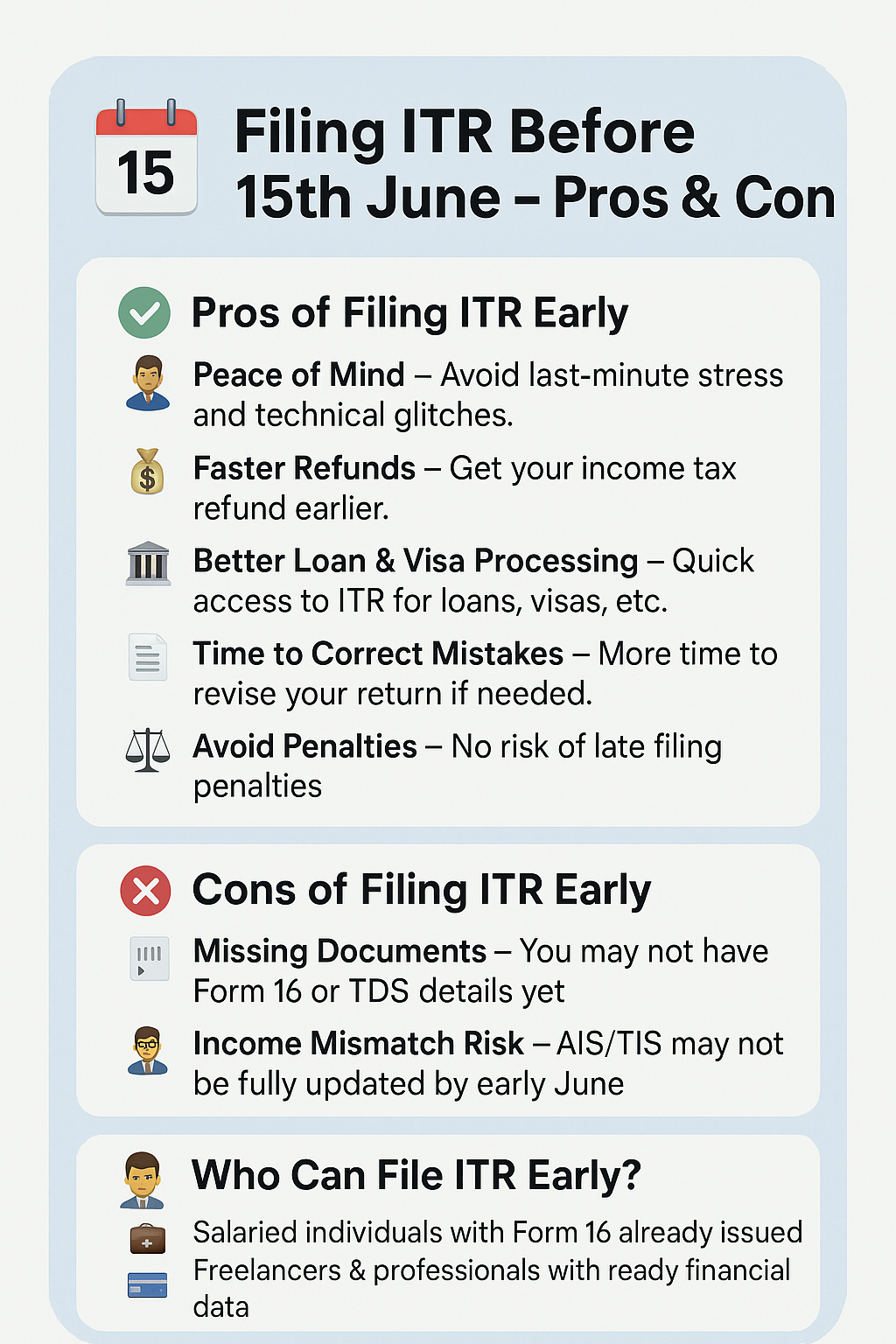
about filing ITR before 15th June, with emojis and clear pros & cons, plus eligibility info: Benefits of Filing ITR Before 15th June 🧘‍♂ Peace of Mind – Avoid last-minute stress and technical glitches. 💰 Faster Refunds – Get your income tax refund earlier. 🏦 Better Loan & Visa Processing – Quick access to ITR for loans, visas, etc. 📑 Time to Correct Mistakes – More time to revise your return if needed. ⚖ Avoid Penalties – No risk of late filing penalties. Drawbacks of Filing ITR Too Early 🧾 Missing Documents – You may not have Form 16 or TDS details yet. 🧮 Income Mismatch Risk – AIS/TIS may not be fully updated by early June. 🔄 Re-filing May Be Needed – If income details change, you’ll have to revise. Who Can File ITR Early? Who Shouldn’t File ITR Early?  Pro Tip Always match your ITR with AIS/TIS & Form 26AS before filing to avoid mismatch notices from the IT department. Different types of ITR and who should file. What Is Form 26AS in income tax What Is AIS in income tax What Is SFT in income tax Contact us for ITR Filing At Finance And Tax Guide, we are offering comprehensive income tax return filing services designed to make the tax process as smooth and stress-free as possible. Our team of experienced tax professionals ensures accurate and timely filing, helping you minimize liabilities and maximize potential refunds. Whether you’re an individual, a small business, or a corporation, we take the time to understand your unique financial situation, offering personalized solutions to meet your needs. Trust us to handle the complexities of tax filing so you can focus on what matters most to you. Don’t rush to file your ITR What can happen? What if you file early? What’s the issue The tax paid and income details on the tax portal may not match with ITR filed What should you do? Real-Life Illustration for ITR filling Reflected in Form 26 AS: 15 June (15 day processing) SFT reporting, which captures high-value transactions (required for AIS) by entities, is also on 31st May If the ITR is filed with nine-month income, details will get updated later. Have to file a revised return when Form 26AS gets updated Conclusion iling ITR before 15th June can save you time and help you receive refunds faster — but only if your data is complete. Always verify your AIS, Form 26AS, and TDS details before submission. When in doubt, wait till mid-June or consult a tax advisor. Contact US FAQs
Section 54EC
Tax

How to Save Capital Gains Tax on Property Sale | Section 54EC

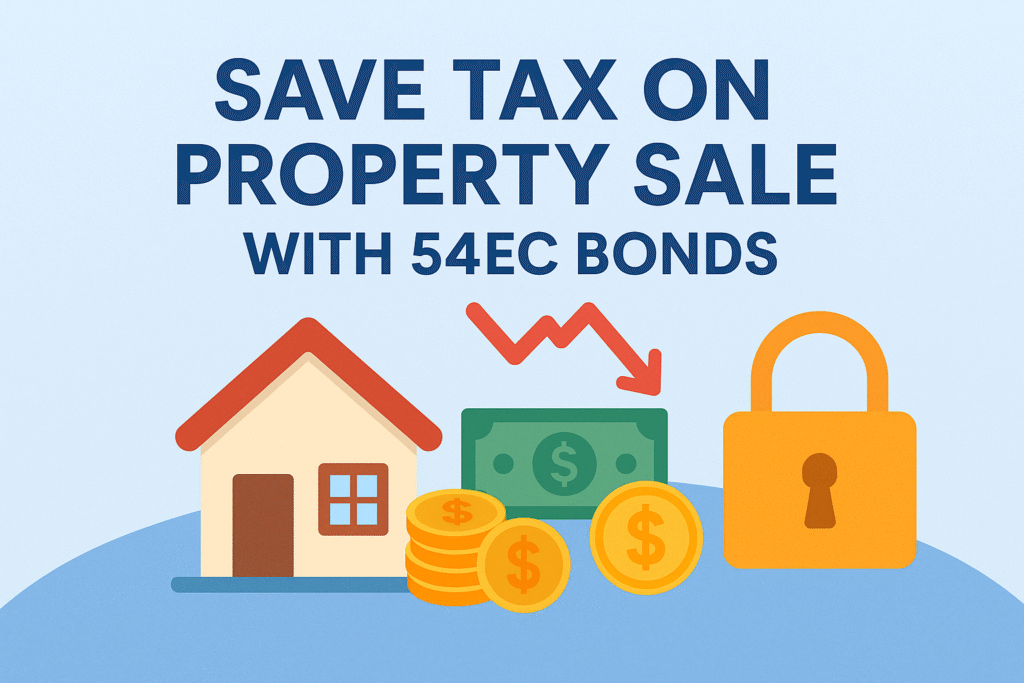
Don’t want to pay tax after selling your land or building? Section 54EC helps you save tax if you invest the money from the sale in certain government bonds. Let’s break it down 👇 How to Save Capital Gains Tax on Property Sale. What is Section 54EC? If you sell a long-term capital asset like land or a building and make a profit (called capital gain), then instead of paying tax on it, you can invest the gain in special bonds (called 54EC bonds) and get tax exemption. Key Conditions You Must Meet Requirement Details 🏠 Asset Sold Land or Building (held for more than 2 years) 💰 What You Get Exemption from capital gains tax 🕒 Time to Invest Within 6 months from the date of sale 🧾 Where to Invest In REC or NHAI 54EC Bonds (Govt-backed) 💸 Maximum Investment ₹50 Lakhs per financial year ⏳ Lock-in Period 5 years (can’t sell the bonds before 5 years) 🛑 Exemption Reversed If… You sell the bond before 5 years Layman Example Now Rahul has 2 options: ❌ If he doesn’t invest → He pays 20% capital gains tax on ₹50 lakhs = ₹10 lakhs tax 😓 ✅ If he invests ₹50 lakhs in 54EC bonds within 6 months,➡️ No tax on ₹50 lakhs! 🎉➡️ He saves ₹10 lakhs in tax!➡️ But he can’t touch that ₹50L for 5 years. Which Bonds Qualify Under 54EC? These are safe, government-backed investments 🏦Interest ~5.25% (subject to change) – but interest is taxable. Points to Remember ❌ Applicable only for land/building, not shares, gold, or mutual funds 🧾 Bonds must be in your name (not a relative or company) 💸 You can invest up to ₹50 lakhs in a financial year ⌛ Don’t miss the 6-month deadline or you’ll lose the tax benefit 🔒 The bonds are locked for 5 years – plan your liquidity accordingly Quick Tip Use this exemption only if you don’t need the money immediately. It locks your money for 5 years but saves big on tax. Conclusion If you’re selling land or a building and want to legally save tax, Section 54EC bonds are a smart, government-backed way to do it. 👉 Just remember: It’s a low-risk, tax-efficient strategy that every property seller in India should know. FAQs

Section 54F
Tax

Section 54F: How to Save Capital Gains Tax by Buying a New House in India

Sold shares, gold, or land (not a house) and made a profit? You can avoid paying tax on the capital gain if you buy a residential house! That’s where Section 54F comes in. Let’s understand it simply 👇 What is Section 54F of the Income Tax Act? If you sell any long-term capital asset (like gold, land, or shares) and use the sale money to buy a residential house, you can save tax on the profit. Eligibility Criteria & Conditions to Claim Section 54F Requirement Details Asset Sold Any long-term capital asset except residential house (e.g., land, gold, shares) What You Must Do Buy or build 1 residential house in India Time to Buy/Build Buy within 1 year before or 2 years after, or build within 3 years from sale date Use of Funds Entire sale amount (not just the gain) should be invested in the new house Own Only One House You should not own more than 1 residential house (other than the new one) at the time of sale Don’t Sell for 3 Years The new house must not be sold within 3 years Real-Life Example – How Section 54F Works (Layman Example) Scenario: Priya sold a plot of land (non-residential) in September 2025 for ₹80 lakhs, which she originally bought for ₹20 lakhs. Case 1: Full Investment in House Case 2: Partial Investment Important Conditions You Shouldn’t Ignore What If You Don’t Buy a House Immediately? You can deposit the money in a Capital Gains Account Scheme (CGAS) in a bank🏦 This keeps your exemption valid – as long as you use it later to buy/build a house within the allowed time. Pro Tip If you’re selling land, gold, or shares and planning to buy a house anyway, Section 54F is a great way to save tax! Conclusion Section 54F is a powerful tax-saving provision for individuals selling long-term capital assets other than a house. By strategically reinvesting the proceeds in a new residential home, you can legally avoid paying capital gains tax. FAQs

residential status
Tax

Residential Status Section 6 of the Income Tax Act

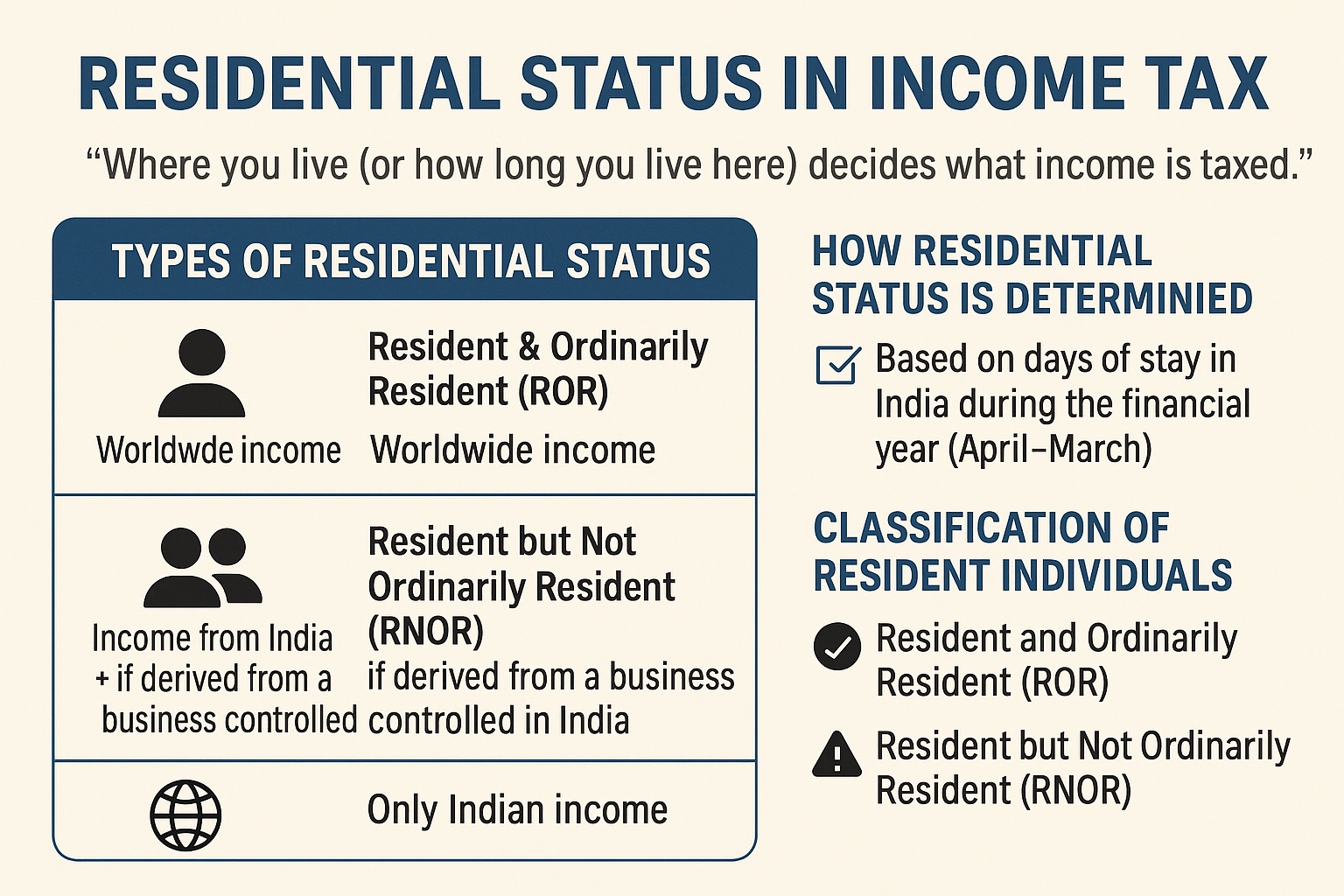
Your residential status decides how much of your income is taxed in India. Whether you’re an Indian citizen or a foreigner, Section 6 tells the government if you’re a resident or not for tax purposes. What Is Residential Status? In India, the level of your tax liability is determined by your residential status. It is determined by the number of days you spend in India during a fiscal year (April–March) and is assessed under Section 6 of the Income Tax Act. Types of Residential Status There are three main categories: 1. Resident and Ordinarily Resident (ROR) 2. Resident but Not Ordinarily Resident (RNOR) 3. Non-Resident (NR) Type Criteria Resident and Ordinarily Resident (ROR) Lived in India for 2+ years out of last 10 and 730+ days in last 7 years Resident but Not Ordinarily Resident (RNOR) If you don’t meet both above conditions How is residential status determined Based on how many days you stay in India in a financial year (April–March). 📝 Note: For Indian citizens or PIOs living abroad, the 60-day rule becomes 182 days if they visit India. Why Does residential status Matter? Your residential status affects your tax liability: Residential Status Taxed on Income From Resident & Ordinarily Resident (ROR) Worldwide income (India + foreign) Resident but Not Ordinarily Resident (RNOR) Income from India + foreign income if derived from business controlled in India Non-Resident (NR) Only Indian income is taxed Resident vs Non-Resident status Person Type Days in India Residential Status Indian visiting from abroad for 120 days 120 days Non-Resident Indian staying 185 days in India 185 days Resident Foreign national in India for 190 days 190 days Resident Indian returning from UAE, stayed 250 days 250 days Resident Example for residential status (Layman) ✔️ He meets the 60+365 rule, so he becomes Resident. BUT – because he has been living abroad for many years, he may qualify as RNOR, not fully Resident.  Quick Tips: Conclusion “Where you live (or how long you live here) decides what income is taxed.” More days in India = more tax exposure (even on foreign income in some cases!) FAQs

Tax

TDS Rate Chart FY 2025-26 (AY 2026-27) – Latest Updates

Understanding the applicable TDS Rate Chart FY 2025-26 rates is crucial for both individuals and businesses to ensure compliance with the Income Tax Act. The Finance Act 2025 has brought some important updates for the financial year 2025–26 (Assessment Year 2026–27). Here’s the comprehensive TDS rate chart for your reference. ✅ Complete TDS Rate Chart FY 2025-26 (AY 2026-27) Section Nature of Payment Threshold Limit TDS Rate Notes 192 Salary As per income slab Slab rates Deducted monthly by employer 192A EPF Premature Withdrawal ₹50,000 10% Applicable if taxable 193 Interest on Securities ₹10,000 10% Includes debentures, government securities 194 Dividend ₹10,000 10% Domestic companies 194A Interest (other than securities) ₹50,000 (others); ₹1,00,000 (senior citizens) 10% Banks, post offices, co-operative societies 194B Lottery Winnings ₹10,000 (single transaction) 30% – 194BB Horse Race Winnings ₹10,000 (single transaction) 30% – 194C Contractor Payments ₹30,000 (single); ₹1,00,000 (aggregate) 1% (Ind/HUF); 2% (Others) – 194D Insurance Commission ₹20,000 5% – 194DA Life Insurance Policy ₹1,00,000 2% – 194G Commission on Lottery Tickets ₹20,000 2% – 194H Commission/Brokerage ₹20,000 2% – 194-I(a) Rent – Land/Building/Furniture ₹2,40,000/year 10% – 194-I(b) Rent – Plant & Machinery ₹2,40,000/year 2% – 194-IA Property Transfer ₹50,00,000 1% – 194-IB Rent by Individual/HUF (not under audit) ₹50,000/month 5% – 194-IC Joint Development Agreement No limit 10% – 194J Professional/Technical Fees ₹30,000 10% (other fees); 2% (technical services) – 194-IA Property Transfer ₹50,00,000 1% – 194M Certain Payments by Individuals/HUF ₹50,00,000 2% – 194N Cash Withdrawal ₹1,00,00,000 2% 5% if ITR not filed for last 3 years 194Q Purchase of Goods ₹50,00,000 0.1% – 194R Business Perquisites ₹20,000 10% – 194S Virtual Digital Assets ₹50,000 (specified); ₹10,000 (others) 1% – 📝 Key Notes on TDS Rate Chart FY 2025-26 1. No PAN Provided? TDS is deducted at the higher of: 2. Form 15G/15H: Submit these forms to banks/post offices to avoid TDS on interest income, if eligible under tax slabs. 3. Higher TDS on Non-Filers: If ITR is not filed for the last 3 years and total TDS exceeds ₹50,000/year, a higher TDS rate applies under Section 206AB. Conclusion Being up to date with TDS Rate Chart FY 2025-26 helps you stay compliant and avoid unnecessary deductions. Bookmark this TDS chart for FY 2025-26 and share it with your peers and clients.

Section 56(2)(x)
Tax

Section 56(2)(x): Buying Property Below Market Value?

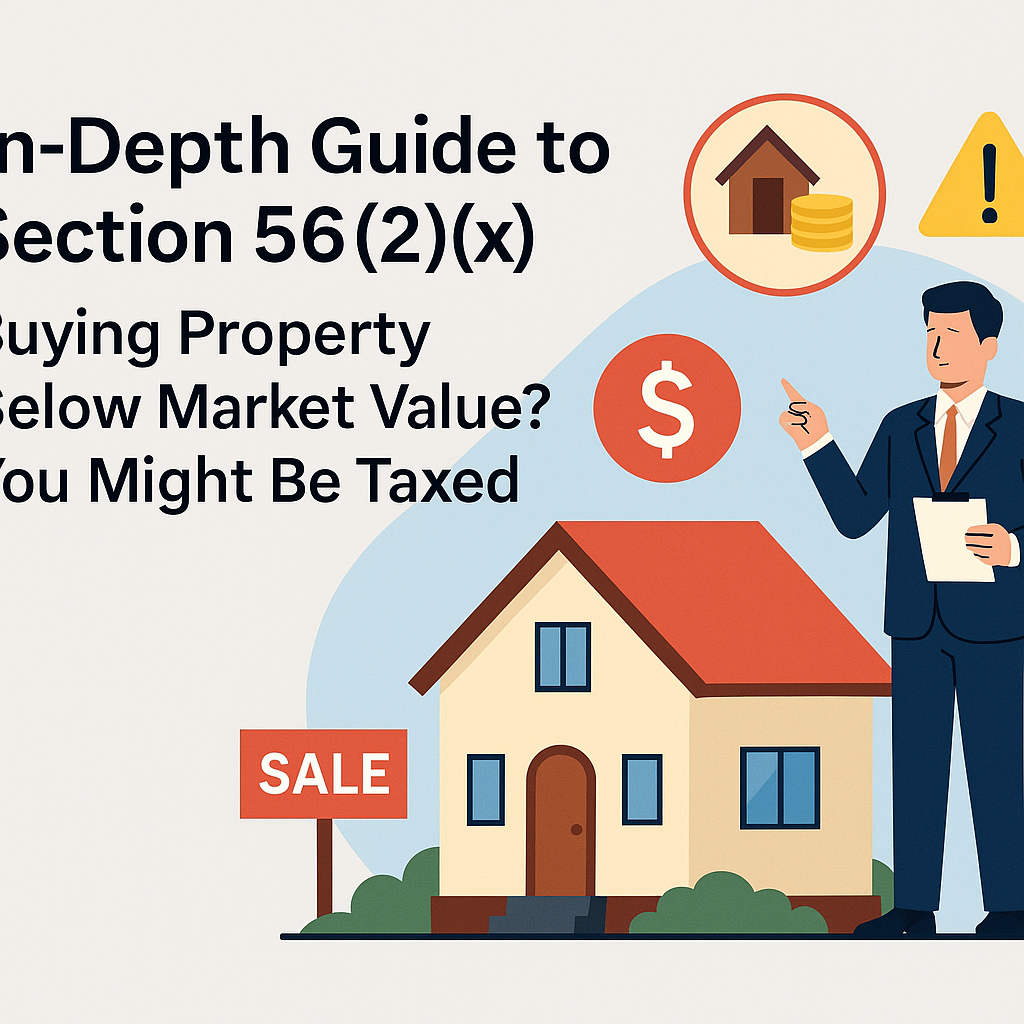
Section 56(2)(x) is one of the most impactful provisions for property buyers, gift recipients, and anyone receiving assets below market value. While Section 43CA and 50C hit the seller, Section 56(2)(x) targets the buyer if they get the property for cheap or for free. 📘 What is Section 56(2)(x)? Introduced to prevent tax evasion through gifts or undervalued transactions, Section 56(2)(x) applies when: In these cases, the difference between the SDV and the actual purchase price is taxed as “Income from Other Sources” in the buyer’s hands. 📋 Conditions for Section 56(2)(x) to Apply: Condition Rule Buyer is an individual or HUF Mostly applies to individuals Buyer receives property as a gift Entire SDV taxed if over ₹50,000 Buyer purchases property below SDV Difference taxed if it exceeds ₹50,000 and >10% Property is land, building, or both Only immovable property considered ✅Safe Harbour – 10% Tolerance Situation Taxable? SDV is up to 10% higher ❌ No tax SDV exceeds sale price by >10% and >₹50,000 ✅ Taxable Gift value (SDV) > ₹50,000 ✅ Entire value taxed 🧮 Example 1: Under-Valued Purchase ✅ Difference > 10% and > ₹50,000 → ✅ The buyer must pay tax on ₹10 lakh as Income from Other Sources. 🧮 Example 2: Gifted Property If you receive a property worth ₹25 lakh (based on SDV) as a gift from a non-relative,✅ The entire ₹25 lakh is taxable in your hands. 👪 Exceptions: When Gifts are Not Taxable under Section 56(2)(x) Section 56(2)(x) does not apply if you receive property from: ✅ These are tax-free gifts. ⚖️ Buyer Beware: It’s Not Just About Saving Money If you’re buying a property at a deep discount (distress sale, auction, or family deal), check the SDV. If the gap exceeds the 10% threshold, you’ll need to pay tax on the difference. 📝Summary Table – Section 56(2)(x) Transaction Type Tax Treatment (if over limits) Gifted property Entire SDV taxed Property bought < SDV by >10% Difference taxed Received from relatives/marriage Exempt SDV difference ≤10% No tax 🔚 Final Thoughts on Section 56(2)(x) Section 56(2)(x) is a powerful tool to tax undervalued deals and undisclosed income. Whether it’s a gift or a cheap deal, buyers must be aware of SDV limits — or face unexpected tax bills. FAQs

real estate sale below SDV
Tax

Section 43CA: Tax on Real Estate Sales

When builders or developers sell real estate at a price lower than the market (stamp duty) value, the Income Tax Act doesn’t stay silent. That’s where Section 43CA steps in. This section ensures that businesses dealing in real estate can’t understate their sales to avoid taxes. 📘 What is Section 43CA of the Income Tax Act? Section 43CA applies when a person sells land or building (or both) held as stock-in-trade, and the actual sale consideration is less than the Stamp Duty Value (SDV). In such cases, the SDV is deemed to be the actual sale value, and the profit is calculated accordingly — increasing the taxable business income. 📌 This provision is applicable to developers, builders, property dealers, and anyone selling real estate not as an investment, but as part of their business. 🏗️ Key Conditions for Section 43CA to Apply: Condition Explanation Asset is stock-in-trade The land/building is part of the business inventory, not a capital asset. Sale of immovable property Property transferred must be land, building, or both. Sale value < Stamp Duty Value Declared sale consideration is less than SDV on the date of agreement or registration. 📆 Date of Agreement vs. Date of Registration If part of the payment is received by cheque, bank transfer, or digital mode on or before the agreement date, the SDV as on the date of the agreement is considered, not registration date. This helps sellers avoid tax consequences due to valuation hikes between agreement and registration. 📉 Safe Harbour Provision – Tolerance Limit To provide relief in cases where the SDV is marginally higher than the actual sale price, a 10% variation is allowed. If SDV is… Taxable value Up to 110% of actual consideration Actual sale value More than 110% of actual consideration Stamp Duty Value 🧮 Example Sale Price: ₹80,00,000SDV: ₹85,00,000 (6.25% higher)✅ Since difference < 10%, actual price is accepted. But if SDV was ₹90,00,000 → Difference = 12.5% → SDV becomes deemed sale value. 📊 Real-Life Example A builder sells a flat to a customer: Business income will be calculated on ₹60 lakh, not ₹50 lakh. ⚖️ Option to Refer to Valuation Officer If the seller believes that the SDV is higher than the fair market value, they can request the Assessing Officer (AO) to refer the matter to a Valuation Officer (DVO). If the DVO’s valuation is lower than the SDV, the DVO’s value is accepted. 🧾 Differences from Section 50C Feature Section 43CA Section 50C Applies to Builders/developers Individuals/investors Nature of Asset Stock-in-trade Capital asset Income Head Business income Capital gains Final Thoughts on Section 43CA Section 43CA ensures that real estate businesses report fair profits, even if they sell below market value. Builders offering steep discounts must check whether they’re still within the 10% safe harbour — or risk paying tax on a higher deemed sale value. FAQs

Section 80-IAC
Tax

Section 80-IAC: Income Tax Deduction for Eligible Startups in India

Section 80-IAC of the Income Tax Act, 1961 is a startup-friendly provision aimed at encouraging entrepreneurship and innovation in India. It offers a 100% income tax deduction on profits for eligible startups, giving them room to grow without the burden of tax in their early years. What is Section 80-IAC? Eligible startups can claim a 100% tax deduction on profits for any 3 consecutive assessment years out of the first 10 years from the year of incorporation. This helps startups reinvest profits into business growth instead of paying taxes during the initial, crucial years. Who Is Eligible Under Section 80-IAC? To claim this deduction, the startup must meet the following conditions: Alternatively, it should be a scalable business model with high potential for employment generation or wealth creation. How to Claim the 80-IAC Deduction To avail of the tax benefit under Section 80-IAC, follow these steps: 👉 Pro Tip: Startups often delay applying until they begin making profits. Choose your 3-year claim period wisely! Certain businesses are not eligible for 80-IAC Deduction Additional Points to Note Summary Criteria Requirement Applicable to Private Limited Companies & LLPs Incorporation Window Between April 1, 2016 and March 31, 2025 Turnover Limit Up to ₹100 crore in any financial year Tax Benefit 100% deduction on profits for 3 years Recognition Required Yes – From DPIIT Claim Period Any 3 consecutive years out of first 10 years Conclusion Section 80-IAC is a powerful incentive for early-stage startups to scale faster without the burden of income tax. If you’re a founder, make sure you check your eligibility and apply for DPIIT recognition to make the most of this benefit FAQs

Tax

Section 50C – Tax on Sale of Immovable Property Based on Stamp Duty Value

Section 50C of the Income Tax Act 1961 is an anti‑tax‑evasion provision. It applies when you sell a capital asset—land, building, or both—and the declared sale consideration is lower than the government‑assessed stamp duty value (SDV). In that case, the higher SDV becomes the deemed sale price, and capital gains are calculated on that amount, not on what you actually receive. Why Does Section 50C Exist? People often underreport property sale values in sale deeds to reduce tax and stamp duty. Section 50C is designed to counter such practices by using the Stamp Duty Value as a benchmark for the property’s fair market value. When Does Section 50C Apply? Understanding Stamp Duty Value (SDV) The Stamp Duty Value is the value assessed by the local Stamp Valuation Authority (SVA) for the purpose of levying stamp duty on real estate transactions. It is based on the circle rate/guideline value in the area where the property is located. Capital‑Gains Calculation Under Section 50C Let’s break it down with an example: Particular Amount (₹) Declared Sale Consideration 50,00,000 Stamp Duty Value (SDV) 65,00,000 Indexed Cost of Acquisition 30,00,000 Since SDV exceeds sale price by > 10 %, Capital Gains = 65,00,000 – 30,00,000 = 35,00,000 (not ₹20,00,000 based on actual sale price). Safe‑Harbour Rule (10 % Tolerance) If the difference between the actual sale price and SDV is not more than 10%, the declared sale price is accepted for capital gains. Period Tolerance Limit Before AY 2021‑22 5 % AY 2021‑22 onward 10 % Example: If Sale Price = ₹90,00,000 and SDV = ₹95,00,000Difference = ₹5,00,000 → 5.56%, which is within 10%So, ₹90 lakh will be considered as sale price (not ₹95 lakh) Right to Dispute SDV (Reference to Valuation Officer): If the taxpayer believes that the stamp duty value is higher than the fair market value of the property, they can request that the matter be referred to a Valuation Officer (VO) under Section 50C(2). If the VO determines a lower fair market value, that value will be used instead of the SDV. Steps: Note: If the DVO’s valuation is higher than the SDV, the lower of the two (SDV or DVO’s value) is used. Section 50C vs. Related Sections Section Applies To Purpose 50C Sale of capital assets (land/building) Deems higher value for capital gains 43CA Sale of stock‑in‑trade (builders) Similar to 50C for business income 56 (2)(x) Buyer purchases below SDV Difference taxed as buyer’s income Where Section 50C Does Not Apply Summary – Quick Facts: Topic Details Applicable on Sale of land/building (capital asset) Trigger Declared sale price < Stamp Duty Value Consequence SDV deemed as sale consideration Relief – Safe Harbour SDV can be up to 10% higher than sale price Option to challenge SDV Yes – Refer to Valuation Officer (VO Option to challenge SDV Section 56(2)(x) – difference taxed as income Summary : Section 50C is a crucial provision that ensures property sellers do not understate sale prices to avoid taxes. It helps the Income Tax Department maintain transparency and fairness in property transactions. If you’re planning to sell land or a building, always check the stamp duty value and be prepared for capital gains to be calculated on that amount, unless your sale price is within the safe harbour limit. Capital Gain Calculator Capital Gain Calculator calculate your Index Cost Free FAQs

Section 64 Income Tax
Tax

Section 64 Income Tax: Clubbing of Income Rules

Section 64 Income Tax rules prevent tax evasion through “clubbing of income.” Specifically, Section 64 prevents individuals from reducing their tax liability by transferring income or assets to family members, such as a spouse or minor children, while still indirectly enjoying the benefits What is Section 64 Income Tax Clubbing? Section 64 of the Income Tax Act contains clubbing of income rules to prevent taxpayers from illegally reducing their tax liability by transferring assets or income to family members. If you transfer income to a close relative to reduce your taxes, the tax department will add (club) that income back to your taxable income. Why Does Section 64 Exist? Many taxpayers try to reduce taxes by: Section 64 stops this tax evasion loophole by “clubbing” such income with the original taxpayer’s earnings. 5 Scenarios Where the Income Tax Department Clubs Income These Are the Main Cases Where Tax Authorities Club Income 1. Transfer of income to Spouse [Section 64 (1)(iv)] Rule: The tax department adds any income (interest, rent, dividends) from assets you gift your spouse without payment to your taxable income. Example: Tax Result: 2. Income of Minor Child [Section 64 (1A)] Rule: The law clubs income earned by children below 18 (except from their own skills/labour) with the higher-earning parent’s income. ⚠ Exceptions: Example:  Tax Benefit:  3. Transfer to Daughter-in-law [Section 64 (1)(vi)] Rule: Assets gifted to son’s wife without payment → Income taxed in your hands. Example: 4. Transfer for the Benefit of Spouse or Daughter-in-law [Section 64 (1)(vii) & (viii)] Rule: The Income Tax Department clubs income with you if you transfer assets to any third party (like a trust or friend) that ultimately benefits your spouse or daughter-in-law. 5. HUF Income from Transferred Assets [Section 64 (2)] Rule: If you transfer personal assets to HUF (Hindu Undivided Family) without payment → HUF’s income from those assets is your income. Summary Table Scenario Who is Taxed Income from assets gifted to spouse Transferor (husband/wife) Income of a minor child Parent with higher income Income from assets gifted to daughter-in-law Transferor Asset transfer to benefit spouse/daughter-in-law Transferor Asset transferred to HUF without consideration Transferor Important Notes: Conclusion Section 64 Income Tax provisions ensure fair taxation by and prevents individuals from using family members to sidestep tax laws. If you’re planning to transfer assets or income to relatives, make sure you Understand the clubbing rules to avoid unexpected tax liabilities. FAQs

Scroll to Top