
Finance and Tax Guide

Author name: Yuvraj Vihol

Yuvraj Vihol is a professional accountant based in Ahmedabad, Gujarat, India, with more than 2 years of hands-on experience in GST compliance, ITR filing, TDS/TCS management, and business accounting.He founded Finance and Tax Guide to simplify complex tax and accounting topics for Indian small businesses, entrepreneurs, and individual taxpayers.His expertise includes: • GST Registration and Return Filing • Income Tax Return (ITR) Filing • TDS and TCS Compliance • Business Bookkeeping • Financial Accounting • Tax Planning for Small BusinessesEvery article published on Finance and Tax Guide is based on practical accounting experience and current Indian tax laws to provide accurate, easy-to-understand financial guidance.

Capital Budgeting and Investment Decisions
Financing

The Ultimate Guide : Capital Budgeting and Investment Decisions 2025

Mastering capital budgeting and investment decisions can make or break a company. In the late 1990s, two companies dominated the video rental market: Blockbuster and a small, quirky startup called Netflix. Blockbuster, sitting on a mountain of cash, had a major capital budgeting decision to make. Should it invest heavily in its massive network of physical stores, or should it pivot to an unknown, unproven mail-order DVD model? It chose the stores. Netflix, with a fraction of the resources, bet its entire existence on the opposite. It poured its limited capital into logistics and, later, a radical new idea called “streaming.” We all know how this story ends. Blockbuster’s decision—a capital budgeting decision—led it to bankruptcy. Netflix’s decision made it a global media titan. This is the power and peril of capital budgeting. It’s not just finance-speak; it’s the strategic framework for deciding where a company invests its most significant resources for long-term growth. These are the “bet-the-company” choices, the billion-dollar questions, and getting them right is the single most important driver of a company’s future value. Defining Capital Budgeting So, what is capital budgeting? At its simplest, capital budgeting is the process a business uses to evaluate and select potential major projects or investments. These aren’t everyday purchases like office supplies. We’re talking about large, long-term investments, also known as Capital Expenditures (CapEx). These are assets that will provide value for many years, such as: The core challenge is that these projects require a massive cash outlay today in exchange for a stream of uncertain cash flows in the future. Capital budgeting gives us the tools to decide if that future stream is worth the upfront cost. Defining Investment Decisions If capital budgeting is the process, then investment decisions are the outcomes. An investment decision is the final choice to say “Yes, we will fund this project” or “No, we will pass.” These decisions are directly linked to capital budgeting. The entire process—from idea generation to number-crunching—is designed to ensure that when the time comes to make that final decision, it’s based on rigorous data and strategic alignment, not just a gut feeling. This guide focuses on long-term investment decisions (CapEx), as opposed to short-term decisions like managing inventory or daily cash (which falls under working capital management). What This Guide Will Cover (And Why It Matters to You) You don’t need to be a CFO to understand capital budgeting. In fact, you shouldn’t be. Whether you’re a finance student, an MBA candidate, a small business owner deciding on a new pizza oven, or a corporate manager pitching a new project, these concepts are vital. This guide will walk you, step-by-step, from the basic “why” to the advanced “how.” We will cover: By the end of this 5,000-word guide, you won’t just know the definitions; you’ll have a complete framework for making smarter, more profitable, and more confident long-term investment decisions. The Critical Importance: Why Master Capital Budgeting? If a company’s day-to-day operations are its engine, then capital budgeting is its steering wheel. It determines the direction and, ultimately, the destination. Mastering this process is non-negotiable for five critical reasons. 1. Maximizing Shareholder Wealth: The Primary Goal Let’s be clear: the primary financial goal of any for-profit company is to increase its value for its owners (the shareholders). Capital budgeting is the single most powerful tool to achieve this. It’s not about just making a profit; it’s about creating value. It does this by providing a simple rule: only accept projects that are worth more than they cost. As we’ll see, techniques like Net Present Value (NPV) tell you the exact dollar amount a project is expected to add to your company’s value. By consistently selecting value-creating projects, you are directly fulfilling the firm’s number one objective. 2. Strategic Alignment: Linking Projects to Long-Term Goals Great ideas are not always good ideas for your company. Capital budgeting decisions are not made in a vacuum. They must be directly tied to the company’s overall strategy. If your company’s 5-year strategy is to be the industry leader in sustainability, a capital budgeting proposal to invest in green technology and solar-powered facilities makes perfect strategic sense. A different proposal to acquire a cheap, high-polluting factory—even if it looks profitable on paper—would be a strategic mismatch. The capital budgeting process forces managers to ask: “Does this project move us closer to our long-term goals?” It acts as a filter, ensuring that the company’s money, time, and energy are all pushing in the same direction. 3. Resource Allocation: Doing More with Less No company on Earth has unlimited resources. Money, time, and skilled employees are all finite. This creates the problem of capital rationing. You may be faced with ten good projects, all of which promise a solid return. But you may only have the budget to fund three of them. How do you choose? This is where capital budgeting shines. It provides the analytical tools (like the Profitability Index) to rank these competing projects. It helps you find the combination of projects that generates the highest possible return for your limited budget. It’s the process of choosing the best projects, not just the good ones. 4. Risk Management: Avoiding Catastrophic Failures A bad long-term investment can do more than just lose money; it can cripple or even bankrupt a company. Remember Blockbuster? That was a single, catastrophic investment decision. The capital budgeting process is, at its heart, a risk management framework. It forces you to quantify and analyze the risks before a single dollar is spent. By analyzing these risks upfront (using techniques we’ll cover later, like sensitivity and scenario analysis), you can avoid devastating failures and make decisions with a clear understanding of the potential downsides. 5. The Peril of Irreversible Decisions If you buy the wrong brand of printer paper, it’s a small, easily corrected mistake. If you build a $500 million, custom-built factory in the wrong location, you can’t just return it. Capital budgeting deals with decisions that are

tax reform
Tax

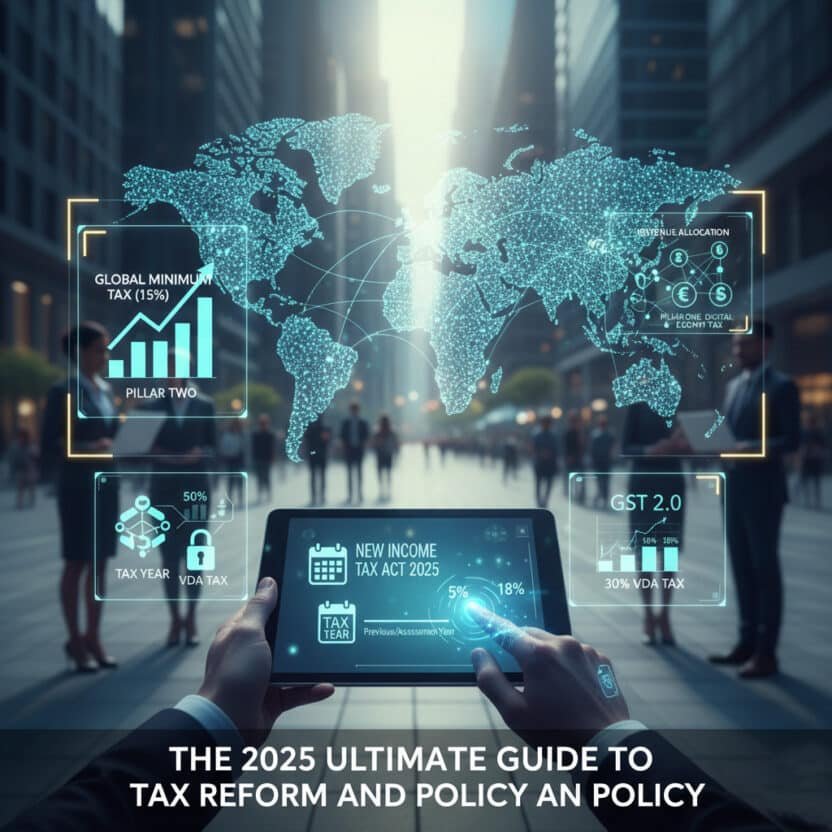
2025 Ultimate Guide to Tax Reform and Policy: Individuals and Businesses

Let’s be honest: for most people, the words “tax reform” are about as exciting as watching paint dry. It’s a topic that feels overwhelmingly complex, hopelessly boring, and reserved for accountants in windowless rooms. Until it isn’t. What if the tax code isn’t just a set of rules, but the “operating system” of our entire society? It’s the invisible script that determines whether a new business gets launched or folds. It dictates the price of your weekly groceries, the viability of your crypto investment, and whether your country can afford to build new hospitals or invest in green technology. And in 2025, that “operating system” is getting its biggest update in decades. We are in the middle of a global tax revolution. On the international stage, over 140 countries are rewriting the rules of globalization, racing to implement a 15% global minimum tax that will fundamentally change how tech giants and multinational corporations (MNEs) are taxed. Meanwhile, on the domestic front, landmark legislation like the new Income Tax Act of 2025 and Next-Generation GST Reforms are rolling out. These aren’t minor tweaks; they are a complete overhaul, promising radical simplification (like replacing the confusing “Assessment Year” with a simple “Tax Year”) while simultaneously introducing new digital-first enforcement and entirely new tax structures for everything from luxury goods to your NFT collection. Where does that leave you? Whether you’re an individual planning your investments, a small business owner trying to stay compliant, or a corporate leader navigating global markets, you can’t afford to ignore this. This guide is your solution. We will cut through the jargon, explain what’s actually changing, and translate complex policy into what it means for your money and your future. Forget the dry theory—this is your ultimate, practical guide to navigating the new world of tax. What Are Tax Reform and Tax Policy? Before we dive into the global minimum tax or the new GST slabs, we need to be speaking the same language. “Tax policy” and “tax reform” are often used interchangeably, but they are two very different things. Understanding this difference is the first step to truly grasping the changes unfolding in 2025. Defining the Terms: What’s the Difference? Think of it like building a house. One term is the blueprint, and the other is the act of renovation. Tax Policy: The “What” and “Why” (The Government’s Strategy) Tax policy is the “why.” It’s the complete strategic framework a government creates to decide what it will tax, how much it will tax, and who it will tax. It’s the grand vision, the philosophical and economic blueprint that answers high-level questions like: Tax policy is a theoretical document. It’s the collection of laws, rules, and intentions that define the entire tax system. When politicians debate “shifting the tax burden,” they are talking about policy. Tax Reform: The “How” (The Action of Changing the System) Tax reform is the “how.” It’s the tangible, real-world action of changing the existing tax system to align it with a new or existing tax policy. It’s the renovation. You don’t just “do” tax policy; you implement it through tax reform. Reform is messy, practical, and has real-world consequences. It’s the process of passing new legislation, like the New Income Tax Act, 2025. It’s the introduction of new systems, like faceless assessments. It’s the adjustment of rates, like the new GST slabs. In short: Policy is the idea. Reform is the action. The massive changes we’re seeing in 2025 are the result of years of policy debates finally being put into action. Why Does Tax Reform Matter? The Impact on Your Wallet and the Economy This is where the theory hits the street. Tax reform isn’t an abstract academic exercise; it’s an event that directly reroutes the flow of money through an entire country. Its effects are felt by everyone, from a single parent buying groceries to a multinational corporation planning a billion-dollar factory. The 3 Goals of Any Tax System: Simplicity, Efficiency, and Equity Every tax reform, from the Roman Empire to the 2025 digital-first overhauls, is trying to solve the same puzzle. Economists and policymakers (famously, Adam Smith) agree that a “good” tax system must balance three competing goals. The 2025 reforms are a perfect example of this balancing act. 1. Simplicity A simple tax system is one that you can understand and comply with. You shouldn’t need a Ph.D. in finance to file your taxes. When a tax code is too complex, it creates loopholes for “creative accountants” and costs honest taxpayers time and money (e.g., paying for filing help). 2. Efficiency An efficient tax system is one that raises the money the government needs without distorting the economy or costing too much to collect. A “distortion” is when a tax causes people to make different economic choices than they otherwise would, like a high property tax that discourages people from improving their homes. 3. Equity (Fairness) This is the most debated goal. Equity asks, “is the tax system fair?” But “fair” means different things to different people. The problem? These three goals are almost always in conflict. The Global Stage: International Tax Reform Takes Center Ring For decades, the rules of international tax were like a dusty old treaty written in the 1920s—they were built for a world of factories, railroads, and shipping, and they completely broke down in the age of the internet. This old system led to two massive problems: After years of gridlock, the world’s governments, led by the OECD (Organisation for Economic Co-operation and Development), have finally launched a two-pronged revolution to fix it. This is known as the Two-Pillar Solution. The Tectonic Shift: Pillar Two and the Global Minimum Tax This is the first, and most immediate, revolution. As of 2025, it’s no longer just a proposal; it’s a reality being implemented by nations worldwide, impacting the largest corporations. What is the 15% Global Minimum Tax? In simple terms: Pillar Two is a global agreement that ensures large multinational companies pay a

International Tax Planning and Transfer Pricing
Tax

The Ultimate Guide to International Tax Planning and Transfer Pricing : 2025

Expanding a business across borders is the modern benchmark for success. It’s a sign of ambition, growth, and global reach. But as soon as your operations touch down in a new country, you enter a complex, high-stakes financial world governed by a web of international tax laws. This is where two of the most critical—and often misunderstood—concepts in global finance come into play: international tax planning and transfer pricing. For many, these terms conjure up images of shadowy loopholes and aggressive avoidance schemes. But in today’s transparent, post-BEPS (Base Erosion and Profit Shifting) world, that view is dangerously outdated. Modern international tax planning is not about if you pay tax, but about where, when, and how much you pay, all while remaining in full compliance. It’s about strategy, risk management, and long-term sustainability. And at the very heart of that strategy lies transfer pricing—the mechanism that governs the price of all transactions between related entities within a multinational group. Getting it wrong doesn’t just mean a higher tax bill; it can mean crippling penalties, double taxation, and endless disputes with tax authorities. In this comprehensive guide, we will demystify international tax planning and transfer pricing. We’ll move from the basic definitions to the core principles, explore the advanced strategies multinationals use, and unpack the new global rules that are changing the game. Whether you are a CFO, a finance manager, or a business owner dreaming of expansion, this article will serve as your blueprint for navigating the complex but critical world of international tax. The Two Pillars: What is International Tax Planning? At its core, international tax planning is the process of structuring your company’s global operations and transactions to legally minimize your total tax liability. However, the modern definition has evolved far beyond simply lowering the tax bill. It’s a strategic function that balances tax efficiency with operational goals and robust risk management. Beyond “Saving Tax”: The Real Goals A common misconception is that tax planning is just about finding the lowest tax rate. In reality, a sustainable strategy has three equally important goals. Achieving Tax Efficiency vs. Tax Avoidance A good international tax plan focuses only on efficiency, ensuring all structures are defensible and have a clear business, or “economic,” substance. Managing Global Risk and Ensuring Compliance The cost of non-compliance is almost always higher than the tax itself. A solid plan prioritizes risk management. This means: Aligning Tax Strategy with Business Objectives Your tax strategy should support your business, not dictate it. A “tax-perfect” structure that creates massive operational headaches is a failure. A human-centered tax plan asks: Key Concepts Every Multinational Enterprise (MNE) Must Know To build a plan, you need to understand the building blocks. These are the core concepts that determine where and how your company is taxed. Permanent Establishment (PE) Risk This is perhaps the most critical risk for any expanding business. A “Permanent Establishment” is a fixed place of business in a foreign country that is significant enough for that country to claim taxing rights over your profits. What constitutes a PE? It used to be simple—a factory, a shop, a permanent office. Today, the lines are blurred. A PE can be triggered by: If you accidentally create a PE in a country, you could suddenly be liable for corporate taxes, VAT, and payroll taxes there, along with penalties for failing to register. Controlled Foreign Corporations (CFC) Rules CFC rules are an anti-abuse measure. They are designed to prevent companies from shifting “passive income” (like interest, dividends, and royalties) into offshore subsidiaries in low-tax or no-tax jurisdictions (tax havens) and leaving it there indefinitely to avoid tax. Here’s how they work: If your company (the parent) in a high-tax country (e.g., the US, UK, Germany) controls a subsidiary in a tax haven, the CFC rules may force you to treat that subsidiary’s passive income as your own income in the current year, even if the subsidiary never paid you a dividend. This immediately subjects that income to tax in your home country. Double Taxation Avoidance Agreements (DTAAs) or Tax Treaties No company wants to pay tax on the same income twice. Double Taxation Agreements (DTAAs), or tax treaties, are bilateral agreements between two countries to prevent this. They are the rulebook for cross-border transactions. They specify: Withholding Taxes (on Dividends, Interest, and Royalties) When you make certain payments to a foreign entity, the source country’s government often requires you to “withhold” a percentage of that payment and send it directly to them as tax. Your international tax plan is the “macro” strategy for how your company is structured. Now, let’s look at the “micro” tool that governs 90% of your day-to-day cross-border transactions: transfer pricing. Demystifying Transfer Pricing: The Heart of International Tax If your multinational company was a single entity, everything would be simple. But it’s not. It’s a group of related legal entities (a parent and its subsidiaries) that are constantly transacting with each other across borders. Transfer Pricing is the system for setting the price for these internal, intra-group transactions. What is Transfer Pricing? A Simple Analogy Imagine you own two companies: “ParentCo” in a country with a 30% tax rate and “SubCo” in a country with a 10% tax rate. ParentCo produces a product for $50. It needs to “sell” it to SubCo, which then sells it to the final customer for $150. By simply changing the internal “transfer price,” you shifted $100 of profit from a high-tax country to a low-tax country, reducing your global tax bill. This is exactly what tax authorities are trying to prevent. The “Arm’s Length Principle”: The Golden Rule of Transfer Pricing To stop this artificial profit shifting, more than 100 countries, led by the Organisation for Economic Co-operation and Development (OECD), have agreed on a single governing rule: The Arm’s Length Principle. This principle is defined in Article 9 of the OECD Model Tax Convention. In simple terms, it states: The price for a transaction between related parties must be

ESG Investing
Financing

The Ultimate Guide to ESG Investing : 2025

In a world grappling with climate change, social inequality, and corporate scandals, a new investment philosophy is gaining momentum, one that looks beyond balance sheets and profit margins. Welcome to the world of Environmental, Social, and Governance (ESG) investing. This is not just another fleeting trend; it’s a fundamental shift in how we perceive value, a recognition that sustainable and ethical practices are not just good for the planet and its people, but also for the bottom line. This comprehensive guide will walk you through everything you need to know about ESG investing. We’ll explore its core principles, uncover its myriad benefits, and equip you with the knowledge to build your own ESG-aligned investment portfolio. So, whether you’re a seasoned investor or just starting, prepare to embark on a journey towards a more sustainable and prosperous future. Part 1: Understanding the ESG Revolution What is ESG Investing? At its heart, ESG investing is a strategy that considers a company’s performance on environmental, social, and governance factors, alongside traditional financial metrics, when making investment decisions. It’s about investing in companies that are not only financially sound but also committed to making a positive impact on the world. Let’s break down the three pillars of ESG: Environmental (E) This pillar examines a company’s impact on the natural world. Key considerations include: Social (S) The social pillar focuses on a company’s relationships with its stakeholders, including its employees, customers, and the communities in which it operates. Key considerations include: Governance (G) The governance pillar examines how a company is managed and led. Key considerations include: Why is ESG Investing Gaining Popularity? The rise of ESG investing is driven by a confluence of factors: Growing Awareness: There is a growing awareness of the pressing environmental and social challenges facing the world, from climate change to income inequality. Investors are increasingly looking for ways to align their investments with their values and contribute to a more sustainable future. Changing Demographics: Millennials and Gen Z, who are more socially and environmentally conscious than previous generations, are entering their prime investing years. They are demanding more from companies than just financial returns. Financial Performance: There is a growing body of evidence that suggests that companies with strong ESG performance tend to outperform their peers over the long term. This is because strong ESG practices can lead to improved risk management, enhanced brand reputation, and increased innovation. Regulatory Tailwinds: Governments and regulators around the world are increasingly introducing policies and regulations that support sustainable finance and ESG investing. This is creating a more favorable environment for ESG investors. Part 2: The Benefits of ESG Investing ESG investing is not just about doing good; it’s also about doing well. By integrating ESG factors into your investment process, you can unlock a range of benefits, both for your portfolio and for the world. For Investors Enhanced Financial Returns Contrary to the misconception that ESG investing means sacrificing returns, a growing body of research shows that companies with strong ESG performance can deliver superior financial results. This is because: Long-Term Value Creation ESG investing is a long-term strategy that is focused on creating sustainable value. By investing in companies that are committed to responsible practices, you can build a portfolio that is resilient to market shocks and positioned for long-term growth. Alignment with Personal Values For many investors, ESG investing is a way to align their financial goals with their personal values. It’s a way to invest in a future that you believe in, a future that is more just, equitable, and sustainable. For Companies Improved Financial Performance Companies that embrace ESG principles can unlock a range of financial benefits, including: Enhanced Brand Reputation and Trust In an age of increased transparency and social media, a company’s reputation is more important than ever. By demonstrating a commitment to ESG, companies can build trust with their customers, employees, and investors. Greater Innovation and Adaptability ESG challenges, such as climate change and resource scarcity, are forcing companies to innovate and adapt their business models. Companies that are proactive in addressing these challenges are better positioned for long-term success. Part 3: Building Your ESG Investment Portfolio Now that you understand the what and why of ESG investing, let’s dive into the how. Here’s a step-by-step guide to building your own ESG investment portfolio. Step 1: Define Your ESG Priorities The first step is to define what ESG issues are most important to you. Are you passionate about climate change? Do you want to invest in companies that are promoting diversity and inclusion? Or are you focused on good corporate governance? Once you have a clear understanding of your ESG priorities, you can start to look for investments that align with your values. Step 2: Choose Your ESG Investment Strategy There are several different ways to approach ESG investing. Here are some of the most common strategies: Exclusionary Screening This is the simplest ESG strategy. It involves excluding companies or industries that are involved in activities that you consider to be harmful, such as tobacco, weapons, or fossil fuels. Inclusionary Screening This strategy involves actively seeking out companies that are leaders in ESG performance. This could involve investing in companies that are developing renewable energy technologies, promoting sustainable agriculture, or have strong records on diversity and inclusion. Impact Investing Impact investing is a strategy that aims to generate a positive, measurable social and environmental impact alongside a financial return. This could involve investing in social enterprises, microfinance institutions, or green bonds. Step 3: Research and Select ESG Investments Once you’ve chosen your ESG strategy, it’s time to start researching and selecting investments. There are a variety of resources available to help you with this, including: Step 4: Monitor and Rebalance Your Portfolio Once you’ve built your ESG portfolio, it’s important to monitor it regularly and rebalance it as needed. This will help you to ensure that your portfolio remains aligned with your ESG priorities and is on track to meet your financial goals. Part

ESG Reporting
Accounting

The Ultimate Guide to Sustainability ESG Reporting : 2025

In today’s fast-evolving business landscape, success is no longer measured in financial terms alone. A new paradigm has emerged, one that places a premium on corporate responsibility, ethical practices, and long-term sustainability. At the heart of this transformation lies Environmental, Social, and Governance (ESG) reporting, a powerful tool that enables companies to transparently communicate their performance in these critical areas. This comprehensive guide will take you on a deep dive into the world of ESG reporting. We’ll explore what it is, why it matters, and how you can leverage it to build a more resilient, reputable, and successful business. We’ll unpack the leading frameworks, navigate the challenges, and provide you with a step-by-step roadmap to creating a world-class ESG report. What is ESG Reporting and Why Does It Matter? At its core, ESG reporting is the disclosure of data and information related to a company’s environmental, social, and corporate governance performance. It provides a holistic view of a company’s operations, going beyond traditional financial metrics to assess its impact on the world. The Three Pillars of ESG To truly understand ESG, we need to break it down into its three constituent pillars: Environmental This pillar encompasses a company’s impact on the natural world. Key areas of focus include: Social The social pillar examines a company’s relationships with its stakeholders, including its employees, customers, and the communities in which it operates. Key considerations include: Governance The governance pillar refers to the systems and processes that a company has in place to manage itself, make effective decisions, and comply with the law. Key aspects of governance include: The Growing Importance of ESG Reporting ESG reporting is no longer a niche activity for a handful of environmentally conscious companies. It has become a mainstream business imperative, driven by a confluence of factors: ESG Reporting Landscape: A Guide to the Top Frameworks One of the biggest challenges in ESG reporting is the proliferation of different frameworks and standards. While a universally accepted global standard has yet to emerge, several leading frameworks have gained widespread adoption. The Global Reporting Initiative (GRI) The GRI is the most widely used ESG reporting framework in the world. It provides a comprehensive set of standards that can be used by any organization, regardless of its size, sector, or location. The GRI Standards are divided into three series: The Sustainability Accounting Standards Board (SASB) The SASB is another popular ESG reporting framework, particularly in the United States. Unlike the GRI, which is designed for a broad range of stakeholders, the SASB is specifically focused on the needs of investors. The SASB has developed a set of industry-specific standards that identify the most financially material ESG issues for each industry. The Task Force on Climate-related Financial Disclosures (TCFD) The TCFD was established by the Financial Stability Board to develop a set of recommendations for consistent, comparable, and reliable climate-related financial disclosures. The TCFD recommendations are structured around four thematic areas: Other Key Frameworks and Standards In addition to the GRI, SASB, and TCFD, there are several other important ESG reporting frameworks and standards, including: The Benefits of ESG Reporting ESG reporting is not just about compliance and risk management. It can also be a powerful tool for creating value and driving business success. Enhanced Brand Reputation and Customer Loyalty In an increasingly crowded marketplace, a strong ESG proposition can be a powerful differentiator. Companies that are transparent about their ESG performance and can demonstrate a genuine commitment to sustainability are more likely to attract and retain customers. Attracting and Retaining Talent The next generation of talent is looking for more than just a paycheck. They want to work for companies that are making a positive impact on the world. A strong ESG program can help you attract and retain the best and brightest talent. Improved Financial Performance A growing body of research shows a positive correlation between strong ESG performance and financial performance. Companies that manage their ESG risks and opportunities effectively are more likely to be successful in the long run. Increased Access to Capital Investors are increasingly using ESG data to inform their investment decisions. Companies with strong ESG performance are more likely to attract investment and have a lower cost of capital. The Challenges of ESG Reporting While the benefits of ESG reporting are clear, there are also a number of challenges that companies need to overcome. The Lack of a Universal Standard As we’ve already discussed, there is no single, universally accepted ESG reporting standard. This can make it difficult for companies to know which framework to use and for investors to compare the ESG performance of different companies. Data Collection and Management Collecting and managing ESG data can be a complex and time-consuming process. ESG data is often spread across different departments and systems, and it can be difficult to ensure its accuracy and consistency. The Evolving Regulatory Landscape The regulatory landscape for ESG reporting is constantly evolving. New laws and regulations are being introduced all the time, and it can be difficult for companies to keep up with the latest requirements. The Risk of Greenwashing Greenwashing is the practice of making false or misleading claims about the environmental benefits of a product, service, or company. As ESG reporting becomes more mainstream, there is a growing risk of greenwashing. It’s important for companies to be transparent and authentic in their ESG reporting to avoid this pitfall. How to Write an ESG Report: A Step-by-Step Guide Now that we’ve covered the basics of ESG reporting, let’s take a look at how to create a world-class ESG report. Step 1: Define Your Purpose and Audience The first step is to define the purpose of your ESG report and identify your target audience. Are you reporting to investors, customers, employees, or a combination of all three? Your purpose and audience will determine the content and format of your report. Step 2: Conduct a Materiality Assessment A materiality assessment is a process for identifying the most important ESG issues

Financial Statement Analysis
Financing

Financial Statement Analysis: A Comprehensive Guide for 2025

The ultimate guide on financial statement analysis. In today’s data-driven world, the ability to dissect and understand a company’s financial health is no longer a skill reserved for Wall Street analysts. Whether you’re an investor looking for the next big opportunity, a business owner striving for sustainable growth, or a student aspiring to a career in finance, mastering financial statement analysis is your key to making informed, intelligent, and profitable decisions. This comprehensive blog post will walk you through everything you need to know about financial statement analysis, from the fundamental concepts to advanced techniques. We’ll explore how to read and interpret financial statements, the various methods of analysis, and how to use this knowledge to your advantage. So, grab a cup of coffee, and let’s dive into the fascinating world of numbers that tell a story. What is Financial Statement Analysis? At its core, financial statement analysis is the process of reviewing a company’s financial statements to make better economic decisions. These statements, which include the income statement, balance sheet, and cash flow statement, provide a snapshot of a company’s financial health and performance over a specific period. By analyzing these documents, you can gain valuable insights into a company’s profitability, liquidity, solvency, and efficiency. Think of financial statement analysis as being a detective. You’re given a set of clues (the financial statements), and your job is to piece them together to understand the full story of a company’s financial situation. Is the company a thriving enterprise with a bright future, or is it struggling to stay afloat? Financial statement analysis helps you answer these critical questions. The Three Pillars of Financial Statements Before we delve into the analysis techniques, it’s crucial to understand the three primary financial statements that form the basis of our investigation. 1. The Income Statement: The Profitability Puzzle The income statement, also known as the profit and loss (P&L) statement, shows a company’s financial performance over a specific period, such as a quarter or a year. It summarizes the company’s revenues, expenses, and profits. The bottom line of the income statement, net income, tells you whether the company made a profit or a loss during that period. 2. The Balance Sheet: A Snapshot in Time The balance sheet provides a snapshot of a company’s financial position at a single point in time. It’s based on the fundamental accounting equation: Assets = Liabilities + Equity. The balance sheet gives you a clear picture of what a company owns (assets), what it owes (liabilities), and the owners’ stake (equity). 3. The Cash Flow Statement: The Flow of Money The cash flow statement (CFS) measures the cash generated and used by a company during a specific period. It’s a crucial statement because it shows how a company is managing its cash position, which is vital for its survival and growth. The CFS is divided into three sections: cash flow from operating activities, investing activities, and financing activities. Why is Financial Statement Analysis So Important? Now that we have a basic understanding of what financial statement analysis is, let’s explore why it’s such a critical skill. The importance of financial statement analysis extends to a wide range of stakeholders, each with their own unique interests. For Investors: Making Smart Investment Decisions For investors, financial statement analysis is the cornerstone of a sound investment strategy. By analyzing a company’s financial statements, investors can: For Business Owners and Managers: Driving Strategic Growth For those at the helm of a company, financial statement analysis is an indispensable tool for strategic planning and decision-making. It enables them to: For Creditors: Assessing Creditworthiness Creditors, such as banks and suppliers, use financial statement analysis to assess the creditworthiness of a company before extending credit. They want to know if the company has the ability to repay its debts on time. A strong financial position, as revealed by the analysis, can lead to more favorable credit terms. Financial Statement Analysis: Methods and Techniques Now, let’s get into the practical side of things. How do you actually perform a financial statement analysis? There are several methods and techniques that you can use, and the most effective approach often involves a combination of them. 1. Horizontal Analysis: Tracking Trends Over Time Horizontal analysis, also known as trend analysis, involves comparing a company’s financial data over a series of reporting periods. This allows you to identify trends and patterns in the company’s performance. For example, you could compare a company’s revenue and net income over the past five years to see if it’s growing, stagnating, or declining. To perform a horizontal analysis, you typically choose a base year and then express the figures for subsequent years as a percentage of the base year. This makes it easy to see the percentage change in each line item over time. 2. Vertical Analysis: Seeing the Big Picture Vertical analysis, also known as common-size analysis, involves expressing each line item on a financial statement as a percentage of a base figure within that statement. For the income statement, the base figure is usually total revenue, while for the balance sheet, it’s total assets. Vertical analysis allows you to see the relative size of each line item and how it contributes to the overall picture. For example, by expressing each expense on the income statement as a percentage of revenue, you can see which expenses are having the biggest impact on the company’s profitability. 3. Ratio Analysis: The Power of Comparison Ratio analysis is one of the most powerful and widely used techniques in financial statement analysis. It involves calculating various financial ratios to gain insights into different aspects of a company’s performance. These ratios can be categorized into several groups: A. Liquidity Ratios: Can the Company Pay its Short-Term Bills? Liquidity ratios measure a company’s ability to meet its short-term obligations. Some of the most common liquidity ratios include: B. Solvency Ratios: A Look at Long-Term Viability Solvency ratios measure a company’s ability to meet its long-term obligations. They provide

Impact of AI on Tax Compliance
Tax

Impact of AI on Tax Compliance : AI Revolution

The Inevitable impact of AI on tax compliance The worlds of artificial intelligence (AI) and taxation, once seemingly distant, are now converging at an unprecedented pace. This fusion promises to redefine the very fabric of tax compliance, transforming it from a manual, error-prone process into a streamlined, data-driven system. As we stand on the cusp of 2025, it’s no longer a question of if AI will impact tax compliance, but how profoundly it will reshape the landscape for taxpayers, tax professionals, and tax authorities alike. What is AI and Why Does it Matter for Taxes? Artificial intelligence, in its essence, is the simulation of human intelligence in machines. It’s the ability of computers to learn, reason, and problem-solve. When applied to the realm of taxation, AI can automate repetitive tasks, analyze vast amounts of data, identify patterns and anomalies, and even predict future trends. This has massive implications for a system that has traditionally been bogged down by paperwork, complex regulations, and the ever-present risk of human error. The Current State of Tax Compliance A System Ripe for Disruption For decades, tax compliance has been a laborious process. Individuals and businesses have had to navigate a labyrinth of tax laws, fill out endless forms, and maintain meticulous records. Tax authorities, on the other hand, have faced the daunting task of auditing returns, detecting fraud, and ensuring that everyone pays their fair share. This system, while functional, is far from efficient. It’s time-consuming, costly, and often a source of frustration for all parties involved. The advent of AI presents a golden opportunity to disrupt this status quo and build a more efficient, transparent, and equitable tax system. A Glimpse into the Future: What to Expect in 2025 By 2025, we can expect to see AI playing a much more prominent role in tax compliance. Taxpayers will benefit from AI-powered tools that simplify the filing process, provide personalized tax advice, and help them make more informed financial decisions. Tax professionals will be able to leverage AI to automate routine tasks, freeing them up to focus on more strategic, value-added services. And tax authorities will use AI to enhance their auditing capabilities, detect fraud with greater accuracy, and create a more level playing field for all taxpayers. The Unseen Hand of AI: How Artificial Intelligence is Revolutionizing Tax Compliance The impact of AI on tax compliance is not some far-off, futuristic concept. It’s happening right now, with a suite of AI-powered technologies that are already transforming the way we think about and interact with the tax system. AI-Powered Data Analysis From Manual Audits to Predictive Analytics One of the most significant ways AI is revolutionizing tax compliance is through its ability to analyze massive datasets. Tax authorities are now using AI-powered algorithms to sift through terabytes of data, identifying patterns and anomalies that would be impossible for a human to detect. This has led to a shift from reactive, manual audits to proactive, predictive analytics. Uncovering Hidden Patterns and Anomalies AI algorithms can analyze a wide range of data sources, including tax returns, financial statements, and even social media activity, to identify inconsistencies and red flags. This allows tax authorities to focus their audit efforts on high-risk cases, leading to a more efficient and effective use of resources. Real-time Fraud Detection AI can also be used to detect and prevent tax fraud in real-time. By analyzing transactional data as it happens, AI algorithms can identify suspicious activities and alert tax authorities immediately. This proactive approach to fraud detection is far more effective than the traditional method of waiting until after a tax return has been filed. Robotic Process Automation (RPA): Automating the Mundane, Liberating the Human Robotic Process Automation (RPA) is another AI-powered technology that is having a major impact on tax compliance. RPA involves the use of software “bots” to automate repetitive, rules-based tasks. Automated Data Entry and Form Processing RPA can be used to automate the process of data entry, form processing, and other administrative tasks. This not only saves time and reduces the risk of human error, but it also frees up tax professionals to focus on more complex and strategic work. Streamlining Repetitive Tasks Many of the tasks involved in tax compliance are repetitive and mundane. RPA can be used to automate these tasks, leading to a more efficient and streamlined workflow. This allows tax professionals to be more productive and provide better service to their clients. Natural Language Processing (NLP): Making Sense of Unstructured Data Natural Language Processing (NLP) is a branch of AI that deals with the interaction between computers and human language. NLP is being used in a variety of ways to improve tax compliance. Analyzing Tax Laws and Regulations Tax laws and regulations are notoriously complex and difficult to understand. NLP can be used to analyze these documents and extract the key information, making it easier for taxpayers and tax professionals to comply with the law. Enhancing Taxpayer Communication with Chatbots Many tax authorities are now using AI-powered chatbots to provide instant support to taxpayers. These chatbots can answer a wide range of questions, from basic filing instructions to more complex tax code clarifications. This 24/7 availability improves the user experience and reduces the burden on human customer service representatives. The Indian Tax System in 2025: A Deep Dive into AI-Driven Transformation India, with its vast and complex tax system, is at the forefront of the AI revolution in taxation. The Indian government has been actively leveraging technology to simplify the tax system, enhance transparency, and combat tax evasion. The ‘Project Insight’ and the Era of Big Data Analytics Project Insight’ is a flagship initiative of the Indian government that aims to create a 360-degree profile of every taxpayer. The project uses advanced data analytics and AI to collate information from a variety of sources, including bank accounts, social media, and other financial transactions. This comprehensive database allows tax authorities to identify high-risk taxpayers and detect tax evasion with greater accuracy. E-invoicing and its

Fraud Triangle
Accounting

The Ultimate Guide to Forensic Accounting and Fraud Detection

In a world driven by numbers, where fortunes are made and lost in the blink of an eye, the integrity of financial data is paramount. Yet, beneath the polished surface of balance sheets and income statements, a darker world of deception often lurks. From multi-billion dollar corporate scandals that topple giants to intricate cyber-frauds that vanish with digital dust, financial crime is more sophisticated than ever. But who stands guard against this rising tide of deceit? Who are the detectives of the financial world, the bloodhounds who can sniff out a single fraudulent entry among millions? Enter the Forensic Accountant. This is not your typical bean-counter’s tale. Forget the dusty ledgers and monotonous calculations. We are diving headfirst into the thrilling, high-stakes world of forensic accounting and fraud detection. This comprehensive guide will take you behind the scenes, exploring the skills, techniques, and real-life dramas that define this critical profession. Whether you’re a student aspiring to a dynamic career, a business owner aiming to protect your assets, or simply a curious mind, prepare to be captivated. What Exactly is Forensic Accounting? More Than Just Crunching Numbers At its core, forensic accounting is the specialized practice of combining accounting, auditing, and investigative skills to examine the finances of an individual or business. The term “forensic” itself means “suitable for use in a court of law.” This is the key differentiator: the findings of a forensic accountant are intended to be used in legal proceedings. Think of it this way: a traditional accountant is like a family doctor, performing regular check-ups to ensure a company’s financial health. A forensic accountant is the specialist surgeon, called in when there’s a critical issue—a suspicion of fraud, a legal dispute, or a financial crime that needs to be dissected and understood. The Forensic Accountant vs. The Traditional Auditor: A Tale of Two Mindsets While both roles involve scrutinizing financial records, their objectives and mindsets are worlds apart. Feature Traditional Auditor Forensic Accountant Objective To express an opinion on the fairness of financial statements. To determine if fraud has occurred and to quantify the loss. Scope A general review of financial data. Specific, targeted investigation of a particular issue. Mindset Professional skepticism. “Proof of wrongdoing” mindset. Assumes nothing. Techniques Sampling and testing of transactions. In-depth analysis, interviews, evidence gathering. Reporting Audit report to stakeholders. Detailed report and expert testimony for legal proceedings. The Two Pillars of Forensic Accounting: Investigation and Litigation Support The work of a forensic accountant typically falls into two major categories, each serving a distinct purpose in the pursuit of financial truth. Investigative Accounting: Following the Money Trail This is the reactive side of the profession. When a “red flag” is raised—perhaps a whistleblower’s tip, an anonymous letter, or an anomaly discovered during a routine audit—the forensic accountant is deployed. Their mission is to investigate allegations of fraud, such as: Litigation Support: The Accountant in the Courtroom Litigation support involves providing assistance and expertise in legal matters. Here, the forensic accountant acts as a financial expert, helping to resolve disputes and presenting complex financial information in a clear, understandable way. Their services are crucial in cases such as: The Psychology of Deceit: Understanding the Fraud Triangle To catch a fraudster, you must first understand what drives them. Why do seemingly ordinary, trusted employees or executives cross the line into criminal behavior? Criminologist Donald R. Cressey developed a powerful model to explain this: the Fraud Triangle. It posits that for fraud to occur, three elements must be present. Pressure: The Motivation Behind the Crime This is the “why.” The individual feels a non-shareable financial pressure. This could be: Opportunity: The Opening to Commit the Act This is the “how.” The individual perceives a clear opportunity to commit the fraud, conceal it, and avoid being caught. This often arises from: Rationalization: The Justification for the Dishonesty This is the internal “it’s okay because…” conversation. The fraudster justifies their actions to themselves, allowing them to maintain their self-image as an honest person. Common rationalizations include: A forensic accountant keeps the Fraud Triangle in mind during an investigation. It helps them identify potential suspects, understand motives, and pinpoint weaknesses in a company’s defenses. The Forensic Accountant’s Arsenal: Skills and Superpowers Becoming a successful forensic accountant requires a unique blend of left-brain analytics and right-brain creativity. It’s not just about being good with numbers; it’s about seeing the story behind the numbers. The Essential Skill Set: Are You a Financial Detective in the Making? The Techniques of the Trade: Uncovering Hidden Truths Forensic accountants use a variety of powerful techniques and technologies to follow the digital and paper trails left by fraudsters. Data Analytics and Computer Forensics In today’s digital age, the smoking gun is rarely a piece of paper; it’s a string of data on a server. Forensic accountants use sophisticated software to analyze vast amounts of electronic data (a process known as e-discovery). They can: The Art of the Interview Beyond the data, the human element is key. A forensic accountant conducts interviews to gather information, corroborate evidence, and assess credibility. They might interview the whistleblower, co-workers, and, eventually, the suspect themselves. These are not casual chats; they are strategically planned conversations designed to elicit crucial information. The Investigation Blueprint: A Step-by-Step Guide to a Forensic Audit Every forensic investigation is unique, but it generally follows a structured process to ensure that all evidence is collected legally and that the findings are robust and defensible. Step 1: Accepting the Engagement and Planning It all starts with a meeting. The forensic accountant meets with the client (a company’s board, lawyers, etc.) to understand the nature of the suspicion. They define the scope of the investigation: What is the alleged fraud? Who is involved? What is the time period in question? Based on this, they develop a detailed investigation plan. Step 2: Gathering Evidence This is the heart of the investigation. The team collects all relevant information, which can include: Crucially, they must maintain a meticulous chain

Indian Accounting Standards
Accounting

Latest Amendments to Indian Accounting Standards (Ind AS) – 2025

The Ministry of Corporate Affairs (MCA) introduced a series of amendments to the Companies (Indian Accounting Standards) Rules (commonly referred to as “Ind AS amendments”) in 2024 that became effective for many reporting entities in FY 2024–25. These amendments targeted a number of core standards — particularly on financial instruments, disclosures, insurance contracts, lease accounting (sale-and-leaseback), and the classification of liabilities as current or non-current — and introduced new disclosure requirements (for example, supplier finance / reverse factoring). The goal: improve transparency, reduce diversity in practice, and align certain Ind AS paragraphs more closely with the international references while addressing India-specific issues. Why these amendments matter: users, preparers and auditors These amendments matter for three core reasons: Timeline & scope: When the amendments were notified and who is affected The principal amendments were notified in mid-2024 (around August–September 2024) via the Companies (Indian Accounting Standards) Amendment Rules, 2024. Some clarifying or relief amendments followed later in 2024 as stakeholders raised implementation challenges. Applicability varies by amendment (some are effective immediately for annual reporting periods beginning on or after specific dates), but many of the changes were explicitly applicable for reporting periods beginning on or after April 1, 2024 (i.e., FY 2024–25), or with disclosure/application guidance expected for the FY 2024–25 year. Users should consult the specific MCA notifications and the ICAI Compendium for exact effective dates and transitional provisions. Key amendment areas (high level) Below are the high-level topics that saw meaningful change or clarifying guidance in the 2024 amendments: Deep dive: Financial instruments (Ind AS 32 / 107 / 109) Classification and presentation changes The amendments clarified substance-over-form issues that often arise for instruments with multiple components (e.g., convertible instruments, loan commitments with linked derivatives). One clear objective: reduce divergent accounting where economically similar instruments were being classified differently. The amendments updated certain definitions and presentation rules to help companies decide whether an instrument is debt, equity or contains embedded features requiring bifurcation. Practical takeaways include stricter analysis on settlement mechanics, contingent settlement outcomes and conversion mechanics. Disclosure expectations Ind AS 107 amendments reinforced the need to disclose: nature and extent of risks from financial instruments; exposures from complex arrangements (such as supplier finance); judgments and changes in models/assumptions; and quantitative reconciliations for fair value hierarchies (level 1–3). Entities should be ready to provide detailed reconciliations and sensitivity analyses where significant estimation uncertainty exists. Big-4 implementation notes flagged that disclosures are not just a compliance exercise — they must be granular enough for an informed reader. Practical examples Prepare examples tying the new classification outcomes to effects on leverage ratios and interest coverage metrics — these are what users look at most. Deep dive: Insurance contracts (Ind AS 117 and related clarifications) Measurement and recognition changes The amendments around Ind AS 117 focused on the measurement of insurance contract liabilities, the allocation between claims and service components, and the interaction with financial instruments. Key points include the requirement to consider future cash flows more granularly and to reflect margins for contractual service where applicable. There was also emphasis on separate recognition of claims incurred and subsequent remeasurement where patterns of cash flows change. These clarifications can affect profit emergence and liabilities on the balance sheet for insurers. Presentation & portfolio-level considerations Insurers must revisit their portfolio groupings and ensure consistent application of the measurement model across similar contracts. The amendments encourage transparent presentation of insurance revenue, insurance service expenses and insurance finance income/expenses to avoid conflation of operating and financing results. Examples and impacts for insurers Insurers should re-run models and reconcile changes to retained earnings and OCI (if applicable) under the new measurement expectations. Deep dive: Leases (Ind AS 116) — sale and leaseback clarifications When a sale is recognised The amendments clarified the sale recognition criteria in sale-and-leaseback transactions, aligning the assessment with the control transfer principles used elsewhere in Ind AS (i.e., whether control of the asset has transferred to the buyer). The guidance includes handling situations where a sale is conditional or where the buy-back or repurchase price is set at a level that effectively retains control. If a sale is recognised, the seller-lessee accounts for the leaseback under Ind AS 116 (right-of-use asset and lease liability). Accounting when sale not recognised Where the criteria for a sale are NOT met, the transaction must be accounted for as a financing arrangement. Under this outcome, the asset remains on the seller-lessee’s balance sheet and the proceeds are recorded as a liability (financing). The amendments made clear indicators (economic substance tests) that help determine which accounting path to follow. Practical checklist for leases Entities with significant property transactions should reconcile prior practice to the clarified approach and explain changes in their notes. Current vs non-current classification (Ind AS 1): covenants and settlement Covenant assessment & remedies One of the most consequential amendments was clarifying when a liability subject to a covenant can still be presented as non-current. The key test: whether the entity has an unconditional right at the reporting date to defer settlement for at least 12 months. If a covenant breach has occurred but the lender has agreed (before the reporting date) not to demand immediate repayment, the liability may still be non-current. However, if the lender’s waiver is only after the reporting date, it is a subsequent event and the liability is current. These fine distinctions can change a company’s working capital presentation and covenant compliance story. Presentation implications Classification affects liquidity metrics, current ratio, and covenant calculations — all things lenders and rating agencies scrutinize. Entities must therefore maintain detailed timelines of covenant breaches, waivers, and communication with creditors, and carefully document facts and management judgments. Example walkthrough Supplier finance arrangements: disclosure and cash flow presentation What to disclose Supplier finance (reverse factoring) arrangements can obscure true trade payables and short-term financing. The amendments require explicit disclosure of the nature of such arrangements, their impact on liabilities, the amounts outstanding, and how they are presented in cash flow statements (i.e., whether repayments

Accounting Information Systems
Accounting

The Ultimate Guide to Accounting Information Systems (AIS)-2025

In today’s fast-paced and data-driven business world, making informed decisions is not just an advantage; it’s a necessity for survival. Businesses, regardless of their size or industry, are constantly seeking ways to streamline their operations, enhance efficiency, and gain a competitive edge. At the heart of this quest lies a critical component that often operates behind the scenes but is fundamental to a company’s success: the Accounting Information System (AIS). If you’re a business owner, a budding entrepreneur, an accounting professional, or a student of business, understanding the ins and outs of Accounting Information Systems is crucial. This comprehensive guide will walk you through every aspect of AIS, from its basic definition to its future trends. By the end of this post, you’ll have a deep understanding of what an AIS is, why it’s so important, and how you can leverage it to drive your business forward. What is an Accounting Information System (AIS)? An Accounting Information System (AIS) is a structured system that a business uses to collect, store, manage, process, retrieve, and report its financial data. It’s a framework that brings together various components, including people, procedures, data, software, and hardware, to create a cohesive and efficient accounting function. Think of an AIS as the central nervous system of a company’s financial health. It captures all the financial transactions and events, processes them into useful information, and then communicates that information to a wide range of users, including management, investors, creditors, and regulatory agencies. The Core Purpose of an AIS The primary purpose of an Accounting Information System is to provide timely and accurate financial information to decision-makers. This information is essential for a variety of tasks, such as: How AIS Transforms Raw Data into Meaningful Information An AIS works by following a systematic process to transform raw financial data into meaningful information. This process typically involves the following steps: The Critical Importance of AIS in Modern Business In today’s competitive landscape, an effective Accounting Information System is not a luxury; it’s a necessity. Here’s why an AIS is so critical for modern businesses: Enhancing Decision-Making with Quality Information The quality of business decisions is directly linked to the quality of the information on which they are based. An AIS provides decision-makers with accurate, relevant, and timely financial information, empowering them to make strategic choices that can drive the business forward. For example, a sales manager can use an AIS to analyze sales trends and identify the most profitable products, while a production manager can use it to monitor costs and identify areas for improvement. Streamlining Business Processes and Improving Efficiency An AIS can automate many of the manual and repetitive tasks associated with accounting, such as data entry, calculations, and report generation. This automation not only saves time and reduces the risk of human error but also frees up accounting professionals to focus on more strategic and value-added activities, such as financial analysis and planning. Ensuring Compliance and Simplifying Audits Businesses are subject to a wide range of laws and regulations, and non-compliance can result in hefty fines and penalties. An AIS helps businesses stay compliant by maintaining a complete and accurate record of all financial transactions. It also simplifies the audit process by providing auditors with easy access to the information they need. The 6 Key Components of an Accounting Information System An Accounting Information System is a complex system with several interconnected components. Understanding these components is essential for designing, implementing, and managing an effective AIS. The six key components of an AIS are: 1. People: The Users of the System The people are the most important component of an AIS. They are the ones who use the system to perform their jobs, and they include accountants, bookkeepers, managers, and executives. The success of an AIS depends on the skills, knowledge, and commitment of its users. 2. Procedures and Instructions: The Framework of Operations The procedures and instructions are the rules and guidelines that govern the operation of the AIS. They define how data is collected, processed, stored, and reported. Well-defined procedures and instructions are essential for ensuring the consistency, accuracy, and reliability of the financial information. 3. Data: The Lifeblood of the AIS The data is the raw material that is fed into the AIS. It includes all the financial transactions and events that occur in the business, such as sales, purchases, payments, and receipts. The quality of the information generated by the AIS is directly dependent on the quality of the data that is put into it. 4. Software: The Engine of the System The software is the set of computer programs that are used to process the data and generate the information. There are many different types of accounting software available, ranging from simple off-the-shelf packages for small businesses to complex enterprise resource planning (ERP) systems for large corporations. 5. Information Technology Infrastructure: The Hardware and Network The information technology (IT) infrastructure is the hardware and network that support the AIS. This includes computers, servers, printers, and the network that connects them. A reliable and secure IT infrastructure is essential for the smooth operation of the AIS. 6. Internal Controls: Safeguarding the System and Data Internal controls are the policies and procedures that are put in place to safeguard the assets of the business, ensure the accuracy and reliability of the financial information, and promote operational efficiency. Internal controls are a critical component of an AIS, as they help to prevent and detect fraud and errors. The Fundamental Functions of an Accounting Information System An Accounting Information System performs several fundamental functions that are essential for the financial management of a business. These functions include: Data Collection and Storage The first and most basic function of an AIS is to collect and store data about the financial activities of the business. This data is collected from various sources, such as source documents (e.g., invoices, receipts) and electronic data capture devices (e.g., point-of-sale scanners). The collected data is then stored in a

Scroll to Top