Finance and Tax Guide

Author name: Yuvraj Vihol

Yuvraj Vihol is a professional accountant based in Ahmedabad, Gujarat, India, with more than 2 years of hands-on experience in GST compliance, ITR filing, TDS/TCS management, and business accounting.He founded Finance and Tax Guide to simplify complex tax and accounting topics for Indian small businesses, entrepreneurs, and individual taxpayers.His expertise includes: • GST Registration and Return Filing • Income Tax Return (ITR) Filing • TDS and TCS Compliance • Business Bookkeeping • Financial Accounting • Tax Planning for Small BusinessesEvery article published on Finance and Tax Guide is based on practical accounting experience and current Indian tax laws to provide accurate, easy-to-understand financial guidance.

Digital economy taxation
Tax

Navigating the Digital Economy Taxation in India: A Comprehensive Guide

In a world that’s rapidly embracing digitalization, the way we do business has fundamentally changed. From ordering groceries to attending virtual meetings, the digital economy is no longer a futuristic concept—it’s our present reality. But as with any major shift, it brings a new set of challenges, and one of the most significant is taxation. How do you tax a business that has no physical presence in a country but earns substantial revenue from its citizens? This is the multi-billion dollar question that governments worldwide, including India, are grappling with. This blog post will serve as your ultimate guide to understanding the intricate world of digital economy taxation in India. We’ll break down the complex jargon, explore the key regulations, and provide a clear roadmap of the current and future landscape. So, whether you’re a business owner, a tax professional, or simply a curious citizen, buckle up as we demystify the taxation of the digital realm. The Rise of the Digital Economy and the Taxation Conundrum The digital economy is characterized by its borderless nature. A company can be headquartered in one country, have its servers in another, and cater to customers in a third. This makes it incredibly difficult to apply traditional tax rules, which are based on the concept of a “physical presence” or “permanent establishment” (PE). Why Traditional Tax Laws Fall Short India’s Proactive Approach to Digital Taxation India has been at the forefront of tackling the challenges of digital economy taxation. Recognizing the need for a new approach, the Indian government has introduced a series of measures to ensure that digital businesses contribute their fair share to the country’s tax revenue. The Equalisation Levy: A Game-Changer One of the most significant steps taken by India was the introduction of the Equalisation Levy, also known as the “Google Tax.” This levy was designed to tax the revenue of non-resident digital companies providing services to Indian residents. Understanding the Two Prongs of the Equalisation Levy The Recent Abolition of the Equalisation Levy In a significant development, India has decided to withdraw the Equalisation Levy in a phased manner. The 2% levy on e-commerce operators was abolished in August 2024, followed by the 6% levy on online advertising in April 2025. This move is in line with India’s commitment to the OECD’s two-pillar solution for international taxation. Significant Economic Presence (SEP): Redefining the “Nexus” To address the issue of “physical presence,” India introduced the concept of Significant Economic Presence (SEP). This concept expands the definition of a “business connection” to include a digital nexus. What Constitutes a Significant Economic Presence? A non-resident entity is considered to have a SEP in India if it meets either of the following criteria: The SEP principle allows India to tax the income of foreign digital companies even if they do not have a physical presence in the country. Goods and Services Tax (GST) in the Digital Age The Goods and Services Tax (GST) regime has also been adapted to the digital economy. GST is applicable to the online sale of goods and services, and e-commerce operators have specific compliance requirements. Key GST Provisions for the Digital Economy TDS on E-commerce Transactions (Section 194-O) To further bring the digital economy into the tax net, the Indian government introduced Section 194-O in the Income Tax Act. How Section 194-O Works Under this section, an e-commerce operator is required to deduct Tax Deducted at Source (TDS) at the rate of 1% of the gross amount of sales of goods or provision of services of an e-commerce participant. Challenges in Taxing the Digital Economy Despite the proactive measures taken by India, there are still several challenges in effectively taxing the digital economy. Characterization of Income Determining the nature of income earned by digital companies is a major challenge. Is it a royalty, a fee for technical services, or business income? The characterization of income has significant tax implications. Attribution of Profits Even if a digital nexus is established, attributing profits to that nexus is a complex exercise. How do you determine the profits generated from a specific jurisdiction when the business is global and interconnected? Risk of Double Taxation Unilateral measures like the Equalisation Levy can lead to double taxation, where the same income is taxed in both the source and residence country. This can create a trade barrier and stifle innovation. The Future of Digital Economy Taxation in India The future of digital economy taxation in India is likely to be shaped by a combination of domestic reforms and global consensus. The OECD’s Two-Pillar Solution India is an active participant in the OECD’s two-pillar solution to address the tax challenges of the digital economy. Pillar One: Re-allocation of Taxing Rights Pillar One aims to re-allocate a portion of the profits of large multinational enterprises (MNEs) to the jurisdictions where their customers and users are located, regardless of their physical presence. Pillar Two: Global Minimum Tax Pillar Two seeks to establish a global minimum corporate tax rate of 15% to prevent MNEs from shifting profits to low-tax jurisdictions. GST 2.0 and the Digital Economy There is growing speculation about the introduction of “GST 2.0” in India. This new version of the GST regime is expected to further simplify the tax structure and address the specific challenges of the digital economy. The Role of Technology in Tax Compliance The Indian tax authorities are increasingly leveraging technology to improve tax compliance in the digital economy. AI and Big Data in Tax Administration Artificial intelligence (AI) and big data analytics are being used to identify tax evasion, track digital transactions, and automate tax assessments. Faceless Assessments The introduction of faceless assessments is a major step towards making the tax system more transparent and efficient. Conclusion The taxation of the digital economy is a complex and evolving area. India has been a pioneer in this field, introducing innovative measures to ensure that digital businesses contribute their fair share to the country’s tax revenue. While challenges remain, the future looks promising,


Fintech
Financing

The Fintech Revolution: How Technology is Redefining Traditional Banking Services Forever

Remember the last time you stood in a long queue at a bank? The rustle of deposit slips, the clank of the teller’s stamp, the agonizing wait to simply move your own money. For many, that memory is becoming increasingly distant, replaced by the swift, silent tap of a smartphone screen. In a matter of seconds, we can now send money across continents, get approved for a loan, or invest in the stock market, all from the palm of our hand. This seismic shift isn’t magic. It’s Fintech. Fintech, a portmanteau of “financial technology,” is arguably one of the most transformative forces of the 21st century. But it’s more than just a buzzword bandied about in tech circles. It represents a fundamental re-imagining of how we interact with money. It’s the engine of innovation that is challenging the very foundations of traditional banking, forcing a centuries-old industry to evolve or risk becoming obsolete. In this ultimate guide, we will embark on a deep dive into the world of Fintech and its profound impact on banking services. We’ll journey from its surprisingly deep historical roots to the cutting-edge technologies that power it today. We will explore the diverse ecosystem of Fintech sectors, analyze the disruption and opportunities it presents for traditional banks, and finally, gaze into the crystal ball to see what the future holds. This is the story of how technology is democratizing, personalizing, and revolutionizing finance for everyone. The Genesis of a Revolution: A Brief History of Fintech While Fintech feels like a very modern phenomenon, its roots stretch back further than you might think. The marriage of finance and technology is not a new concept; it’s an evolutionary process that has occurred in three distinct waves. Fintech 1.0: The Analog Foundation (1866-1967) Long before the internet, innovation was already reshaping finance. This first era was defined by the creation of foundational infrastructure that enabled the global movement of money. From Telegraphs to Credit Cards The journey began in 1866 with the first successful transatlantic cable, which allowed financial information to be transmitted between North America and Europe in minutes rather than weeks. This was the first time finance truly broke the chains of physical distance. This era also gave us innovations like Fedwire in 1918, which used Morse code to transfer funds electronically between U.S. Federal Reserve banks. The most significant consumer-facing innovation of this period was the Diner’s Club card in 1950, the world’s first multi-purpose credit card, planting the seed for a future of cashless transactions. This era was analog, but it laid the critical groundwork for the digital revolution to come. Fintech 2.0: The Dawn of Digital Banking (1967-2008) This second wave marks the shift from analog to digital, with traditional banks themselves being the primary drivers of technological adoption. The goal was to digitize existing processes to improve efficiency. The ATM, SWIFT, and the First Online Banks The year 1967 was a landmark, as Barclays installed the first Automated Teller Machine (ATM) in London, fundamentally changing how people accessed their cash. The 1970s brought us NASDAQ, the world’s first electronic stock market, and SWIFT (Society for Worldwide Interbank Financial Telecommunication), which created a secure messaging standard for international payments that is still in use today. As personal computers became household items in the 1980s and 90s, banks began to experiment with online banking, allowing customers to view balances and make transfers from their home computers. This era was characterized by digitization, but the power remained firmly in the hands of the large, established financial institutions. Fintech 3.0: The Post-Crisis Boom (2008-Present) The Fintech we know today—agile startups, sleek mobile apps, and disruptive new models—was born from the ashes of the 2008 global financial crisis. Why the 2008 Financial Crisis was a Catalyst The 2008 crisis shattered public trust in traditional banks. Suddenly, there was a widespread appetite for alternatives. A wave of new regulations designed to stabilize the old system inadvertently created openings for new, more nimble players. Talented financial professionals, disillusioned with the old guard, left large banks to build new solutions from the ground up. The Rise of the Smartphone and the App Economy This cultural shift coincided with a technological one: the launch of the Apple iPhone in 2007 and the subsequent explosion of the mobile app ecosystem. For the first time, everyone had a powerful, internet-connected computer in their pocket. This was the perfect delivery mechanism for a new generation of financial services—services that were mobile-first, user-friendly, and built for the digital age. Companies like Square, Stripe, and PayPal (which existed earlier but thrived in this era) capitalized on this, and the Fintech revolution truly began. The Core Technologies Driving the Fintech Engine Fintech is not a single technology but a convergence of several powerful innovations. Understanding these core components is key to grasping how Fintech is able to challenge the old way of doing things. Artificial Intelligence (AI) and Machine Learning (ML) AI and its subset, ML, are the brains behind modern Fintech. These technologies excel at analyzing vast amounts of data to identify patterns, make predictions, and automate complex decisions. Personalization, Fraud Detection, and Robo-Advisors In banking services, AI is used in countless ways: Blockchain and Distributed Ledger Technology (DLT) Initially famous as the technology behind cryptocurrencies like Bitcoin, blockchain’s potential is far broader. It’s essentially a shared, immutable digital ledger that records transactions in a secure and transparent way without needing a central authority. Beyond Cryptocurrency: Smart Contracts and Secure Transactions For banking, blockchain offers tantalizing possibilities: Big Data and Advanced Analytics In the digital age, every transaction, click, and interaction creates data. Big Data refers to the ability to collect and process these massive datasets. Advanced analytics is the process of examining this data to uncover hidden patterns, market trends, and customer preferences. For banks, this is a goldmine of insight, allowing them to understand customer behavior at a granular level and make data-driven decisions about product development, marketing, and risk management. Cloud Computing and

Cryptocurrency Taxation in India
Tax

The Ultimate Guide to Cryptocurrency Taxation in India (2025): Decode the 30% Tax, 1% TDS, and More

The world of cryptocurrency in India has been a rollercoaster, to say the least. From meteoric rises in value to regulatory uncertainty, investors have navigated a complex landscape. The biggest shift, however, came with the Union Budget 2022, when the Indian government finally introduced a specific tax framework for cryptocurrencies and other digital assets of Cryptocurrency Taxation in India. This wasn’t just a small change; it was a seismic event that redefined how profits, losses, and transactions in the crypto world are treated. The introduction of a high flat tax rate and a new TDS mechanism meant that every crypto investor, trader, and enthusiast had to sit up, take notice, and understand the new rules of the game. If you’ve ever bought, sold, traded, or even received crypto as a gift, this guide is for you. We will break down every single aspect of the new tax regime for Virtual Digital Assets (VDAs) in India. We’ll demystify the jargon, explain the calculations with clear examples, and guide you through the compliance requirements so you can navigate the world of crypto taxation with confidence. First Things First: What Exactly is a Virtual Digital Asset (VDA)? Before we jump into tax rates and deductions, it’s crucial to understand what the government considers a taxable asset. The Finance Act, 2022, introduced a new clause, Section 2(47A), to the Income Tax Act, 1961, which formally defines a Virtual Digital Asset (VDA). Understanding this definition is key because it determines what falls under this special tax regime. The Official Definition of a VDA According to the law, a VDA is defined as: This is a broad definition designed to be future-proof, covering not just current technologies but also those that may emerge later. What’s Included in the VDA Category? The definition is wide-reaching. Here’s a practical list of what is considered a VDA in India: What’s Excluded from the VDA Category? The government has also explicitly excluded certain items from the definition of a VDA to avoid confusion: The government also retains the power to exclude any other digital asset from this definition through official notification. The Heart of the Matter: How Your Crypto Profits Are Taxed Under Section 115BBH The entire crypto tax framework is built around a new section in the Income Tax Act: Section 115BBH. This section lays down the core rules for how income from the transfer of VDAs is calculated and taxed. Forget everything you thought you knew about capital gains; VDA taxation is a completely different ballgame. The 30% Flat Tax Rate: No Exceptions, No Slab Benefits This is the most talked-about feature of the new regime. Any income or profit you make from the transfer (sale, exchange, or trade) of a VDA is taxed at a flat rate of 30%. Let’s be crystal clear about what this means: Example: Suppose you bought 1 ETH for ₹1,50,000 and sold it a few months later for ₹2,50,000. The “No Deductions” Rule: Only Your Purchase Price is Allowed This is another critical and often harsh rule. When calculating your profit from a VDA transfer, the only deduction you are allowed to claim is the cost of acquisition (the price you paid for the crypto). Absolutely no other expenses can be claimed to reduce your taxable profit. This includes: This is a significant departure from how business income or capital gains are calculated, where various related expenses are typically allowed as deductions. Example (Continued): In the previous example, let’s say you paid a 0.2% transaction fee on both buying and selling the ETH on an exchange. Even though you spent ₹800 on fees, your taxable profit remains ₹1,00,000. You cannot deduct this ₹800. Your tax remains ₹31,200. The Harshest Rule: No Set-Off of Losses This is arguably the most punitive aspect of the VDA tax regime and the one that catches most investors off-guard. Rule 1: VDA Losses Cannot Be Set Off Against Any Other Income If you make a loss from selling a VDA, you cannot use that loss to reduce your tax liability from any other source of income. You cannot set it off against: Example: Rule 2: Loss from One VDA Cannot Be Set Off Against Profit from Another VDA This is a point of major contention and confusion. Initially, it was believed that you could net your crypto profits and losses (e.g., a profit in BTC could be offset by a loss in DOGE). However, the wording of the law is very specific. It taxes the “income” from the “transfer of any virtual digital asset.” The prevailing interpretation by tax experts is that you must calculate the profit or loss on each VDA transfer individually. You cannot net the losses from one crypto against the gains of another. Example: In a financial year, you make two transactions: The Final Blow: No Carry Forward of Losses To round it all off, any loss you make from a VDA transaction cannot be carried forward to subsequent financial years. The loss lapses in the same year it is incurred. This is in stark contrast to capital losses from stocks or property, which can be carried forward for up to 8 assessment years. With crypto, your loss is your own to bear, with no future tax benefits. Tracking Every Move: TDS on Crypto Under Section 194S To ensure that no crypto transaction goes unreported, the government introduced Section 194S, which mandates Tax Deducted at Source (TDS) on the transfer of VDAs. What is Section 194S and Why Does it Exist? Section 194S requires the person paying for the VDA (the buyer) to deduct tax at a rate of 1% on the amount paid to the seller. The primary goal of this TDS is not to collect revenue but to create a trail for every transaction. By collecting the PAN details of the seller, the tax department can easily track who is transacting in crypto and ensure they are reporting the income correctly in their tax returns. Who is Responsible for Deducting

Corporate Mergers and Acquisitions
Financing

The Ultimate Guide to Corporate Mergers and Acquisitions (M&A)-2025

In the dynamic and ever-evolving world of business, corporate mergers and acquisitions (M&A) are a powerful tool for growth, expansion, and strategic repositioning. Whether you’re a business owner, an investor, or simply curious about the forces that shape our corporate landscape, understanding M&A is essential. This comprehensive guide will walk you through everything you need to know about the M&A process, from the initial strategic planning to post-merger integration. What are Mergers and Acquisitions (M&A)? At its core, M&A refers to the consolidation of companies or assets through various types of financial transactions. While the terms “mergers” and “acquisitions” are often used interchangeably, they have distinct meanings: In practice, the distinction can be blurry. Most M&A deals are structured as acquisitions, even if they are friendly and mutually agreed upon. The Importance of M&A in Today’s Business Environment M&A activity is a key indicator of economic health and a driver of corporate evolution. Companies engage in M&A for a variety of strategic reasons, including: Process of Mergers and Acquisitions (M&A) The M&A process is a complex and multi-faceted journey that can be broken down into several distinct stages: 1. Strategic Planning The M&A process begins with a clear strategic vision. The acquiring company must identify its growth objectives and determine if M&A is the right path to achieve them. This involves: 2. Due Diligence Once a potential target has been identified, the due diligence process begins. This is a comprehensive investigation into the target company’s financial, legal, and operational health. The goal is to identify any potential risks or liabilities that could impact the deal. 3. Valuation Valuation is a critical step in the M&A process. The acquiring company must determine a fair price for the target company. There are several common valuation methods: 4. Negotiation and Deal Structuring Once the due diligence and valuation are complete, the negotiation process begins. The acquiring and target companies will negotiate the key terms of the deal, including: 5. Integration Planning and Execution The final stage of the M&A process is post-merger integration. This is the process of combining the two companies into a single, cohesive entity. A well-executed integration plan is critical to the success of any M&A deal. Types of Mergers and Acquisitions M&A deals can be categorized based on the relationship between the two companies: 1. Horizontal Merger A horizontal merger is a merger between two companies that are in the same industry and at the same stage of production. 2. Vertical Merger A vertical merger is a merger between two companies that are in the same industry but at different stages of production. 3. Conglomerate Merger A conglomerate merger is a merger between two companies that are in completely different industries. 4. Congeneric Merger A congeneric merger is a merger between two companies that are in the same industry but do not have a customer-supplier relationship. Reasons for Mergers and Acquisitions Companies engage in M&A for a wide range of strategic reasons: 1. Economies of Scale By combining their operations, two companies can often achieve significant cost savings. This can be due to: 2. Market Expansion M&A can be a quick and effective way to expand into new markets. This can be: 3. Acquiring New Technology In today’s fast-paced business environment, technology is a key competitive advantage. Acquiring a company with innovative technology can be a shortcut to R&D. 4. Eliminating Competition Acquiring a competitor can be a powerful way to increase market share and reduce price competition. 5. Tax Benefits In some cases, M&A can provide tax benefits. For example, a profitable company may acquire a company with tax losses in order to reduce its own tax liability. Benefits and Drawbacks of Mergers and Acquisitions While M&A can offer significant benefits, it is not without its risks. Benefits of M&A Drawbacks of M&A Famous M&A Deals: Successes and Failures The history of M&A is filled with both spectacular successes and cautionary tales. Successful M&A Deals Failed M&A Deals The Future of Mergers and Acquisitions The M&A market is constantly evolving, and several key trends are shaping its future: 1. Technology as a Driving Force Technology will continue to be a major driver of M&A activity. Companies will look to acquire companies with expertise in areas such as artificial intelligence, machine learning, and cybersecurity. 2. Cross-Border M&A As globalization continues, we can expect to see an increase in cross-border M&A deals. 3. ESG Considerations Environmental, social, and governance (ESG) factors are becoming increasingly important to investors and other stakeholders. As a result, companies will need to consider ESG issues when they are evaluating potential M&A targets. 4. Private Equity’s Growing Influence Private equity firms have become major players in the M&A market. They have a significant amount of capital to deploy, and they will continue to be active in a wide range of industries. Conclusion Corporate mergers and acquisitions are a complex and challenging but ultimately rewarding endeavor. By understanding the M&A process, the different types of M&A deals, and the reasons why companies engage in M&A, you can be better prepared to navigate this exciting and dynamic area of the business world. Whether you are a business owner, an investor, or simply a curious observer, we hope that this guide has provided you with a valuable overview of the world of M&A. FAQs

Indian Accounting Standards
Accounting

Latest Amendments to Indian Accounting Standards (Ind AS): A Comprehensive Guide for FY 2025-26

In the dynamic world of finance and accounting, staying ahead of the curve is not just an advantage; it’s a necessity. Indian Accounting Standards (Ind AS) are constantly evolving to align with global best practices, enhance transparency, and provide a clearer picture of a company’s financial health. The Ministry of Corporate Affairs (MCA) has recently notified a series of amendments to Ind AS that will significantly impact how companies prepare and present their financial statements. Whether you’re a seasoned chartered accountant, a finance professional, or a business owner, understanding these changes is crucial for ensuring compliance and making informed decisions. This comprehensive guide will walk you through the key amendments to Ind AS, breaking down the complexities into easy-to-understand insights. We’ll explore the implications of these changes, provide practical guidance, and help you navigate the evolving landscape of Indian accounting. Section 1: Decoding the 2025 Amendments (Second Amendment Rules) The Companies (Indian Accounting Standards) Second Amendment Rules, 2025, have introduced some pivotal changes that will be effective from April 1, 2025. Let’s delve into the specifics. Navigating the Nuances of Liability Classification (Ind AS 1) One of the most significant amendments is to Ind AS 1, Presentation of Financial Statements, which refines the classification of liabilities as current or non-current. Current vs. Non-Current Liabilities: A Deeper Dive The amendment provides much-needed clarity on how to classify liabilities, particularly when the right to defer settlement is subject to certain conditions. A liability is classified as non-current only if the entity has a substantive right to defer settlement for at least twelve months after the reporting period. This right must have substance and be in existence at the end of the reporting period. What Does This Mean in Practice? This change requires a more careful assessment of the terms of loan agreements and other liabilities. Companies will need to evaluate whether their right to defer settlement is unconditional or if it depends on meeting certain covenants. The Covenant Clause: A Game-Changer for Lenders and Borrowers The amendment introduces specific guidance on the impact of covenants on liability classification. If a company is required to comply with certain covenants on or before the reporting date, and it fails to do so, the liability may need to be reclassified as current, even if the original maturity date is more than twelve months away. The Impact on Financial Ratios This change can have a significant impact on a company’s financial ratios, such as the current ratio and the debt-to-equity ratio. It’s crucial for companies to proactively monitor their compliance with covenants to avoid any surprises at the year-end. Illuminating Supplier Finance Arrangements (Ind AS 7 & 107) In a move to enhance transparency, the amendments to Ind AS 7, Statement of Cash Flows, and Ind AS 107, Financial Instruments: Disclosures, introduce new disclosure requirements for supplier finance arrangements. What are Supplier Finance Arrangements? Supplier finance arrangements, also known as reverse factoring, are financing arrangements where a financial institution agrees to pay a company’s suppliers on its behalf. These arrangements can have a significant impact on a company’s cash flows and working capital management. New Disclosure Requirements: Transparency is Key The amendments require companies to disclose qualitative and quantitative information about their supplier finance arrangements. This includes: Tackling International Tax Reforms (Ind AS 12) The amendment to Ind AS 12, Income Taxes, is a response to the global tax landscape, particularly the Pillar Two model rules developed by the OECD. Understanding the Pillar Two Model Rules The Pillar Two model rules aim to ensure that large multinational enterprises (MNEs) pay a minimum level of tax on their income arising in each jurisdiction where they operate. Impact on Multinational Corporations Companies that are part of MNE groups with a global turnover of more than €750 million will be affected by this amendment. They will be required to: Section 2: The 2025 Amendments (First Amendment Rules) The Companies (Indian Accounting Standards) Amendment Rules, 2025, have also brought in a key change to Ind AS 21, effective from April 1, 2025. Addressing Currency Exchangeability Issues (Ind AS 21) The amendment to Ind AS 21, The Effects of Changes in Foreign Exchange Rates, provides guidance on how to determine the spot exchange rate when a currency is not exchangeable. The Challenge of Non-Exchangeable Currencies In some cases, a company may operate in a country where the local currency is not freely convertible into other currencies. This can make it challenging to translate foreign currency transactions and balances. New Guidance on Estimating Spot Exchange Rates The amendment provides a framework for estimating the spot exchange rate when a currency lacks exchangeability. This involves using an observable exchange rate that meets certain criteria, such as being for a currency that is exchangeable into the functional currency. Section 3: A Look Back at the 2024 Amendments The Companies (Indian Accounting Standards) Amendment Rules, 2024, introduced a new standard on insurance contracts and made consequential amendments to other standards. Revolutionizing Insurance Accounting (Ind AS 117) Ind AS 117, Insurance Contracts, has replaced the earlier standard, Ind AS 104, and has brought about a fundamental change in the way insurance contracts are accounted for. Key Features of the New Standard Ind AS 117 introduces a new measurement model for insurance contracts, which is based on a “building block” approach. This model requires insurers to: Impact on the Insurance Sector This new standard has had a profound impact on the insurance industry. It has led to significant changes in the financial statements of insurance companies, providing a more transparent and comparable view of their performance and financial position. Aligning with the New Insurance Standard The introduction of Ind AS 117 necessitated amendments to several other standards to ensure consistency. These include: Section 4: Key Takeaways from the 2023 Amendments The amendments in 2023 also brought some important clarifications and changes. Materiality Matters (Ind AS 1) The amendment to Ind AS 1 replaced the term “significant accounting policies” with “material accounting policies.” This change emphasizes the

Financial vs Management Accounting
Accounting

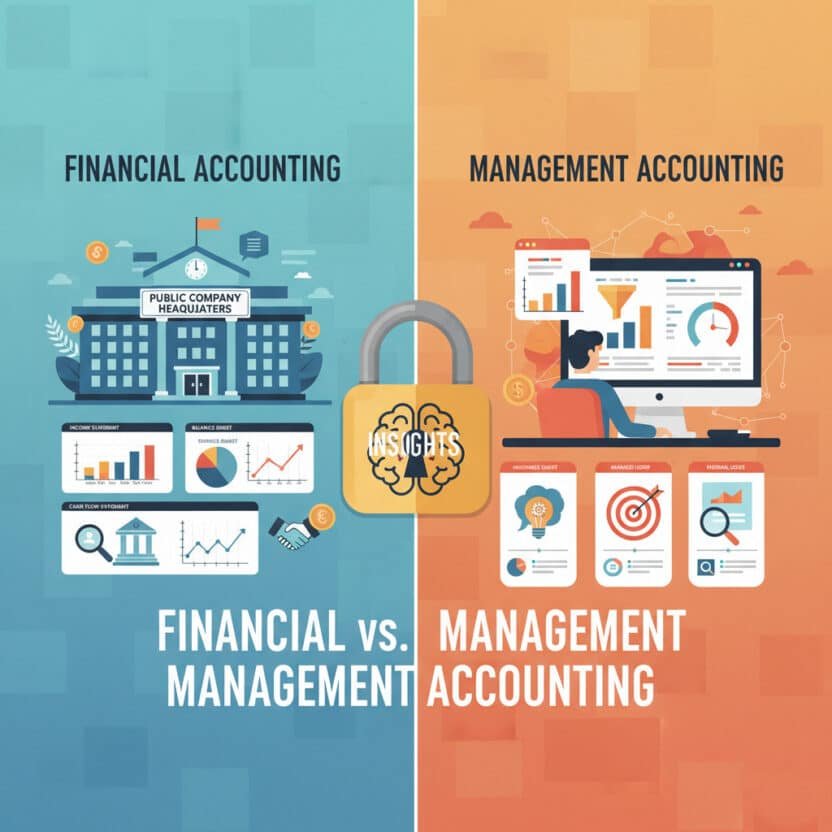
Difference Between Financial Accounting vs Management Accounting – The Ultimate Guide

Two of the most critical perspectives are financial vs management accounting. While they might sound similar, they serve vastly different purposes. Welcome, business owners, entrepreneurs, and aspiring financial professionals! In the dynamic world of business, understanding your numbers is paramount to success. But did you know there are different ways to look at those numbers? This comprehensive guide will explore the difference between financial accounting and management accounting. We’ll delve into their definitions, characteristics, key distinctions, and why your business needs both to thrive. So, grab a cup of coffee, and let’s demystify the world of accounting! What is Financial Accounting? Financial accounting is the process of recording, summarizing, and reporting a company’s business transactions through financial statements. Think of it as the official storyteller of your company’s financial history. Definition and Purpose The primary purpose of financial accounting is to provide accurate and consistent information to external stakeholders. These are individuals and entities outside your company who have an interest in its financial performance. Key Characteristics of Financial Accounting The Core Financial Statements Financial accounting culminates in the preparation of several key financial statements: What is Management Accounting? Management accounting, also known as managerial accounting, is the process of identifying, measuring, analyzing, interpreting, and communicating financial information to managers for the pursuit of an organization’s goals. It’s the “insider’s view” of the company’s finances. Definition and Purpose The main goal of management accounting is to provide internal decision-makers with the information they need to make informed business decisions, plan for the future, and control operations. Key Characteristics of Management Accounting Common Management Accounting Reports Management accounting generates a wide variety of reports, including: The Key Differences: Financial vs Management Accounting Now that we have a foundational understanding of both, let’s dive into the key difference between financial accounting and management accounting. Basis of Comparison Financial Accounting Management Accounting Users External stakeholders (investors, creditors, etc.) Internal management Time Focus Historical (past-oriented) Future-oriented Rules Governed by GAAP/IFRS No fixed rules; based on management needs Scope Focuses on the company as a whole Focuses on specific segments or departments Report Frequency Periodically (quarterly, annually) As needed (daily, weekly, monthly) Level of Detail Highly aggregated Very detailed Objectivity Objective and verifiable Subjective and relevant Legal Requirement Mandatory for public companies Optional Users of Information As the table shows, this is the most significant difference between financial accounting and management accounting. Financial accounting provides a standardized view for those outside the company, while management accounting offers a customized perspective for those inside. Time Focus Financial accounting is like looking in the rearview mirror, while management accounting is like looking at the road ahead through the windshield. One tells you where you’ve been, and the other helps you decide where to go. Rules and Regulations The strict adherence to GAAP or IFRS in financial accounting ensures that all companies are speaking the same financial language. Management accounting, on the other hand, is like a private conversation within the company, so it can use its own shorthand and focus on what’s most important to the decision-makers. Scope and Nature of Information Financial accounting paints a broad picture of the entire organization’s financial health. Management accounting, however, can zoom in on a specific product line, a single department, or even an individual project to provide granular insights. Similarities Between Financial and Management Accounting Despite their many differences, it’s important to recognize that financial and management accounting are not entirely separate. They share some common ground: Why Both are Crucial for Business Success A common misconception is that businesses need to choose between financial and management accounting. The truth is, a successful business needs both to thrive. Financial Accounting for Investor Confidence Financial accounting is your company’s face to the world. Accurate and transparent financial reporting builds trust with investors, lenders, and other stakeholders, which is essential for securing funding and maintaining a positive public image. Management Accounting for Strategic Decisions Management accounting is the engine that drives your business forward. It provides the insights you need to make smart, data-driven decisions that will lead to growth and profitability. Career Paths in Financial and Management Accounting The difference between financial accounting and management accounting also extends to the career paths available in each field. Financial Accounting Careers Management Accounting Careers Conclusion Understanding the difference between financial accounting and management accounting is not just for accountants; it’s essential for anyone involved in business. Financial accounting provides a clear and accurate picture of your company’s past performance, while management accounting gives you the tools to shape its future. By leveraging the strengths of both, you can build a more resilient, profitable, and successful business. I hope this in-depth guide has clarified the difference between financial accounting and management accounting. FAQs

Section 87A Rebate
Tax

Section 87A Rebate: STCG Dispute and the Landmark ITAT Ruling

Navigating the labyrinthine world of income tax can be a daunting task, especially for small taxpayers. Every year, as the tax season approaches, a flurry of questions and confusion arises. One such area of contention that has recently been in the limelight is the availability of the tax rebate under Section 87A Rebate of the Income Tax Act, 1961, on Short-Term Capital Gains (STCG). This issue has been a bone of contention between taxpayers and the Income Tax Department, leading to a significant dispute that has finally been addressed by the Income Tax Appellate Tribunal (ITAT). This comprehensive blog post will delve deep into the nuances of the tax rebate under Section 87A Rebate, the ongoing STCG dispute, and the landmark ITAT rulings that have brought much-needed clarity to the matter. We will explore the eligibility criteria for the rebate, the arguments from both sides of the dispute, a detailed analysis of the ITAT’s decisions, and the practical implications for taxpayers. So, whether you are a seasoned investor or a novice trying to understand the intricacies of tax laws, this guide will equip you with the knowledge you need to navigate this complex issue. What is the Tax Rebate under Section 87A? Section 87A Rebate of the Income Tax Act provides a rebate to resident individuals, which can significantly reduce their tax liability. This provision was introduced to provide relief to taxpayers in the lower income brackets. Let’s break down the key aspects of this rebate. Who is Eligible for the Rebate? To be eligible for the tax rebate under Section 87A, a taxpayer must meet the following conditions: Residency and Total Income Criteria Changes in Eligibility over the Years The income threshold for claiming the rebate under Section 87A Rebate has been progressively increased by the government to provide more relief to small taxpayers. Here’s a quick look at the evolution of this limit: How much is the Rebate? The amount of rebate available under Section 87A has also seen changes over time. The rebate is the lower of the actual income tax payable or the maximum prescribed limit. Evolution of the Rebate Amount The maximum rebate amount has been increased in tandem with the changes in the income threshold, offering more significant tax savings to eligible individuals. Eligibility for Section 87A Rebate To qualify for this tax relief, you must meet two primary conditions: Rule of Rebate Calculation A crucial point to remember is that the rebate is always the lower of two amounts: Rebate Amounts: New vs. Old Tax Regime 1. Under the New Tax Regime: The rebate here is tiered and has been updated for the upcoming financial year. 2. Under the Old Tax Regime: The rules remain consistent. Future Changes There are specific incomes against which this rebate cannot be claimed: The “Tax Payable” Conundrum The language of Section 87A states that the rebate is available on the “income-tax payable on the total income”. This phrasing is at the heart of the STCG dispute, as the interpretation of “total income” and “tax payable” has been a subject of debate. Section 87A Rebate on Short-Term Capital Gains (STCG) The primary point of contention revolves around whether the tax rebate under Section 87A can be claimed against the tax payable on STCG, especially those taxed at a special rate under Section 111A. A Primer on Short-Term Capital Gains (STCG) Before we delve into the dispute, let’s quickly understand what STCG is. What are Capital Gains? Capital gains arise from the sale or transfer of a capital asset, such as property, stocks, mutual funds, etc. The gain is the difference between the selling price and the cost of acquisition of the asset. STCG under Section 111A vs. Other STCG The Contention of the Income Tax Department The Income Tax Department has been of the view that the rebate under Section 87A is not available against the tax payable on STCG under Section 111A. Their arguments are based on the following premises: The Taxpayer’s Argument Taxpayers, on the other hand, have put forth strong counter-arguments, which are primarily based on a literal interpretation of the law. Their key arguments are: Marginal Relief for Taxpayers In the new tax regime, you pay zero tax up to an income of ₹7 lakhs thanks to the Section 87A rebate. But what happens if your income is, say, ₹7,15,000? Without a special rule, you’d face a “tax cliff”—a small increase in income would cause a massive jump in your tax bill. This is where Marginal Relief comes in. Think of it as a safety net that ensures your tax increase is never more than your income increase over the ₹7 lakh threshold. The Core Principle: Your final tax payable (before cess) cannot be more than the extra income you earned above ₹7 lakhs. Let’s see how this works with Mr. Ravi, whose income is ₹7,15,000 for FY 2024-25. Solution Rebate Calculation Amount (Rs) Step 1: Calculate excess above Rs. 7 lakhs (Rs 7,15,000 – Rs 7,00,000) (A) 15000 Step 2: Tax on total income of Rs 7,15,000  (Before Cess) (B) 21500 Step 3: Since B>A, rebate u/s 87A would be (B-A)   6500  (Rs 21,500- Rs 15,000) Tax Calculation Amount (Rs) Tax On total income 21500 Rebate u/s 87A 6500 Tax payable (this is equivalent to income in excess of Rs. 7 lakhs) 15000 Add: Health & Education Cess @ 4% 600 Tax Liability 15600 Steps to Claim Income Tax Rebate in FY 2024-25? Step 1: Calculate Your Total Earnings First, add up all your income from every source (salary, business, etc.) for the financial year (April 1, 2024, to March 31, 2025). This gives you your Gross Total Income. Step 2: Determine Your Net Taxable Income Next, subtract any tax deductions you are eligible for. This step is where the Old and New Tax Regimes differ significantly. The figure you arrive at after deductions is your Net Taxable Income. Step 3: Check Your Eligibility for the Rebate This is the final check.

Ind AS updates
Accounting

The Ultimate Guide to GST, Ind AS & Tech in Indian Accounting (2025)

In the dynamic and rapidly accelerating economy of India, the accounting profession isn’t just about crunching numbers anymore. It’s about being a strategic partner, a tech-savvy navigator, and a compliance expert all rolled into one. As we step into 2025, the landscape is more intricate and exciting than ever before. From the pervasive influence of the Goods and Services Tax (GST) to the sophisticated demands of Indian Accounting Standards (Ind AS) and the revolutionary potential of new technologies, staying updated isn’t just an advantage—it’s a necessity. This comprehensive guide is meticulously crafted for accounting professionals, aspiring CAs, diligent business owners, and finance students who want to not just keep pace, but lead the charge in India’s financial future. We’ll peel back the layers of complex regulations, demystify advanced standards, and explore how technology is fundamentally reshaping the way accounting is done across the nation. Explaining Goods and Services Tax (GST) in 2025 The implementation of GST in 2017 was a watershed moment, unifying a fragmented indirect tax regime into a single, cohesive system. Years later, it remains the most searched and discussed topic in Indian accounting, constantly evolving with new notifications, clarifications, and technological integrations. For 2025, a nuanced understanding of GST is more critical than ever. GST Fundamentals Revisited: A Strong Foundation Before diving into the complexities, let’s quickly revisit the core tenets of GST that continue to define its operation. What is GST and Why Does it Matter? At its heart, GST is a consumption-based tax levied on the supply of goods and services. It replaced multiple indirect taxes like excise duty, VAT, and service tax, aiming for a ‘one nation, one tax’ philosophy. Its multi-stage, destination-based nature means tax is collected at each stage of value addition and ultimately borne by the final consumer. For businesses, it streamlined operations, reduced the cascading effect of taxes, and enhanced transparency. Key Components: CGST, SGST, IGST, and UTGST Understanding the different types of GST is crucial: Navigating GST Registration and Compliance in 2025 One of the most frequent queries revolves around GST registration and the labyrinth of compliance requirements. Who Needs to Register for GST? Thresholds and Mandatory Registrations The primary threshold for mandatory GST registration is typically an aggregate turnover exceeding ₹40 lakh for suppliers of goods and ₹20 lakh for service providers (with special category states having lower limits). However, certain businesses must register regardless of turnover, including: The Lifecycle of GST Returns: GSTR-1, GSTR-3B, GSTR-9, and More Filing accurate and timely returns is the backbone of GST compliance. Input Tax Credit (ITC): The Key to Tax Efficiency ITC is arguably the most critical component of GST for businesses, allowing them to offset the tax paid on inputs against the tax payable on outputs. Maximizing eligible ITC reduces tax outflow and improves cash flow. E-Invoicing and E-Way Bills: Digital Pillars of GST The push for digitalization within GST has led to mandatory e-invoicing for a growing number of businesses and the ubiquitous e-way bill system. E-Invoicing: Streamlining B2B Transactions E-invoicing involves electronically generating and authenticating invoices on the Invoice Registration Portal (IRP). This mandates that all B2B and export invoices above a certain threshold (currently ₹5 crore) must be reported to the IRP. E-Way Bill System: Tracking Goods in Transit An e-way bill is an electronic document required for the movement of goods over a certain value (typically ₹50,000) from one place to another. Embracing Global Standards: Indian Accounting Standards (Ind AS) in 2025 While GST focuses on indirect taxation, Ind AS governs how financial transactions are recorded and presented, directly impacting a company’s financial statements. India’s commitment to converging with International Financial Reporting Standards (IFRS) has made Ind AS a critical area for all listed entities and large private companies. The Journey to Ind AS: Why Convergence Matters India adopted Ind AS with a phased approach, aligning its accounting practices with global benchmarks. This move enhances comparability of financial statements across international borders, attracting foreign investment and fostering greater transparency. Key Differences: Ind AS vs. Previous Indian GAAP For many, the transition from the old Indian GAAP (Generally Accepted Accounting Principles) to Ind AS was a significant undertaking. Key differences often revolved around: Crucial Ind AS Standards for 2025: A Deeper Dive Understanding specific Ind AS standards is paramount for accurate financial reporting. Ind AS 115: Revenue from Contracts with Customers This standard provides a comprehensive framework for revenue recognition, moving away from previous rules-based approaches. It involves a five-step model: Ind AS 116: Leases – A Game-Changer Ind AS 116 effectively eliminates off-balance sheet financing for most leases, requiring lessees to recognize a “right-of-use” (ROU) asset and a corresponding lease liability for virtually all leases longer than 12 months. Ind AS 109: Financial Instruments This complex standard covers the recognition, classification, measurement, impairment, and hedge accounting for financial assets and financial liabilities. Key areas include: Recent Amendments and Emerging Issues in Ind AS (2025) Staying abreast of amendments is non-negotiable. The Digital Revolution: Technology Reshaping Indian Accounting in 2025 If GST and Ind AS define what we account for and how we report it, technology dictates how efficiently and accurately we do it. The digital transformation in Indian accounting is not just a trend; it’s the fundamental shift in operational paradigms. The Rise of Accounting Software: From Desktops to the Cloud Gone are the days of purely manual ledgers. Modern accounting software is the bedrock of efficient financial operations. Tally Prime: The Enduring Champion for Indian Businesses For decades, Tally has been synonymous with accounting software in India. Tally Prime continues this legacy, offering robust features for: Cloud Accounting Platforms: Zoho Books, QuickBooks Online, and Beyond The shift to cloud-based accounting solutions is gaining unprecedented momentum. ERP Systems: The Integrated Powerhouse For larger enterprises, Enterprise Resource Planning (ERP) systems like SAP and Oracle NetSuite integrate accounting with other critical business functions such as supply chain management, human resources, and customer relationship management. This provides a holistic view of the organization, eliminating data silos and enhancing

Tax Audit Criteria AY 2025-26
Tax

Tax Audit Criteria AY 2025-26: Ultimate Guide to Turnover Limits, Section 44AB, and Due Dates

Understanding the Tax Audit Criteria AY 2025-26 is paramount during the crucial tax season, a period of meticulous planning, careful calculations, and strict adherence to deadlines for businesses and professionals alike. One of the most critical aspects of this season is the tax audit, a thorough examination of a taxpayer’s financial records to ensure they comply with tax laws. For the Assessment Year (AY) 2025-26, it is essential for every taxpayer to be aware of the criteria that necessitate a tax audit. This comprehensive guide will serve as a ready reckoner, helping you navigate the complexities of the Income Tax Act with ease and confidence. Introduction to Tax Audit and its Importance What is a Tax Audit? A tax audit is an independent audit of the books of accounts of a taxpayer by a practicing Chartered Accountant. The primary objective of a tax audit is to ensure that the taxpayer has maintained proper books of account and that the financial statements reflect a true and fair view of their financial position. The audit report is then submitted to the Income Tax Department in the prescribed format. Why is a Tax Audit Important? A tax audit serves several important purposes: Who can conduct a Tax Audit? A tax audit can only be conducted by a practicing Chartered Accountant who holds a valid certificate of practice from the Institute of Chartered Accountants of India (ICAI). Understanding the Legal Framework: Section 44AB of the Income Tax Act, 1961 The requirement for a tax audit is governed by Section 44AB of the Income Tax Act, 1961. This section specifies the conditions under which a taxpayer is required to get their accounts audited. The Objective of Section 44AB The main objective of Section 44AB is to ensure that the books of account and other records of the taxpayer are properly maintained and that they reflect the true income of the taxpayer. It also helps in preventing tax evasion and avoidance. Key Provisions of Section 44AB for AY 2025-26 For AY 2025-26, Section 44AB mandates a tax audit for the following categories of taxpayers: Tax Audit Criteria for Businesses for AY 2025-26 The General Turnover Limit For businesses, the general turnover limit for a tax audit is ₹1 crore. If the total sales, turnover, or gross receipts of a business exceed ₹1 crore in the financial year 2024-25 (relevant to AY 2025-26), then a tax audit is mandatory. What is included in “Turnover”? The term “turnover” is not defined in the Income Tax Act. However, it is generally understood to mean the aggregate amount for which sales are effected or services are rendered by an enterprise. It includes excise duty, but excludes GST. The Enhanced Turnover Limit for Digital Transactions To promote digital transactions, the government has provided a relaxation in the turnover limit for businesses that conduct most of their transactions through digital modes. The turnover limit for a tax audit is increased to ₹10 crore if the following conditions are met: The 95% Digital Transaction Rule Explained The enhanced limit of ₹10 crore is applicable only if: Key Considerations for Tax Audit Criteria AY 2025-26 If a business fails to meet even one of these conditions, the general turnover limit of ₹1 crore will be applicable. What are considered “Digital Transactions”? Digital transactions include payments or receipts made through: Tax Audit for Businesses under Presumptive Taxation (Section 44AD) Understanding Section 44AD Section 44AD of the Income Tax Act provides a presumptive taxation scheme for small businesses. Under this scheme, eligible businesses can declare their income at a prescribed rate of their turnover, without having to maintain detailed books of account. The prescribed rates are: The turnover limit for opting for the presumptive taxation scheme under Section 44AD is ₹2 crore. This has been increased to ₹3 crore from FY 2023-24, provided the cash receipts do not exceed 5% of the total turnover. When does a business under Section 44AD need a Tax Audit? A tax audit is mandatory for a business that has opted for the presumptive taxation scheme under Section 44AD, if: The “5-Year Rule” under Section 44AD If a business opts for the presumptive taxation scheme under Section 44AD and in any of the subsequent five assessment years, it opts out of the scheme, then it will not be eligible to opt for the scheme for the next five assessment years. In such a case, the business will have to maintain books of account and get them audited if its total income exceeds the basic exemption limit. Tax Audit Criteria for Professionals for AY 2025-26 The Gross Receipts Limit for Professionals For professionals, the gross receipts limit for a tax audit is ₹50 lakh. If the gross receipts of a professional exceed ₹50 lakh in the financial year 2024-25, then a tax audit is mandatory. Tax Audit for Professionals under Presumptive Taxation (Section 44ADA) Understanding Section 44ADA Section 44ADA of the Income Tax Act provides a presumptive taxation scheme for specified professionals. Under this scheme, eligible professionals can declare 50% of their gross receipts as their income. The gross receipts limit for opting for the presumptive taxation scheme under Section 44ADA is ₹50 lakh. This has been increased to ₹75 lakh from FY 2023-24, provided the cash receipts do not exceed 5% of the total gross receipts. When does a professional under Section 44ADA need a Tax Audit? A tax audit is mandatory for a professional who has opted for the presumptive taxation scheme under Section 44ADA, if: A Quick Ready Reckoner: Tax Audit Applicability at a Glance Category Turnover/Gross Receipts Condition Tax Audit Required? Business > ₹1 crore – Yes > ₹1 crore but ≤ ₹10 crore Cash receipts ≤ 5% of total receipts AND Cash payments ≤ 5% of total payments No > ₹10 crore – Yes Business under Presumptive Taxation (Sec 44AD) ≤ ₹2 crore (or ₹3 crore if cash receipts ≤ 5%) Declares income ≥ 8%/6% of turnover No ≤ ₹2 crore (or ₹3 crore if cash

new gst rates
Tax

GST 2.0 : Ultimate Guide to the New GST Rates, Reforms, and Amnesty Scheme of 2025

The buzz in India’s financial corridors is getting louder. Whispers and headlines are all pointing towards a monumental shift in the country’s biggest tax reform to date. The term being coined for this next evolutionary step is GST 2.0. For millions of business owners, consumers, and tax professionals, this isn’t just jargon; it’s a signal of significant changes that could impact everything from the price of your daily groceries to the way businesses file their taxes. Since its historic launch in 2017, the Goods and Services Tax (GST) has been a dynamic and evolving system. It replaced a complex web of central and state taxes with a unified structure, aiming for “One Nation, One Tax.” While it has streamlined many processes and improved tax collection, the journey has been filled with challenges, amendments, and learning curves. Now, as we navigate 2025, the government and the GST Council are gearing up for the next generation of GST reforms. These aren’t just minor tweaks. We are looking at a potential overhaul of the tax slabs, a new lease on life for businesses with the GST Amnesty Scheme 2025, and crucial clarifications on hot-button issues like the rumoured GST on UPI transactions. This definitive guide is designed to be your single source of truth. We will dissect every component of these upcoming changes. We will explore the much-anticipated new GST rates list 2025, break down what the new GST rates will mean for your wallet and your business, and provide a clear, in-depth analysis of the entire GST 2.0 framework. Let’s dive in. GST Rate Structure GST Rate Description / Applicability Nil Essential/priority goods and services, exempt health/education/agriculture items  5% Daily essentials, agricultural items, healthcare, education essentials, many basic consumer goods  18% Standard rate—majority of processed goods, electronics, small vehicles, most services  40% “Sin/luxury goods”—tobacco, pan masala, sugary drinks, high-end vehicles, etc.  GST Rate Cuts (Effective from 22nd Sept 2025) Item / Sector Old Rate New Rate Daily essentials (hair oil, shampoo, toothpaste, soap, shaving cream, toothbrushes, etc.) 18% 5% Butter, ghee, cheese, dairy spreads, pre-packaged namkeens, utensils, feeding bottles, napkins 12% 5% Tractors, parts, tractor tyres, sewing machines, certain agriculture/horticulture machines 12-18% 5% Dairy products, 33 life-saving drugs, all diagnostic kits, and reagents 12% Nil/5% Individual health and life insurance 18% Nil Educational essentials (maps, charts, globes, pencils, sharpeners, notebooks, crayons, erasers) 5-12% Nil Electronic appliances (TVs, ACs, dishwashers, monitors, projectors) 28% 18% Automobile: Small cars, motorcycles (≤350cc), 3-wheelers, goods vehicles 28% 18% Corrective spectacles 12% 5% Medical devices and healthcare equipment 12-18% 5% Renewable energy products, solar water heaters, cookers, and related devices 12% 5% Job work services (umbrellas, textiles, printing, bricks, pharma, leather processing) 12% 5% Handicrafts, handmade paper, art ware, handcrafted toys, embroidered shawls, etc. 12% 5% Footwear up to ₹2500 per pair 12% 5% Most agriculture and poultry equipment, basic wooden goods, etc. 12% 5% Fertilizer acids, specified pesticides, micronutrients 12-18% 5% All dutiable articles for personal use 28% 18% Other machinery: Fuel elements (nuclear), engine parts, pumps 28% 18% GST Rate Hikes (Effective from 22nd Sept 2025) Item / Sector Old Rate New Rate Coal, lignite, peat 5% 18% Sin goods: pan masala,* tobacco*, aerated/caffeinated beverages, soda, carbonated juice 28% 40%* Motor cars & luxury vehicles (above small car thresholds, >350cc) 28% 40% Aircraft, yachts, pleasure vessels 28% 40% Admission to casinos, race clubs, betting & online gaming* 28% 40% Paper and paperboards, specialty papers 12% 18% Apparel/made-ups >₹2,500, quilted cotton products >₹2,500 12% 18% Quarrying/mining items, professional services in petroleum/natural gas 12% 18% Job work (not elsewhere specified), motor vehicle seats, etc. 12% 18% List of Nil-Rated and Exempt Items Sector Description (Selective Examples) Healthcare 33 life-saving drugs/medicines (specified), therapeutic drugs, recombinant drugs Insurance All individual health and life insurance, reinsurance Education Educational tools (maps, charts, globes, pencils, notebooks, sharpeners, erasers) Food UHT milk, paneer, pizza bread, certain Indian breads, fortified rice kernels Social Approved food items for free distribution (ICDS), gene therapy for rare diseases Railway Platform tickets, cloak rooms, battery operated carts (by Indian Railways) List of Items Taxed at 5% GST Rate Sector Key Examples (Selected) Essentials Soap, toothpaste, shampoo, talcum powder, utensils, diapers Food Dairy products, prepared foods, snacks, sugar, soya milk Agriculture Tractors, irrigation, fertilizers, seeds, animal feed Healthcare Diagnostic kits, medical oxygen, glucometers, test strips Education Geometry boxes, educational job work, art supplies Energy Solar/wind devices, renewable parts Textiles Apparel and made-ups up to ₹2,500, yarn, hats Footwear ≤₹2,500 per pair Transportation Transport (rail/multimodal with restrictions), 3-wheelers Handicrafts Handmade items, art ware, traditional toys List of Items Taxed at 18% GST Rate Sector Key Examples (Selected) Electronics TVs (all sizes), monitors, ACs, dishwashers Automobiles Cars ≤1,200cc (petrol/hybrid), ≤1,500cc (diesel), motorcycles ≤350cc Construction Cement, works contracts Job work/services Most manufacturing job work, technical and business services Mining Coal, lignite, peat Apparel/Textile >₹2,500 value items, selected finished goods Paper Most paper/paperboard products Miscellaneous Dutiable articles for personal use, job work (where not reduced) Local Delivery By e-commerce except when specifically exempted List of Items Taxed at 40% GST Rate Sector Key Examples (Selected) Sin/Luxury Goods Pan masala, tobacco & nicotine substitutes, cigars/cigarettes Beverages Aerated/caffeinated sodas, carbonated fruit drinks, sugar drinks Vehicles Luxury/large cars (>small car threshold), motorcycles >350cc Leisure Private aircraft, yachts, pleasure/sports vessels Services Casinos, race clubs, bookmaker licensing, online gaming, betting Miscellaneous Smoking pipes, revolvers/pistols, some leasing services Download New GST Rates Chart Decoding GST 2.0 – More Than Just a Buzzword Before we jump into the specifics, it’s essential to understand what “GST 2.0” truly represents. It’s important to note that GST 2.0 is not an official term announced by the government. Rather, it’s a phrase adopted by economists, media, and industry experts to describe the next comprehensive phase of GST reforms aimed at simplifying the structure, broadening the tax base, and leveraging technology to plug leakages. If GST 1.0 was about establishing the foundational infrastructure, GST 2.0 is about optimizing it for efficiency, stability, and growth. The Core Objectives of GST 2.0: Essentially, GST 2.0 is the

Scroll to Top