Finance and Tax Guide

Author name: Yuvraj Vihol

Yuvraj Vihol is a professional accountant based in Ahmedabad, Gujarat, India, with more than 2 years of hands-on experience in GST compliance, ITR filing, TDS/TCS management, and business accounting.He founded Finance and Tax Guide to simplify complex tax and accounting topics for Indian small businesses, entrepreneurs, and individual taxpayers.His expertise includes: • GST Registration and Return Filing • Income Tax Return (ITR) Filing • TDS and TCS Compliance • Business Bookkeeping • Financial Accounting • Tax Planning for Small BusinessesEvery article published on Finance and Tax Guide is based on practical accounting experience and current Indian tax laws to provide accurate, easy-to-understand financial guidance.

New Income Tax Act 2026
Tax

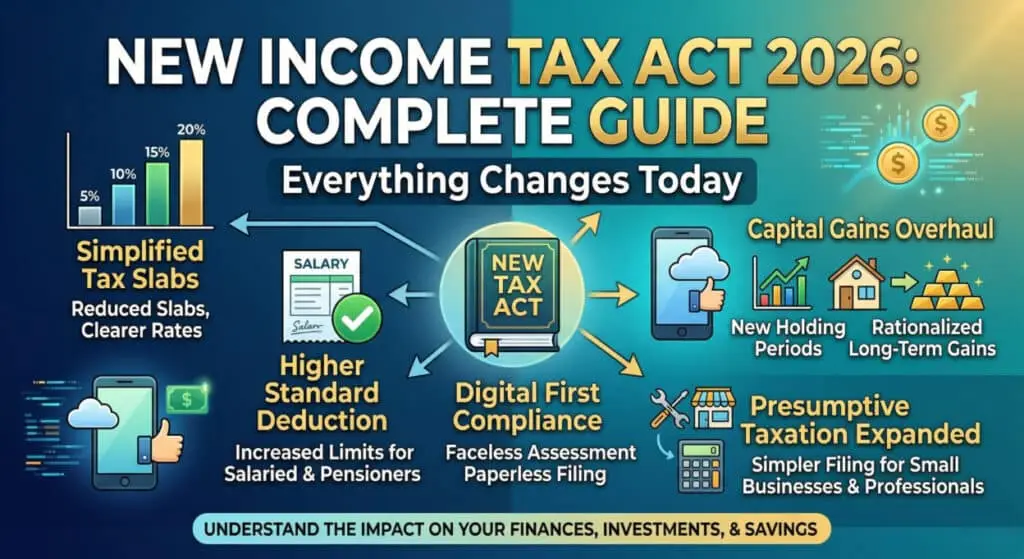
New Income Tax Act 2026: Complete Guide Everything Changes Today

Today is the day India’s tax system officially steps into a new era. The New Income Tax Act 2026 has come into force from 1st March 2026, replacing the six-decade-old Income Tax Act of 1961. If you pay taxes, run a business, or simply earn a salary — this guide is your complete roadmap to understanding what has changed and what you must do next. Why Was the Old Income Tax Act Replaced? The Income Tax Act of 1961 was a monumental piece of legislation for its time, but over six decades it had grown into an unwieldy document of over 800 sections, thousands of sub-sections, and so many provisos that even seasoned chartered accountants needed to cross-reference multiple circulars just to file a routine return. The government’s stated goal with the New Income Tax Act 2026 was straightforward: simplify, modernise, and reduce litigation. The new Act has reportedly shrunk the overall text by nearly 60%, rewritten provisions in plain language, and eliminated redundant sections that were holdovers from an entirely different economic era. Key Fact: The New Income Tax Act 2026 officially becomes effective from 1st March 2026. All income earned from this date onward will be governed by the new Act, though transitional provisions exist for income already assessed under the old Act. What Are the Major Changes in the New Income Tax Act 2026? Here are the most impactful changes, explained in plain terms: 1. Simplified Language and Structure The new Act uses direct, modern English. Legal jargon like ‘notwithstanding anything contained in the foregoing provisions’ has been replaced with plain sentences that a college graduate can follow without a law degree. This alone is expected to reduce tax disputes significantly. 2. Consolidated Tax Regimes The old Act had two competing tax regimes. The new Act consolidates both into a cleaner structure while preserving the option to choose based on your financial situation. 3. Updated Income Tax Slabs for FY 2026-27 The slab structure has been revised to offer higher basic exemption and more progressive rates at the upper end. how to calculate income tax on salary under the new regime. Here is a snapshot of the new tax slabs: Income Range New Regime Rate Old Regime Rate Up to ₹3,00,000 Nil Nil ₹3,00,001 – ₹7,00,000 5% 5% ₹7,00,001 – ₹10,00,000 10% 20% ₹10,00,001 – ₹12,00,000 15% 30% ₹12,00,001 – ₹15,00,000 20% 30% Above ₹15,00,000 30% 30% 4. Changes to Deductions and Exemptions Section 80C (investments up to ₹1.5 lakh) remains largely intact but has been renumbered. HRA exemption rules have been simplified. Standard deduction for salaried individuals has been enhanced. 5. Digital-First Filing Infrastructure The new Act formally recognises e-filing as the primary mode of compliance. Stricter timelines and automatic processing triggers mean the department can act on discrepancies faster than before. What Stays the Same? Income is still classified into five heads: salary, house property, business/profession, capital gains, and other sources. TDS mechanisms continue to operate broadly as before. The concept of previous year and assessment year is retained. Important: The transition from the old Act to the new Act is not retroactive. Income earned in FY 2025-26 will still be assessed under the provisions of the Income Tax Act 1961. The new Act governs income from FY 2026-27 onwards. For how the New Income Tax Act affects your bookkeeping and TDS accounting, refer to our Complete Guide to Accounting in India 2026. What Should You Do Right Now? Step 1: Review Your Tax Regime Choice With the new slab structure in place, the math on whether the new or old regime saves you more may have shifted. Run the numbers or speak to your CA. Step 2: Check Your Investments Before 31st March If you have deductions pending under 80C, 80D, or NPS, the window closes on 31st March 2026. Step 3: Read the Dedicated Posts on This Site We are covering every aspect of the New Income Tax Act 2026 this month — slabs, deductions, compliance deadlines, and more. Final Thoughts The New Income Tax Act 2026 is, by most measures, a genuine improvement over the 1961 Act. It is cleaner, more readable, and better aligned with a digital economy. But like any major legislative shift, it comes with a learning curve. This website will be your guide through that curve. Bookmark this page, subscribe to our YouTube channel, and follow along as we break down every section of the new Act in plain language throughout March 2026.


Income Tax Calculator FY 2026-27
Tax

Income Tax Calculator FY 2026-27 | Use Tax Calculator Online

Use this free online Income Tax Calculator to calculate your income tax liability for FY 2026-27 (AY 2027-28) and FY 2025-26 (AY 2026-27). Compare New Tax Regime vs Old Tax Regime, check updated income tax slabs, and plan your tax savings using deductions under Section 80C, 80D, HRA, and more. step-by-step salary tax calculation guide. Income Tax Calculator FY 2026-27 | Finance and Tax Guide ₹ Finance and Tax Guide financeandtaxguide.com FY 2026-27 • AY 2027-28 Income Tax Calculator Calculate your income tax for FY 2025-26 & FY 2026-27  •  Compare New vs Old Tax Regime  •  Free Online Tool Your Details Annual Income (Gross) ₹12.0L ₹1L₹1Cr Your Age 30 yrs 18 yrs90 yrs Age Category: Below 60 Years Select Tax Regime 🆕 New Regime 📋 Old Regime Standard deduction ₹75,000. Lower slab rates. No other deductions allowed. Deductions Total: ₹0 Section 80C (PPF, ELSS, LIC…) Max ₹1.5L ₹ Section 80D (Health Insurance) Max ₹25K ₹ NPS – Section 80CCD(1B) Max ₹50K ₹ HRA Exemption Actual amount ₹ Home Loan Interest 24(b) Max ₹2L ₹ Other Deductions ₹ 💡 New Regime saves you more Calculating… Gross Income ₹12,00,000 Taxable Income — Total Tax Payable — Tax Summary Regime Comparison Slab Breakdown Tax under New Regime ₹0 Effective Rate 0% Income Tax (on slabs) ₹0 Surcharge ₹0 Health & Education Cess (4%) ₹0 🆕 New Tax Regime — Effective rate: 0% Taxable Income— Tax on Slabs— Cess (4%)— 📋 Old Tax Regime — Effective rate: 0% Taxable Income— Tax on Slabs— Cess (4%)— New Regime saves you — Visual Comparison New Regime Tax — Old Regime Tax — New Regime FY 2026-27 Below 60 Years Income Slab Tax Rate Tax Amount 📌 Standard Deduction ₹75,000 🎯 Rebate 87A Limit Income ≤ ₹12L 📊 H&E Cess 4% on Tax+Surcharge 📅 Assessment Year AY 2027-28 Finance and Tax Guide  •  financeandtaxguide.com  •  This tool is for guidance only. Please consult a Chartered Accountant for official tax filing. 1. What is an Income Tax Calculator? An Income Tax Calculator is a free online tool that helps you calculate your total income tax liability based on your annual income, applicable deductions, and the tax regime you choose. Whether you are a salaried employee, self-employed individual, or senior citizen, an income tax calculator saves time and eliminates manual errors. Key benefits of using an online income tax calculator: Whether you are asking “how to calculate income tax on salary”, “what is my income tax for FY 2026-27”, or “income tax calculator for AY 2027-28”, this comprehensive guide covers everything you need to know. 2. How to Use the Income Tax Calculator Online – Step-by-Step Using the Finance and Tax Guide Income Tax Calculator is simple and takes less than 2 minutes: Pro Tip: Always compare both regimes before filing your ITR. The new tax regime has lower slab rates but does not allow most deductions, while the old tax regime allows deductions under 80C, 80D, HRA, and more. 3. Income Tax Slabs for FY 2026-27 (AY 2027-28) The income tax slabs for FY 2026-27 (Assessment Year 2027-28) have been updated following the Union Budget 2026. Below are the applicable tax slabs under both regimes: A. New Tax Regime – Income Tax Slabs FY 2026-27 The New Tax Regime (default regime) offers lower tax rates but does not allow major deductions except the standard deduction of Rs. 75,000 for salaried individuals. Income Tax Slab (Annual Income) Tax Rate (New Regime FY 2026-27) Up to Rs. 4,00,000 Nil (No Tax) Rs. 4,00,001 – Rs. 8,00,000 5% Rs. 8,00,001 – Rs. 12,00,000 10% Rs. 12,00,001 – Rs. 16,00,000 15% Rs. 16,00,001 – Rs. 20,00,000 20% Rs. 20,00,001 – Rs. 24,00,000 25% Above Rs. 24,00,000 30% Note: Under the new tax regime, income up to Rs. 12,00,000 is effectively tax-free for salaried employees after accounting for the standard deduction of Rs. 75,000 and the rebate under Section 87A (up to Rs. 60,000). B. Old Tax Regime – Income Tax Slabs FY 2026-27 Income Tax Slab (Old Regime) Tax Rate – Below 60 Yrs Tax Rate – Senior Citizen (60-79) Tax Rate – Super Senior (80+) Up to Rs. 2,50,000 Nil Nil Nil Rs. 2,50,001 – Rs. 3,00,000 5% Nil Nil Rs. 3,00,001 – Rs. 5,00,000 5% 5% Nil Rs. 5,00,001 – Rs. 10,00,000 20% 20% 20% Above Rs. 10,00,000 30% 30% 30% Surcharge on Income Tax FY 2026-27 Net Taxable Income Surcharge Rate Up to Rs. 50 Lakh Nil Rs. 50 Lakh – Rs. 1 Crore 10% Rs. 1 Crore – Rs. 2 Crore 15% Rs. 2 Crore – Rs. 5 Crore 25% Above Rs. 5 Crore 25% (capped under new regime) Health and Education Cess: 4% is applicable on (Income Tax + Surcharge) for all taxpayers. 4. New Tax Regime vs Old Tax Regime – Which is Better? One of the most searched questions by Indian taxpayers is: “New tax regime vs old tax regime – which is better for me?” The answer depends on your income level and available deductions. Feature New Tax Regime Old Tax Regime Default Regime Yes (from FY 2023-24) Optional (opt-in required) Standard Deduction Rs. 75,000 (salaried) Rs. 50,000 (salaried) Section 80C Deduction Not Allowed Up to Rs. 1,50,000 Section 80D (Health Insurance) Not Allowed Up to Rs. 25,000-50,000 HRA Exemption Not Allowed Allowed Section 24(b) Home Loan Interest Not Allowed Up to Rs. 2,00,000 NPS Deduction (80CCD) Only employer contribution Up to Rs. 50,000 extra Tax Rates Lower slab rates Higher slab rates Best For Low deductions / Higher income High deductions / Medium income General Rule of Thumb: If your total deductions (80C + 80D + HRA + home loan, etc.) exceed Rs. 3.75 lakh, the old tax regime may save you more tax. Otherwise, the new tax regime is typically more beneficial. 5. How to Calculate Income Tax – Step-by-Step Formula Here is the step-by-step method to manually calculate your income tax for FY 2026-27: Step 1: Calculate Gross Total Income Add income from all five heads: Step 2: Subtract

Behavioral finance
Financing

Behavioral Finance: The Psychology of “Loss Aversion”—Why Business Owners Hoard Cash During Inflation and How to Advise Them Differently

Inflation is more than a macroeconomic trend—it’s a psychological trigger. When prices rise and economic uncertainty dominates headlines, many business owners instinctively hoard cash, delay investment, and resist strategic moves that could create future growth. While traditional financial advice focuses on numbers, ratios, and forecasts, behavioral finance helps us understand the deeper truth: people don’t make financial decisions logically—they make them emotionally. At the center of these emotions lies Loss Aversion, one of the most powerful behavioral biases ever documented. It shapes perception, distorts risk assessment, and often leads business owners to make choices that feel safe today but cost them significantly tomorrow. This article takes a deep dive into why business owners hoard cash during inflation, the psychology behind it, and most importantly, how advisors can guide clients toward healthier, more profitable financial decision-making. What Is Behavioral Finance and Why Does It Matter in Inflationary Periods? Behavioral finance examines how emotions, cognitive biases, and social dynamics shape financial choices. Unlike classical economics—which assumes people behave rationally—behavioral finance acknowledges that uncertainty triggers instinctive responses rooted in human psychology. Inflation amplifies these responses. When the cost of living rises and markets become volatile, the brain defaults to threat detection mode. Business owners start thinking less about growth and more about protection. Three behavioral factors matter most here: 1. Threat Sensitivity Increases During Inflation The brain interprets inflation as a loss of control. Cash reserves appear to be the only “safe” asset—even though they lose purchasing power. 2. Risk Perception Becomes Distorted Inflation magnifies uncertain outcomes, making business owners fear investment even if the long-term benefits outweigh the short-term risks. 3. Decision Paralysis Sets In With too many conflicting variables—prices rising, demand fluctuating, supply chain unpredictability—many decision-makers default to doing nothing, believing inaction avoids loss. This is where Loss Aversion comes into play. Understanding Loss Aversion: The Psychological Core of Cash Hoarding Loss aversion is a cornerstone principle in behavioral finance:People feel the pain of losses twice as intensely as the pleasure of equivalent gains. This means: Let’s break down the cognitive mechanisms behind this behavior. Why Loss Aversion Intensifies During Inflation 1. Inflation Makes Money Feel Scarcer Even if revenue remains stable, business owners feel poorer because their dollars buy less. This illusion of scarcity activates survival instincts. 2. Cash Feels Like Control In uncertain environments, liquid money appears to offer freedom and flexibility. Owners think: “If things get worse, at least I have cash.” Ironically, keeping too much cash during inflation guarantees real loss, since inflation erodes purchasing power. 3. Loss Aversion Causes Overestimation of Worst-Case Scenarios Business owners often imagine dramatic negative outcomes that are statistically unlikely, such as complete market collapse or sudden bankruptcy. 4. Familiarity Bias Reinforces Cash Hoarding People prefer assets they understand. Cash is familiar. Investments, expansion, automation, or hiring during inflation feel unfamiliar—and therefore risky. Psychological Patterns Seen in Business Owners During Inflation Advisors often observe these predictable patterns: These decisions stem not from poor business sense, but from cognitive biases triggered by real or perceived threats. Why Hoarding Cash Feels Safe—But Isn’t Always Rational From a behavioral standpoint, hoarding cash provides psychological comfort. But from a financial standpoint, it carries hidden risks. 1. Inflation Erodes Value If inflation is 6%, cash loses 6% of its purchasing power annually.Hoarding may feel safe, but financially, it ensures a slow and silent loss. 2. Missed Opportunities Cost More Than Small Losses During inflation, many competitors retreat. This creates rare chances to: Not acting can be more harmful than making the wrong move. 3. Cash Hoarding Creates Strategic Rigidity Businesses that cling to liquidity often: 4. Hoarding Can Signal Fear to Employees and Stakeholders When leaders make fear-driven decisions, teams sense instability—reducing morale and productivity. How Advisors Can Guide Business Owners Differently (Based on Behavioral Finance Principles) Traditional advice like “diversify your investments” or “focus on growth” falls flat during inflation because it ignores the emotional reality of the business owner. To influence decisions effectively, advisors must address the psychology first, then the strategy. Step 1 – Acknowledge the Fear Before Offering Analysis Do not begin with spreadsheets. Begin with empathy. Say things like: “It makes sense that inflation feels risky right now.”“Your caution shows responsible leadership.” When business owners feel understood, they become open to guidance. Step 2 – Reframe Loss Aversion into “Opportunity Cost Awareness” Instead of focusing on potential losses, shift the conversation toward losses that happen from inaction. For example: This subtle reframing reduces psychological resistance. Step 3 – Present Options in Simple, Limited Choices Behavioral research shows that too many options paralyze decision-making. Offer two or three well-structured alternatives, such as: Business owners feel more in control, not overwhelmed. Step 4 – Use Scenario Planning to Reduce Fear of the Unknown Show owners what happens under: Highlight that the balanced or growth strategy performs better in most realistic scenarios. Step 5 – Introduce “Safe-to-Fail Experiments” Instead of asking business owners to commit to 100% of a strategy, suggest small steps: These micro-investments build confidence and reduce loss aversion. Step 6 – Create a Cash Allocation Framework That Feels Safe Most owners hoard cash because they lack a structured liquidity plan. Help them calculate: Once they see cash in buckets, they stop overprotecting all of it. Strategic Financial Recommendations That Work During Inflation Business owners need clarity, not vague encouragement. Here are evidence-based strategies aligned with behavioral finance: 1. Maintain 3–6 Months of Operating Liquidity This satisfies the safety instinct without over-hoarding. 2. Channel Excess Cash Into Inflation-Resistant Assets Depending on the business type: These reduce long-term cost pressure. 3. Prioritize Pricing Power and Value Elevation The best inflation defense is strong pricing power—achieved through: Advisors should help clients justify price increases confidently. 4. Invest in Efficiency Instead of Expansion Alone Efficiency investments often bring: Business owners find these decisions emotionally easier because they reduce, rather than increase, perceived risk. The Advisor’s Mindset: Become a Behavioral Guide, Not a Financial Lecturer Your ultimate role is to bridge the gap between emotion and

Cloud Accounting
Accounting

Cloud Accounting & Data Sovereignty: Are You Breaking the India DPDP Act?

The rapid shift toward cloud accounting has transformed the way businesses maintain books, manage GST filings, automate billing, handle payroll, and collaborate with accountants in real time. But this technological leap also introduces a modern legal dilemma: Are you unknowingly violating the Digital Personal Data Protection (DPDP) Act by storing client or employee financial data on foreign servers? If your accounting platform, CRM, invoicing tool, or ERP system hosts data outside India, your business may fall into a compliance grey zone—especially if the platform does not provide adequate data localization controls, consent mechanisms, or privacy safeguards mandated by the DPDP Act. The burning question for every CFO and practice lead today is simple: Is storing your client’s sensitive financial data on foreign servers now a crime? Understanding Cloud Accounting in Today’s Digital Business Environment Cloud accounting refers to maintaining financial data through remote servers accessed via the internet rather than storing everything on local machines or physical files. The rise of cloud accounting platforms has been driven by: But the same feature that makes cloud accounting powerful—remote server storage—also creates serious legal responsibilities in India post-DPDP Act. Why Cloud Accounting Has Become the New Standard Businesses today expect speed, flexibility, and digital-first collaboration. Cloud accounting enables: 1. Real-Time Financial Insights Business owners and accountants can log in from anywhere and access updated financial records instantly. 2. Automatic Backups & Reduced Data Loss Risk Cloud platforms offer redundancy, meaning multiple copies of your data are stored. 3. Seamless Integrations Across Tools Most cloud systems connect with CRMs, payment gateways, e-commerce platforms, HRMS tools, and tax filing software. 4. Team Collaboration Without Physical Files Multiple users can access the same books without overwriting each other’s data. These advantages, however, must now be viewed through the lens of legal compliance, data sovereignty, and personal data protection obligations. The Compliance Checklist: Are You Breaking the Law? Storing data on foreign servers isn’t an automatic breach, but ignoring the conditions of that storage is. Here is how you might be breaking the Act: 1. Lack of Notice & Consent Have you updated your engagement letters? The DPDP Act requires a “Privacy Notice” that explicitly tells the client where their data is being processed. If you use a foreign cloud provider, you must disclose this at the point of consent. 2. Failure to Ensure Safeguards Under Section 8, you are responsible for any breach that happens at the “Data Processor” level (your cloud provider). If your provider has weak encryption or lacks ISO 27001 certification, you are the one liable for the fine. 3. The “Significant Data Fiduciary” Trap If your firm handles a vast volume of data, you may be labeled a Significant Data Fiduciary (SDF). SDFs have much stricter rules, including: Cloud Accounting & Data Sovereignty: Are You Breaking the India DPDP Act? The world of accounting has shifted from dusty ledgers to the sleek, borderless efficiency of the cloud. But as your data floats effortlessly across digital borders, a new legal storm is brewing on the horizon. The Digital Personal Data Protection (DPDP) Act, 2023 has landed, and it fundamentally changes the rules for every accounting firm, fintech startup, and enterprise in India. The burning question for every CFO and practice lead today is simple: Is storing your client’s sensitive financial data on foreign servers now a crime? In this deep dive, we explore the intersection of cloud accounting and data sovereignty, dissecting whether your current tech stack is a compliance ticking time bomb under the DPDP Act. The New Reality: Cloud Accounting Meets the DPDP Act For years, Indian accounting firms have relied on global SaaS giants like QuickBooks, Xero, or Zoho, often without a second thought as to where the underlying servers—the actual “hard drives” of the internet—are located. Often, this data resides in data centers in Virginia, Ireland, or Singapore. Under the DPDP Act, your firm is classified as a Data Fiduciary—the entity that determines why and how personal data is processed. This means the legal burden of safeguarding your clients’ personal information rests squarely on your shoulders, regardless of which cloud provider you use. Why Personal Data in Accounting is a “Hot Potato” In accounting, “personal data” isn’t just a name and email. It includes: The DPDP Act mandates that this data be handled with explicit, informed, and withdrawable consent. If that data is sitting in a server farm halfway across the world, can you truly guarantee its sovereignty? Data Sovereignty: Are Foreign Servers the Enemy? “Data Sovereignty” refers to the principle that digital data is subject to the laws and governance of the country in which it is located. When you store Indian client data on a US-based server, that data may technically be subject to US laws (like the CLOUD Act), creating a jurisdictional tug-of-war with India’s DPDP mandates. Section 16 of the DPDP Act: The “Negative List” The most critical provision for cloud accounting is Section 16. Unlike the absolute localization requirements once feared, the Act takes a “Negative List” approach. The Rule: Data fiduciaries can transfer personal data outside India, unless the Central Government specifically restricts transfers to a particular country or territory. While this sounds like good news, it’s a double-edged sword. If the Indian government blacklists a specific jurisdiction tomorrow, your accounting firm might have to migrate massive amounts of data overnight to avoid crushing penalties. The Compliance Checklist: Are You Breaking the Law? Storing data on foreign servers isn’t an automatic breach, but ignoring the conditions of that storage is. Here is how you might be breaking the Act: 1. Lack of Notice & Consent Have you updated your engagement letters? The DPDP Act requires a “Privacy Notice” that explicitly tells the client where their data is being processed. If you use a foreign cloud provider, you must disclose this at the point of consent. 2. Failure to Ensure Safeguards Under Section 8, you are responsible for any breach that happens at the “Data Processor” level (your cloud provider). If your

ESOP taxation
Tax

ESOP Taxation Guide: The “Double Tax” Trap Employees Face at Exercise and Sale

Employee Stock Options (ESOPs) are often positioned as a powerful wealth-building tool—especially in startups, tech companies, and fast-growing organizations. They offer employees the chance to own equity, contribute to growth, and participate in the upside.But here’s the hidden truth most employees don’t discover until it’s too late: ESOPs can create a painful “double tax” trap—first at exercise and again at sale—leading to large, unexpected tax bills. The complexity stems from a phenomenon known as the “Double Tax Trap.” Unlike a standard salary, where you are taxed once when you get paid, ESOPs are taxed at two distinct, often expensive stages. Without a clear ESOP taxation guide, you risk losing over 50% of your gains to the government. This guide breaks down exactly how ESOP taxation works, why the double tax trap happens, and how smart planning can save employees thousands (sometimes lakhs) in taxes. What is an ESOP? An Employee Stock Option Plan (ESOP) allows employees to buy company shares at a fixed price—instead of the market price—after completing a vesting period. It’s designed as: However, ESOPs are not free shares; they are options that must be exercised, and exercising triggers taxation. Before diving into the tax trap, it is essential to understand the lifecycle of an Employee Stock Option. An ESOP is not a share of stock today; it is a right to buy a share in the future at a locked-in price, known as the Exercise Price or Strike Price. How to Plan for ESOP Taxation: 5 Expert Strategies Strategic planning can turn a tax liability into a wealth-building machine. Here is how sophisticated investors manage their ESOPs. 1. Timing the Exercise in a “Low Income” Year Since the exercise perquisite is added to your salary, try to exercise options during a year when your other income might be lower—perhaps during a sabbatical, a career transition, or when you aren’t receiving a large performance bonus. This keeps you in a lower tax bracket. 2. The “Early Exercise” Strategy If your company allows “early exercise” (exercising before options are fully vested), you can buy the shares when the FMV is nearly identical to the Exercise Price. This results in a $0 perquisite tax today and starts the clock on the holding period for Long-Term Capital Gains immediately. 3. Holding for Long-Term Capital Gains (LTCG) Patience pays. By holding your shares for the required period (usually 1 year for listed or 2 years for unlisted companies), you move from a high salary tax rate to a much lower LTCG rate. This single move can save you 15-20% in taxes. 4. Splitting Sales Across Financial Years If you have a large block of shares to sell, don’t sell them all on December 31st. By splitting the sale between the end of one financial year and the start of the next, you spread the capital gain across two years, potentially staying under tax thresholds or utilizing annual exemptions. 5. Utilizing Tax Credits and DTAA (For Global Employees) If you work for a US-based company but live in India or Europe, you might be subject to withholding in both countries. Ensure you leverage Double Taxation Avoidance Agreements (DTAA) to claim foreign tax credits so you don’t actually pay twice on the same income. Feature Stage 1: Exercise Stage 2: Sale Tax Type Perquisite (Salary Income) Capital Gains Tax Taxable Amount FMV – Exercise Price Sale Price – FMV at Exercise Tax Rate Your Income Tax Slab 10% – 20% (Long Term) or Slab/15% (Short Term) Cash Impact Out-of-pocket (Cash outflow) Proceeds received (Cash inflow) Key ESOP Terms Every Employee Must Know Before diving into the tax trap, let’s understand the terminology. 2.1 Grant Date The date the company offers ESOPs to the employee. 2.2 Vesting ESOPs unlock gradually—often over 3–4 years. Only vested options can be exercised. 2.3 Exercise The moment you convert ESOP options into real company shares by paying the exercise price. 2.4 Exercise Price (Strike Price) The fixed price at which you buy ESOP shares. 2.5 Fair Market Value (FMV) The market price of the share on the date you exercise your options. 2.6 Sale When you sell your exercised shares—either privately, in a buyback, secondary sale, or after IPO. Understanding these terms is crucial because taxation applies at two different stages:exercise and sale. Understanding the ESOP Taxation Lifecycle ESOP taxation occurs in two major stages: Stage 1: Tax at Exercise You pay tax on the difference between FMV and exercise price.This difference is treated as salary income. Stage 2: Tax at Sale You pay capital gains tax on the appreciation after exercise. This two-step taxation is what leads to the double tax trap. Why Does the “Double Tax” Trap Happen? The “double tax” trap occurs because: This means you’re taxed: The problem becomes worse because: This can turn ESOPs into a liability rather than an asset. ESOP Exercise Tax: The Pain Point At exercise, you pay tax on: (FMV – Exercise Price) × Number of Shares This is considered a perquisite / salary income. Why This Hurts Who Faces the Highest Burden? Employees at: ESOP Sale Tax Explained When you sell shares, you pay capital gains tax on: Sale Price – FMV at Exercise The rate depends on: Employees often misunderstand this part and underestimate the second tax. How the Double Tax Trap Erodes Your Wealth The problem compounds when: Imagine paying taxes on a high valuation only to see the share price crash later.This is real wealth destruction, and many employees have experienced it. Real-World Numerical Example (Very Important) Let’s assume: Step 1: Tax at Exercise Perquisite gain = (50 – 5) × 5,000 = $225,000Tax @ 35% = $78,750 out of pocket You paid $78,750 BEFORE selling anything. Step 2: Tax at Sale Scenario A: Sale at $100 Capital gain = (100 – 50) × 5,000 = $250,000Capital gains tax (20%) = $50,000 Total tax paid = $128,750 Scenario B: Sale at $40 (Down Round) Capital gain = (40 – 50) = negativeNo capital gains taxBUT

AI startup valuation
Financing

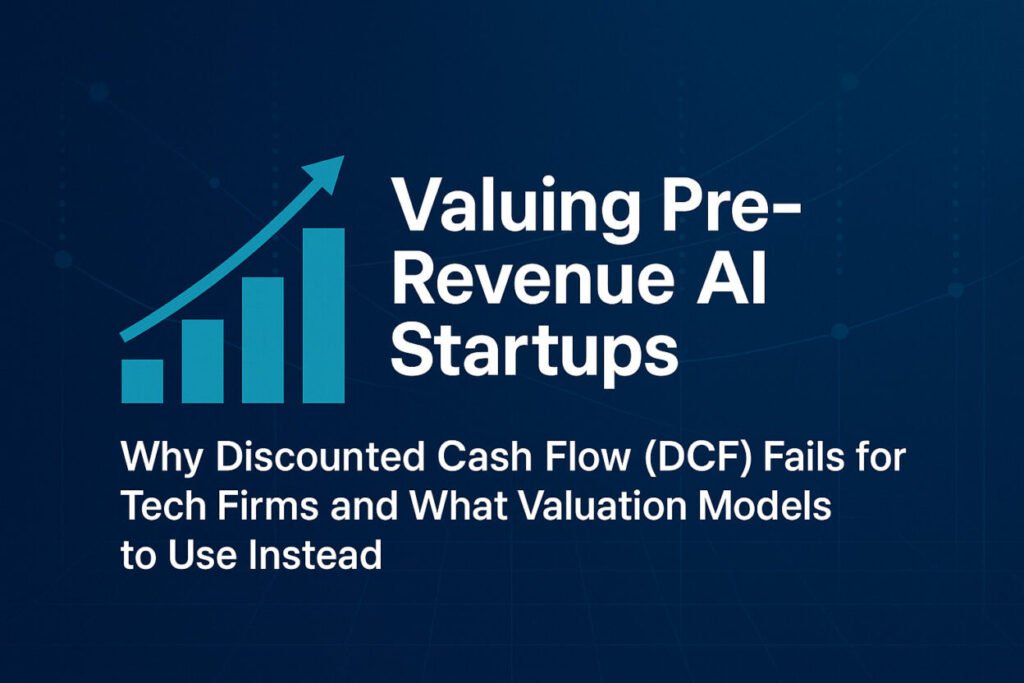
Pre-Revenue AI Startup Valuation: Why “Discounted Cash Flow” (DCF) Fails and Better Models to Use

Artificial Intelligence (AI) startups are among the fastest-growing and most heavily funded businesses globally. Yet, they are also the hardest companies to value especially pre-revenue AI startup valuation that have not yet monetized their models, products, or platforms. Investors who try to apply the traditional Discounted Cash Flow (DCF) method often end up with unrealistic numbers, distorted assumptions, or valuations that fail to reflect the true potential (or risk) of the business. Traditional finance practitioners often reach for the Discounted Cash Flow (DCF) method. While it is the “gold standard” for mature corporations, applying DCF to a pre-revenue AI startup is like trying to measure the speed of a rocket with a sundial. It’s the wrong tool for the job. In this definitive guide, we explore why DCF breaks down for early-stage tech, how AI compounds these weaknesses, and which valuation frameworks investors actually rely on today. Why the Discounted Cash Flow (DCF) Fails for Pre-Revenue AI The DCF method determines a company’s current value by projecting future cash flows and “discounting” them back to the present day using a discount rate (usually the Weighted Average Cost of Capital, or WACC). While mathematically elegant, DCF crumbles under the uncertainty of pre-revenue AI for three key reasons: 1. The “Garbage In, Garbage Out” Paradox A DCF is only as good as its revenue projections. For a mature firm, you can project growth based on historical trends. For a pre-revenue startup, you are essentially guessing. If you change a single growth assumption from 20% to 25%, the “valuation” might swing by millions. In high-stakes AI, where product-market fit hasn’t been established, these projections are purely fictional. 2. The Extreme Sensitivity of Terminal Value In a typical DCF, about 60% to 80% of the calculated value comes from the “Terminal Value”—the value of the business beyond the initial 5-year forecast. This figure relies on a stable growth rate. However, the AI landscape changes every six months. Predicting the “stable” growth of an AI firm ten years from now is an exercise in futility. 3. Prohibitive Discount Rates (WACC) For public companies, a discount rate might be 8-10%. For a pre-revenue AI startup, the risk of failure is so high that investors effectively apply a discount rate of 30% to 70%. When you discount future money by 50% year-over-year, the “present value” of those future cash flows shrinks to almost nothing, failing to capture the massive upside potential that makes AI attractive. Better Valuation Models for Pre-Revenue Tech Firms If DCF is off the table, how do savvy angel investors and VCs decide what an AI startup is worth? They use a combination of qualitative and comparative models. 1. The Berkus Method: Focus on Risk Mitigation Developed by angel investor Dave Berkus, this method is ideal for pre-revenue firms. It ignores financial forecasts and instead assigns a monetary value (traditionally up to $500,000 per factor) to five key indicators of success. 2. The Scorecard Valuation Method: Benchmarking against the Best The Scorecard method compares your startup to average valuations of similar startups in the same region and sector. You start with a “baseline” (e.g., $4 million for a seed-stage AI firm in San Francisco) and adjust it based on comparative factors: If your team is significantly better than the average, you might multiply that 30% by a factor of 1.5, increasing your valuation. 3. The Venture Capital (VC) Method: Working Backward from Exit The VC method doesn’t look at what you have today; it looks at what you could be in 5–7 years. The Formula: This method aligns with the reality of high-growth tech: you aren’t valuing the business for today; you are valuing the possibility of a billion-dollar acquisition. AI-Specific Valuation Drivers AI companies are unique because they have specific “moats” that traditional tech firms do not. When using qualitative models, ensure you weight these heavily: Why Valuing AI Startups Is Uniquely Complex AI startups operate very differently from traditional businesses. Their core value often lies in: Unlike conventional firms—where revenue, margins, and cash flows follow somewhat predictable trajectories—AI companies evolve rapidly and unpredictably. Even the startup itself may not have a clear monetization strategy at the early stage. The Revenue Problem: Why Most AI Startups Don’t Earn Early Many AI startups spend their first 2–5 years focusing on: Revenue frequently comes later, often suddenly, and may scale exponentially if product-market fit is achieved. This non-linear growth makes early valuation difficult. Why Discounted Cash Flow (DCF) Fails for Pre-Revenue AI Startups DCF was designed for stable, predictable businesses—manufacturers, retailers, mature tech firms, etc. DCF Requires Cash Flow Visibility – AI Startups Don’t Have It DCF relies on projecting future free cash flows, often 5–10 years forward. For pre-revenue AI startups, these numbers are: Even tiny assumption changes—CAC, churn, cloud costs, LLM usage, pricing—can swing valuation by millions. The Terminal Value Problem DCF valuations often derive 60–90% of value from terminal assumptions. For AI startups, terminal value depends on: These cannot be predicted with the certainty DCF requires. AI Unit Economics Are Not Stable Early On AI costs shift drastically due to: DCF assumes stable long-term margins. AI does not behave that way. DCF Penalizes Innovation DCF discounts future earnings heavily. But AI value often materializes after years of research. DCF systematically undervalues: Exponential Growth and S-Curves Break DCF Math AI adoption follows: DCF assumes linear or modest growth, so it cannot capture asymmetric upside. What Valuation Models Actually Work for Pre-Revenue AI Startups Investors and VCs rarely use DCF for pre-revenue tech. Instead, they rely on alternative frameworks designed for uncertainty. Below are the methods most commonly used for AI startups today. 1. The Venture Capital (VC) Method This is the most widely used method for early-stage AI. How It Works Unlike DCF, it does not require detailed cash flow projections. Why the VC Method Suits AI 2. Comparable Company Analysis (Comps) AI startups are often valued by comparing them to: What Metrics Are Used? Even pre-revenue companies have relevant inputs: 3.

Prompt engineering for accountants
Accounting

Prompt Engineering for Accountants: 20 Specific ChatGPT/Claude Prompts to Draft Audit Observations and Client Emails 5x Faster

Artificial intelligence is reshaping every profession, and accounting is no exception. Whether you’re an auditor, tax associate, internal controller, or finance manager, you’ve likely realized one thing: your work involves a TON of documentation. AI is one of many forces reshaping accounting in India — get the full picture in our Complete Guide to Accounting in India 2026. The list never ends. Imagine reducing the time spent writing all this by 70–80%—without compromising quality, tone, or compliance. That’s exactly what prompt engineering for accountants achieves. In this long-form guide, you’ll learn: By the end, you’ll know how to produce concise, accurate, and professional audit deliverables 5x faster—and stand out as the accountant who understands how to leverage AI the right way. The Core of Prompt Engineering: The R-C-I-O Framework Before we dive into the specific prompts, it is essential to understand why some prompts work while others produce generic “fluff.” To think like a human writer, you must treat the AI like a highly capable junior associate who needs a detailed briefing. We utilize the R-C-I-O Framework: Why Prompt Engineering Matters for Accountants in 2025 and Beyond AI is not replacing accountants.It is replacing accountants who do not use AI. But here’s something most professionals misunderstand: AI output is only as good as the prompt you feed it. A sloppy prompt produces: ❌ Incorrect accounting logic❌ Unsupported conclusions❌ Weak audit observations❌ Robotic emails❌ Generic explanations that won’t pass review A well-structured accountant-specific prompt produces: ✅ Clear, defensible audit observations✅ Emails that sound like YOU✅ Accurate accounting explanations✅ Polished management letter points✅ Documentation aligned with auditing standards This is why prompt engineering is becoming a core skill for accountants, just like Excel proficiency or audit methodology. How AI Transforms the Audit & Accounting Documentation Process Below are the areas where accountants save the most time using ChatGPT or Claude with proper prompts. 1. Drafting Audit Observations Writing an audit observation can take 20–40 minutes when done from scratch. AI reduces that to under 2 minutes. But only if the prompt is engineered correctly—otherwise you get vague or incorrect observations. 2. Client Emails Accountants spend around 30–40% of their time reading, writing, clarifying, and following up on emails. AI helps produce: 3. Working Papers & Narratives Whether it’s an internal control assessment, walkthrough documentation, or analytical review commentary, AI can structure the narrative so you don’t start from zero. 4. Management Letters AI can instantly draft: 5. Accounting Research Summaries Instead of copying standards, AI can explain them in plain English—and apply them to your fact pattern. Best Practices for Using AI in Audit & Accounting Tasks Before the prompts, here are simple rules for safe and effective prompt engineering. 1. Never upload confidential client data Summaries are safer. Instead of uploading: “Here is ABC Bank’s GL…” Use: “Client revenue decreased 17% this year. Key variances include…” 2. Use structured prompts Accountants need structure, not essays. Use bullet points and sections. 3. Tell the AI your role Example: “You are a senior auditor writing review-ready documentation.” 4. Specify the tone and level Professional? Formal? Friendly? Concise? 5. Ask for review-ready content AI must understand that the output goes to reviewers or clients. 6. Always perform a technical accuracy check AI speeds up writing, not judgment. 20 Powerful ChatGPT/Claude Prompts for Accountants to Increase Productivity 5x Below are 10 field-tested prompts written exclusively for auditors and accountants. You can copy/paste these directly. Prompt 1: The “Condition-Criteria-Effect-Recommendation” Framework Writing audit findings from scratch is time-consuming. This prompt uses the standard industry structure to ensure technical completeness. Prompt: “You are an internal audit manager. Based on the following raw data: [Insert Data/Facts], draft a formal audit observation using the four-part structure: 1. Condition (What is happening?), 2. Criteria (What should be happening?), 3. Cause/Effect (Why it matters?), and 4. Recommendation (How to fix it?). Keep the tone objective and professional.” Prompt 2: Simplifying Complex Variance Analysis Client management often struggles to understand why numbers changed. Use this prompt to turn data into a narrative. Prompt: “Act as a Financial Analyst. I will provide you with a Budget vs. Actual spreadsheet [Paste Data]. Identify the three most significant unfavorable variances. Write a three-paragraph executive summary explaining the likely operational causes for these variances and suggest two corrective actions for management.” Prompt 3: Internal Control Deficiency Memo When you find a weak link in the process (like a lack of segregation of duties), use this to articulate the risk. Prompt: “You are a Senior Risk Consultant. Draft a memo to a client’s CFO regarding a discovered lack of segregation of duties in the accounts payable department. Explain the fraud risk associated with this weakness and recommend a specific internal control workflow to mitigate the risk for a firm with only 5 accounting staff.” Prompt 4: Mapping Audit Findings to COSO Framework For higher-level reporting, you often need to categorize findings under standard frameworks. Prompt: “I have the following audit finding: [Insert Finding]. Rewrite this observation to specifically align with the COSO Internal Control Framework components (Control Environment, Risk Assessment, etc.). Highlight which component is being compromised.” Prompt 5: Drafting the Audit Executive Summary The most read part of any report. It needs to be punchy but accurate. Prompt: “Take the attached list of 10 audit observations and synthesize them into a one-page Executive Summary for a Board of Directors. Use bold headings for ‘High-Risk Areas’ and provide a final audit opinion based on the severity of the findings provided.” Prompt 6: Requesting Missing Information (The “Nudge” Email) We spend hours chasing clients for documents. This prompt creates a firm yet polite request. Prompt: “Write a polite but firm email to a client who has missed three consecutive deadlines to provide their year-end bank statements and payroll records. Explain that further delays will impact the filing deadline and may incur penalty fees from the IRS. Provide a checklist format for the requested items.” Prompt 7: Explaining New Tax Legislation Turning “legalese” into client value. Prompt: “You are

Algo Trading Taxes
Tax

Algo Trading Taxes: How to Prove Your Bot-Trading Profits are “Capital Gains” and Not “Speculative Business Income”

Algorithmic trading—popularly known as Algo trading or bot-trading has grown from a niche strategy to a mainstream tool for modern investors. While bots help automate trades and remove emotional biases, they also bring a major challenge: How do you classify the income for tax purposes? (Algo trading Taxes) Many traders fear their gains will be treated as speculative business income, which attracts higher taxes, stricter reporting standards, and possible scrutiny from the tax department. However, with the right documentation, structure, and compliance, you can establish that your bot-driven trading is capital gains, not business income. This comprehensive guide—built for long-term investors, algorithmic traders, tax professionals, and finance enthusiasts—explains exactly how to do that. We’ll explore the legal logic, audit-proof documentation, behavioural indicators, and real-world strategies that convince tax authorities you’re an investor using automation, not a business conducting speculative trading. The rise of high-frequency trading (HFT) and retail algorithmic bots has democratized the stock market, but it has also created a massive headache for taxpayers. For the modern retail trader using Python scripts or pre-built bots on platforms like Tradetron or Zerodha Streak, the biggest question isn’t “how much profit did I make?”—it’s “how will the IT Department tax this?” In India, the difference can be the difference between paying a flat 15% (Short Term Capital Gains) and paying up to 30% or more (Business Income). This guide explores the legal nuances of algorithmic trading taxes and provides a roadmap to defend your tax characterization. Introduction When algo-traders face tax assessments, the biggest fear is hearing this:“Your activity resembles business. Your profits are treated as speculative income.” This classification is costly. It may lead to: But the truth is simple: The use of automation does not automatically convert investing into business activity.What matters is intent, behaviour, volume, and structure. In today’s digital era, the IT Department has adapted tax rules to accommodate algorithmic tools. You simply need to show that your algo is an investment assistant, not a speculative engine. This article explains every detail—legally, practically, and strategically—so you can stand confidently during assessments. Understanding How Tax Departments Classify Trading Income Tax departments worldwide do not classify income based solely on the tool used (bot or manual). Instead, they analyze activity patterns. Typically, trading income falls under three categories: Capital Gains Non-Speculative Business Income Speculative Business Income With algorithmic trading, the classification depends on how and why you trade, not the bot itself. Capital Gains vs. Business Income: Why It Matters The Role of Tax Audit (Section 44AB) Regardless of whether you call it business or capital gains, if your turnover exceeds the threshold (currently ₹10 Crores if 95% of transactions are digital), you need a mandatory Tax Audit by a Chartered Accountant. For algo traders, turnover is calculated by adding the absolute profit and loss. If your turnover is high, you are automatically forced into the “Business Income” category during the audit process. Strategies to Optimize Your Algo trading Taxes Liability Algo Trading: Investor Tool or Business Activity? A trading bot does not define your tax category. Human intention does. Automation = Convenience, Not Classification Tax authorities accept that: So why would algo-trading be any different?It isn’t—unless your behaviour becomes business-like. The Legal Criteria to Determine Capital Gains vs Speculative Business Income Tax authorities use a clear logic chain to determine whether your activity is investment or business. Below are the universal criteria used globally (India, US, UK, EU, etc.): The Intention Test The Holding Period Test The Volume & Frequency Test The Dependency Test Investors usually have multiple income streams. Businesses rely primarily on trading. The Infrastructure Test If you have: …then the tax authority may classify it as business. The Risk Undertaking Test Investors take positional risk, not operational business risk. How to Prove Your Bot-Trading Profits Are Capital Gains This section is the backbone of this article. Below are the most powerful ways to establish investor status—even with a trading bot. Show That the Bot Is Only an Execution Tool Document that your bot: How to Explain This to the Tax Department “I use automation to remove emotional bias and execute consistent rules. The strategy focuses on positional trades, not speculative intraday flipping.” Maintain Reasonable Holding Periods To qualify as capital gains: Limit the Number of Trades A bot can make dozens of trades quickly, which may appear “business-like.” To stay investor-friendly: This helps you maintain a portfolio-like activity pattern. Maintain Clear Segregation of Portfolios Have two separate accounts: 1. Investment Portfolio (Capital Gains) 2. Trading Portfolio (Business Income) Segregation is a strong legal argument. Maintain a Written Investment Policy Statement (IPS) An IPS is your proof of intention. Include: This impresses assessing officers. Keep Evidence of Not Having Business Infrastructure If you have: …then you are clearly an investor using automation. Maintain All Broker Statements and Bot Logs Clean documentation proves you’re compliant. Include: Well-organized documentation reduces scrutiny significantly. Maintain Proof of Other Income Sources If trading is not your main livelihood, you are not running a speculative business. Show: This is one of the strongest arguments. Critical Documentation Required for Tax Assessment To win your capital-gains classification, gather: Trading Bot Documentation Broker Records Investment Policy Statement Tax Computation Statements Logs & Backtests Not mandatory, but helpful during audits. Mistakes Algo-Traders Make That Trigger “Business Income” Classification Avoid these at all costs: ❌ Trading thousands of times/day ❌ Running HFT-style bots ❌ Having trading as your only income source ❌ Using margin frequently ❌ Running trading from an office setup ❌ Selling trading strategies/services ❌ Mixing portfolios If you avoid these, your investor claim becomes strong. Best Practices to Maintain Investor Status While Using Bots Use Positional or Swing Algo Strategies These clearly show investment intent. Maintain Moderate Trade Count Don’t let the bot overtrade. Avoid Intraday Strategies If You Want Capital Gains Intraday = speculative by default. Keep an IPS and Update It Yearly A professional habit tax officers recognize. Maintain Separate Demat/Trading Accounts Segregation = clarity. Do Not Depend on Algo-Trading for

Invoice Discounting
Financing

Invoice Discounting (TReDS): The “Hidden” Way for MSMEs to Unlock Working Capital Without Taking a Bank Loan

Micro, Small, and Medium Enterprises (MSMEs) are the backbone of India’s economic engine. They contribute more than 30% to India’s GDP and employ millions. Yet, they face one persistent and painful problem: delayed payments from buyers. Even MSMEs supplying to large, reputable corporate buyers often wait 45–120 days or more to receive payments. This gap creates working capital stress, disrupts cash flow, and forces entrepreneurs to rely on costly loans, credit cards, or informal borrowing. But what if there was a smarter way?A way to convert unpaid invoices into cash within days, without taking a loan, without pledging collateral, and often at lower interest rates than traditional credit? That solution already exists – It’s called Invoice Discounting on TReDS (Trade Receivables Discounting System). And surprisingly, many MSMEs still don’t know about it.This blog is your ultimate guide to understanding how TReDS can unlock hidden working capital for your business—quickly, safely, and digitally. What Is Invoice Discounting? (Simple Explanation) Invoice Discounting is a financing method where a business uses its unpaid invoices to get early payment from a financier (banks or NBFCs) before the actual due date. Instead of waiting 60–90 days for a buyer to pay, the MSME receives funds immediately (minus a small discount fee). How Invoice Discounting Works in One Line: You sell your invoice → Financier pays you early → Buyer pays financier later. Why It’s Not a Loan This is why it is one of the most powerful financial tools for MSMEs today. What Is TReDS? Understanding the Government-Approved Platform TReDS stands for Trade Receivables Discounting System, an RBI-regulated digital marketplace that enables MSMEs to discount their invoices with participating financiers. Purpose of TReDS Who Operates TReDS Platforms? RBI has authorized specific institutions to run TReDS platforms in India.(We will not mention individual platforms to avoid unnecessary brand reference.) Each platform acts as a neutral marketplace connecting: Why TReDS Is Called the Hidden Way to Raise Working Capital Although TReDS has been active for years, many MSMEs still rely on costly loans, overdrafts, or informal credit because they simply don’t know about invoice discounting—or they misunderstand it. Here’s why TReDS is considered a hidden gem: 1. Collateral-Free Working Capital You don’t need property, machinery, or personal guarantees.Invoices themselves become the asset. 2. Financing Depends on Buyer’s Credit Rating Even if the MSME has a low credit score or thin credit history, financing is still possible because lenders evaluate the buyer’s credibility. 3. Lower Cost Than Typical Loans Interest rates can be significantly lower than: 4. Full Digital, Transparent, and Fast No branch visits.No paperwork chaos.Everything happens on a secure online platform. 5. Zero Risk of Buyer Default Once the buyer accepts the invoice on TReDS, it becomes a guaranteed payment obligation, reducing risk for financiers and sellers alike. How Invoice Discounting Works on TReDS—Step-by-Step Process Let’s break it down into the simplest form possible. Step 1 – MSME Supplies Goods or Services You deliver the product/service to the buyer as usual. Step 2 – MSME Uploads Invoice on TReDS You upload the invoice to the TReDS platform. Step 3 – Buyer Confirms the Invoice This is a crucial step.Once the buyer validates the invoice, financiers know that payment is guaranteed on the due date. Step 4 – Financiers Bid to Discount the Invoice Banks and NBFCs compete by offering the lowest discount rate. This benefits MSMEs because the cost of funding goes down due to competition. Step 5 – MSME Accepts the Best Rate You choose the most attractive offer. Step 6 – Financier Pays MSME Immediately You receive funds (usually within 24–72 hours). Step 7 – Buyer Pays Financier on Due Date The buyer pays the full invoice amount to the financier. You don’t have to do anything after receiving the discounted amount. Key Features of Invoice Discounting Through TReDS 1. 100% Digital Workflow Right from invoice upload to fund disbursal. 2. Multiple Financiers More competition → Better discount rates → Lower financing costs 3. No Follow-Ups for Payment Financiers collect payment from the buyer—You only focus on business. 4. Faster Cash Flow Cycles Turn receivables into instant cash. 5. Strengthens MSME–Corporate Relationship Buyers see MSMEs as stronger, more reliable partners. Who Can Use TReDS? (Eligibility Criteria) MSME Sellers All registered MSMEs (manufacturing or service-based). Corporate Buyers Large companies from any industry with substantial procurement activity. Government Departments / PSUs Many government organizations are already on TReDS. Banks & NBFCs Registered financiers approved by RBI. Why MSMEs Should Choose Invoice Discounting Over Bank Loans 1. No Loan Application Hassles No documentation of: 2. No Additional Debt Your balance sheet stays clean. 3. Uses Existing Business Transactions Funding comes from your day-to-day invoices. 4. Instant Liquidity = Faster Growth With quick working capital, you can: 5. Removes Cash Flow Uncertainty If your buyers regularly delay payments, invoice discounting becomes a life-saver. Comparison Table: Invoice Discounting vs. Bank Loan Feature Invoice Discounting Bank Loan Requires Collateral ❌ No ✔️ Yes (often) Credit Check Based On Buyer MSME Time to Get Funds 1–3 Days Weeks to Months Impact on Balance Sheet No debt Increased liabilities Process Fully digital Paper-heavy Follow-up for Payment Not needed Required Interest Cost Competitive Higher Invoice Discounting wins clearly for MSMEs needing predictable working capital. Benefits of TReDS for MSMEs (In Detail) 1. Improves Cash Flow Stability No more worrying about 60–90 day payment cycles.This enables better monthly planning. 2. Reduces Working Capital Gap Quick access to funds means smoother operations. 3. Strengthens Financial Health 4. Encourages Timely Payments by Buyers Buyers gain visibility and must adhere to timelines. 5. Boosts Growth and Expansion Your business can take larger orders confidently. Common Misconceptions About Invoice Discounting & TReDS “It’s a Loan.” No, it’s not. There is no EMI, no collateral, and no debt added. “Only big companies can use it.” Registered MSMEs are the primary beneficiaries. “It is complicated.” It is simpler than applying for an overdraft. “My buyer might not approve my invoices.” Most reputable buyers already support TReDS because it improves

Rectification request
Tax

Income Tax Portal Update Makes Rectification Requests Faster and Easier (2025 Update)

The Income Tax Department has rolled out a new update on the ITR e-filing portal. Taxpayers can now file rectification requests online for certain tax orders, reducing delays, paperwork, and repeated follow-ups with tax officials. If you’ve ever noticed a small error in your income tax order and dreaded the correction process, there’s some relief. The Income Tax Department has introduced a new feature on the ITR e-filing portal that allows taxpayers to file rectification requests online directly with the concerned authority. This update is aimed at reducing delays, cutting paperwork, and making tax compliance smoother for individuals and businesses alike. What’s New on the Income Tax e-Filing Portal? Earlier, rectifying errors in tax orders wasn’t always straightforward. Even when an order was passed by a specific authority, taxpayers often had to route their rectification requests through the Assessing Officer (AO), leading to unnecessary delays. With the latest update, the e-filing portal now allows direct online submission of rectification requests to the appropriate authority, eliminating extra steps in the process. In short: Why This Update Matters to Taxpayers This change solves a long-standing pain point for many taxpayers. Quicker Resolution of Errors Since requests go straight to the authority responsible for the order, correction timelines are expected to improve. Completely Online Process The entire rectification process can now be completed digitally through the e-filing portal. Improved Transparency Taxpayers can track the status of their rectification requests online, reducing uncertainty and manual follow-ups. Less Hassle During Assessments For cases involving technical or high-value assessments, this update removes unnecessary administrative burden. Which Tax Orders Are Covered Under This Feature? The new online rectification facility applies to errors related to: If the mistake is apparent from existing records — such as a calculation or clerical error — it can be corrected using this feature. How to File a Rectification Request Online Filing a rectification request on the ITR portal is simple: The process takes only a few minutes and requires no paperwork. Who Can Use This Facility? You can file a rectification request if: Authorized representatives can also submit requests on behalf of taxpayers. Common Errors That Can Be Rectified Some typical issues that can be corrected include: Rectification cannot be used to revise income or make new claims. Why This Update Fits India’s Digital Tax Push The Income Tax Department has been steadily upgrading the e-filing ecosystem. This new rectification feature is another step toward simpler, faster, and more transparent tax administration. For taxpayers, it means less stress. For the system, it means better efficiency. And for everyone, it means fewer delays in fixing genuine mistakes. Conclusion If you’ve been postponing a rectification request because the process felt complicated, this update changes that. With direct online submission and better tracking, correcting errors in tax orders is now quicker and far more convenient. FAQs

Scroll to Top