The Indian government has introduced a new tax regime under Section 115BAC of the
Income Tax Act. This provides lower tax rates but removes many deductions and
exemptions available under the old tax regime.
For Assessment Year (AY) 2025-26, the latest updates as per Finance Act (No. 2) of 2024
have been made, and here’s everything you need to know in simple terms.
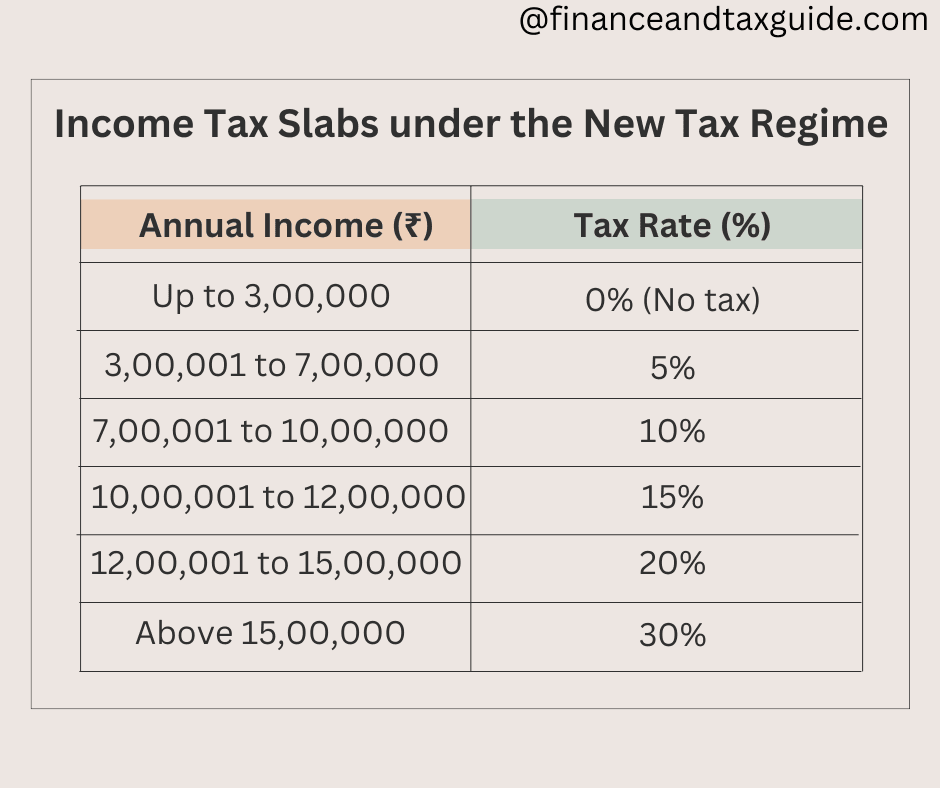
Income Tax Slabs under the New Tax Regime
In this new system, income is taxed based on the following slabs:
| Annual Income (₹) | Tax Rate (%) |
| Up to 3,00,000 | 0% (No tax) |
| 3,00,001 to 7,00,000 | 5% |
| 7,00,001 to 10,00,000 | 10% |
| 10,00,001 to 12,00,000 | 15% |
| 12,00,001 to 15,00,000 | 20% |
| Above 15,00,000 | 30% |
Important Points About These Tax Slabs:
✅If your income is ₹3,00,000 or below, you don’t have to pay any tax.
✅ If your income is ₹7,00,000 or below, you get a rebate under Section 87A, meaning
your
tax liability becomes zero (more details below).
✅ Unlike the old tax system, there is no separate tax slab for senior citizens.
Benefits & Features of the New Tax Regime
Even though this regime removes many deductions, the government has allowed some
benefits:
1. Standard Deduction for Salaried Individuals & Pensioners:
o If you are a salaried person or a pensioner, you get a ₹75,000 standard
deduction. Which is earlier only ₹ 50,000
o This means if your income is ₹7,75,000, after applying the standard
deduction, your taxable income becomes ₹7,00,000, which makes you
eligible for the tax rebate.
2. Family Pension Deduction:
o If you receive a family pension, you can claim a deduction of ₹25,000 or
one-third of the pension amount (whichever is lower).
3. Tax Rebate Under Section 87A:
o If your taxable income (after deductions) is up to ₹7,00,000, you get a rebate
of ₹25,000 on your tax liability.
o This means your final tax payable is zero.
3. What You Lose in the New Tax Regime
If you choose the new tax regime, you cannot claim the following deductions & exemptions:
❌ House Rent Allowance (HRA) – No exemption on rent paid.
❌ Leave Travel Allowance (LTA) – No tax benefit for travel expenses.
❌ Deductions under Chapter VI – A (80C, 80D, etc.) – You cannot claim deductions for:
Investments like PPF, ELSS, NSC, LIC premium (under Section 80C)
Health insurance premiums (under Section 80D)
Education loan interest (under Section 80E)
Home loan interest deduction on self-occupied house (under Section 24(b))
Example:
In the old tax regime, if you invest ₹1.5 lakh in PPF and pay ₹25,000 for health
insurance if it is for senior citizen amount will be ₹50,000 for health insurance , you
can claim deductions.
But in the new tax regime, you cannot claim these deductions.
4. Surcharge & Cess Under the New Tax Regime
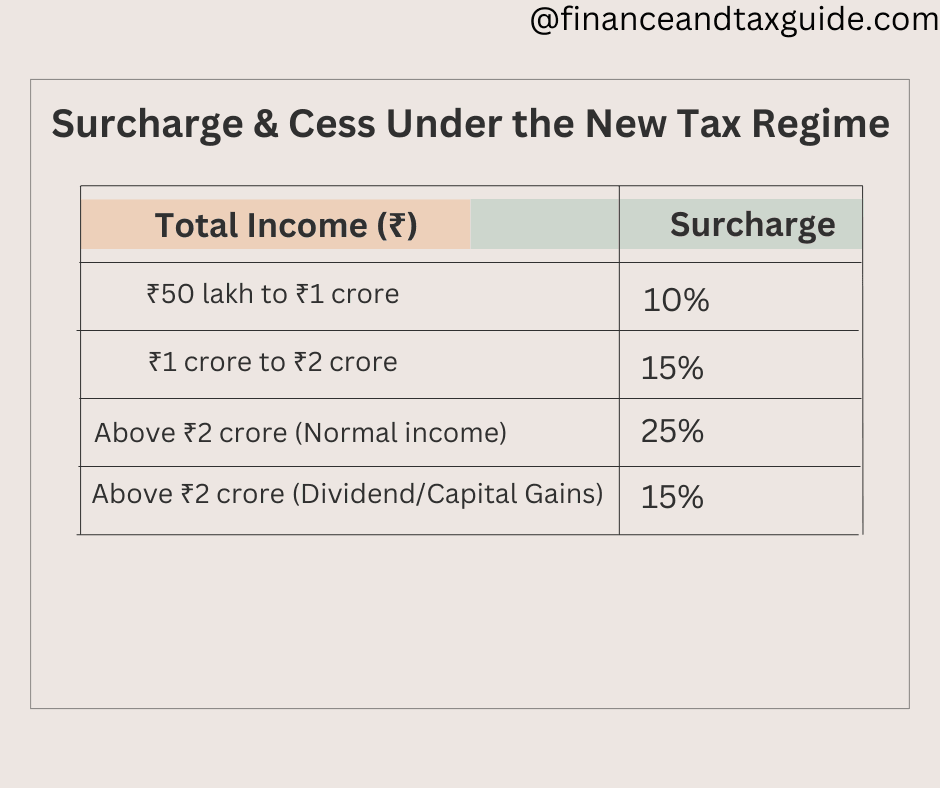
📌 Surcharge (Additional Tax for High Earners)
If your total income is more than ₹50 lakh, you have to pay an extra surcharge:
| Total Income (₹) | Surcharge |
| ₹50 lakh to ₹1 crore | 10% |
| ₹1 crore to ₹2 crore | 15% |
| Above ₹2 crore (Normal income) | 25% |
| Above ₹2 crore (Dividend/Capital Gains) | 15% |
📌 Cess (Education & Health)
A 4% cess is added on total tax + surcharge.
5. How to Choose the New Tax Regime?
1. Salaried Employees:
o If you are a salaried person, the new tax regime is the default option from
AY 2024-25 onwards.
o If you are a salaried person, you can select the new tax regime while
submitting declarations to your employer.
o You can also change your option at the time of filing the Income Tax
Return (ITR).
2. Business Owners & Professionals:
o If you have business income and opt for the new regime, you cannot switch
back to the old regime in future years (except once in a lifetime).
6. Should You Choose the New Tax Regime?
If you do not claim many deductions means approx. more than ₹ 3 lakh , the new
tax regime is better because of lower tax rates.
If you claim deductions like HRA, 80C, 80D, 80GGC etc., the old tax regime may
be better for you.
Final Thoughts
The new tax regime offers lower tax rates but removes deductions.
It is now the default tax regime, but you can opt for the old regime if it benefits
you.
It is better for individuals who don’t claim many tax benefits.
Carefully calculate your tax under both systems before deciding.